
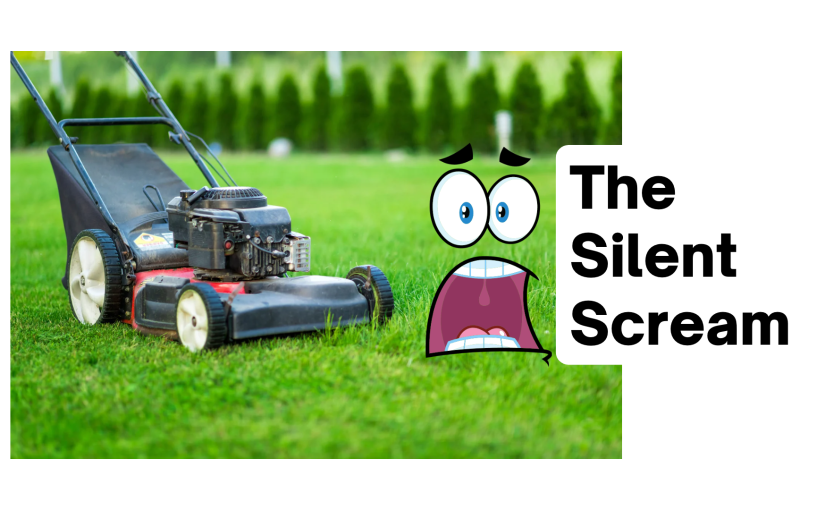
The aroma of Freshly Cut Grass: A Tale of Green Signals and Hidden Pheromones
It is the beginning of summer. The birds are out early since they have been taught that the early bird gets the worm.
In the school of worms, they forgot to teach the worm not to get up early and wiggle about.
Depending on which life form you associate yourself with, choose when you get out of bed. That’s the moral of the story.
But I digress. Where was I? Ah, yes. Let’s try this again.
It’s summer, yay!
Summertime – I am straddling my ride-on lawn mower, a hat in place, dressed regally in a tank top and shorts. I spend a good three hours intricately creating patterns on the lawn. Believe me; it’s so well done that a passing helicopter might mistake it for crop circles. Here’s the second moral of the story. If anyone starts a statement with a ‘believe me,’ you can be sure that whatever is said afterward is a pure concoction.
To summarize, I am on the porch sipping my iced lemonade, enjoying the evocative smell of freshly cut grass, when my daughter, a total nerd, complete with horn-rimmed eyeglasses, is doing a postdoctoral fellowship in prestigious university remarks.
“Enjoying the smell, acha?” For those of you scratching your heads about what ‘acha’ is, it’s the Malayalam word for father. When I relocated to the USA, my children were all kids. My wife and I knew that there was no way we could keep their Malayalam intact, but we put our foot down about how they address us – Mother, amma; Father, acha.
I nodded in agreement; I was enjoying the smell of cut grass.
And then, she ruined it for me. “Do you know that the smell you love is the olfactory equivalent of the grass screaming in pain and warning all other vegetation nearby that a monster is on the loose, annihilating our existence?
I did not need a Ph.D. to realize that by ‘monster,’ she meant me.
She then went on a rant. This is a summary of what she spewed forth.
The reason behind the smell of freshly-cut grass
This ubiquitous scent is much more than a delightful summer fragrance. It’s a complex chemical signal and a cry for help involving fascinating biochemical mechanisms and even elements of pheromones.
To understand why freshly cut grass has a unique smell, we first must delve into plant physiology. When a lawnmower’s blades slice through your lawn, they rupture the grass cells, releasing a medley of volatile organic compounds (VOCs). These VOCs evaporate quickly, generating the characteristic aroma we associate with freshly cut grass. The most crucial of these VOCs are a class of chemicals called green leaf volatiles (GLVs), predominantly composed of six-carbon alcohols and aldehydes such as hexenal, hexanol, and hexanol.
GLVs are not exclusive to grass and are released by most green plants when their tissues are damaged. They serve several purposes, with the most significant being a distress signal. When a plant is under attack, be it from a lawnmower or a grazing animal, GLVs are rapidly produced and emitted. It’s as if the plant is crying out in pain, albeit in a chemical language that humans perceive as a delightful aroma.
But how do these distress signals function, and are any pheromones involved in this intriguing process?
The story of grass’s aromatic distress calls gets even more fascinating when we bring in the players responding to these signals — other plants, insects, and even mammals. That’s where we enter the realm of pheromones, those chemical substances produced and released into the environment by an organism, affecting the behavior or physiology of others of its species.
Among the respondents to the GLVs distress signals are neighboring plants, which interpret these volatile compounds as a warning of impending danger. They react by bolstering their defenses, producing compounds that make them less palatable or harder to digest. In other words, the aroma of freshly cut grass is a biochemical SOS that initiates a cascade of defensive measures in the plant community.
The realm of insects offers another exciting aspect of this pheromone story. Certain beneficial insects are attracted to these GLVs, particularly parasitoid wasps. These insects have a life cycle that involves laying their eggs inside other insects. Upon hatching, the young wasps devour their hosts from the inside. How does this relate to the aroma of cut grass? Many insects, like parasitoid wasps, target pests that feed on plants. When these pests start feeding, and the plant releases GLVs, it’s like ringing the dinner bell for the wasps. Thus, GLVs serve as an indirect defense mechanism, drawing in allies in the fight against plant-eating pests.
Lastly, the aroma of freshly cut grass also affects mammals, especially humans. Many people find this smell pleasing, describing it as fresh, calming, and comforting. Though it’s not typically categorized as a pheromone, its impact on human behavior bears some similarities, evoking strong emotional responses and nostalgia for many.
In conclusion
In conclusion, the scent of freshly cut grass is a complex interplay of biochemical signals and responses involving elements of pheromones. Far from being an incidental byproduct of lawn mowing, this aroma is a vital part of the plant’s defense strategy and a dynamic form of communication within the ecosystem. So, the next time you savor that fresh, green smell, remember—you’re catching a whiff of nature’s distress call and the hidden world of plant communication.
What I did to be guilt-free
I decided to sell the lawn mower. Now I employ Jose to mow my lawn.

 Nalla Madras