The Empty Beat Is Not Empty

Where Music, Silence and Consciousness Meet

When I first started learning music seriously, I thought music was made of notes.

This is a very common beginner’s disease. Fortunately, it is curable, though the treatment can take several years and may involve many stern looks from music teachers.

In the beginning, we are obsessed with the visible parts of music: the swaras, chords, tempo, raga, lyrics, tala, fingering, pronunciation, and the correct place to come in without looking like we just missed the bus.

All of that is necessary.

But somewhere along the way, if one is lucky, music quietly opens a side door and reveals something more mysterious.

The real music does not live only in the notes.

It lives in the interval between them.


The Space That Sings

It lives in the breath before the phrase.
The hesitation before the sam.
The lingering after a meend.
The silence after a temple bell.
The moment just before the mridangam lands.
The tiny pause where the listener’s heart leans forward.

That space is not empty.

It is alive.

Indian music has always known this. We may not always discuss it in fancy language, but the tradition itself breathes this truth.

Take the alap in Hindustani music. Before the tabla enters, before tala announces its authority, before anyone starts calculating whether this is Teental, Ektaal, Jhaptaal or “please don’t ask me, I am just here for the tea,” the raga slowly reveals itself.

There is no hurry.

A phrase appears. It rests. Another phrase answers. A note is approached, not attacked. The raga does not behave like a government office file being pushed from one table to another. It unfolds like dawn.

In that unhurried space, one begins to understand that rhythm is not merely counting.

Rhythm is breath.


Khali: When Emptiness Has a Seat

Then comes tala, and we imagine tala means beat.

Clap here. Wave there. Come back to sam without falling into the ditch. Very good.

But tala is far more profound than a counting system. It is cyclical time. It is memory returning. It is departure and homecoming.

And then there is khali — the so-called empty beat.

What a magnificent idea.

Only Indian music could look at emptiness and say, “We should give this fellow a proper seat in the cycle.”

Khali is not a mistake. It is not absence. It is marked. It is recognized. It has dignity. In a rhythmic cycle, even emptiness has responsibility.

This is a very deep spiritual statement hiding in plain sight.

Because life also has khali.

The pauses. The waiting periods. The years when nothing seems to move. The phone that does not ring. The prayer that appears unanswered. The project that refuses to take shape. The silence after loss. The strange empty space before the next chapter begins.

We usually panic during these periods.

We think nothing is happening.

But any good musician knows that silence is not necessarily the absence of music. Sometimes silence is where the next phrase is gathering strength.


Breath, Groove and the Human Pause

A bansuri player understands this intimately. In flute music, breath is not separate from the composition. The phrase exists because breath exists. The pause is not decorative. It is biological, musical and almost spiritual.

Pandit Hariprasad Chaurasia can make a single note feel like it has arrived from somewhere beyond the visible world. But equally important is the breath around the note. The bamboo does not sing by force. It sings because air passes through emptiness.

That itself is a teaching.

A flute is mostly emptiness.

Yet look what happens when breath enters it.

The same principle appears in rhythm. A great tabla player does not merely play strokes. He plays expectation. He knows when to land, when to tease, when to disappear, and when to return with such inevitability that the listener smiles before the phrase is even complete.

The joy is not only in the bol.

The joy is in knowing where the bol is going.

This is why mechanical perfection alone rarely moves us. A computer can place every beat correctly. It can quantize rhythm until every note stands in line like passengers at airport immigration. Perfect, yes. Alive, not always.

Groove needs relationship.

A little leaning forward.
A little holding back.
A little human imperfection.
A little mercy from the metronome.


Ilaiyaraaja, Rahman and the Architecture of Space

In film music too, the masters understood this in different ways.

Ilaiyaraaja often fills the space between notes with astonishing inner architecture. His bass lines are not merely bass lines. They walk around like characters in the story. His counter-melodies answer the main melody. His strings do not simply decorate; they think.

A folk phrase, a Western harmonic movement, a Carnatic instinct, a rustic pulse — all of them somehow converse inside the same house without calling a family meeting.

With Ilaiyaraaja, the space between notes is often wired with invisible intelligence.

You may think you are listening to a simple melody. Then suddenly the bass moves, the flute responds, the strings open a window, and you realize there was an entire city operating beneath the surface.

A. R. Rahman approaches space differently.

Rahman often allows the space to remain open. His music frequently gives the listener room to enter. A pad floats. A voice appears as if from memory. A rhythm does not always announce itself immediately. Something distant glows before the song becomes fully visible.

Rahman once spoke of finding something special in the stillness of silence. That is not surprising. His best music often understands silence not as a gap, but as atmosphere.

And of course, one cannot speak of Rahman’s sound world without remembering H. Sridhar, the great recording engineer who helped sculpt that space. In a good mix, every instrument does not fight for the same chair. Each frequency is given room to live. The result is not clutter, but depth.

This too is philosophy disguised as engineering.

When everything shouts, nothing is heard.

When each sound has space, music becomes three-dimensional.


The Spiritual Interval

This is also true of devotion.

In bhajan and kirtan, repetition is not mere repetition. A line returns again and again, but each return is different because the listener is different. The space between repetitions does the work. The name is sung, received, absorbed, and returned.

Call and response is not only a musical format.

It is a spiritual model.

The devotee calls.
The universe responds.
Sometimes immediately.
Sometimes after several uncomfortable years.

Even japa works this way. The mantra is repeated, but the transformation often happens in the spaces between repetitions. One bead. Then another. Then another. At some point, the mantra continues even when the tongue stops moving.

The sound has entered silence.

Or perhaps silence has revealed itself as the source of sound.


Drowning in Notes, Starving for Music

Modern life has very little respect for intervals.

We fill everything.

We are drowning in notes:

  • notifications,
  • opinions,
  • content,
  • noise,
  • urgency,
  • endless stimulation.

Every silence must be interrupted. Every waiting room must have a television. Every elevator must have music. Every spare moment must be fed to a screen. Even boredom has been outsourced to algorithms.

No wonder so many people feel exhausted.

Life has become over-arranged.

No rests. No khali. No breath. Just constant input.

But music teaches another way.

Leave space.

Let the phrase breathe.

Do not rush to the sam before its time.

Do not be afraid of the empty beat.


The Space Around the Note

The empty beat is not empty.

It is where the next movement gathers. It is where memory and expectation meet. It is where the listener participates. It is where consciousness quietly does its work.

Maybe the same is true of spiritual life.

We search for dramatic experiences — visions, signs, breakthroughs, cosmic fireworks, some divine customer service representative finally answering our pending ticket.

But the real transformation may be happening in the intervals.

Between two thoughts.
Between two breaths.
Between the chant and the silence after it.
Between longing and surrender.
Between what we planned and what actually unfolded.

That is where music becomes prayer.

That is where silence becomes teacher.

That is where consciousness stops being an idea and becomes something quietly obvious.

The note is beautiful.

But listen carefully.

The space around it is singing too.

The Many Forms of the Mother

There are some forces in life that quietly shape us long before we fully understand them.

For me, that force was always Devi — the Divine Mother.

Even as a young boy growing up in India, I felt an unexplainable pull toward Her. Not out of fear, nor because of strict religious conditioning, but from something much deeper and strangely familiar. Looking back now, I sometimes feel it may have been the quiet continuation of spiritual impressions carried across lifetimes — a culmination of punya that naturally drew my heart toward the Mother.

And perhaps, like many of us, my first glimpse of the Divine Mother came through my own mother — through her care, sacrifice, protection, and quiet strength. Before we understand philosophy or spirituality, we first understand love through a mother’s presence.

Life eventually carried me far away from home. Nearly three decades ago, I relocated to the United States. Like many immigrants, I became absorbed in the practical realities of building a life — work, responsibilities, survival, family, adapting to a new culture. Yet through all the movement and noise of life, one thing remained constant:

My connection to Her.

Prayer continued. Worship continued. Even when life became turbulent, Devi remained the silent center I returned to again and again.

Then, through what first appeared to be a chance encounter with a professor at Rutgers University, life opened another unexpected door. One thing led to another, and I was blessed to meet Sri Amritananda Natha Saraswati of Devipuram, who initiated me into the Shakti path through the sacred Panchadashakshari mantra.

Years later, Guruji asked me to help clean up some audio recordings; Viraja Homam and Rashmi Mala Mantras, and add musical interludes to them. During that process, I heard chants and invocations to Matangi Devi. Something within me immediately responded. It did not feel like discovering someone new. It felt like remembering someone ancient and intimate.

I was irresistibly drawn to Her.

Life, of course, did not suddenly become free from difficulty. Like everyone else, I have experienced uncertainty, disappointments, emotional upheavals, and periods where the road ahead seemed unclear.

But through every rise and fall, my faith in the Divine Mother has remained unwavering.

And perhaps that is what motherhood truly represents.

Not perfection.
Not control.
But unconditional presence.

The ability to nurture life even while carrying one’s own burdens. The ability to comfort, protect, sacrifice, forgive, and continue loving despite exhaustion and pain. The world often celebrates power loudly, but the quiet strength of a mother sustains humanity itself.

Over time, I began to realize that the Mother I worshipped in temples and mantras was also present in the women around me — in their resilience, compassion, intuition, creativity, and immense capacity to give of themselves.

To all women, I say this with great reverence:

You are blessed to embody Her Shakti.

Whether you are raising children, caring for family, supporting others emotionally, creating beauty, healing hearts, or simply carrying love into a difficult world — you are expressing the Divine Feminine in ways both seen and unseen.

And even if you are not a biological mother, the nurturing principle still lives within you. The ability to create, protect, inspire, and nourish life is itself sacred.

What greater gift can there be?

On this Mother’s Day, I bow to the Divine Mother in all Her forms — and with gratitude remember my own mother, through whom I first experienced Her love.

Shree Matre Namaha.

Happy Mother’s Day to all.

The Mahout, the Marma Points, and the Heavy Burden of Knowing Too Much

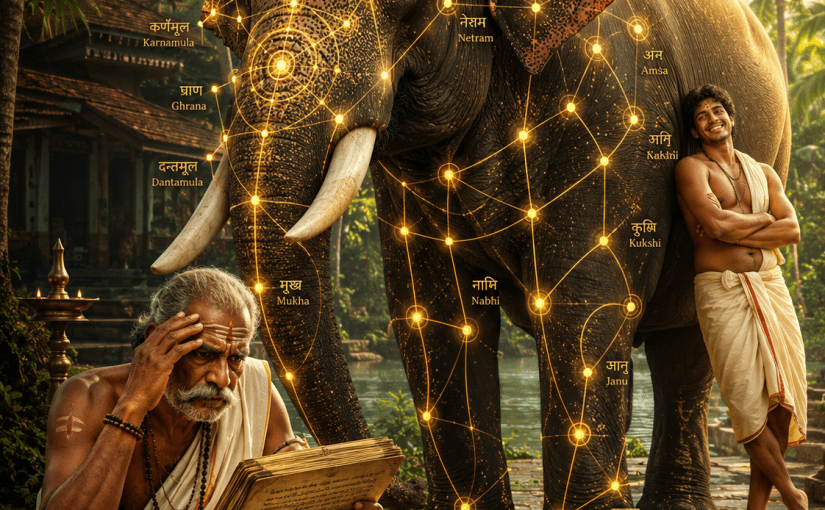
There is an old Indian legend about elephant trainers—mahouts—that perfectly explains why I sometimes sit in my studio staring at a Logic Pro session, completely paralyzed, while the rest of the world just goes ahead and makes music. 

Let me paint the picture. You have an Expert Mahout and an Inexperienced Mahout. The Expert has spent decades studying the ancient texts. He knows every single marma point on the elephant. (For the uninitiated, marma points are the vital, vulnerable energy centers in Ayurvedic anatomy. Strike the wrong one, and you either permanently injure the animal or, more likely, it turns you into a human dosa). 

So, when the elephant misbehaves, the Expert stands there calculating: “If I tap him behind the ear, I might hit the Sringataka marma… If I strike the flank, I might damage his spleen…” To his educated eyes, the elephant is basically a giant, walking minefield. There is hardly a single square inch of the beast that is safe to touch. By the time he calculates the optimal trajectory for applying discipline without causing a catastrophe, the elephant has already eaten a banana grove and wandered off to Kerala.

Then you have the Inexperienced Mahout. He hasn’t read the texts. He doesn’t know what a marma point is. The elephant acts up? Whack. He just taps it on the rump with his stick. No calculation. No Ayurvedic consultation. No existential dread. 

And the absolute best part? He gets away with it. The elephant just grunts, accepts the correction, and gets back in line. 

This story isn’t a critique of the beginner; it’s a tragedy of the expert. Why does knowing your subject inside and out make you lose your confidence? Psychologists call it the Dunning-Kruger effect, but honestly, I often find myself envying that early stage. The beauty of not knowing the rules is that you aren’t terrified of breaking them. The more you know, the more hesitant you get. The curse of expertise is that you see marma points everywhere. 

Have you seen that viral video of the Malayali uncle, Reji Annan, singing the classic Yesudas track “Gange Thudiyil”? He isn’t in a treated acoustic room. He isn’t worrying about phase alignment, breath control, or whether his EQ masking is clashing with a backing track. He just opens his mouth and belts it out with pure, uninhibited joy and absolute conviction. He isn’t looking at the marma points. He’s just riding the elephant. And millions of people loved it, completely hooked by his raw authenticity.

Meanwhile, I look at my own vocal tracks in Logic Pro and freeze. I’ll spend three days agonizing over whether to use Waves Tune, terrified to send a mix to the sound engineer unless my TC-Helicon is dialed in to the exact millimeter. What if the venue’s acoustics hit a sonic marma point?! The knowledge that was supposed to empower my music ends up acting like a pair of handcuffs. 

You see it in spiritual sadhana, too. We study the scriptures and worry if we are pronouncing the Shyamala Dandakamwith the exact right phonetic intonation, terrified of offending the cosmic grammar police. We hesitate to chant because our Sanskrit isn’t flawless. Meanwhile, someone else is cheerfully butchering the grammar with pure, overwhelming devotion—and they are the ones getting all the grace. 

Knowing the marma points is a beautiful thing; it is what makes you a master. But the legend of the mahout is a humbling reminder. The goal of acquiring knowledge shouldn’t be to build a prison of hesitation around yourself. Sometimes, you have to realize that the elephant—whether that’s your audience, your art, or the universe itself—is a lot thicker-skinned than you think. 

Sometimes, we need to stop overthinking the marma points, let go of our expert hesitation, and just sing the song.

You didn’t hire the heart!

You Didn’t Hire the Digestion Department: On Ramana Maharishi and the Supreme Doer

The 3 AM Regret Committee

You know how it works.

It’s somewhere between 2:47 and 3:15 AM, and your brain, which had absolutely nothing useful to say during the actual meeting, has suddenly convened an emergency session. The agenda? Every bad decision you have ever made. The tone? Prosecutorial. The mercy on offer? None.

“Remember 2009? That thing you said to Ramesh? Remember the job you didn’t take? The relationship you didn’t value enough? That investment you made in what turned out to be the financial equivalent of a paper boat in the monsoon?”

And so the mind replays, rewinds, and re-examines, as if a 47th viewing of the blunder might somehow change the ending.

We’ve all been there. If you haven’t, please write a separate blog, because clearly you are an entirely different species.

Enter the Sage. No PowerPoint Required.

A devotee once came to Bhagavan Ramana Maharishi at Arunachala with exactly this question – not at 3 AM necessarily, but with the same existential heaviness. The weight of past deeds. The crushing burden of karmic ledgers that seem to carry interest at rates that would embarrass a credit card company.

“Bhagavan,” the devotee essentially asked, “how do I get out from under the effects of the bad things I have done?”

Now, another teacher might have assigned a few hundred rounds of a mantra, or perhaps a month-long diet of boiled vegetables and noble thoughts. Ramana’s answer was something far simpler – and, if you sit with it, far more earth-shaking.

He said, in effect: Look. Right now, are you digesting your lunch?

The Stomach Has Better Things to Do Than Take Your Opinions

Here is the miracle that happens every single day that we completely ignore.

You eat your idly-sambar. Perhaps some rice in the afternoon. Maybe, if you are having a particularly adventurous evening, some pasta that you told yourself was “light.” And then – and this is the remarkable part – you forget about it entirely.

You don’t sit there holding a clipboard, managing the acid levels, dispatching enzymes, supervising the peristaltic movement of your intestines. You don’t schedule a 4 PM reminder saying, “Check on protein absorption in the small intestine.” You just… live your life.

Meanwhile, an incredibly complex, unimaginably precise operation is happening inside you. Every minute. Every second. And you are not running it.

Your heart beats. Not because you remembered. Not because you set it up in a settings menu somewhere. It just beats – about 100,000 times a day – without a single conscious instruction from you. Your lungs breathe. Your liver quietly does something extraordinary with seventeen different toxins from last Tuesday. Your immune system, right now, is probably handling something that would have hospitalised you if it had waited for you to notice it.

You are hosting an operation more complex than ISRO’s mission control, and you are completely unaware of it.

And Ramana’s point was this: Who do you think is running that?

The Invisible CEO

Think of your body as a massive corporation. Thousands of departments, millions of processes, an unimaginably intricate supply chain running 24/7 without a single holiday or a “we are experiencing high volume, please wait” message.

Now – who is the CEO?

It certainly isn’t your conscious mind. Your conscious mind is that enthusiastic but slightly clueless intern who sits in the front office, takes all the credit, and panics when the WiFi goes down. The real operations are being managed by something far more capable, far more silent, and far more permanent.

The ancient texts call it Ishwara. Ramana called it the Self. Modern people might call it Source, or Consciousness, or if they are trying very hard to avoid Sanskrit, “the Intelligence underlying existence.”

The name doesn’t matter. What matters is this: it is running the show. It has always been running the show. You are not, and have never been, the Chief Executive.

“But What About My Mistakes?”

And here is where Ramana’s answer becomes genuinely revolutionary.

If the same Supreme Intelligence that runs your digestion and beats your heart is also the Force underlying all of existence – then who, exactly, was the “doer” of those past actions you’re so busy prosecuting yourself for?

This is not a hall pass for bad behaviour. This is not Vedantic permission to be careless. This is something far more precise.

It’s the recognition that the “you” who made those decisions – the anxious, grabbing, fearful, confused identity that acted back then – was itself a product of a web of causes and conditions so vast and so complex that no individual ego could have possibly directed it. Ramana is essentially saying: you were not the driver. You were, at most, the passenger who thought they were steering.

Think of it like the GPS on your phone. You think you’re navigating. But the GPS is using satellite data, traffic algorithms, map updates, real-time rerouting decisions – a million variables your eyes can’t even see. If you end up on the wrong road, is it really you who chose it? Or was it the signal, the map data, the moment of distraction, the imperfect information?

The Supreme Doer – that vast Intelligence – accounts for all of it. Every variable. Every condition. Every circumstance that led to every choice.

The Background App You Forgot About

Here’s another way to think about it.

On your phone right now, there are apps running in the background that you have completely forgotten exist. They are syncing your data, updating your contacts, managing your cloud storage – quietly, competently, without any drama or press releases.

Consciousness works the same way. It is the background process that runs everything – your autonomic nervous system, the movement of the planets, the water cycle, the growth of a child in the womb. It doesn’t send you notifications. It doesn’t ask for acknowledgment. It simply operates, with a precision and elegance that makes the most advanced AI look like a pocket calculator.

And here is the liberating part: that same Intelligence was also the background process behind everything that has happened to you, and everything you have done.

The good. The bad. The cringe-worthy. The regrettable. All of it arose from that Totality.

The Lighter Wallet of Guilt

Ramana’s teaching isn’t asking you to become irresponsible. It’s asking you to become honest.

The ego says: “I did that. I am guilty. I must carry this forever.”

The Supreme Doer teaching says: “That action arose from the Totality. You were the instrument. The instrument is not guilty of what the music is.”

When you truly internalize this – even for thirty seconds – something remarkable happens. The fist in your chest around that old regret… loosens. Not because you have escaped accountability, but because you have suddenly seen the full picture of what accountability even means when you are not, in fact, the independent agent you thought you were.

The cosmic laptop, as it were, has a much better virus protection system than your individual guilt-loop.

A Practical Experiment

Next time you find yourself spiralling into the past – whether it’s 3 AM or 3 PM – try this.

Take a slow breath. Notice the breath happening. Notice that you did not decide to breathe in the last sixty seconds – it just happened. Notice that your heart is beating, your cells are functioning, your temperature is being regulated, all without a single conscious instruction from you.

And then ask: who is doing all of that?

Sit with that question. Not to get an intellectual answer, but to feel the weight of the Intelligence behind it. The same Intelligence that handles your digestion with such extraordinary precision is also handling the full arc of your story – including the chapters you wish you could redact.

And maybe, just maybe, that Intelligence knows a bit more about the editing process than your 3 AM committee does.

The Final Word (From Arunachala, Not from Me)

Ramana was the quietest revolutionary who ever lived. He didn’t shout from rooftops. He didn’t run workshops with certificates and a merch table. He just sat, in stillness, and pointed to the one thing that was undeniably real: the Self – the Supreme Doer – that underlies everything.

His message on past karma wasn’t “don’t worry about it.” It was far more powerful: you were never the doer you thought you were. And the Force that actually runs this show? It doesn’t make mistakes. It doesn’t have a ledger of your sins. It’s too busy keeping your heart beating to hold a grudge.

So maybe go ahead and fire that 3 AM committee.

The Supreme CEO has it handled.


Published on Nalla Madras – All things movies, music, and philosophy, from a South Indian, Madras-born native’s perspective.

Life is a Time-Lapse: Why You Are the Camera, Not the Movie

The Stationary Camera: Why Time Doesn’t Exist (And Einstein Agrees with the Rishis)

You know that feeling when you look at a time-lapse video of the night sky?

The stars are streaking across the heavens, the Milky Way is spinning like a giant cosmic pinwheel, and the earth seems to be on a wild carousel ride. But the camera? The camera sits there—rock solid, unmoving, silently watching the show.

We usually think we are the ones moving through time, getting older, rushing to meetings, and chasing deadlines. But what if we’ve got it backwards?

What if Time doesn’t exist? What if we are the stationary camera, and it’s the environment that is whizzing past us?

This isn’t just a late-night “hostel terrace” theory. It’s a place where modern physics and ancient Vedanta decide to have a cup of filter coffee together.

The Photographer’s Philosophy

Let’s look at this “Stationary Camera” theory.

In a time-lapse, two things are happening:

  1. The Changing: The stars, the clouds, the rotation of the earth.
  2. The Changeless: The camera lens that captures it all.

If the camera started moving around, the video would be a blurry mess. The only reason we see the movement of the stars is because the observer is still.

Now, apply this to your life. Your body changes (grey hairs appear, knees creak). Your mind changes (happy today, annoyed at the traffic tomorrow). The world changes (new governments, new iPhones).

But YOU—the sense of “I am”—does that ever change? The “I” that felt the sun on your face at age five is the exact same “I” reading this blog right now.

You are the camera. The world is the Milky Way.

“But Saar, What About Science?”

I can hear the skeptics (and the physics majors) clearing their throats. “Nanda, time is real! Entropy! The Second Law of Thermodynamics! You can’t un-break an egg!”

Fair point. But here is where it gets interesting.

Einstein enters the chat.
In the old Newtonian days, we thought time was a steady river flowing at one speed for everyone. Then Einstein came along with Relativity and proved that time is actually bendy. It slows down if you move fast; it warps near black holes.

When his best friend died, Einstein wrote a letter to the family saying:

“The distinction between past, present and future is only a stubbornly persistent illusion.”

Science is basically admitting that “Time” isn’t the solid container we think it is. It’s an illusion. Or, as we call it back home, Maya.

The Vedantic Upgrade: Drg-Drishya-Viveka

Our ancient rishis didn’t have DSLRs, but they had this exact same theory. They called it Drg-Drishya-Viveka (The discrimination between the Seer and the Seen).

They would say your Camera theory is perfect, with one major “Pro Mode” upgrade.

In your analogy, you might think:

  • Camera = My Mind
  • Milky Way = The World

Vedanta says: Not quite.

If a bug crawls across the camera lens, the camera sees it. If the lens gets foggy, the camera sees the fog.
Your thoughts, memories, and emotions are like that bug or that fog. They are constantly moving. They come and go.

So, the Mind isn’t the Camera. The Mind is part of the movie!

The real Camera is the Sakshi (Witness Consciousness). It watches the world move, and it watches the mind think about the world moving. It is the Sat-Chit-Ananda—the existence that never moves, never sleeps, and never changes.

The Final Verdict

So, are there holes in this theory? Only if you try to make the “Camera” into your ego. Your ego is definitely moving (and usually running late).

But the real You? You are stationary in eternity.

  • Science studies the movie (the changing particles, the biology, the entropy).
  • Spirituality studies the Camera (the Observer).

You don’t have to choose between them. You can enjoy the science of the stars while resting in the stillness of the Self.

Try this today:
Next time you are stuck in a chaotic situation—maybe traffic on Mount Road or a heated meeting—just pause. Be the camera. Let the cars and the shouting be the Milky Way spinning around you.

You might find that while the world is noisy, the Witness is silent.


The Trap of Sensory Pleasures: How to Escape

This or that?

You know the feeling.

It’s 11:30 PM. You are doom-scrolling on Amazon, and suddenly, you see it. A noise-canceling headphone that promises to silence not just the traffic outside, but arguably your own thoughts. Or maybe it’s Saturday night, and that second slice of chocolate truffle cake is looking at you with the intensity of a long-lost lover.

In that moment, a powerful wave rises. The ancient texts call it Kama (desire), but let’s just call it what it is: The Itch.

The Itch says, “If I get this, I will be happy.”

And you know what? It’s not entirely lying. You will be happy. For about fourteen minutes. Maybe twenty if the cake is really good. But then? The happiness evaporates, leaving you exactly where you were, perhaps with just a slightly lighter wallet or a heavier stomach.

This is the trap of the sensory world. It sells us rental happiness and charges us ownership prices.

But there is a little game you can play to hack this system. I call it “This or That.”

The Two Menus

Imagine life is a restaurant with only two items on the menu.

Item 1: “This”

  • Ingredients: Sensory pleasures, shopping sprees, that extra glass of wine, the dopamine hit of a new gadget.
  • Guarantee: Instant gratification.
  • Side Effects: Transient. It fades quickly, leaving a vacuum that demands to be filled again. It is the hamster wheel of happiness.

Item 2: “That”

  • Ingredients: Satchitananda (Existence-Consciousness-Bliss).
  • Guarantee: Eternal peace. A subtle, unshakeable joy that doesn’t depend on what is in your driveway or your refrigerator.
  • Side Effects: A sense of invincibility. The realization that you are already full.

How to Play the Game

The game is deceptively simple. The moment a craving arises—whether it’s for a new car, a harsh retort to a colleague, or just mindless consumption—you pause.

Take a breath. Create a tiny gap between the urge and the action. And in that gap, ask yourself:

“Do I want This… or That?”

Do I want the fleeting thrill of the object (“This”)?
Or do I want the eternal stability of my own Self (“That”)?

When you choose “This,” you are choosing to be a beggar, asking the world to drop a coin of happiness into your bowl.
When you choose “That,” you remember you are the Emperor.

The “That” is Always There

Here is the secret the marketing departments don’t want you to know: The peace you are looking for in the object is actually what remains when the wanting of the object drops.

When you finally buy that gadget, you feel a moment of relief. You think the gadget gave you joy. It didn’t! The gadget simply removed the craving for a moment, revealing the natural joy (Satchitananda) that was already there underneath.

So why take the detour through the shopping mall? Go straight to the source.

The Practice

Next time the urge hits, catch it mid-air.

  • Craving for approval? Ask: This (someone else’s opinion) or That (my own inner fullness)?
  • Craving for distraction? Ask: This (social media noise) or That (the silence of being)?

You might still choose the cake. And that’s fine! We aren’t trying to be monks overnight. But simply asking the question breaks the trance. It reminds you that you have a choice.

You are standing at the crossroads of the momentary and the eternal fifty times a day.

So, my friend… This or That?

Spirituality’s Biggest Pyramid Scheme 

The Inverted Pyramid Scheme of Enlightenment

Let’s talk about spiritual enlightenment. You know, that lofty goal of self-realization, the grand finale of the cosmic show where you finally get it. We imagine it as a pinnacle, the top of a mighty mountain we must climb, laden with backpacks full of mantras, vegan recipes, and well-thumbed scriptures.

But what if we’ve got it all upside down? What if enlightenment isn’t a mountain, but an inverted pyramid?

Picture it: a massive, ornate pyramid, balanced precariously on its tiny, sharp point.

That single, infinitesimally small point? That’s the Truth. It’s simple, stable, and unbelievably direct. It’s what’s left when you strip away everything that changes. It’s the silent, constant awareness that’s reading these words right now. It has no name, no form, no frequent-flyer miles. It’s just… is.

The instructions to get there are almost insultingly simple: “You are not your thoughts. You are not your body. You are not your job title or your political opinions. You are the awareness in which all that stuff appears and disappears.” Done. That’s the whole teaching. Pack it up, we’re going home.

Ah, but we humans are never satisfied with simple, are we? We look at that beautiful, simple point and say, “That’s it? I can’t build a five-day retreat around that.”

And so, we build.

From that one simple point, the great, wobbling, inverted pyramid of stuff begins to rise. This is the fluff. The base of the inverted pyramid is a sprawling, chaotic metropolis of doctrines, dogmas, rituals, and rules. It’s the thousands of books explaining the one thing that needs no explanation. It’s the heated debates over whether the cosmic turtle is a sea turtle or a tortoise. It’s the secret handshakes, the special diets, the certificates of enlightenment, and the merch table in the lobby.

We spend our lives exploring this massive, ever-expanding base. We become experts in one corner of the pyramid (“12th Century Gnostic Chanting, Subsection B”), convinced it holds the key. We run from workshop to workshop, collecting spiritual tools like they’re Pokémon, hoping the next one will finally be the one that makes us feel complete. We’re so busy navigating the pyramid’s sprawling surface that we forget the entire structure is resting on the simple point we started with.

The joke, of course, is that you were never on the pyramid. You are the point. You’ve always been the point. All that other stuff—the beliefs, the practices, the frantic search—is just the elaborate, top-heavy structure you built on top of yourself, seemingly in an effort to find yourself.

So, maybe the path isn’t about climbing higher. Maybe it’s about courageously dismantling the pyramid. It’s about letting go of the complex answers and getting comfortable with the simple, silent reality they were meant to explain. It’s about having a good laugh at the absurdity of building a skyscraper just to find the ground you were already standing on.


Pop-Up Cards and Liberation: A Morning Metaphor for Reality

You know those pop-up greeting cards — the ones that look flat and innocent until you open them, and suddenly bam!— an entire Taj Mahal made of paper springs out, usually accompanied by glitter and guilt for not buying a simpler one?

That’s sort of what happens every morning when we open our eyes.

After a good night’s sleep (the rare kind where no one from your childhood WhatsApp group appears in your dreams asking for donations), the moment you wake up, a full 3D world unfolds — people, places, problems, pending bills — all popping up like that elaborate paper diorama.

It’s quite the show.


The Great Morning Unfolding

When you open your eyes, you also pop up — the “me” character, complete with opinions, breakfast preferences, and mild existential anxiety. The whole identity kit just unfolds smoothly like it’s been waiting all night under your pillow.

Some people say, “But Nanda, the world doesn’t vanish when you sleep! It’s still there!”

Maybe. But here’s the trick — the very someone making that argument is also part of your conscious field. That clever, philosophical person pointing out your ‘flaw in logic’? Yep, also a pop-up.

It’s like arguing with a character inside the card about whether the card exists.


Flat When Closed

When the pop-up card is closed, nothing is destroyed. The scene is just folded — the palace, the trees, the smiling couple in matching paper sarees and kurtas — all compacted into flatness.

Similarly, when you’re asleep or in deep meditation, the world — with all its drama and color — folds back into stillness. Not gone, but dormant. Like your boss on a Sunday.

And when you “wake up,” the grand production begins again: light, sound, identity, memory — everything leaps up, shouting “Surprise!” like an overeager birthday card.


The Trick of Believability

The funny thing about pop-up cards is how convincing they can be, especially to children (and occasionally to adults before coffee). You forget it’s just paper cleverly cut and glued.

Likewise, consciousness projects such a convincing show that we forget it’s a projection at all. The mind doesn’t just open the card — it hires a full cast, builds sets, adds background music, and gives you the lead role.

The irony? You’re both the audience and the actor.


Liberation as Folding Back

So what is liberation then? It’s not burning the card or running away from it. It’s simply realizing that whether the card is open or closed — nothing truly new appears or disappears.

The essence was never in the paper palace or the pop-up people; it was always in the space that allowed it to unfold.

That awareness — silent, spacious, unbothered — is the real greeting.

Everything else is just… decoration with a bit of glitter.


Closing Thought

Next time you wake up, watch the show unfold. Don’t rush to start the day. Just notice how the world pops up — your name, your room, your phone, your to-do list — all springing to life from nowhere.

And maybe, before diving in, smile and whisper to yourself:

“Ah, there it is — the morning card. Let’s see what scene consciousness is sending me today.”

(Just don’t try to fold your spouse back into the card when they ask you to make coffee. Enlightenment has limits.)

The Ego: Friend, Foe, or Just Misunderstood?

For centuries, sages, saints, and that one uncle at weddings who insists he knows “the truth of everything” have been shouting in unison: shed the ego! According to them, the ego is the villain of the spiritual soap opera, the moustache-twirling bad guy who blocks us from enlightenment. One modern guru even turned it into a neat acronym: E.G.O = Edging God Out.

Sounds convincing, right? But here’s the twist: without the ego, you wouldn’t even know there was a truth to realize in the first place.

The Double Life of Ego

Think of ego like your neighborhood auto driver. On one day, he’s weaving dangerously through traffic, shouting at pedestrians, and playing film songs at full volume—annoying, loud, and best avoided. On another day, he’s the one who drops you exactly where you need to be, gives you change without grumbling, and even warns you about the pothole near the signal. Same guy, two different roles.

Ego works like that. If you identify it with your endless stream of random thoughts—“what’s for dinner?”, “does my WhatsApp DP look fat?”, “why hasn’t Netflix released Season 2 yet?”—then yes, ego is the troublemaker. But if you recognize ego as the quiet sense of “I am” that sits beneath all this noise, suddenly it becomes a signpost pointing straight toward Truth.

The Shopping Mall Analogy

Picture yourself in a shopping mall. Every shop window is blaring for attention: “Buy me! Eat me! Discount 50%!” These are your thoughts. Your ego, depending on how you use it, can do one of two things:

  1. Chase the mannequins—run around from Zara to Apple Store to the food court, completely distracted.
  2. Stand in the middle of the mall—aware that all these shops exist, but not compelled to enter. Just resting in the fact that you are present in the mall, not the stuff inside it.

One leads to exhaustion (and an empty wallet). The other leads to realization.

The Cosmic Stage Show

Think of life as a stage play. The thoughts, emotions, aches, and identities are like actors. The ego can either insist, “I’m the hero, the villain, the comedian, and also the audience—give me all the parts!” Or it can sit back as the stage itself—the screen upon which the entire drama plays.

It’s the same ego, but which way you flip it makes all the difference.

Why We Need Ego to Drop Ego

Here’s the paradox no one tells you: you need ego to even decide to shed ego. Who else is sitting there reading blogs about spirituality at 11:47 p.m. on a Tuesday? The “I” that seeks the Truth is still ego—but it’s the refined version, the ego that points beyond itself, like a GPS that tells you, “Recalculating route to Infinity.”

So maybe the sages weren’t wrong about letting go of ego. But until you use it to realize what’s beyond, dropping it too soon is like throwing away the car keys because you’re frustrated about potholes. The car’s still the way to get home.

Everyday Example: The Alarm Clock

Think of your alarm clock. It’s annoying, intrusive, and loud. You want to smash it against the wall every morning. But without it, you wouldn’t even wake up to know there is a morning. Ego’s the same. It wakes you up to the sense of “I am”—and from there, you get to see that you are more than the random noise of thoughts and identities.

In short: Ego isn’t the villain. It’s the slightly irritating but ultimately helpful character that gets you to the truth. Shed the noisy part, keep the “I am” part, and you might just find that what you thought was blocking God was really pointing to God all along.

How to Tune Into Your Inner Steady Hum

Have you ever walked past a giant generator or one of those industrial motors and felt it in your bones before you even heard it? That low, steady hum… reassuring, powerful, unbothered. It’s just there. Not shouting for attention, not needing to prove itself, but quietly powering the whole building.

That, my friend, is exactly what the sense of “aliveness” feels like.

We’re so used to identifying with thoughts—this endless parade of “should I…”, “what if…”, “oh no…”, “why me…”—that we forget there’s something far more fundamental buzzing underneath. A current that’s been running since before you knew your name, before you knew you had knees that creak when you get up too fast, before you had a list of worries that could rival a grocery bill.

The Dynamo Within

Sit still for a moment. Drop the drama. Forget the story of “you.” What’s left? A hum. Not metaphorical, but a very real sense that something is alive in you. Breathing, pulsing, steady as a ceiling fan in a summer power cut (when the current isn’t steady, you really notice!).

From that humming place, you’ll see your thoughts like little fireflies outside a streetlamp—pretty maybe, sometimes irritating, but clearly not the light itself. Even your precious “identity”—that carefully curated name, job title, Instagram bio—sits outside this hum. The aliveness doesn’t care if you’re CEO of the world or Chief Operator of the Remote Control. It just hums.

Aches, Pains, and Invincibility

Here’s the wild part: even the body’s complaints—sore shoulders, stiff back, that knee that behaves like it’s auditioning for a horror movie soundtrack—can be observed from here. You notice them, yes. But they’re not you. They’re like background noise in a café where the espresso machine hisses, chairs scrape, and the couple at the next table is arguing over pineapple on pizza. None of it stops the café from being a café.

And from here, strangely enough, there’s a feeling of invincibility. Not the Marvel superhero kind where you dodge bullets, but a deeper invincibility. Even mortality feels… well, slightly overrated. Because the hum doesn’t really start or stop—it just is.

Everyday Example: The Fridge

Think of your refrigerator. You don’t stand there all day listening for the motor. But if the hum stops, you immediately sense something’s wrong. Suddenly, all the thoughts appear: “Do I need to call the repair guy? Will my ice cream melt? How fast can I eat three tubs of Ben & Jerry’s?”

Our aliveness is like that fridge motor. It’s constant, reliable, and easily overlooked because it’s always there. But notice it, and suddenly the thoughts about melted ice cream (or anything else) are just noise outside that steady hum.

The Easy Part

Here’s the best news: nobody can deny being alive. This isn’t some mystical achievement reserved for monks in Himalayan caves. You’re alive, right now. The hum is running. Tuning into it doesn’t take effort—it takes not effort. Just notice.

The hard part? We forget. The easy part? We can remember again, any time.

So the next time you find yourself spiraling in thought or getting stuck in an ache, pause. Step back. Listen for the dynamo. That quiet, invincible hum of aliveness.

It’s been there all along, and unlike your fridge, you don’t need to call a repair guy.