
In my teenage years, my favorite author was P.G. Wodehouse. Although the settings and trapping of the English peerage were alien, the comical humor had me in stitches! My favorite character was the ever-resourceful Jeeves, the gentleman’s gentleman, as he would call himself.
I had always associated Jeeves as a stoic. A stoic person does not go over the top with happiness or curl up into a fetal position when confronted with tragedy. Even keel at all times.
But wrong I was. Stoicism is more complex; believe me, you. Actually, I hate this usage of ‘believe me you.’ It was a favorite usage of an ex-boss of mine while I was in the airline industry. At least that was my definition before I took a deep read into stoicism.
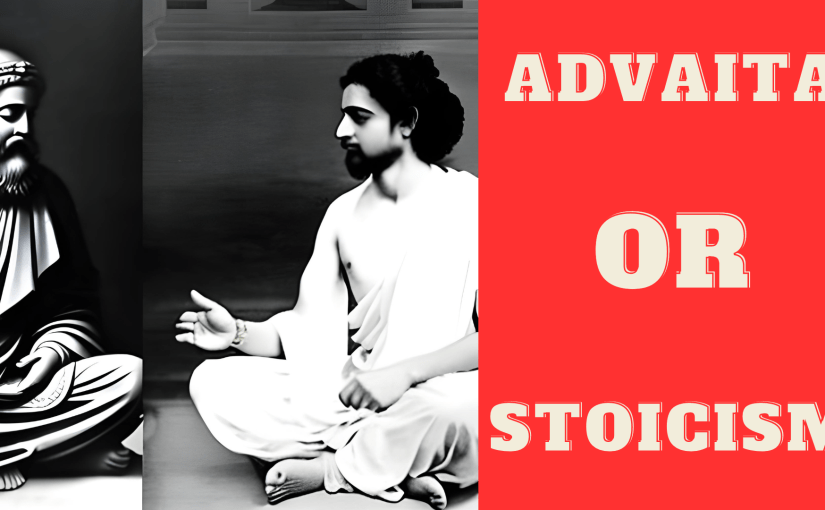
While reading about stoicism, one of the cardinal rules that struck out was that you control the process but you do not control the outcome. But this was exactly what Lord Krishna implied in the Bhagavat Gita, amongst many others. So I decided to take a dive at advaita and stoicism, and here is what I came up with.
Introduction:
Advaita and Stoicism, two philosophical schools of thought from ancient India and Greece, respectively, have fascinated seekers of wisdom throughout history. Despite their distinct origins, these philosophies share common threads and offer profound insights into the nature of existence, the human experience, and the pursuit of inner peace. In this blog, we will explore the similarities and differences between Advaita and Stoicism, shedding light on their shared principles and unique approaches to life.
The Nature of Reality
Advaita: Originating from the Upanishads and expounded by scholars like Adi Shankara, Advaita philosophy emphasizes non-duality. It asserts that the ultimate reality, referred to as Brahman, is an undivided and universal consciousness. The illusory nature of individual identities (Atman) is revealed, leading to the realization of oneness.
Stoicism: Stoicism, epitomized by thinkers like Epictetus, Seneca, and Marcus Aurelius, perceives reality as governed by a rational and divine order. It teaches that individuals should align with this natural order, recognizing their limited control over external circumstances while cultivating mastery over their inner thoughts and actions.
Similarity
Advaita and Stoicism converge in recognizing a higher reality and the need to transcend limited perspectives. Both philosophies urge individuals to embrace a broader understanding of existence, fostering harmony and unity with the world.
Detachment and Equanimity
Advaita: Advaita teachings advocate detachment from worldly attachments and the transient nature of material existence. By realizing the impermanence of external phenomena, individuals are encouraged to seek lasting happiness within, liberated from the fluctuations of desires and external circumstances.
Stoicism: Stoic philosophy promotes a similar concept of detachment, emphasizing the development of inner resilience and emotional self-control. Stoics believe that accepting the transitory nature of external events can cultivate a state of equanimity and tranquility, irrespective of external circumstances.
Both Advaita and Stoicism highlight the significance of inner detachment, allowing individuals to remain unperturbed by the unpredictable fluctuations of life. Through cultivating non-attachment, both philosophies offer pathways to stability, peace, and freedom from suffering.
Self-Reflection and Self-Mastery
Advaita: Advaita philosophy encourages self-inquiry and introspection to realize one’s true nature and the nature of the universe. Through practices such as meditation and self-reflection, individuals can transcend the limitations of the ego and directly experience their intrinsic connection with the universal consciousness.
Stoicism: Stoicism places a strong emphasis on self-reflection and the examination of one’s thoughts and actions. Observing and understanding our emotions, judgments, and beliefs, we develop self-awareness and cultivate virtues such as wisdom, courage, and temperance.
Difference
While both philosophies endorse self-reflection, Advaita emphasizes the direct experiential realization of the ultimate reality through practices like meditation. Stoicism, on the other hand, focuses more on rational reflection and the cultivation of virtues as a means to navigate life’s challenges.
Conclusion
Advaita and Stoicism, originating from different times and cultures, offer profound insights into the human condition and the quest for inner peace. Both philosophies emphasize transcending limited perspectives, cultivating detachment, and developing self-awareness. Advaita emphasizes the realization of non-duality and the oneness of existence, while Stoicism focuses on aligning oneself with the rational order of the universe. Exploring the similarities and differences between these philosophies can broaden our understanding of human nature and provide valuable tools for personal growth and fulfillment.
I find it easier to implement Stoicism in my daily life rather than advaita philosophy.
How about you?

 Nalla Madras