
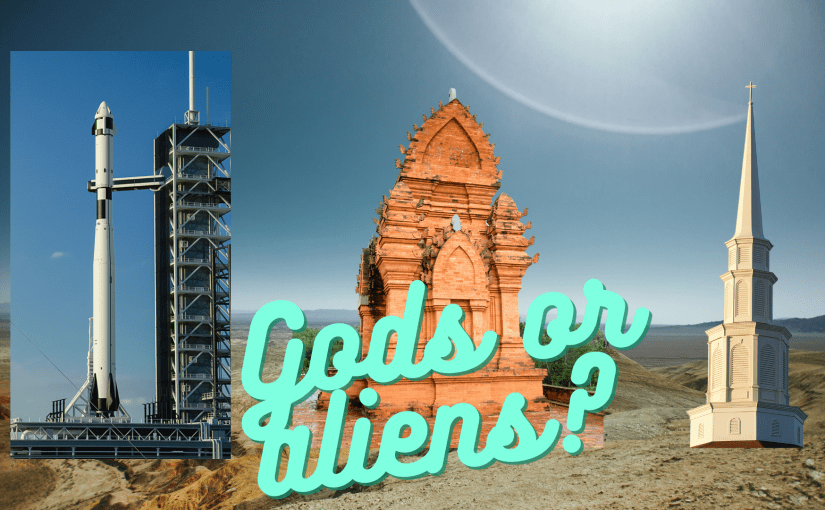
The Divine Structures: Temple Vimanas, Church Steeples and the Alien Hypothesis
David Charles Grusch
David Charles Grusch, a former intelligence official turned whistleblower, has provided a fresh perspective to this conversation. Grusch served as a decorated combat officer in Afghanistan and is a veteran of the National Geospatial-Intelligence Agency (NGA) and the National Reconnaissance Office (NRO). He represented the reconnaissance office to the Unidentified Aerial Phenomena Task Force from 2019-2021 and was the NGA’s co-lead for UAP analysis and its representative to the task force from late 2021 to July 2022.
Grusch has provided Congress and the Intelligence Community Inspector General with extensive classified information about deeply covert programs. These programs allegedly possess retrieved intact and partially intact craft of non-human origin. Grusch claims that this information has been illegally withheld from Congress and has filed a complaint alleging illegal retaliation for his confidential disclosures.
His testimonies, backed by corroborating information from other active and retired intelligence officials, add a layer of intrigue to the conversation on ancient astronaut theories and potential extraterrestrial influences on human civilization and religious traditions. These insights suggest that we might indeed have had visitors from the stars in the past.
Our world is filled with wondrous structures, whose histories reach far back into the annals of time. Among these architectural wonders, two types of buildings – Hindu temples and Christian churches – have drawn fascination and intrigue for centuries. This blog explores:
- The resemblance between the ‘vimana’ of Hindu temples and the steeples of Christian churches to the structure of modern spacecraft
- The speculation that these structures could represent extraterrestrial spacecraft
- The possibility that the deities worshipped in these religious traditions might indeed be aliens who visited Earth
The Vimana and The Steeple: A Structural Analysis
The vimana and the steeple – structures of Hindu temples and Christian churches, respectively – bear a surprising resemblance to the streamlined structure of modern spacecraft. Both aim skywards, pointing towards the celestial realm, the final frontier for humanity.
Vimana: Spaceships of the Gods?
The Sanskrit word ‘vimana’ intriguingly denotes both:
- The towering structure of a temple
- Mythical flying palaces or chariots of the gods, as described in ancient Indian scriptures
Detailed descriptions of vimanas, with their light and noise, moving at great speeds, and capable of traversing dimensions, bear striking similarity to modern accounts of UFO sightings.
Pushpaka Vimana: The Celestial Chariot of the Gods
The Pushpaka Vimana, a prominent example from ancient Indian literature, is described as a divine flying palace or chariot, capable of traveling vast distances. It is often depicted as:
- Large and luxurious, capable of accommodating an army
- Able to move at the speed of thought
- Capable of altering its size according to its master’s wish
- Able to navigate in any direction
These descriptions have been interpreted by proponents of the ancient astronaut theory as potentially pointing towards extraterrestrial influence.
Rituals and Resemblance to Spaceship Landings
Certain rituals performed in Hindu temples, such as the lighting of camphor, could mirror the conditions of a spacecraft’s landing or take-off:
- The priest stands on the doorway of the vimana during the ritual
- There is a crescendo of activity – loud chanting, ringing of bells, bright flames, and dense smoke
- The atmosphere created by these rituals is similar to the anticipation felt during the moments preceding a spacecraft’s launch
Hindu Deities: Divine Beings or Astronauts?
The depictions of Hindu deities, often shown with elaborate crowns, shields, and other unique objects, have led some to speculate a possible connection to extraterrestrial beings:
- Crowns are sometimes interpreted as potential helmets, akin to those worn by modern astronauts
- Divine weapons, or ‘astras,’ are sometimes seen as potentially advanced technological devices
- Vahanas, or divine mounts/vehicles, are sometimes interpreted as potential representations of advanced vehicles or spacecraft
Manna from Heaven: Divine Intervention or Extraterrestrial Aid?
The biblical account of manna from heaven, described in the book of Exodus, has also been examined through the lens of the ancient astronaut theory. Some speculate that manna could be the product of an advanced technology, possibly of extraterrestrial origin:
- Manna is described as white, flaky, and tasting like honey
- It appeared six mornings a week and doubled in quantity on the eve of the Sabbath
- Similar to the pilgrims being sustained by the indigenous peoples’ knowledge of the land, could the Israelites have been sustained by extraterrestrial beings with advanced technology?
Interpretations by Erich von Däniken
Erich von Däniken, a Swiss author known for his controversial theories about extraterrestrial influences on early human civilization, has proposed some intriguing interpretations:
- The vimana of Hindu lore could be interpreted as advanced flying machines or spacecraft
- Certain biblical stories and phenomena could be read as encounters with extraterrestrial beings
Gods or Extraterrestrial Beings?
The “ancient astronaut” hypothesis speculates that many divine beings were, in fact, extraterrestrial life forms. For example:
- In Hindu mythology, gods like Vishnu and Indra are often associated with vimanas, their celestial chariots
- In Christian tradition, events such as the Ascension of Christ have been interpreted as encounters with extraterrestrial technology or beings
In Conclusion: What is your take?
Whether our religious structures symbolize our ancestors’ understanding of the divine, or represent a more concrete interaction with advanced, extraterrestrial technology, remains a question for thought-provoking debate. Regardless, the vimanas of Hindu temples and the steeples of Christian churches continue to inspire us with their beauty and symbolism. They stand as testaments to human ingenuity and our quest to understand the unknown. Our rituals, like the lighting of camphor, contribute to our rich religious and cultural heritage, even as they open up new avenues of interpretation and exploration.
From the description of the Pushpaka Vimana in ancient texts to the stories of manna in the desert, these narratives continue to inspire wonder and provoke thought, enriching our understanding of our past and, potentially, our future.

 Nalla Madras