Mani Stores @Velacheri

MANI STORES

Velacheri was a calm, quiet place.  It had all the hallmarks of a quaint village; lush paddy fields irrigated by the waters of a rather vast lake that looked endless during monsoons. St. Thomas Mount and the Pallavaram hills framing the north-western and western horizons were visible.  The air was so clear that I could count the stars at night; they were like shimmering lights against the inky black sky, which was not lit up by the city glow as there were no large colonies nearby, and electricity hadnʼt reached all houses, including ours.

The location

The bus stand was at the intersection of Brahmin Street and Velacheri High Road.  The bus stand was an arrangement of cement benches with red oxide slabs, and it was a kind of meeting point for most residents. There was a certain lazy, languid air about the place until the bus arrived. After that, it became a beehive of activity, and everybody jostled with each other to get on to the bus first, to claim a vacant seat.  Invariably, there would be a village do-gooder who would yell out to the milling, jostling mass.

The know-all at the bus stop

“Make way for the ladies, especially the ones with children.  Everyone will be able to get in.  Donʼt hurry,” he would shout out, with the authority of one who has seen several hundred arrivals and departures.  Then there was another group; the dashing young men dressed in their finest.  They would remain a distance away from the bus with studied nonchalance, and once the bus began to move, they would run alongside the bus for a while and jump on the alighting steps.  These ʻfootboardʼ travelers, as they were called, would hang in sometimes on just a toehold, and this would get admiring looks from the girls on the bus.  To them, this meant everything. To some, this was a way of getting a free ride!

When the bus departed,  the mix of people changed, so new topics were invariably started or old ones repeated to a new audience. So there were always varied points of view every time.

The village park

Behind the bus stand was the village park that came to life in the evening.  A community radio blasted out programs from a station called Vividbharati.  The park had one lone gardener, who rarely smiled but was always digging a hole or pruning a croton bush and was the employee of the village panchayat.  He wore khaki half-pants and a khaki shirt.  Under his half-pants were bright-colored boxers that were bigger than his khakis, giving the impression that beneath that drab exterior was a bright side to his personality. He also wore a huge watch with a stainless steel bracelet that contrasted brilliantly against his sunburned, brown skin.

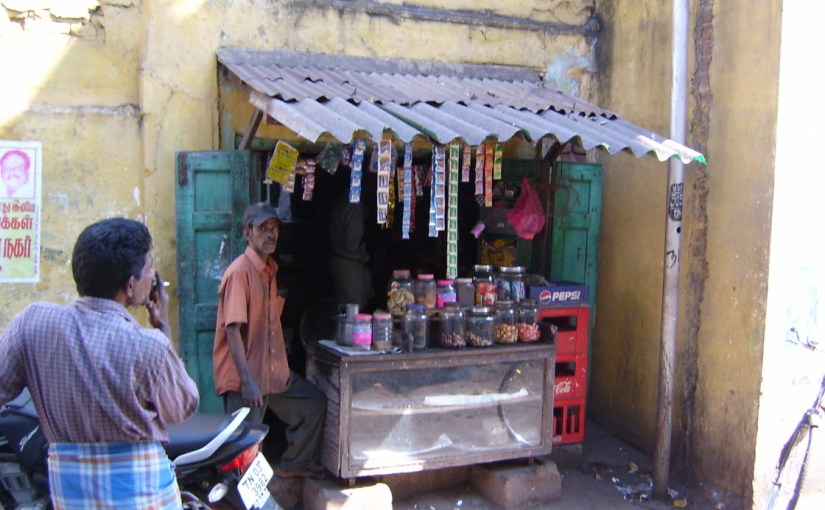
A few shops were next to the bus stand; to the right was a shop selling cigarettes, beedis, and brightly colored candy.  The different varieties of candy were all stored in identical jars.  The shop also sold lemonade which was made fresh every time.  The shopkeeper would use soda instead of water for an extra ten paise.  The soda bottle was fully recyclable.  It had a marble inside the bottle, and it rested in the upper quarter of the bottle.   During manufacturing, the gas inside the bottle would force the marble up the opening and push it to shut onto a rubber ring washer near the bottle’s opening.  To open the bottle,  a wooden peg was used to push down the marble, and depending on when the soda was prepared; it would either be a mini-explosion or a soft swoosh. 

Mani Store

On the opposite side, some distance away was the main grocery store called Mani Stores. The term grocery store was more for convenience as it was a mishmash of fancy merchandise.  The proprietor, whose name was Mani, was a pioneer of sorts. While most other shops were small cubby shacks selling peanuts, colored candy, and essentials like lentils and rice, Mani stocked luxurious items like fancy soaps, talcum powder, lotions, and perfumes.

Mani resembled a famous Tamil film actor, or at least that was the opinion of many residents of Velacheri. He knew it and played it to the hilt by mimicking certain signature mannerisms of the star.  Teenage girls in their half-sarees would giggle when they passed by his shop. Somehow, I could see only a vague resemblance; I not being much of a moviegoer those days.    My parents believed that movies caused moral turpitude and were the cause of all evils in society. So, my comparison was limited to posters and paintings of the film star plastered all over the walls of the nearby transformer factory. 

Every evening, Mani would get his assistant to sweep the entrance to his shop and sprinkle water to cool down the bit of earth heated by the post-afternoon heat of the sun.  This gave rise to a warm, earthy smell, not unlike what you would encounter after a summer rain.  Mani would then switch on his prized transistor radio.  It was a Bush Baron, a Cadillac among transistor sets, and it would belt out music at such loud volumes that you could hear it until you reached the park.  From there, the radio in the park took over.  So, it was a kind of relay race.  Thankfully, they were all tuned to the same station, so it did not sound like so many popular remixes of today.

Mani had one failing.  He hated to admit his ignorance.  So, when somebody asked for something that he hadnʼt a clue about, he would pretend to look for it.  His search was bound to bring no results since he did not know what he was looking for.  So, he would say he had run out of stock after a point.  Later, he trained a sidekick, a small boy with a leaky nose.

At times, he hadnʼt a clue what I wanted.

“Give me a pack of Marie biscuits,”  I would ask.

“Boy, give sir Hari biscuits,” Mani would yell to the boy inside. His trained sidekick would yell out that they were out of stock. He nor his sidekick had a clue what Marie biscuits were.   I would begin to do an about-turn and start walking out of the shop when Mani would call out to me in an apologetic tone.

“Stock just over, sir.  I will get it surely next week”   I knew he was bluffing.  Mani would never exhibit his ignorance.  After all, his was ʻtheʼ grocery store in the village!

This used to go on.  I then decided to teach him a lesson and would ask if he had a stock of various brands of ice cream and things of that nature, knowing he did not have a deep freezer. Nobody had one because an uninterrupted electricity supply was unheard of in the state of Madras.

Later, it became a game, and I became more adventurous. Those days, it was lonely in Velacheri, and this was one way of keeping my mind busy!  Once I remember I asked him for a Ford Mustang. Another time, it was for a Soyuz spacecraft.  Some months later, he saw through my game.  Some bystander must have told him, behind my back, that I was pulling his leg.

Later, whenever he was unfamiliar with an item, he would ask me with a half-smile. “ Sir, I hope you are not trying to fool me,” asked Mani.

He was a sport, and he enjoyed the exchanges with me. 

The over run

Mani survived for about five years as being the only ʻsupermarketʼ in town.  When the village became an overgrown municipality, many traders set up businesses on both sides of the now Velacheri High Road. Maniʼs shop lost all the luster and exclusivity it once had.  His transistor set, which could be heard until the beginning of the park fence, was lost in the din due to a combination of the overall increase in ambient noise levels and the arrival of cassette recorders in every one of the new shops.  Also, his Bush Baron was no longer at its prime and started fading out with Maniʼs importance of being the only supermarket in town.

It was about this time that I finished my schooling, and I moved to Bombay for my future education with stars in my eye.  This plan did not work for several reasons, so after about a year, I was back at Velacheri, more affluent in the experience of living, traveling, and working in a vast metropolis, with valuable lessons on how folks behave when you start living with them.

For the old time’s sake, I visited Mani.  He had a pair of thick bifocals, and his curly hair, which once was shiny black and draped his forehead like a mini unicorn horn, was thin and lay limp.  All the charisma had gone.  I wondered how all this happened in just one year.  His store, which generally used to burst at its seams with stock, had almost nothing.

“ Mr. Mani, I want a bottle of Horlicks,” I asked for old-time’s sake.  His face broke into a glow of recognition, and he gave me a wide smile.  Two of his front teeth were missing.

Instead of yelling out, he ambled into the dark recess of his small store!  He no more had an assistant.

“ No stock, sir.  Not like before, sir.  I have very few customers, so I donʼt get enough sales to buy new merchandise.  Good times are behind us, sir, “ said Mani with a strange smile. Mr. Mani might have changed in appearance, but his attitude was still the same.

That was the last time I saw him. His store was demolished to give way for a multilayered textile showroom. 

A town called Malgudi

Does the name Rasipuram Krishnaswami Iyer Narayanaswami ring a bell?

“Sometime in the early 30’s,” Graham Greene recalled, “an Indian friend of mine called Purna brought me a rather traveled and weary typescript — a novel written by a friend of his — and I let it lie on my desk for weeks unread until one rainy day.” The English weather saved an Indian voice: Greene didn’t know that the novel “had been rejected by half a dozen publishers and that Purna had been told by the author . . . to weight it with a stone and drop it into the Thames.”

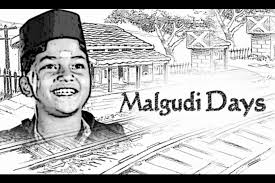
A novel that was made into a film by Vijay Anand

Greene loved the novel, “Swami and Friends,” found a publisher for it in London, and so launched India’s most distinguished literary career of recent times, that of Rasipuram Krishnaswami Narayan.

Rasipuram Krishnaswami Iyer Narayanaswami, better known as R. K. Narayan, became one of India’s most prolific authors.

R.K. Narayan was born in 1906 in Madras (now known as Chennai, Tamil Nadu), British India, to an ordinary Hindu family. He was raised in the city of Madras and in the city of Mysore, India, where he attended the prestigious Maharaja’s College.

Because his mother was sick and his father was a teacher who was often away, Narayan was raised in Madras by his grandmother and uncle. Narayan’s grandmother sparked his interest in language and humanity. He claims that the Christian chaplain’s mockery of the Hindu gods during his time at the Christian Mission School ultimately led him to embrace Hinduism.

In 1930, Narayan earned his diploma from Maharaja’s College in Mysore. He tied the knot in 1934, but his wife Rajam passed away in 1939 from typhoid. He never married again. Hema was his only child.

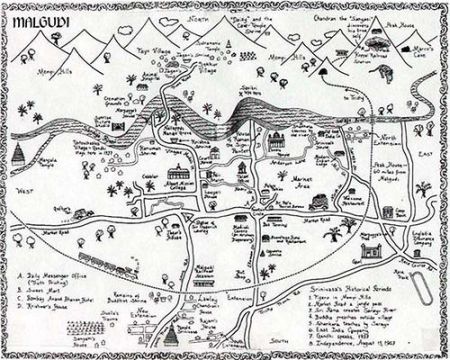
the town called Malgudi

With his first novel, Narayan fabricated a small southern Indian town called Malgudi, an entirely fictional urban city in Southern India. Critics later likened this town to the imaginary county Yoknapatawpha, invented by William Faulkner. Faulkner set most of his novels in this mythical city. Like Narayanan, Faulkner’s novels were also grounded in compassionate humanism and celebrated the humor and energy of ordinary life.

The map of Malgudi – https://churumuri.blog/2011/06/09/where-is-malgudi-where-we-all-wish-we-lived/

During my tenure with a foreign airline in Kochi, my wife and I often visited a small market near Kakanad. Those were the days of extreme power crisis in Kerala, perennial power-cut. When we did have power, it was low-voltage. So, the market, which sold mainly woven baskets, ropes, and other kinds of quaint merchandise, lit up by hurricane lanterns, had an aura of time gone by.

I promptly named the market Malgudi.

the troika of Indian authors

The troika of R. K. Narayan, Raja Rao, and Mulk Raj Anand was the leading English-language writers of India. My personal choice was precisely in this order; at times, Mulk Raj Anand held second place, but R. K. Narayan was always my first choice. Probably because the language he used and the description of the settings of his stories were all very South Indian, this is something that I could easily relate to, the primary reason being that I am South Indian! Also, his humor was strangely Wodehousian, like if P.G. Wodehouse were a South Indian, he would probably write like Narayan. And I say this as a compliment to Narayan.

Narayan’s stories are grounded in the real world, with characters from all walks of life and various situations. As time passes, everyday occurrences become increasingly absurd due to random chance, human error, or misunderstanding. The hero is just as likely to experience good fortune as bad. The characters believe everything will work out for the best, regardless of their intentions or actions. Western goods, attitudes, and bureaucratic institutions collide in Malgudi with established norms and values. Because Malgudi accepts only what Malgudi it wants according to its private logic, the modern world can never win a clear-cut victory.

Critic Anthony Thwaite of the New York Times praised Narayan for creating “a world as richly human and volatile as that of Dickens” in his review of Narayan’s novel The Painter of Signs from 1976. The protagonist of his next book, A Tiger for Malgudi (1983), is a tiger whose holy master attempts to teach him the meaning of life. In 1987, he published his fourteenth novel, Talkative Man, to mixed reviews.

his life in while he was 80

Even as he entered his 80s, Narayan was still having books published. In 1994, he published Grandmother’s Tale and Other Stories, which Publishers Weekly hailed as “an exemplary collection from one of India’s most distinguished men of letters” because it focused on the woman who had first inspired him to write: his grandmother. For Booklist’s Donna Seaman, this collection of short stories spanning over half a century of Narayan’s career represents “an excellent sampling of his short fiction, generally considered his best work” from “one of the world’s finest storytellers.”

his quotes

In his own words, Narayan once said, “Novels may bore me, but never people.”

Some of his other quotes were:
“life is about making right things and going on..”
― R.K. Narayan

“You become [a] writer by writing. It is a yoga.”
― R. K. Narayan

“The difference between a simpleton and an intelligent man, according to the man who is convinced that he is of the latter category, is that the former wholeheartedly accepts all things that he sees and hears while the latter never admits anything except after a most searching scrutiny. He imagines his intelligence to be a sieve of closely woven mesh through which nothing but the finest can pass.”
― R. K. Narayan

“To be a good writer anywhere, you must have roots both in religion and family. I have these things. I am rooted.”

He would often describe some writers,

“His writing is interesting, but the writer has no roots.” ― R. K. Narayan.

Says N.Ram, chairman of The Hindu;

He didn’t leave the house much except to see his great-grandchildren. He would also show up at my home out of the blue and say, “I am giving you trouble,” while pointing at the couch. That was where he sat, holding his walking stick. As a matter of fact, I can still picture him here.

The Southern Spice at the Taj was always a go-to for us. He had his preferred table and order (usually a dosa or appam) down to a science. In terms of nutrition, he was highly self-controlled. When he ate, he wouldn’t have anything to eat or drink beforehand.

Though his son-in-law has diabetes, he never experienced any of its symptoms. However, he had a soft spot for sweets, especially chocolate and Indian candies. He’d scour the house for treats when he got hungry late at night.

His stories always had an O. Henry-like twist at the end.

AMONG THE BEST-RECEIVED OF NARAYAN’S 34 NOVELS ARE:

  • The English Teacher (1945),
  • Waiting for the Mahatma (1955),
  • The Guide (1958),
  • The Man-Eater of Malgudi (1961),
  • The Vendor of Sweets (1967), and
  • A Tiger for Malgudi (1983).

Narayan also wrote several short stories; collections include

  • Lawley Road (1956),
  • A Horse and Two Goats and Other Stories (1970),
  • Under the Banyan Tree and Other Stories (1985), and
  • The Grandmother’s Tale (1993).

In addition to works of nonfiction (chiefly memoirs), he also published shortened modern prose versions of two Indian epics, The Ramayana (1972) and The Mahabharata (1978).

Narayan passed away on May 13, 2001, in Madras (Chennai), the city of his birth.

sources

Idly-Sambar, a South Indian delicacy? Nah!

Think idly-sambar, and what image pops up in your head immediately?

Yes, the logo of Nalla Madras has eight excellent, fluffy idlis, vadas, chutney, and sambhar.

Nalla Madras logo

And where would you find this heavenly breakfast?

“Go to any self-respecting place serving tiffin, I say” would be a Subramaniam’s answer.

Well, if you asked a Kapoor, the answer would be, “Go to any Madrasi hotel bhai.”

Peoples of any state South of the Vindhyas were Madrasis to my brethren living in the North of the Vindyas. We in the South would refer to those north of the Vindhyas as Hindi-kaaranga (Hindi wallahs).

I’m talking mid-70s up until late90s.

Each was the object of ridicule for the other. I can’t blame the people. Hindi films showed South Indians as comical figures with a tuft and dhoti (think actor Mehmood). Tamil films portrayed our North Indian brethren as merciless, fat, usually cast as pawn brokers, speaking pidgin Tamil.

Thanks to A R Rehman and the RRRs and PS1’s and the internet, and general increased awareness, such terms are no longer in vogue, which is fantastic. The Kapoors and the Sharmas know that Tamil Nādu is different from Karnataka, which is different from Kerala, which is different from Andhra, and so on.

Wait, what? There are two Andhras now? What’s the other one called? Oh yes, Telangana.

Rombo confusing saar.

Now going back to idly-sambhar. Supposing you had a reporter from a popular South Indian newspaper stop you on the street in a busy Chennai intersection at a traffic light and ask you.

“Sir, do you know from where did the idly and sambar originate?” You would probably look at the guy weirdly and ask if his head is screwed in the right place.

If the reporter persisted, you would probably turn on the most indignant glare and reply,

“C’mon bro, everyone knows that idly-sambar is from Chennai and is a very popular all over the South and now in the North of India too.”

Ding Ding – correct answer! This is what you would expect to hear.

Instead, the reporter would smash it right back into your forehand with a smirk.

“You are wrong, sir.”

You start to react indignantly, but suddenly you hear a lot of honking behind you, spiced up with some cuss words questioning your parentage, etc., and you suddenly realize the light has turned green and you have been holding up the traffic.

So, you speed away, shaking your head and punching the air. If you were on a motorcycle or scooter, that is.

Difficult to punch the air inside a car, especially if you are driving a car like the Maruti 800.

All this spiel to just talk about the origins of the idly and sambar? Yes, like they would say in Chennai.

“Build up saar.”

Idly-sambar

Let’s get to know the idly batter, er….better.

There are many theories of where the humble idly originated.

According to food historian KT Acharya, the chef employed by a Hindu-Buddhist king of Indonesia may have been the mastermind behind the invention of idly and was the person responsible.

Acharya mentions an Indonesian dish called kedli, which, according to him, is like an idly. The chef must have pinched this recipe, changed the ratio of the ingredients and shape, and proudly presented it to the king.

“O Mighty One, I present to you, my culinary invention, the Idly .”And the king must have awarded the chef a thousand gold coins. It might have turned into a thousand lashes if some jealous sous-chef ratted to the king that it’s just a rehash of the kedli.

Since this is not mentioned anywhere in the history books, I presume the chef neatly pocketed the thousand gold coins and must have had a wild night with his mates.

Yet another theory suggests that South India and Arabia had a long-standing trading relationship well before the arrival of the prophets; Arab traders settled in South India and made certain rice cakes that were later recognized as idlis.

Yet another theory claims that the idly is a version of the Ida. This dish came to South India in the 10th century CE when the silk-weaving community of Saurashtra settled in Tamil Nadu.

I would go with the idly from Indonesia theory. Why? Just simbly ….did I just give away my Kerala roots?

Now to dive into the origins of sambar.

His Highness Shahu Maharaj

According to one version of a legend, the souring agent called ‘Kokum,’ a tropical fruit used mainly in Western India, ran out while a king named Shahu Maharaj, who owed allegiance to Sambhaji Maharaj, son of the great Maratha warrior Shivaji Maharaj, was preparing a famous Maharashtrian dish with lentils called ‘Amti.’

The king substituted tamarind for the ‘Kokum,’ and bingo, the sambar, was born.

Why would the great king Shahu Maharaj don an apron and go to the kitchen to prepare Amti when he had thousands of vassals waiting on him hand and foot? I don’t know.

My guess is it must have gone on like this.

Sambaji Maharaj: “I feel like eating some Amti today. Ask the royal cook to prepare some Amti.”

After about ten minutes, the shivering royal cook said, “A thousand apologies, O mighty one, we are out of kokum.”

A less benevolent king might have said, “What, no kokum? All you must do is cook, and you can’t keep track of your pantry stocks?” “Off with his head.”

However, Sambaji Maharaj was a kind ruler who thought outside the box.

“Never mind, add tamarind instead,” said Sambaji Maharaj, and voila, a new dish was born.

Another legend has it that during one of Shambhaji’s visits to Thanjavur, South India, the royal kitchens created a special lentil dish they named Sambhar in his honor. For the uninitiated, Thanjavur was ruled by the Marathas, and the mighty Maratha kings visited Thanjavur off and on. The Maharaja is sure to have ended up with king-sized saddle sores at the journey’s end.

It’s a long ride on the back of a horse. Express trains take two full days to complete the journey, giving you an idea of the distance involved. Someone must have come up with a salve to get rid of a sore behind, but that’s another story for another blog.

Kottu, a dish described in Tamil literature, is often viewed as the ancestor of sambhar, and the concept of combining lentils and vegetables in a single dish is common in traditional Tamil cooking.

Interestingly, the lentils’ Tuvar Dal’ (also called ‘Toor’) and ‘Arhar,’ popular dals in Western India, form the basis of the Sambhar. Also, the Tuvar Dal is not widely known in Tamil Nadu, so using a Maharashtrian Dal in a well-known Tamil dish may seem strange.

So, QED.

Idly – from Indonesia
Sambar – from Maharashtra

So the next time you slurp your sambar and eat melt-in-your-mouth idlis, think of the Indonesians and the Maratha kings.

Doubt if you will, but I have said what I had to say.

Cited Sources

Dabba O Dabba

This is a small music quiz for you.

1) What is harmony?
2) What is a beat?
3) How is this connected with the dabbawallahs of Mumbai?

I finished my Senior Cambridge exams, which happened in December. This is unlike standard board exams, which are in April or so. So, I had a good 5 to 6 months before I could enroll in a college course. The axiom then was that an idle mind is a devil’s workshop. So before the shaitan could start applying for a three-phase connection to create a pattarai (Tamil word for workshop), I was carted away to ‘Amchi Mumbai,’ where my brother was posted.

So with trepidation, I set out to Bombay, as it was called at that time, bag and baggage. The plan was that I was to try out several career-oriented courses, and if I liked any, I would sign up. Since the earliest I could sign up…… I’ll leave that to your intelligence, dear reader. The experiment didn’t work so well, especially ‘the aaplla manoos’ part of the scenario, and so I was back, bag, baggage, and experience in Madras by about April.

During the four months in Bombay, I got a job as an apprentice audit clerk with a chartered accountant firm in Nariman Point. I was living with the bro in Borivli. In those days, the mid-seventies, Borivli was at the edge of civilization. Those morning train rides from Borivli to Churchgate and back were eye-opening. Everything went about in sheer harmony (clue number 1). If you rode the same compartment, you were with the same folks, and you were kind of guaranteed the same seat. Don’t ask me how. Things just happen in Bombay.

The dabbawallas

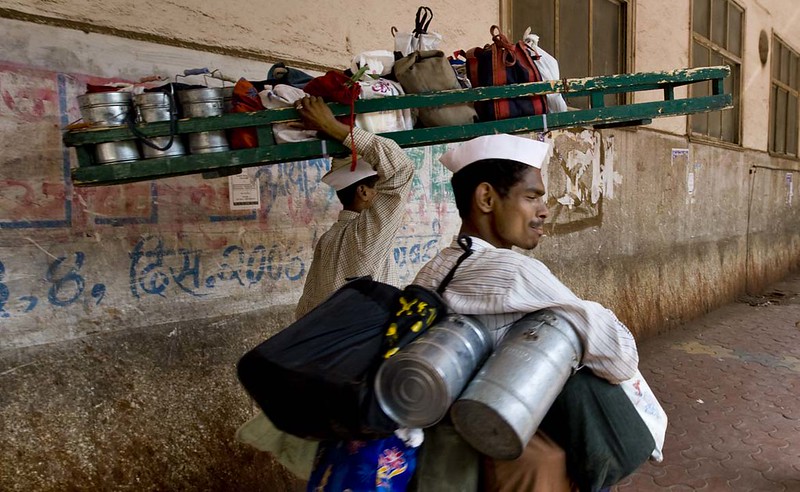
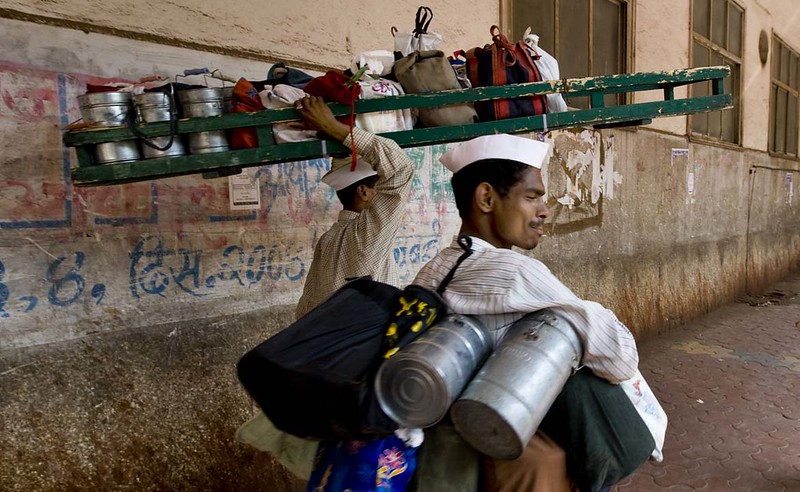
Then, I noticed these guys in off-white kurta-pajamas, with a neta cap to boot, scurrying around with long crates with similar-looking containers. They boarded the luggage compartment, and there was a minimum fuss in their operation until you crossed their path. Then all of hell would break loose.

The dabbawallahs of Mumbai

With some Sherlock Holming, I discovered that these were Mumbai’s dabbawallahs. Now that the stage is set let’s burrow in.

The dabbawallas coordinate home-cooked meal delivery to thousands of Indian office workers and have provided them a modest $3-7 monthly charge.

Some insights which you might not have known:

A lil’ bit of history

Dabbawalas first came into existence in 1890, when a Parsi banker in Mumbai’s Ballard Pier needed lunch delivered to his office. The banker asked a migrant named Havji Madhu Bacche to bring the food to his office in Mumbai. Meals were initially delivered by the many migrant workers living in Mumbai, but this changed as home cooks began preparing food for working people. Because of this, the number of dabbawalas steadily increased over 130 years.

The founding principles of the dabbawallas

The system has a moral code intertwined with the bhakti movement, called the Varkari Sampradaya, which treated all peoples as equals. This clashed with traditional Hinduism, which had varnas, where Brahmins were the masters of all the religious rites and were considered the go-betweens in the worshipper-God relationship. In the Varkai sampradaya, no one was superior or inferior; food was supreme as it was considered a common thread connecting humanity. No food was impure. So, serving food was considered an ultimate prayer.

Food is food, period. Since food is supreme, and nothing is impure, beef curry or mutton biryani is treated the same way a sattvic vegetarian meal is treated. This meant there were no religious distinctions; a Muslim’s tiffin was picked up and delivered the same way a Christian’s or an Iyer’s vegetarian meal was handled.

The lineage believes that they are the descendants of the great warrior Chatttrapati Shivaji, and the dabbawalla’s ancestors were foot soldiers of the great Maratha. Since there was no need for soldiers, they chose a profession aligned with their beliefs. “Our families believe that providing food is punya, a worthy action that brings religious virtue: work is worship. Serving food is considered a worthy action,” says Raghunath Medge, the President of the Mumbai Tiffenmen’s Association.

The dabbawallahs operate as a cooperative. This means there is no boss or subordinate. All are equal partners, including the supervisors who are called mukadams, who are elected. So there is no ‘yes sir, no sir’ culture. All are equal.

The operation

Every dabba is delivered to the client’s office on a handcart right before lunchtime. The dabbawala who initially picks up the lunch is not likely to be the one to deliver it. After being sorted, the lunches are loaded onto a train and distributed to different parts of Mumbai. Six days a week, dabbawalas ferry upwards of 130,000 lunch boxes from customers’ homes to their offices with remarkable accuracy: they navigate a congested city on trains, bikes, and autos, with no help from technology and not a mobile phone either. So Mr. Venkateswaran Iyer gets his rice, sambar, curds, and pickles while Mr. Verghese Puttemeparayil gets his parottas and beef fry while Mr. Mustafa Moideen gets his……..you get the general drift by now, right?

The way the codes work

Since the pick-up person and the delivery dabbawallah are different, how does the right dabba reach the right person? Here is where the hieroglyphs on the dabba begin to make sense.

There are four codes that are color coded on every dabba. There are other codes to narrow the delivery point further. So, in general, each letter in the color shows,
(1) the collection points,
(2) the starting station,
(3) the number for the destination station and
(4) markings for the destination – building and floor.

The codes of the dabbawalla

Let’s understand a similar code S 11 30 J 2.

So, to you and me, this is gibberish, just like music notation is to a layman. But to a dabbawalla, it is a complete address, like latitude-longitude is to a pilot or sailor. By the way, the pilot/sailor uses a GPS while the dabbawallah still relies on the codes. So blah to you, ye four stripers.

S – means Mira Road station – the point of entry in the train
11 – is Churchgate Station – the point where the dabba gets out of the train network
30 – Colaba area
J – a specific office building in the Colaba area, in this case, the Raheja Building
2 – second floor of the building

So effective is the dabbas delivery system that the President of Mumbai’s Tiffin Men’s Society claims that the dabbawallas only commit an error once every six lakh delivery. This amounts to roughly one missing delivery every two months. This is the estimate by Ragunath Medge, president of Mumbai Tiffinmen’s Association, and is not based on any scientific study.

Internationally well known

The dabbawallahs’ delivery system has become so well-known and fascinating that it has captured people’s attention worldwide. The 5,000-person cooperative is widely regarded as one of the most effective logistics networks in the world, despite its reliance on an unskilled workforce, a two-tier management system, and no technology more advanced than Mumbai’s train network. They bring in some extra cash by hosting high-ranking officials from shipping companies like FedEx and Amazon. Richard Branson, of all people, has invested a day in uncovering their techniques.

Their connection with the Royals of England

The first time Prince Charles of Wales visited India in 2003, he wanted to meet the dabbawalas, but the dabbawalas insisted on two things. They can’t inconvenience Mumbai’s two hundred thousand maharajas (customers) to meet the prince, now King, so they will meet with Prince Charles in their spare time after serving tiffin instead. Second, Prince Charles must personally meet with them. Prince Charles agreed to both terms.

The two office-bearers of the Mumbai Dabbawalla Organization, Raghunath Medge and Sopan Mare were subsequently extended invitations to the April 2005 wedding of Prince Charles and Camilla Parker. They both went to this wedding. 

They presented Prince Charles and Camilla with a sari and kurta. 

On the occasion of Prince Harry and Meghan Markle’s wedding in 2018, the dabbawalas presented a hand-woven Paithani sari, a specialty of the Indian state of Maharashtra’s Paithan region. Meghan Markle received an orange and green sari, while Prince Harry received an orange kurta, lehenga, and Maharashtrian turban.

The dabbawalas mourned the death of Queen Elizabeth II.

The present-day competition to the dabbawallas

The modern-day Uber Eats, the Deliveroos, the Swiggys, and the Runnrs of the world are being given a run for their money by the dabbawallas. Sorry for the pun; Runnr, run for the money. I just had to do it. “There’s no competition. They won’t be able to keep up with the service we provide,” says Kiran Gavande, a Lower Parel dabbawalla. “There’s only one Mumbai dabbawala.”

Now, what is the moral of the story?

-You don’t need a skilled force to make your operation a success
-You need to believe that what you do is a service to humanity and God
-You do not need a multi-tier corporate setup. Just a lateral format works
-All employees are equal. If one person slips up, the entire network is down.

Quiz answers

Like any good music, the dabbawallahs operate in harmony
Like you can predict the next beat, the dabbawallahs deliver your tiffin box on time, every time.

Jai Sri Vitthala!

Mumbai Dabbawala or Tiffin Wallahs: 200,000 Tiffin Boxes Delivered Per Day” by babasteve is licensed under CC BY-NC 2.0.

Dabba Markings I” by Meanest Indian is licensed under CC BY-NC-ND 2.0.

Cited Sources

#mumbais food     #lunchbox delivery     #food vendors     #food delivery     #mumbais dabbawalas     #dabbawalas sort     #dabbawalas feel     #clients lunch     #dabbas delivery     #professional food     #mumbai tiffinmens     #lunch boxes     #mumbai dabbawallahs     #lakh deliveries     #lunch hours