He came, he saw, he composed an unforgettable tune, and he left

For those of you who prefer to listen than read

The song Janaki Jaane, from the 1988 Malayalam movie, Dhwani, was composed and written by two gentlemen of Muslim faith, sung by a Christian, and is about Lord Rama. The lyrics are so endearing and beautifully written in Sanskrit, and it goes like this:

During our suffering, you are our only friend,
Only you can end our fear
To cross to the ocean of samsara, you are the only boat
O Lord Rama, the one who Sita knows so well

Unfortunately, so much is lost in translation.

Now take a trip back to 1936. A Jewish refugee composer, a Parsee violinist, composed a tune in the raga Shivaranjini, played every day at dawn in India and probably in the house of overseas Indians and Indophiles.

1988: The song Jaanaki Jaani was composed by Naushad, written by Yusuf Ali Kecheri, and sung by Yesudas. These men have achieved so much greatness that there is no title like Shri. or Mr. that will do them justice, so I have just referred to them with their names.

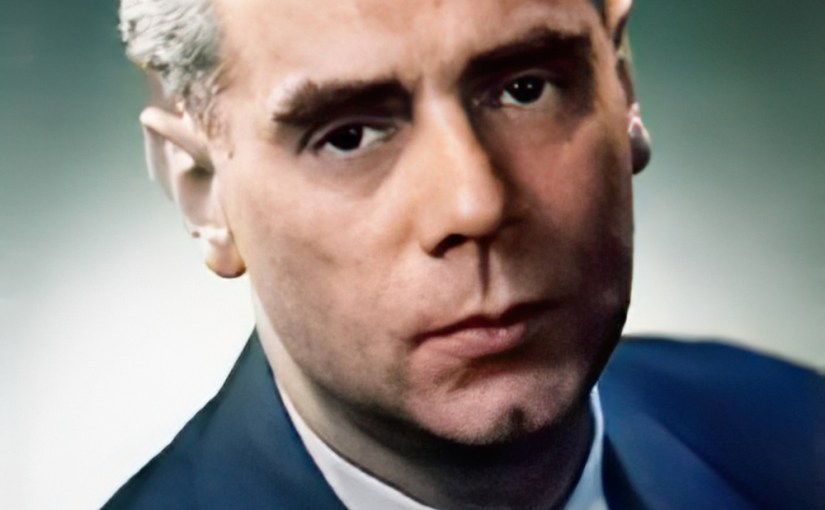
1936: This tune was composed by Walter Kaufmann, a Jew, and played by violinist Mehli Mehta a Parsi, for a radio station first founded by Professor M V Gopalaswamy, who taught Psychology at Mysore University. Some of you must have guessed it by now. It is the signature tune of All India Radio.

Mehli Mehta, incidentally, is the father of composer-conductor Zubin Mehta.

Almost eight decades have passed since the composition of this piece is based on the raga Shivaranjini. However, the lilting violin notes played over a tambura still manage to evoke a sense of longing. The signature tune was followed immediately by Vande Mataram.

There is doubt if he created this melody solely as a signature tune for AIR or was it was part of a symphony he composed. Whatever that may be, the bottom line: the music is Kaufmann’s, and Mehli Mehta played the violin. No doubts about that.

For the very few who have not heard this signature tune

Kaufmann’s early days

From 1927 to 1933, Walter Kaufmann led opera productions in Berlin, Karlsbad, and Eger, Bohemia, during the summer months. The German University in Prague accepted Kaufmann’s dissertation on Gustav Mahler in 1934. Still, he declined to accept the doctorate after learning that his supervisor, Prof. Gustav Becking, was the leader of the local Nazi youth group. So carrying a letter declining the award of a doctoral degree, he went to the post office and then to a travel agent.

“I carried this letter to the post office, went to the biggest travel agent and bought myself a ticket to Bombay with the money I had received for the operetta (which he had composed),” Kaufmann recalled in his autobiography, which was based on memoirs recorded in 1934 but written up in the 1970s when he was a Professor of Musicology at Indiana University, Bloomington.

He arrives in Bombay

Boarding the Conte Verde in Venice, he arrived in Bombay, where he stayed with a friend until he could secure more permanent housing. His first wife, Gerty Herrmann, a French instructor and niece of Franz Kafka, joined him shortly.

It is reported that someone asked him why Bombay? He replied it was the easiest place to get a visa!

After arriving in Bombay, his first exposure to Indian music took him by surprise. He soon realized that Indian music would take some time to learn, so he decided to sell his return ticket to fund his stay. Regardless, he could not return to Europe while fascism was in power, so he remained in India for another 12 years until the end of World War II. India ended up saving both his and his wife’s lives. They had a daughter whom they named Katherina.

Kaufmann adapted to Indian culture in a way few of his fellow ex-pats could. A low salary and a position as director of European music at All India Radio (AIR) in Bombay awaited him in 1935. From 1937 to 1946, Walter Kaufmann lived in India and served as AIR’s music director.

When the All-India Radio station first went on air in 1939, he wrote an opera called “Anasuya” to celebrate the occasion. Although it had a European theme, the story was set in a fantastical Maratha kingdom.

Several people, including Mehli Mehta, under his leadership, founded the Bombay Chamber Music Society and established the Bombay Chamber Music Society, which performed every Thursday. Kaufmann taught piano in Bombay; he was Zubin Mehta’s teacher.

His stint in Bollywood

Kaufmann had a stint in Bollywood as well. Together with Mohan Bhavani, Kaufmann collaborated on films for Bhavnani Films and Information Films of India. To know more, please click here.

His works include operas, symphony orchestra pieces, ballet scores, chamber music compositions, and film scores. Among his works are ten string quartets, three piano trios, an Indian piano concerto, six Indian miniatures, and the Navaratnam.

His notable works include Musical Notations of the Orient: Notational Systems of Continental, East, South, and Central Asia and The Ragas of North India, and The Ragas of South India: A Catalogue of Scalar Material.

While the Western world has largely forgotten the Czech Jewish composer, his music is still widely prevalent in India. This concert is anchored by Kaufmann’s extraordinary life and the rediscovery of his concert works.

His archives

His works are archived in the Moldenhauer Archives in Spokane, Washington; the Houghton Library at Harvard University; and the Kaufmann Archive in the William & Gayle Cook Library for Music at Indiana University. According to an essay by Agatha Schindler, the Bombay Chamber Music Society performed several of his pieces from this period, including the Navaratnam, Ten String Quartets, Three Piano Trio, Indian Piano Concerto, Six Indian Miniatures, and Indian Concerto.

Friends in high places

Despite his many scholarly publications, and friendships with prominent thinkers like Albert Einstein, Franz Kafka, and Max Brod, Kaufmann is often overlooked when discussing the history of Indian Jewry or European Jews in India.

Albert Einstein’s letter to Walter Kaufmann – Source

Synagogue President in New Delhi and Bene Israel Indian Jew Ezra Kolet founded the Delhi Philharmonic. The New Delhi Philharmonic Orchestra played a previously unheard piece by Walter Kaufmann in 1995 at a symposium on Jewish exiles in India hosted by Dr. Georg Lechner of the Max Mueller Bhavan. From all accounts, Kaufmann spent a few months in Madras, India, taking in the local culture and music. The music by Kaufmann was exotic and layered.

Walter Kaufmann died in 1984, but his signature tune is still played every morning.

Sources:

https://www.thehindu.com/society/radio-reminiscences-the-golden-years/article34840785.ece
https://www.thehindubusinessline.com/catalyst/tuning-into-broadcast-history/article7765864.ece
https://www.asianjewishlife.org/pages/articles/AJL_Issue17_Winter2016/AJL_Issue17_The-Walter-Kaufmann-Story.html
https://thejewsofindia.com/remembering-the-jewish-refugee-who-composed-the-all-india-radio-signature-tune/
https://runtheyear2016.com/2019/08/19/who-is-the-composer-of-all-india-radio-tune/ 4
https://newsonair.gov.in/News?title=Walter-Kaufmann%2C-who-worked-as-Director-of-music-at-AIR%2C-Bombay-from-1937-to-1946%2C-composed-Akashwani%26%2339%3Bs-signature-tune&id=428199
https://holocaustmusic.ort.org/resistance-and-exile/walter-kaufmann/
https://www.thebetterindia.com/169757/all-india-radio-tune-composer-archive-history-kaufmann/
http://www.e-pao.net/epSubPageSelector.asp?src=The_Jewish_connection_to_AIR_Tune_By_Kamal_Baruah&ch=leisure&sub1=EI
https://en.wikipedia.org/wiki/Walter_Kaufmann_(composer)
https://maddy06.blogspot.com/2008/02/air-signature-tune.html
https://www.sweatlodgeradio.com/who-composed-the-all-india-radio-signature-tune/
https://qz.com/india/287319/remembering-the-jewish-refugee-who-composed-the-all-india-radio-caller-tune/
https://schoolofmusic.ucla.edu/event/from-india-to-indiana/

How Madras A and Madras B went on AIR

The Madras Station of All India Radio

My love affair with the radio

As the youngest child growing up alone, the next sibling being ten years older and living abroad, the radio was my constant companion. The radio was my first music guru, and you will be surprised, it still is my favorite media device.

Cyclones were constant visitors to the east coast of India. The coast of Madras would get a direct blow sometimes, but most time, we would escape the direct effects as the ‘eye’ had a mind of its own. Andhra Pradesh, the unified version, would get the most out of it. Again, I’m vacillating here. The topic is All India Radio. I was beginning to say that weather bulletins would often be issued over the radio during the cyclone threat. So between bulletins, Madras A would intersperse the bulletins with fantastic programming. So, I would get up red-eyed, glued to the radio all night. Hey, those are some great opening lines for a song!

Early days

It is believed that in 1920, the first regular broadcasting station in the world went on air in Pittsburgh, United States. On February 23, 1920, the Marconi Company transmitted a program from Chelmsford, England. The BBC began broadcasting regularly in November 1922, with John Reith at the helm.

The genesis of the Madras AIR

In Chennai, The Madras Presidency Radio Club was formed less than two years later, on May 16, 1924, by a group of dedicated amateurs led by C.V. Krishnaswamy Chetty. It broadcasted nightly music and talk show that lasted for two and a half hours (and a morning transmission on Sundays and holidays). Beginning on July 31, 1924, it transmitted daily with a 40-watt transmitter. A 200-watt one eventually took its place. The club met in Holloway’s Garden, Egmore.

When financial difficulties forced its closure in October 1927, it donated its transmitter to the Madras Corporation, which began broadcasting regularly from Ripon Building on April 1, 1930.

The Marina, Robinson Park, People’s Park, and the High Court Beach each had six loudspeakers tuned to the sunset broadcasts. Fourteen Corporation schools also received small indoor receiving sets.

The official launch of AIR

This continued until All India Radio’s official launch on June 16, 1938, when the station was taken over by AIR. Lord Erskine was the Governor of Madras Province when he inaugurated the AIR station on Marshall’s Road in Egmore. An inaugural naadaswaram concert was performed by the great Tiruvengadu Subramania Pillai. On that same day, Smt. D.K. Pattamal, the doyen of Carnatic music, performed too. On the second day, Vidwan S. Rajam performed with Madras A. Kannan on mridangam and Govindasami Naicker on the violin.

On AIR’s 50th anniversary, S. Rajam performed a concert accompanied by the same musicians and, per the wishes of AIR, he sang the same songs he had sung fifty years ago at the inauguration!

AIR was lucky to have Victor Paranjoti as its first director when it opened its Madras station. Legendary Indian Conductor Victor Paranjothi was the first Indian accompanist of the MMA’s choir. He knew a lot about Western music. He included Western music—performed mainly by Anglo-Indians—in the show. Back then, Handel Manuel hadn’t yet joined AIR.

Paranjoti cared deeply about music and about keeping standards high. In the past, he would travel to listeners’ homes to collect first-hand comments. Mylapore beach, T’Nagar Park, and the Marina across from the Fort were once bustling with listeners tuning in to AIR broadcasts at kiosks. Overall, the high standards of broadcasting can be totally attributed to Paranjoti.

As early as the 1940s, AIR had its in-house auditioning system. Music supervisors were hired to assist the station directors in auditions, rehearsals, and training of artists. Vidwan S. Rajam was the music supervisor for AIR Madras from 1944 until his retirement in 1977.

The move to AIR’s present location

On July 11, 1954, AIR relocated to its brand-new building on South Beach Road (now Kamarajar Salai) in the San Thomé neighborhood. The new studios’ first broadcast began at 6:55 a.m. with T.N. Rajaratnam Pillai playing a brief alapana (exposition) in the Todi raagam.

In 1961, at AIR’s silver jubilee celebration, Krishnaswamy Chetty, one of the founders of the Madras Presidency Radio Club, was honored for his groundbreaking contributions to broadcasting in Madras with a commemoration award.

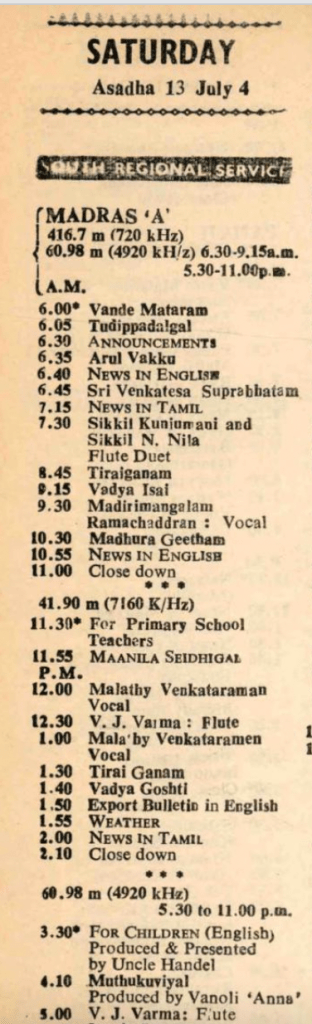
The programming of All India Radio, Madras A, July 4, 1970. Look out for Uncle Handel and Vaanoli Anna (Radio Brother) in my subsequent blogs.

The language controversy

The Trichy and Madras broadcasting station used to announce themselves as Vaanoli Nilayam (Tamizh for a radio station). On April 25, 1942, the D.G. of AIR ordered all stations to stop translating ‘All India Radio’ into any of the Indian languages. No one knows what prompted that order from the Ministry. In 1946, G.T. Sastri, the director of Trichy’s radio station, wrote to the Director General, asking for permission to refer to his facility as ‘Vanoli Nilayam,’ and that’s where the discussion ended. However, In December 1957, the D.G. communicated the Ministry’s decision to change all Hindi and other Indian language announcements to “Akashvani,” while keeping “All India Radio” for use in English.

The director of the Trichy station reported to the D.G. that the order had been carried out. Still, he also mentioned that there had been violent protests and even hunger strikes in Madras Province against using Akashvani. The director of the Trichy station was informed that the name Akashvani was in the Kannada language and not in Hindi; the original name of the Mysore station was Akashvani. However, the agitators were not appeased.

Govind Vallabh Pant, the then Minister of Home Affairs for India, discussed the issue with K. Kamaraj, chief minister of the Indian state of Tamil Nadu. The Ministry of Communication eventually confirmed that the term ‘Vaanoli” could be used interchangeably with “radio” without any qualms.

In May 1982, the Hindi Advisory Committee of the Ministry of Information and Broadcasting brought up the contentious issue again by suggesting that All India Radio change its name to Akashvani for all its programming, including its Hindi and English offerings. The Minister of Information and Broadcasting, Vasant Sathe, unaware of the tumultuous past, agreed with the suggestion. Chief Minister M.G. Ramachandran raised the issue with Prime Minister Indira Gandhi, who was abroad at the time because he expected serious trouble in Tamil Nadu. And she immediately called Sathe to cancel his directives and return things to the way they were.

Sources:

The man behind the growth of Radio Ceylon

Most of you who lived in India from the 60s until the late 70s must have tuned into Radio Ceylon to listen to film songs. Some of you must have been die-hard fans of that silken voice of Ameen Sayani, presenting the Binaca Geet Mala, a countdown of the top songs from Hindi films. 

Then there was B.H. Abdul Hameed of the Tamizh Sevai, with Tamil film songs. Radio Ceylon even reached remote points in Assam’s tea estates! For the budding rock stars of India, Radio Ceylon was the go-to source for their favorite music. 

Advertisers in the sub-continent flocked to Radio Ceylon. Their top salesman (back handed compliment) was an Indian minister, Balakrishna Vishwanath Keskar, also known as B. V. Keskar.

Keskar was the Minister for Information and Broadcasting from 1952 to 1962 who, amongst other things, banned filmed music from All India Radio, saying that it was morally corrupting.  

Keskar also prohibited the harmonium, saying that it was a Western instrument. Until 1972, the harmonium was banned entirely from the Radio. 

To Keskar’s credit, the man in charge of the Radio pre-independence, Lionel Fielden, a senior BBC producer and then Controller General of Radio, had a similar opinion.

The ban on the harmonium came about after John Foulds, an expert on Western music, said that the instrument was ill-suited to reproducing microtones, an essential aspect of Indian music. So, the harmonium was banned from All India Radio until about 1970.

Keskar hated cricket and predicted the game would die out soon since the British had quit India. He thought cricket was a British legacy and tried to ban cricket commentaries on AIR. Due to intense pressure and backlash, he relented.  

Keskar also tried to ban film music. He then relented a little bit and allowed 10% of airtime. He tried negotiating with the Motion Picture Producers Guild of India, who opposed this quota, which talks broke down, resulting in AIR stopping broadcasting film music for several years. 

BV Keskar also claimed that All India Radio was not likely to air musicians such as Kesarbai Kerkar or Omkarnath Thakur due to their high fees. As a minister, B.V. Keskar also banned the playing of folk films on Radio as he felt they did not have respect for higher culture. 

Film music had an increasing audience in India, and Keskar’s decision to prohibit it over All India Radio allowed Radio Ceylon to take advantage of this opportunity. 

Keskar would be outraged if he heard the music the film industry makes today. Still, it is ironic that some of the most iconic and memorable songs in newly independent India, made during the golden era of Hindi cinema, were once considered objectionable and would have been perhaps stifled by a draconian policy of a single man had a radio channel from a neighboring country not intervened. Filmfare magazine has described Keskar as a cunning person whose decisions were as much calculated shots to damage the movie industry’s image as they were to drive movie music from the market (August 1952 edition). Keskar believed that Indian music had become stale during the Muslim and British rule. B. V. Keskar wanted AIR to work towards the cultural growth of a young nation.

B.V. Keskar also discontinued the practice of advertising film titles along with the songs, as he felt that was marketing. Keskar was also responsible for establishing the Vadya Vrinda as a national orchestra and creating a new genre of lighter music, commissioning the Sitarist Ravi Shankar to lead Vadya Vrinda and to provide light musical alternatives to the broadcasting of classical music. Keskar was the third person to head India’s Ministry of Information & Broadcasting and had a ten-year stint at the helm, making him the longest-serving Minister in the Ministry.

The worst was in 1959, the Minister of information and broadcasting, B. V. Keskar, who is said to have had the barbaric opinion that Indian Christians should not be composing Indian music, refused to allow Anthony Gonsalves to write a piece of music for an animated movie. You can listen to Anthony in a rather painful conversation with Rajan Parrikar, a musicologist born and raised in Goa who moved to the USA in 1988 for graduate study and obtained a Ph.D. in Electrical Engineering at the University of Colorado at Boulder and currently lives in Iceland.

Rajan Parrikar in conversation with Anthony Gonsalves

.  I hate to end a blog this way but let this sting. 

Cited Sources

Anthony Prabhu Gonsalves – musician, arranger; unparalleled.

When composers Laxmikant-Pyarelal and lyricist Anand Bakshi sat down to work on the music for the film Amar Akbar Anthony, the original lyric was ‘My name is Anthony Fernandes”. After much humming and hawing, they concluded that ‘My name is Anthony Fernandes’ did not sound appealing and wasn’t rolling off the tongue well. Pyarelal suggested naming the character Anthony Gonsalves. It was his way of honoring his violin teacher, Anthony Gonsalves.

Anthony Prabhu Gonsalves was born in the picturesque coastal village of Majorda in south Goa in 1927. Jose Antonio Gonsalves, his father, was a choirmaster at Majorda’s Me de Deus church. 

Anthony studied Indian Classical Music and developed techniques for writing Indian Classical Music pieces in staff notation and harmonizing them with western music pieces. He could compose music and integrate it into a complete score for a song in western staff notation. This was the most challenging job those days since most music directors of the Hindi film industry were not familiar with Western staff notation. Pyarelal Sharma, of the Laxmikant Pyarelal duo, who is widely regarded as one of the best composers in the country, still speaks of him in awe. In 1958, Gonsalves founded the Symphony Orchestra of India, blending Indian and Western music, featuring playback singers Lata Mangeshkar and Manna Dey as soloists. Lakshmikant and Pyarelal, who were on top of the game as composers in the Bombay film industry, played in the symphony as instrumentalists.  Such was the respect the duo had for Anthony Gonsalves. 

Every Sunday, his apartment at Sushila Sadan on Bandra’s Linking Road was open to eager students, two of whom – R.D. Burman and Pyarelal – would go on to become significant composers themselves. Unlike many of his Goan contemporaries, whose western-trained ears couldn’t quite wrap themselves around the sinuous lines of Hindustani tunes (though they could play them well enough from a score), Gonsalves developed a deep love for raga-based music.

He also collaborated with Anil Bishwas, Gulam Haidar, Shyam Sundar, Naushad, Sachin Dev Burman, Ghulam Mohammed, Salil Chowdhary, and Madan Mohan, among others. 

Anthony’s psyche was harmed by an incident in 1959, from which he never fully recovered. B.V. Keskar, the then-Minister of Information and Broadcasting, refused to let Anthony compose a score for an animation film because Keskar held the barbaric view that “Indian Christians should not even be provided with jobs.” This was the same person who prohibited harmonium use on All India Radio. 

Anthony moved to Syracuse, New York, in 1965 to join the university’s music department. He became a member of the American Society of Composers, Publishers, and Authors after moving to the United States in 1958. There, his son Kiran and daughter Laxmi were born. He returned to India in the early 1970s and settled in his ancestral village of Majorda. He never worked in the music industry again. All the symphonies and orchestral scores he wrote and conducted during his career are housed in a rusted trunk. Symphony in Raga Multani, for example, is a testament to his lifelong love of Indian Classical Music. He still hopes that they will be revived and replayed someday.

At the 41st International Film Festival of India in Panaji, Gonsalves received the Karmaveer Puraskar, a national people’s award, at 83. 

Anthony Gonsalves died on January 18, 2012, at 84, in Goa. 

Arrangements:

Hum Aap ki ankhon mein -Pyaasa

Baithi Hoon Teri Yaad Ka – Village Girl’ 45 – Shyam Sundar  |  Dil Jalta Hai to Jalne De – Pahli Nazar’ 45 – Anil Biswas  |  Zamaane Ka Dastoor Hai Yeh – Lajwaab’ 50 – Anil Biswas  |  Chhalak Raha Hai – Dholak’ 51 – Shyam Sundar  |  Seene Mein Sulagte Hain Armaan – Taraana’ 51 – Anil Biswas  |  Yeh Raat Yeh Chandni Phir Kahaan – Jaal’ 52 – SD Burman  |  ‘All Songs’ – Do Beegha Zameen’ 53 – Salil Chowdhary  |  Hum Aapki Aankhon Mein – Pyasa’ 57 – Sd Burman