
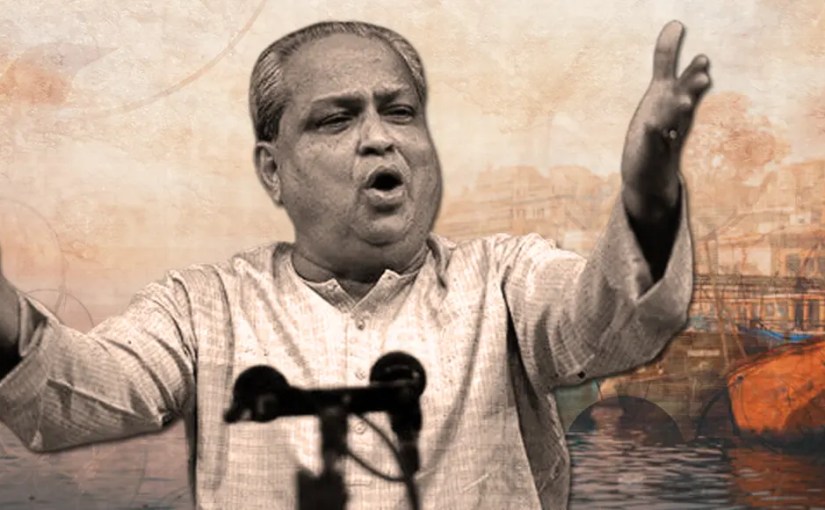
The one-lung celestial singer

I am dividing this blog into two parts – the mythological part and the fact-checked part.

I can already sense a few hackles rising.

“So, do you say that all mythological books are not based on facts?” “What about the Ramayana, the Gita, the Bible?”

Dear Sir/Madam – a thousand apologies – let’s leave all this for the stringent right, okay va?

Mythology

A child prodigy whose starts to sing as early as five is the apple of everybody’s eye. The child grows up and becomes a young adult.

This young man has a passion for seeking meaning. A meaning for his existence in all things unseen. His explorations connect him with a group of wandering minstrels of Bengal, the Bauls.

Who are the Bauls? The actual term ‘Baul’ means madman. In this context, there is a group or a band of singing minstrels who are crazy about spirituality and God. There are elements of Sufism, Vaishnavism, and Tantra, and they also inhabit areas of West Bengal, Assam, and Bangladesh.

Returning to our young man, he decides to go with the Bauls in their wandering. Just the music or the spiritual aspect would have been enough to drag him along, but with music and spirituality, it was inconceivable that our young man would have come unstuck. He stuck with them like a limpet to rock – and I don’t mean this in a derogatory way, as the word association of limpet is not exactly complimentary.

Long story short – the young man, who is not so young – roughened by the complete absence of creature comforts – remember this was not a trip on a mobile home hitched to an SUV. This was the real McCoy of wandering. Apart from heavily calloused feet and tousled, matted hair, the not-so-young man had contracted a raging infection.

Tuberculosis

The myth within this mythology is that the infection, the disease, caused him to return to ‘civilization.’

As luck would have it, the doctors had to remove a damaged lung to cure him of tuberculosis. Many would have just resigned to fate and plod along till the end of their time, but not the not-so-young man. He continued with his singing. He changed his style of singing to short phrases instead of long aalaps. If anything, he got more fans.

The name he was most popularly known as – Kumar Gandharva.

FACT: Kumar Gandharva: A Musical Genius of India

Kumar Gandharva was a legendary Indian classical singer known for his unique style and innovative approach to classical music. Born as Shivaputra Siddharamayya Komkali on 8 April 1924, he was a revered figure in the world of Hindustani classical music and is still remembered today for his contributions to the genre.

Gandharva’s musical journey began at a young age when he showed an early interest in music and began singing bhajans at the age of five. He went on to study under several renowned music teachers and eventually developed his own style, which combined traditional classical music with elements of folk and devotional music. This fusion of styles gave his music a unique and captivating quality that set him apart from other classical singers of his time.

One of the most distinctive aspects of Gandharva’s music was his use of a unique, nasal voice, unlike anything in classical music. Despite being criticized by some traditionalists, Gandharva’s innovative style was embraced by audiences worldwide and helped to bring classical music to a broader audience.

In addition to his musical contributions, Gandharva was also known for his devotion to his art and deep spiritual connection to music. He was deeply influenced by the Bhakti movement, which emphasizes the individual’s devotion to God, and this spiritual dimension is evident in the emotional intensity of his performances.

Despite his success and popularity, Gandharva’s life was challenging. He struggled with health issues throughout his career, including tuberculosis, eventually leading to his death at 63. However, despite his early passing, his legacy lives on, and he is remembered as one of the greatest classical musicians of all time.

In conclusion, Kumar Gandharva was a musical genius who revolutionized the world of Hindustani classical music with his unique style and innovative approach. His devotion to his art and deep spiritual connection to music has made him a beloved figure in classical music. His contributions will continue to be remembered and celebrated for generations to come.
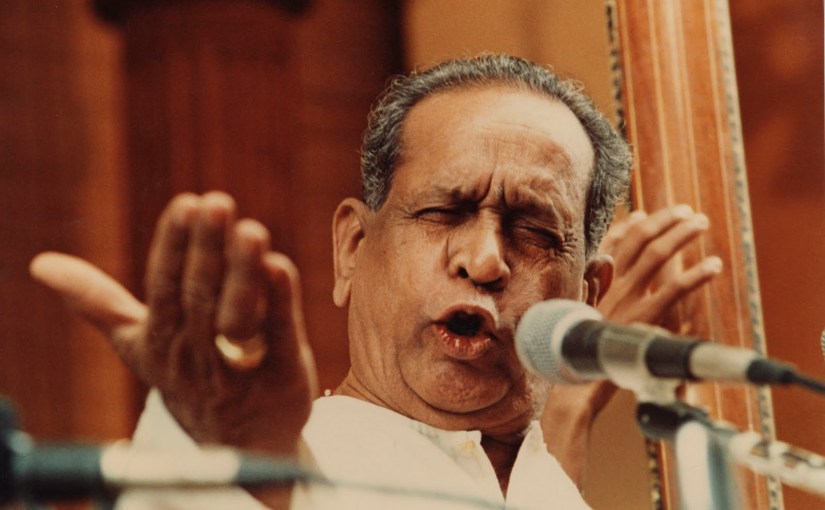
A boy who ran away from home

The family sat down for lunch. All were being served. An eleven-year-old boy wanted ghee (clarified butter), but was refused. He created a scene and walked out of the house.

Everyone thought he would return once the hunger pangs started gnawing at his innards.
The boy had other ideas. He headed to the nearest railway station and boarded a train to Gwalior with not a penny in his pocket. When the train conductor went around, checking for free boarders, this boy would sing songs of Panditrao Nagarkar and Narayanrao Vyas and impress them. Most Maharashtrian folks used to be connoisseurs of popular music, so he got away and rode for free. Some conductors did not appreciate music, and they handed him over to the authorities. He did spend a few nights in jail!

Reach Gwalior or bust

So, long story short, it took the boy nearly two months to reach Gwalior.

Why Gwalior? Because Gadag, where the boy lived, had no music teachers. And he wanted to sing like Abdul Karim Khan Sahib, whose song he first heard on a gramophone recording. Gwalior was famous for the arts. It was also where Ustad Hafiz Ali Khan sahib lived, the father of Amjad Ali Khan, the renowned sarod player. Gwalior used to serve one meal for all who were learning music, obviously as an encouragement to the arts. That kept him alive. The rest of the time, he was with his guru.

This is how the journey began for Bhimsen Gururaj Joshi, who later became the renowned Pandit Bhimsen Joshi, the first Indian singer to win the Bharat Ratna (2008), who emerged as the face of Khayal Gayaki.

Once during an interview with Gulzar, the famous lyricist of Indian films, about why he walked away from home after being denied a spoonful of ghee, the maestro explained that the ghee was just an excuse to walk away from home.

Kolkata, here we come

When he realized that Hafiz Ali Khan sahib was busy traveling to various cities for concerts, the young Joshi took off to Kolkata and landed as a domestic servant to Pahari Sanyal, a Bengali singer, and film actor. Joshi used to listen to all the rehearsals and grab whatever he could learn.
In later years, Pandit Bhimsen Joshi was singing at a conference of musicians, and Pahari Sanyal was in the audience. Pahari Sanyal had no clue that this was the same boy, now a famous artist, who was once a domestic help in his house. After the concert, Pahari Sanyal went over to congratulate Pandit Bhimsen Joshi for an outstanding recital. The maestro then told Pahari Sanyal that he was the same Joshi, a domestic help at the Sanyal’s household! I am sure many would have given an arm and a leg to glimpse Pahari Sanyal’s face at that moment!

Anyway, getting back on track, the middle-aged Joshi headed to Delhi, where he heard of the father and uncle of Ustad Nasiruddin Dagar, to learn the dhrupad singing style. He had no money to pay fees, so he headed to Jalandhar to meet with Bhakt Mangat Ram, a visually handicapped singer, to learn dhrupad.

Life takes a full circle

At the Hariballab conference, he came across Vinayak Rao Patwardhan, who asked him what his purpose for all this travel was. Almost akin to the story of the musk deer searching the forest for the origin of the scent, when all along the deer had it on its tail, Patwardhan told him that there was Sawai Gandharva a teacher near his very village at Gadag, in the Dharwar district. At this point, his life took a full circle, and returned to his native land and enrolled in the Gandharva Mahavidyalaya, headed by Sawai Gandharva, a disciple of Ustad Abdul Karim Khan, the singer who inspired the young Joshi to start his music career.

Kirana Gharana

Pandit Bhimsen Joshi followed the aesthetics of Kirana Gharana. The word Kirana comes from the village near Sonepur/Panipat, where the mythological character Karna was born. Karna was mispronounced as Kirana. According to Pandit Bhimsen Joshi, the gharana tradition is like Karna, the warrior prince; do or die!

Kirana Gharana boasts of a proud lineage of artists; Roshanara Begum, Ustad Kale Khan, incidentally, her father, Ustad Vilayat Khan sahib, and many others.

His Bollywood foray

Pandit Bhimsen Joshi abhorred the title ‘pandit’ as he felt too many half-baked musicians started calling themselves pandit. He much preferred to be called Bhimsen Joshi without any honorifics.
He wasn’t a film music fan. His forays into the industry were rare. One such occasion was when he sang for the film Basant Bahar.

When Manna Dey had the jitters!

The scene was a competition; the resident Ustad’s voice was Pandit Bhimsen Joshi, and the hero Bharat Bushan’s voice was Manna Dey. In true Bollywood style, the hero could never lose a competition, so it comes down to Manna Dey being pitted against Pandit Bhimsen Joshi and Manna Dey winning. Manna Dey recalls how petrified he was and flatly refused. It was Pandit Bhimsen Joshi who encouraged and encouraged him to sing. The sheer magnanimity and the absolute confidence in the art!

Fast cars were his passion

Besides being an outstanding singer, Pandit Bhimsen Joshi was a car aficionado. He used to drive fast and was a mechanic too! When his car broke down, he would repair the vehicle himself. He had a Fiat, a Ford, and later a Mercedes. He used to travel mainly by air and by train, but certain towns did not have an airport, and train ticket reservations were difficult. So, he bought a used car, hired a driver, and the whole family set out to Mysore for a Dusherra concert. The driver, who barely knew driving, and didn’t have a license, plunged into a 40ft ravine on his way back. Fortunately, Pandit Joshi and his family survived the crash without a scratch. Pandit Joshi attributed it to the quality of cars then. He then decided to drive his cars – the motto was that if he were fated to die in a road crash, it had better be when he had his hands on the steering wheel!

Some highlights

  •  HMV released his first album of devotional songs in 1942.
  •  He was the first musician from India whose concerts were advertised through posters in New York City, United States.
  •  Pt. Joshi is remembered for his famous ragas, including Shuddha Kalyan, Miyan Ki Todi, Puriya Dhanashri, Multani, Bhimpalasi, Darbari, Malkauns, Yaman, Asavari Todi, Miyan Ki Malhar, and others.
  •  He was instrumental in organizing the Sawai Gandharva Music Festival annually as a homage to his guru, Pandit Sawai Gandharva.
  •  In 1998, he was awarded the Sangeet Natak Akademi Fellowship.
  •  Subsequently, he received the Bharat Ratna, India’s highest civilian honor, in 2009.

The maestro passed into eternity on January 24, 2011. He was 88

His thoughts on modern-day singers

When asked what he thought of the modern-day singers, he said they were a talented lot, intelligent and worldly-wise, but none of their renditions lived in the ears of the listeners for long. They are heard and forgotten.

Now that’s a pretty broad brush he used there. Dear reader, what do you think?