

The Stationary Camera: Why Time Doesn’t Exist (And Einstein Agrees with the Rishis)
You know that feeling when you look at a time-lapse video of the night sky?
The stars are streaking across the heavens, the Milky Way is spinning like a giant cosmic pinwheel, and the earth seems to be on a wild carousel ride. But the camera? The camera sits there—rock solid, unmoving, silently watching the show.
We usually think we are the ones moving through time, getting older, rushing to meetings, and chasing deadlines. But what if we’ve got it backwards?
What if Time doesn’t exist? What if we are the stationary camera, and it’s the environment that is whizzing past us?
This isn’t just a late-night “hostel terrace” theory. It’s a place where modern physics and ancient Vedanta decide to have a cup of filter coffee together.
The Photographer’s Philosophy
Let’s look at this “Stationary Camera” theory.
In a time-lapse, two things are happening:
- The Changing: The stars, the clouds, the rotation of the earth.
- The Changeless: The camera lens that captures it all.
If the camera started moving around, the video would be a blurry mess. The only reason we see the movement of the stars is because the observer is still.
Now, apply this to your life. Your body changes (grey hairs appear, knees creak). Your mind changes (happy today, annoyed at the traffic tomorrow). The world changes (new governments, new iPhones).
But YOU—the sense of “I am”—does that ever change? The “I” that felt the sun on your face at age five is the exact same “I” reading this blog right now.
You are the camera. The world is the Milky Way.
“But Saar, What About Science?”
I can hear the skeptics (and the physics majors) clearing their throats. “Nanda, time is real! Entropy! The Second Law of Thermodynamics! You can’t un-break an egg!”
Fair point. But here is where it gets interesting.
Einstein enters the chat.
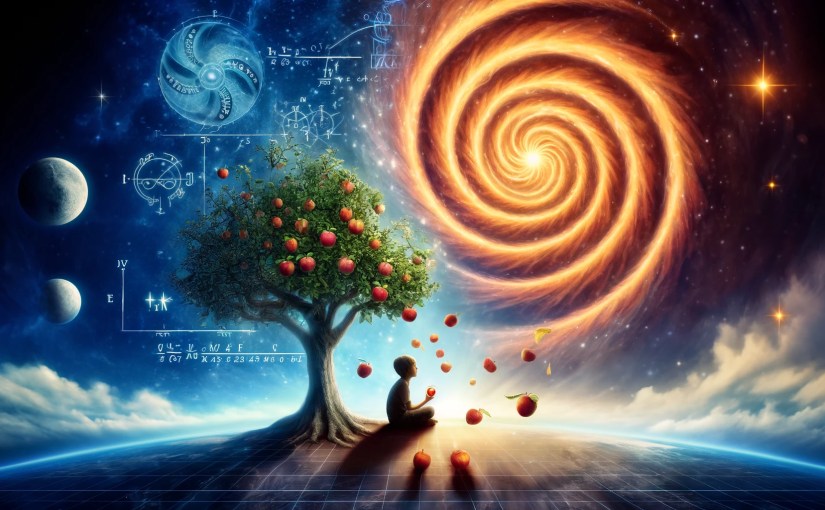
In the old Newtonian days, we thought time was a steady river flowing at one speed for everyone. Then Einstein came along with Relativity and proved that time is actually bendy. It slows down if you move fast; it warps near black holes.
When his best friend died, Einstein wrote a letter to the family saying:
“The distinction between past, present and future is only a stubbornly persistent illusion.”
Science is basically admitting that “Time” isn’t the solid container we think it is. It’s an illusion. Or, as we call it back home, Maya.
The Vedantic Upgrade: Drg-Drishya-Viveka
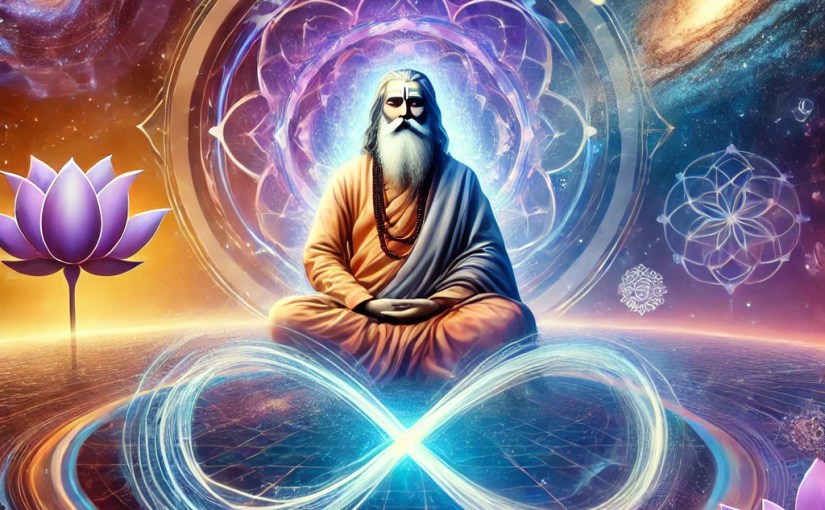
Our ancient rishis didn’t have DSLRs, but they had this exact same theory. They called it Drg-Drishya-Viveka (The discrimination between the Seer and the Seen).
They would say your Camera theory is perfect, with one major “Pro Mode” upgrade.
In your analogy, you might think:
- Camera = My Mind
- Milky Way = The World
Vedanta says: Not quite.
If a bug crawls across the camera lens, the camera sees it. If the lens gets foggy, the camera sees the fog.
Your thoughts, memories, and emotions are like that bug or that fog. They are constantly moving. They come and go.
So, the Mind isn’t the Camera. The Mind is part of the movie!
The real Camera is the Sakshi (Witness Consciousness). It watches the world move, and it watches the mind think about the world moving. It is the Sat-Chit-Ananda—the existence that never moves, never sleeps, and never changes.
The Final Verdict
So, are there holes in this theory? Only if you try to make the “Camera” into your ego. Your ego is definitely moving (and usually running late).
But the real You? You are stationary in eternity.
- Science studies the movie (the changing particles, the biology, the entropy).
- Spirituality studies the Camera (the Observer).
You don’t have to choose between them. You can enjoy the science of the stars while resting in the stillness of the Self.
Try this today:
Next time you are stuck in a chaotic situation—maybe traffic on Mount Road or a heated meeting—just pause. Be the camera. Let the cars and the shouting be the Milky Way spinning around you.
You might find that while the world is noisy, the Witness is silent.

 Nalla Madras