
For those who want an audio version!
Clarity, Magic, Mantras, Doubt. The Long Search Between Silence and Song.
There was a period in my life when Jiddu Krishnamurti was not merely an interesting philosopher to read over morning coffee. He was a full-blown obsession. The kind that makes you slightly difficult to talk to at dinner parties.
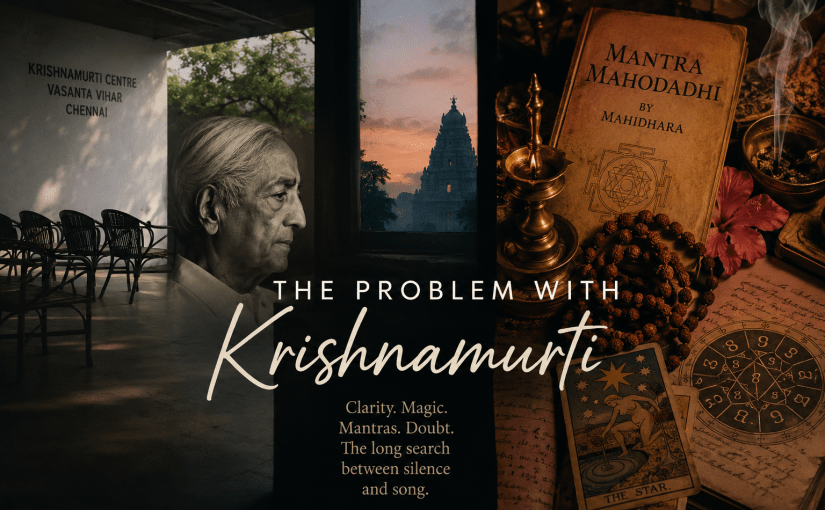
From my early teens well into my late twenties, I devoured his books with the intensity of someone who has misplaced their car keys and is convinced the answer is in the next room. I spent countless evenings at the Krishnamurti Centre at Vasanta Vihar in Chennai, listening to recordings of his talks. The voice. The pauses. The surgical precision. The relentless insistence on watching the movement of thought without distortion, without the comfort of a pre-packaged conclusion.
At that age, it felt nothing short of revolutionary.
No gurus.
No rituals.
No temples.
No comforting spiritual lullabies.
Just observation. Pure, unsentimental, slightly uncomfortable awareness.
And it worked. Mostly.
Except for one small problem.
Something inside me remained stubbornly hungry.
Not for truth, perhaps. But for magic.
THE CLEAN ROOM PROBLEM
Krishnamurti could dismantle illusion with surgical brilliance. But after a while, life began to feel — how do I put this — spiritually austere. Like living in a beautifully clean, well-lit room with no music playing and no one bringing tea.
The mind was alert.
But the heart was homesick.
And so, almost secretly — the way one quietly switches from a salad to a biryani when nobody is watching — I drifted elsewhere.
Into the fragrant, mysterious corridors of mantra and ritual.
I still remember buying the Mantra Mahodadhi of Mahidhara from the bookstore at the Theosophical Society in Chennai. That bookstore had a peculiar atmosphere — part library, part sanctuary, part doorway into dimensions that the management probably should have put a warning sign on. Seriously. “Enter with discernment. Do not attempt yantras at home without supervision.”
But I was fascinated. Entranced. Gone.
Soon I was memorizing mantras, studying rituals, exploring yantras, mudras, tantric procedures, obscure planetary invocations, and all the dazzling, incense-soaked architecture of sacred tradition.
Unlike Krishnamurti’s sparse philosophical landscape, this world was overflowing with texture.
Incense.
Sanskrit syllables.
Temple bells.
Sacred geometry.
Mystery.
And, frankly, much better aesthetics.
WHEN BEAUTY BRINGS FRIENDS YOU DIDN’T INVITE
And unlike the cool clarity of pure inquiry, this path offered something the heart had been quietly craving. Emotional warmth. Participation. Devotion. A sense that the cosmos was alive, responsive, and — most importantly — somewhat personally invested in your situation.
But there was a catch.
Along with the beauty came a slow, polite invasion of uncertainty.
Astrology entered quietly. Then tarot. Then auspicious timings. Then planetary periods, gemstones, and predictions. Before long, every inconvenience in life — a delayed appointment, a misfiled document, a bad cup of filter coffee — threatened to become cosmically sponsored.
The mind that Krishnamurti had once attempted to free slowly became occupied again — this time not by ideology, but by metaphysical traffic.
Was Saturn causing this?
Should this mantra be done 108 times or 1008?
Was this a sign?
A transit?
A karmic block?
Or just Tuesday?
THE UNCOMFORTABLE TRUTH
The strange thing is this: nothing destabilized me during my Krishnamurti years.
But nothing enchanted me either.
And that, I think, is the uncomfortable truth that many seekers quietly avoid admitting.
Human beings do not merely seek freedom. We also seek poetry.
We do not survive on clarity alone.
A life stripped completely of myth, symbol, ritual, music, and sacred imagination may very well liberate the intellect — but it can sometimes leave the emotional body standing barefoot in an empty field, wondering where everyone went.
A TRUCE OF SORTS
Today, I no longer see these worlds as enemies. They were never really at war with each other. I just made them fight because that’s what I do when left unsupervised with large ideas.
Perhaps Krishnamurti cleaned the window.
And perhaps mantra taught me how to sing beside it.
I have found my balance somewhere between observation and devotion, between the silence that inquires and the sound that celebrates. Neither pure Advaita austerity nor astrology-driven anxiety. Somewhere in the middle, making music, singing kirtan, and occasionally still wondering what Rahu is up to.
As for astrology, numerology, tarot, and the rest of the cosmic circus?
Honestly… I still don’t know.
And I have decided that is perfectly fine.
Some questions are not waiting for answers. They’re just waiting for you to stop being afraid of them.
A NOTE ON SEEKING
If you’ve been through your own version of this journey — Krishnamurti to mantra, or silence to devotion, or skepticism to something-softer-than-skepticism — you’re not confused. You’re just human.
The path rarely looks like the map.
And the map, as Krishnamurti would remind you, is not the territory.
Though the territory, I should add, has much better music.


