G. D. Naidu – The Pioneering Inventor from Coimbatore

Introduction

In the annals of Indian inventors, there lies a hidden gem whose remarkable contributions to engineering and invention deserve more recognition: Gopalswamy Doraiswamy Naidu, or G. D. Naidu. Born in Coimbatore, G. D. Naidu was influenced by the Stanes Group of Institutions, among other mentors and visionaries, who guided him throughout his career. In this blog, we take a closer look at the life, achievements, and people who shaped G. D. Naidu’s illustrious journey, from his humble beginnings as a server in a hotel to becoming a successful inventor and entrepreneur.

Early Life and Background

G. D. Naidu was born in Coimbatore on March 23, 1893, and displayed an extraordinary aptitude for machines and mechanics from an early age. Although he faced numerous challenges, including financial constraints and limited access to formal education, his passion for learning and inventing remained undeterred.

Driven by his love for machines, Naidu obtained work as a server in a hotel in Coimbatore to save money to buy a motorcycle. After purchasing the vehicle, he spent time dismantling and reassembling it, eventually becoming a mechanic. This hands-on experience with machinery laid the foundation for his future career.


The motorcycle G. D. Naidu bought from a British Revenue officer to understand how it worked


In 1920, Naidu began his transport business by purchasing an automobile coach, driving it between Pollachi and Palani. His venture, Universal Motor Service (UMS), quickly grew and, in a few years, owned the country’s most efficient fleet of public transport vehicles.

Influence of Stanes and Other Visionaries

The Stanes Group of Institutions, founded by Sir Robert Stanes in 1862, played a significant role in shaping Coimbatore’s growth as an industrial hub. These institutions provided hands-on training and education in various technical fields, and the Stanes Motor School, in particular, captivated young Naidu.

Apart from the Stanes Group, several visionaries and mentors influenced G. D. Naidu’s journey. One such influential figure was Diwan Bahadur R. K. Shanmugam Chettiar, a successful businessman and philanthropist who recognized Naidu’s potential and provided financial assistance to pursue his passion.

Later, Naidu traveled to Germany, where he met German inventor and industrialist Richard Küchen. Küchen’s work on safety razors and other cutting tools inspired Naidu to develop his own Rasant Razor, which would gain international attention.

Inventions and Innovations

G. D. Naidu’s inventive spirit led him to create over 100 patents in various fields. Some of his most notable inventions include:

  1. The Rasant Razor (1930): The safety razor with replaceable blades, which garnered international acclaim and helped Naidu establish a long-lasting business relationship with Richard Küchen.
  2. India’s First Electric Motor (1937): This indigenous electric motor was used in domestic appliances, fans, and other machines, paving the way for Indian self-reliance in electrical engineering.
  3. The Universal Grinding Machine (1954): Naidu’s versatile grinding machine could grind complex shapes and profiles with precision, making it a valuable asset in the manufacturing sector.
  4. Contributions to the Indian Film Industry: Naidu’s passion for cinematography led him to design a portable film projector called the “Filmadora” and a movie camera named “Naiduscope.” His work in this field was instrumental in shaping India’s burgeoning film industry.
  5. Naidu’s Self-starting Two-stroke Engine: This innovative engine provided a cost-effective and fuel-efficient solution for two-wheelers and three-wheelers, revolutionizing the Indian automobile industry.

Philanthropy and Legacy

G. D. Naidu was not only an inventor but also a dedicated philanthropist. In 1945, he established the G. D. Naidu Charities to support educational and healthcare initiatives in Coimbatore. The G. D. Naidu Industrial Exhibition, held annually, showcases the inventions and innovations of young engineers and entrepreneurs.

Conclusion

The story of G. D. Naidu’s life and achievements is a testament to the power of passion, perseverance, and the impact of influential mentors.

The easy button

So, we were all in the sunroom, slouching in our respective, well-upholstered, deep sofas. By all, I mean the family; me, the missus, and three of our off-spring.

It’s at times like this ‘ recreational argumentativeness’ takes over and possesses us. Once such sprang forth when one of us casually remarked as to how these weight loss shots er….shots for A1C regulation for Type 2 diabetes were for lazy people.

“Nothing like exercise and a controlled diet,” said the daughter.

“That’s an over-simplification,” said I, the slouch that I was. “Obesity and diabetes can happen to very fit and active people too”

While two of the off-springs were in the health industry, I was what you would call a Google medicine man. But that didn’t stop me from taking them on!

“In any case, laziness is not a bad thing, so much of good has come about due to laziness”

“Prove it,” said she, not to give in easily

And so, here goes the sermon. For those of you who don’t want a lengthy spiel, there is a concise list after this verbiage.

The story of how laziness caused inventions

Some of the most significant inventions have been born out of laziness. People have always been looking for ways to make their lives easier and more comfortable, and this desire for convenience has often led to remarkable discoveries.

The wheel is one of the earliest examples of an invention born out of laziness. The wheel was first used by early humans around 3500 BC and was a game-changer for transportation. Prior to the invention of the wheel, people would have to carry heavy loads by hand, which was both time-consuming and physically demanding. The invention of the wheel allowed people to move heavier loads with less effort, making it possible to build larger structures and expand trade networks.

Another example of an invention born out of laziness is the remote control. Invented by Eugene Polley in 1955, the remote control was initially created to make it easier for people to change channels on their TV without having to get up from their chairs. While it may seem like a simple invention, the remote control has become an essential part of our daily lives, allowing us to control everything from our TVs to our air conditioning units with the touch of a button.

In more recent times, robotic vacuum cleaners like the Roomba have become increasingly popular. The Roomba was invented by iRobot in 2002 and was designed to help people avoid having to vacuum their homes manually. With its autonomous navigation system, the Roomba can clean floors without any human intervention, making it a favorite among busy homeowners.

Similarly, automatic pet feeders have become a popular choice for pet owners who are too lazy to feed their pets regularly. These feeders dispense food at preset times, ensuring that pets are fed even if their owners are away from home.

In conclusion, many of the inventions that we use today were born out of laziness. While some may view laziness as a negative trait, it has led to some remarkable discoveries that have made our lives easier and more comfortable. From the wheel to the Roomba, these inventions have had a profound impact on society, and it will be interesting to see what other innovations come about in the future due to our desire for convenience.

List of inventions born from laziness

  1. Remote control: Invented by Eugene Polley in 1955 because he was too lazy to get up from his chair to change the channel on his TV.
  2. Roomba: A robotic vacuum cleaner that was created by iRobot in 2002. It was invented to help people avoid having to vacuum their homes manually.
  3. Self-stirring mug: For those who don’t like stirring their coffee, this invention is perfect. The mug has a built-in motor that spins a small plastic disk at the bottom, stirring the drink.
  4. Lazy glasses: These glasses use prisms to change the angle of vision, allowing the wearer to read or watch TV without having to tilt their head.
  5. Automatic pet feeder: Invented for pet owners who are too lazy to feed their pets regularly, the automatic pet feeder dispenses food at preset times.
  6. Electric can opener: The first electric can opener was invented in the 1930s to make opening cans easier and less labor-intensive.
  7. Microwave oven: Invented by Percy Spencer in 1945, the microwave oven was initially developed to heat food quickly and conveniently, allowing people to avoid spending time cooking.
  8. Segway: Designed by Dean Kamen in 2001, the Segway was intended to be a more efficient and effortless way of getting around than walking.
  9. Power windows: Power windows were introduced in cars in the 1940s to allow drivers to roll their windows up and down without having to use a hand crank.
  10. Video conferencing: While video conferencing has become essential during the pandemic, it was initially developed as a way for businesses to avoid travel costs and the hassle of in-person meetings.

No prizes for guessing who or what created this sermon or list. AI did it! Artificial Intelligence and not Air India bhaiya! The crown invention stemmed from sheer laziness!

The one-lung celestial singer

I am dividing this blog into two parts – the mythological part and the fact-checked part.

I can already sense a few hackles rising.

“So, do you say that all mythological books are not based on facts?” “What about the Ramayana, the Gita, the Bible?”

Dear Sir/Madam – a thousand apologies – let’s leave all this for the stringent right, okay va?

Mythology

A child prodigy whose starts to sing as early as five is the apple of everybody’s eye. The child grows up and becomes a young adult.

This young man has a passion for seeking meaning. A meaning for his existence in all things unseen. His explorations connect him with a group of wandering minstrels of Bengal, the Bauls.

Who are the Bauls? The actual term ‘Baul’ means madman. In this context, there is a group or a band of singing minstrels who are crazy about spirituality and God. There are elements of Sufism, Vaishnavism, and Tantra, and they also inhabit areas of West Bengal, Assam, and Bangladesh.

Returning to our young man, he decides to go with the Bauls in their wandering. Just the music or the spiritual aspect would have been enough to drag him along, but with music and spirituality, it was inconceivable that our young man would have come unstuck. He stuck with them like a limpet to rock – and I don’t mean this in a derogatory way, as the word association of limpet is not exactly complimentary.

Long story short – the young man, who is not so young – roughened by the complete absence of creature comforts – remember this was not a trip on a mobile home hitched to an SUV. This was the real McCoy of wandering. Apart from heavily calloused feet and tousled, matted hair, the not-so-young man had contracted a raging infection.

Tuberculosis

The myth within this mythology is that the infection, the disease, caused him to return to ‘civilization.’

As luck would have it, the doctors had to remove a damaged lung to cure him of tuberculosis. Many would have just resigned to fate and plod along till the end of their time, but not the not-so-young man. He continued with his singing. He changed his style of singing to short phrases instead of long aalaps. If anything, he got more fans.

The name he was most popularly known as – Kumar Gandharva.

FACT: Kumar Gandharva: A Musical Genius of India

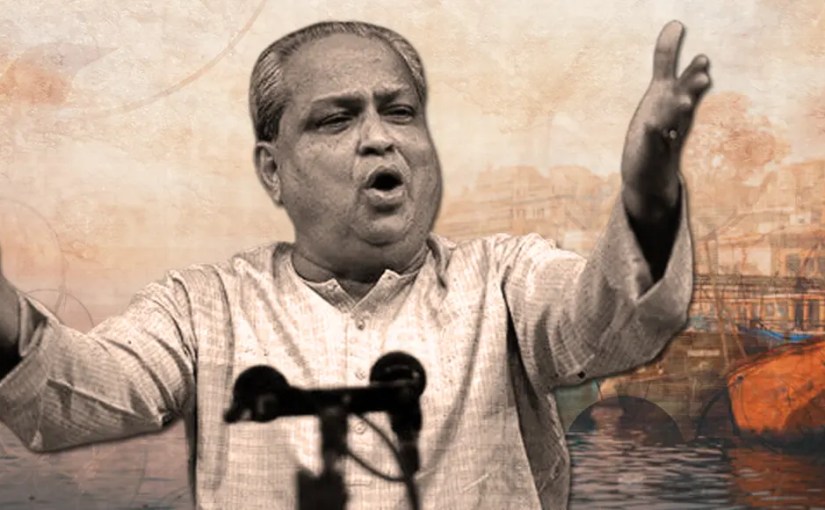
Kumar Gandharva was a legendary Indian classical singer known for his unique style and innovative approach to classical music. Born as Shivaputra Siddharamayya Komkali on 8 April 1924, he was a revered figure in the world of Hindustani classical music and is still remembered today for his contributions to the genre.

Gandharva’s musical journey began at a young age when he showed an early interest in music and began singing bhajans at the age of five. He went on to study under several renowned music teachers and eventually developed his own style, which combined traditional classical music with elements of folk and devotional music. This fusion of styles gave his music a unique and captivating quality that set him apart from other classical singers of his time.

One of the most distinctive aspects of Gandharva’s music was his use of a unique, nasal voice, unlike anything in classical music. Despite being criticized by some traditionalists, Gandharva’s innovative style was embraced by audiences worldwide and helped to bring classical music to a broader audience.

In addition to his musical contributions, Gandharva was also known for his devotion to his art and deep spiritual connection to music. He was deeply influenced by the Bhakti movement, which emphasizes the individual’s devotion to God, and this spiritual dimension is evident in the emotional intensity of his performances.

Despite his success and popularity, Gandharva’s life was challenging. He struggled with health issues throughout his career, including tuberculosis, eventually leading to his death at 63. However, despite his early passing, his legacy lives on, and he is remembered as one of the greatest classical musicians of all time.

In conclusion, Kumar Gandharva was a musical genius who revolutionized the world of Hindustani classical music with his unique style and innovative approach. His devotion to his art and deep spiritual connection to music has made him a beloved figure in classical music. His contributions will continue to be remembered and celebrated for generations to come.

The talent that was underrated – Thangavelu

Madras wasn’t a hotbed of job opportunities in the late sixties and probably most of the seventies. While I was lucky to find a job in the erstwhile Indian Airlines, many of my college mates were still searching for a job.

I did run into many of my mates, and the conversation would go like this.

” Dey, machhan, how are you? It’s been a while since I saw you last. Where are you working now?”

Reply: ” I am fine, enjoying life!”

That should have given me a clue that the poor lad is unemployed. But the idiot in me keeps plowing on.

Me: ” That’s great, but where do you work?”

Reply: “I work as a manager in a company.”

Me: “That’s great. Which company?”

Most times, the reply would be Mannar and company! Which meant he didn’t have a job! We would burst out laughing.

In those good days, we didn’t have to worry about being politically correct. You just expressed yourself, and that’s it.

The lads of today, who I am sure would be scratching their heads about what all this is about, here’s the explanation.

Mannar & Co.

Mannar & Co. is a fictitious firm that the character played by the prolific Thangavelu would answer if he were asked about employment in the film Kalyana Parisu (Tamizh). So, to most of us, who lived during that memory time frame, Mannar & Co. was an honorable way of saying the person is unemployed. It also had shades of deceit, but let’s leave that aside now.

Mannar & Co

So, back to Thangavelu, the actor who should have had much more recognition and fame than he got.

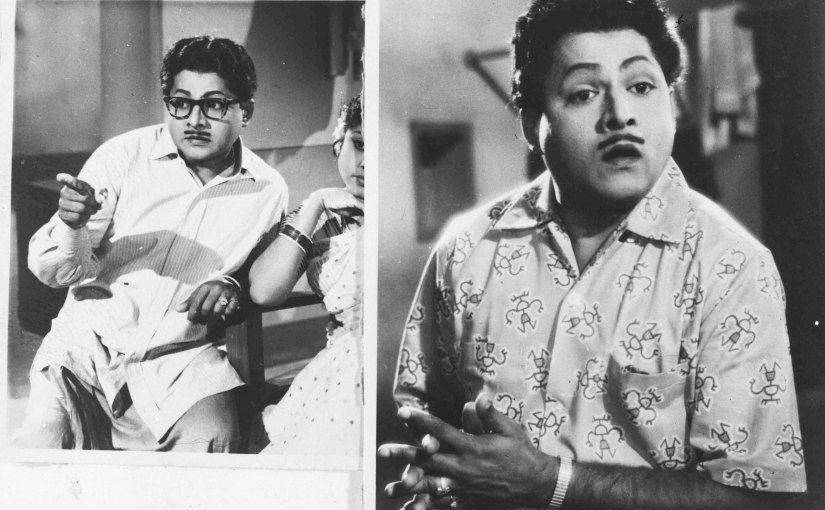
K. A. Thangavelu was an actor who excelled in almost every role he played. While his comedy relied on timing and facial expressions, it did not have the physicality of a Chandrababu or Nagesh. His humor was subtle but expressive enough for anyone to understand. In other words, you didn’t need to include a caption card with the word ‘JOKE’ emblazoned in it with poster colors.

Early days

The man suffered a lot as a child and even in early adulthood. His father was an alcoholic, and his refuge, his mother, died when Thangavelu was about six. His father left Thangavelu in the care of a relative and sailed off to Singapore in search of better days.

The young Thangavelu was a servant. He had to do all the menial jobs, like washing the cattle, cleaning the house, washing vessels, and the like. The only thing that kept him sane was his love for music and dance, which he would break into whenever he felt like it.

This singing and dancing would turn on the wrath of his foster parents, but Thangavelu soldiered on. He eventually joined the Rajambal Company troupe and was taught acting and mentored initially by Yedhartham Ponnuswamy Pillai and later by M. Kandaswamy Mudaliar.

For nine years, he worked in theatre. When Kandaswamy Mudaliar moved over to the cinema, Thangavelu followed him. His first break was a small role in the film Sathi Leelavathi, the 1936 version, which was the remake of the play Pathi Bhakti. Elis R. Dungan directed the film.

Sathi Leelavathi launched the career of M.G.R., T.S.Baliah, and N.S. Krishnan, all of them became very successful actors. However, this didn’t prove a lucky break for Thangavelu, so he quit movies and had to beg at a nearby temple to feed himself. M M Marappa, an actor, spotted him at the temple and brought him back to the theatre. He became a little stable this time, and coincidentally, his errant father returned from Singapore and lived with him.

N.S. Krishnan – the superstar who saved him

N. S. Krishnan, the superstar actor-director, spotted Thangavelu in theater and gave him another lease of life in cinema. He cast him in a comical role in the film Singari. His comedic timing impressed N.S.K. so much that N.S.K reportedly gave Thangavelu an advance of Rs. 5,000. Thangavelu’s relative thought he had stolen the money from N.S.K and promptly headed out to N.S.K’s house to apologize for his ward’s stealing. It was then the relative came to know the actual worth of Thangavelu.

Thangavelu was ever thankful to N.S.K for resurrecting his career and bringing him back to films, dancing, and acting, something he loved doing. Thangavelu wore a locket that had N.S.K’s picture in it as a tribute to the man who picked him from the dumps and gave him stature.

No role fazed Thangavelu. At one time, he was pitted against P. Bhanumathi, the reigning superstar, in the movie Rambayin Kadalan. He could hold his own and not let Bhanumathi overshadow him despite her more considerable stature (and I don’t mean being obese) and star billing.

Circling back to my opening paragraph about the film Kalyana Parisu, Thangavelu married the lady that played his wife in the movie, M. Saroja, who was his second wife and several years his junior in age. They lived a happy life.

His autumn years

During his autumn years, he got a few acting jobs, which he could have had more if he had reduced his fee. He refused to do this, and so too his adamancy to act in only Tamizh films. He won the Tamil Nadu government’s Kalaimamani in 1968 and Kalaivanar award in 1989.

He shed his mortal coil in his house in Chennai in September 1994. His wife Saroja lived on until April 2012.

Karaoke, a Dunning-Kruger effect?

It was past the time the cows came home. The good missus and I were squeezing out the few minutes between verticality and horizontality.

Jeez!

It was time to go to bed because the next day was a working day. However, The good wife was on her phone, scrolling through the various videos that social media algorithms were feeding her device.

There was this dude who was singing away to glory. That video was to entice people to a local bar that hosted karaoke events every weekend.

I use the word ‘entice’ with care because he was doing such a horrible job of singing the song that it probably was bait to get people over; two, er..three classes of people.

  • One, those who think they can do a better job and
  • Two, those who felt if he can do it, I can.
  • Three, those repulsed by the singing, muttering, if this is the standard, then even wild horses cannot drag me there.

Now, how can you find wild horses in a city? Exactly.

“Doesn’t he know he can’t sing?” asked my wife.

My reply was, “the poor bloke may not even know enough to know that he can’t sing.”

As soon as those words popped out, I had a surreal experience. I heard myself speak something I never knew existed in my knowledge bank.

The next day, after all the necessary expulsions and intakes, I headed straight to my laptop to find out why people sometimes overestimate their capabilities.

It was then that I stumbled upon the Dunning-Kruger effect.

What is the DK effect? And I am not talking about Dinesh Kartik, you cricket crazies.

The Dunning-Kruger effect

Here it is, courtesy Chat.openAI

Quote:
The Dunning-Kruger effect is a cognitive bias in which people with low ability at a task overestimate their ability. It is named after a 1999 study by David Dunning and Justin Kruger, in which they found that people who scored poorly on a test of their sense of humor also tended to overestimate their sense of humor. The effect is related to metacognition, or the ability to think about one’s thinking. People with low ability at a task may be unable to accurately assess their knowledge because they lack the metacognitive skills needed to do so. This can lead to a phenomenon known as “illusory superiority,” in which people believe they are more skilled or knowledgeable than they really are.
Unquote

The DK effect pervades the entire universe, irrespective of gender, race, or color.

Rombo, sorry, saar/madam, but that includes you and me.

Consider a scenario. You are flying at 30,000 ft and into your third glass of wine. The PA system crackles into life.

“Is there a pilot on board?”

A smart aleck pipes up. ” Actually, there should be two in the cockpit.”

He looks around for applause for the beautiful joke. Or so he thinks.

The steward is not amused.

“We have an emergency on board, and the pilots are incapacitated. I repeat, is there anyone here who can land a plane safely?”

If you raise your arm to volunteer to fly the plane because you watched a few videos on YouTube or if you played a flight simulation game, don’t blame it on the wine.

It’s a case of a full-blown Dunning-Kruger effect.

What has the heart to do with love?

Consider this:

A boy has been pining for a girl in his class.  Unfortunately, he doesn’t have the nerve to profess his love to her.  Several times, he approaches the girl, but his knees quake, and his mouth dries up.  All he can manage is a ‘hi,’ and that in a raspy voice. The school term is over, and she doesn’t show up the following year.

The boy is utterly heartbroken.

The wife is pregnant with their second child.  The husband strays and has an affair with another woman.  The wife is devasted, and she ends up having an abortion. 

The wife is utterly heartbroken.

So, what is the recurring theme here? Heartbreak. 

Heart and emotions

Now arises the question, why does everyone refer to the heart when there is a strong emotional loss or, for that matter, a great joy?  I grieve with all my heart, a heartful thanks for what you did for me; it’s with a heavy heart that I have to tell you this and so on.

The logical man stands up and says that all this is horse poop.  A brain is necessary to feel emotion.  A heart is a muscle mass responding to periodic electrical impulses that make it beat.   And many nodding heads give more credence to the statement.  Much sentimental baloney, right?

The ‘little brain’

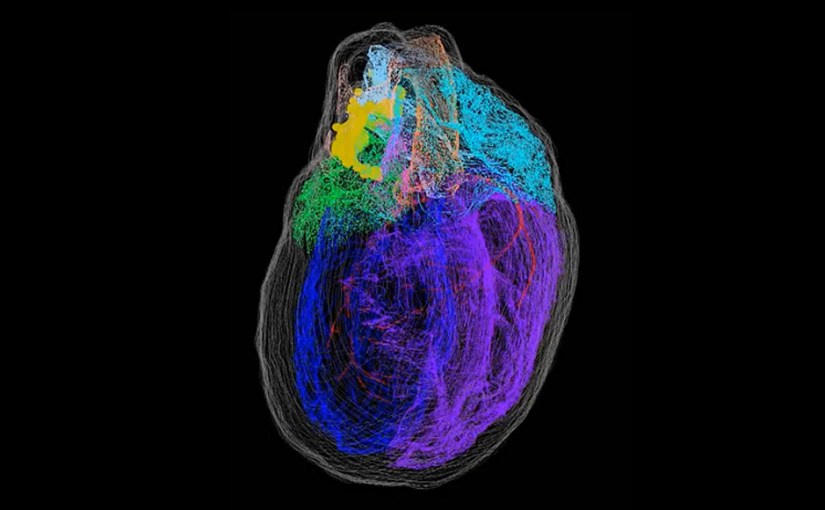
And lo and behold, recent findings by Dr. Armour in 1991 discovered that the heart has its “little brain” or “intrinsic cardiac nervous system.” This “heart brain” is composed of approximately 40,000 neurons that are alike in the brain, meaning that the heart has its own nervous system.

Reference: https://pubmed.ncbi.nlm.nih.gov/31728781/

This is an extract of the article referred to.

Quote: Scientists have reported that pain is always created by the brain. This may not be entirely true. Pain is not only a sensory experience but also can be associated with emotional, cognitive, and social components. The heart is considered the source of emotions, desire, and wisdom. Therefore, the aim of this article was to review the available evidence about the role of the heart in pain modulation. End quote

At his point, the logical man has an egg on his face, a gooey duck egg at that.

Not only does the heart have its own brain, but it also acts independently. 

Personality changes after a heart transplant?

Not to be outdone, the logical man pipes up again.  “So, what happens when a heart is transplanted?” “Does the recipient exhibit the traits and desires of the owner?”

There is the case of Claire Sylvia, a professional dancer, who was the recipient of the heart of an eighteen-year-old boy who died in a motorcycle accident. After the transplant, Claire craved Kentucky Fried Chicken and beer.  The hallmarks of an eighteen-year-old.  The family didn’t pay much attention to this until when Claire started walking, she had the purposeful stride of a man.  That led to an investigation as to who the donor was. It usually is not easy to find the donor, but with the right amount of persuasive pressure, the secrecy was lifted, and the truth unfolded.

Reference: https://www.psychologytoday.com/us/blog/explorations-the-mind/202110/heart-transplants-personality-transplants

A layman’s point of view

Me no physician, but this leads me to think that if the heart feels and stores memories and emotions, there is a need to cure the ache in the heart and not just in the logical brain. 

  • Put another way, is the pain or the emotion in the heart, the subconsciousness that has been bandied about for so long?
  • Since the emotive heart is probably not in sync with the brain in the head most of the time, is there a way to sync the two?
  • Does music help?
  • If the brain and the heart are not in sync, do we live life in conflict always?
  • Would syncing be the way to attain a superconscious state?

I tried asking these questions to the logical man.  He just gave me a blank stare and walked away.

Sigh!

A boy who ran away from home

The family sat down for lunch. All were being served. An eleven-year-old boy wanted ghee (clarified butter), but was refused. He created a scene and walked out of the house.

Everyone thought he would return once the hunger pangs started gnawing at his innards.
The boy had other ideas. He headed to the nearest railway station and boarded a train to Gwalior with not a penny in his pocket. When the train conductor went around, checking for free boarders, this boy would sing songs of Panditrao Nagarkar and Narayanrao Vyas and impress them. Most Maharashtrian folks used to be connoisseurs of popular music, so he got away and rode for free. Some conductors did not appreciate music, and they handed him over to the authorities. He did spend a few nights in jail!

Reach Gwalior or bust

So, long story short, it took the boy nearly two months to reach Gwalior.

Why Gwalior? Because Gadag, where the boy lived, had no music teachers. And he wanted to sing like Abdul Karim Khan Sahib, whose song he first heard on a gramophone recording. Gwalior was famous for the arts. It was also where Ustad Hafiz Ali Khan sahib lived, the father of Amjad Ali Khan, the renowned sarod player. Gwalior used to serve one meal for all who were learning music, obviously as an encouragement to the arts. That kept him alive. The rest of the time, he was with his guru.

This is how the journey began for Bhimsen Gururaj Joshi, who later became the renowned Pandit Bhimsen Joshi, the first Indian singer to win the Bharat Ratna (2008), who emerged as the face of Khayal Gayaki.

Once during an interview with Gulzar, the famous lyricist of Indian films, about why he walked away from home after being denied a spoonful of ghee, the maestro explained that the ghee was just an excuse to walk away from home.

Kolkata, here we come

When he realized that Hafiz Ali Khan sahib was busy traveling to various cities for concerts, the young Joshi took off to Kolkata and landed as a domestic servant to Pahari Sanyal, a Bengali singer, and film actor. Joshi used to listen to all the rehearsals and grab whatever he could learn.
In later years, Pandit Bhimsen Joshi was singing at a conference of musicians, and Pahari Sanyal was in the audience. Pahari Sanyal had no clue that this was the same boy, now a famous artist, who was once a domestic help in his house. After the concert, Pahari Sanyal went over to congratulate Pandit Bhimsen Joshi for an outstanding recital. The maestro then told Pahari Sanyal that he was the same Joshi, a domestic help at the Sanyal’s household! I am sure many would have given an arm and a leg to glimpse Pahari Sanyal’s face at that moment!

Anyway, getting back on track, the middle-aged Joshi headed to Delhi, where he heard of the father and uncle of Ustad Nasiruddin Dagar, to learn the dhrupad singing style. He had no money to pay fees, so he headed to Jalandhar to meet with Bhakt Mangat Ram, a visually handicapped singer, to learn dhrupad.

Life takes a full circle

At the Hariballab conference, he came across Vinayak Rao Patwardhan, who asked him what his purpose for all this travel was. Almost akin to the story of the musk deer searching the forest for the origin of the scent, when all along the deer had it on its tail, Patwardhan told him that there was Sawai Gandharva a teacher near his very village at Gadag, in the Dharwar district. At this point, his life took a full circle, and returned to his native land and enrolled in the Gandharva Mahavidyalaya, headed by Sawai Gandharva, a disciple of Ustad Abdul Karim Khan, the singer who inspired the young Joshi to start his music career.

Kirana Gharana

Pandit Bhimsen Joshi followed the aesthetics of Kirana Gharana. The word Kirana comes from the village near Sonepur/Panipat, where the mythological character Karna was born. Karna was mispronounced as Kirana. According to Pandit Bhimsen Joshi, the gharana tradition is like Karna, the warrior prince; do or die!

Kirana Gharana boasts of a proud lineage of artists; Roshanara Begum, Ustad Kale Khan, incidentally, her father, Ustad Vilayat Khan sahib, and many others.

His Bollywood foray

Pandit Bhimsen Joshi abhorred the title ‘pandit’ as he felt too many half-baked musicians started calling themselves pandit. He much preferred to be called Bhimsen Joshi without any honorifics.
He wasn’t a film music fan. His forays into the industry were rare. One such occasion was when he sang for the film Basant Bahar.

When Manna Dey had the jitters!

The scene was a competition; the resident Ustad’s voice was Pandit Bhimsen Joshi, and the hero Bharat Bushan’s voice was Manna Dey. In true Bollywood style, the hero could never lose a competition, so it comes down to Manna Dey being pitted against Pandit Bhimsen Joshi and Manna Dey winning. Manna Dey recalls how petrified he was and flatly refused. It was Pandit Bhimsen Joshi who encouraged and encouraged him to sing. The sheer magnanimity and the absolute confidence in the art!

Fast cars were his passion

Besides being an outstanding singer, Pandit Bhimsen Joshi was a car aficionado. He used to drive fast and was a mechanic too! When his car broke down, he would repair the vehicle himself. He had a Fiat, a Ford, and later a Mercedes. He used to travel mainly by air and by train, but certain towns did not have an airport, and train ticket reservations were difficult. So, he bought a used car, hired a driver, and the whole family set out to Mysore for a Dusherra concert. The driver, who barely knew driving, and didn’t have a license, plunged into a 40ft ravine on his way back. Fortunately, Pandit Joshi and his family survived the crash without a scratch. Pandit Joshi attributed it to the quality of cars then. He then decided to drive his cars – the motto was that if he were fated to die in a road crash, it had better be when he had his hands on the steering wheel!

Some highlights

  •  HMV released his first album of devotional songs in 1942.
  •  He was the first musician from India whose concerts were advertised through posters in New York City, United States.
  •  Pt. Joshi is remembered for his famous ragas, including Shuddha Kalyan, Miyan Ki Todi, Puriya Dhanashri, Multani, Bhimpalasi, Darbari, Malkauns, Yaman, Asavari Todi, Miyan Ki Malhar, and others.
  •  He was instrumental in organizing the Sawai Gandharva Music Festival annually as a homage to his guru, Pandit Sawai Gandharva.
  •  In 1998, he was awarded the Sangeet Natak Akademi Fellowship.
  •  Subsequently, he received the Bharat Ratna, India’s highest civilian honor, in 2009.

The maestro passed into eternity on January 24, 2011. He was 88

His thoughts on modern-day singers

When asked what he thought of the modern-day singers, he said they were a talented lot, intelligent and worldly-wise, but none of their renditions lived in the ears of the listeners for long. They are heard and forgotten.

Now that’s a pretty broad brush he used there. Dear reader, what do you think?

Manakkal Rangarajan – the speedster in brighas!

Back in time in India

About two and a half decades back, I was a tour operator, organizing and conducting inbound tours from the UK and USA.  I had a modest office off Lattice Bridge Road when I started this operation.  Lattice Bridge road, known as L.B. Road, bisected Indira Nagar and Thiruvanmiyur. My office was on the Indira Nagar side.

My first glimpse of the man

Every day I used to see a person with a starched white shirt and a white dhoti go past my office, most times in the morning and sometimes in the evening too.  He used to walk with a purposeful gait.  He had rather long hair coming out from his ears, which was accentuated even more so because he had a thinning hairline.  His hair, or whatever was left of it, would be oiled and neatly combed back. His forehead was swathed in vibuthi or sacred ash, punctuated by a red vermilion dot just above the bridge of his nose. A light dusting of talcum powder dressed his face. To describe this gentleman’s personality even more clearly, I would say he looked like the ‘common man’ in R.K. Laxman’s cartoons.  And I don’t mean this disrespectfully.

His personality intrigued me, which led me to enquire about who he was.  Somehow, this reached his son’s ears, and the son paid a visit to my office, asking why I was enquiring about his dad!  I explained that something about his dad differentiated him from the other passers-by. 

My meeting with him

Then I heard of Manakkal Rangarajan and that he was a Carnatic musician.  I told his son that I would like to meet with him.

I met with him later that week, and after the customary salutations and preambles, I asked if he would teach my daughter Carnatic music.  He hesitated a bit but said he would check her aptitude first.  So, I took him home; I lived a stone’s throw away from my office on the Thiruvanmiyur side. She passed the skill or talent test, and the lessons started in earnest, the week after.

She had the fortune of learning music from him. At that time, she was also learning dance from Kalakshetra. Today she is an accomplished Bharatanatyam artiste herself, but she still remembers with pride that she is a student of Manakkal Rangarajan.  The vocal exercises he taught her allowed her to render brigas with speed.  Brigas or brighas are note ornamentations that enhance the beauty of the rendering.   

His birth and background

Manakkal Rangarajan (13 September 1922 – 26 February 2019) was a Carnatic music vocalist from Manakkal village, Trichy district.  He was known for his unique brand of Carnatic music.

Manakkal is a village in Valangaimana taluka, Thiruvarur District, Thiruvarur district, Tamil Nadu State.

Rangarajan’s father, Santhana Krishna Bhagavathar, was an exponent of the Harikatha but did not impart any musical lessons to Rangarajan.    His mother’s name was Seethalakshmi Ammal. Shri. Rangarajan had five brothers. He was the youngest. He started singing in concerts from the age of fifteen.

His rendition of songs such as Ninnuvina (Navarasakannada), Sarasasamadana (Kapinarayani), and Nenarunchinanu (Malavi) was eagerly lapped up by the audience at his concerts. Artists like Murugaboopathi and Umayalpuram Sivaraman enjoyed accompanying him.  So did the violin vidwans such as Kumbakonam Rajamanickam Pillai, Mysore Chowdiah, Lalgudi Jayaraman, and T.N. Krishnan.  

The Tiruvyaru incident 

He used to sing at Tiruvayaru, the birthplace of Shri. Thyagaraja for the music festival. The story goes that M.S. Subbalakshmi, the reigning queen of Carnatic music and a film star, sang before Shri. Rangarajan’s concert. She had a huge fan base, and when MS finished her concert, everyone went to see her off. Shri. Rangarajan had an empty audience. Then he let loose a volley of fast-paced krithis, and everyone came running back to listen to him!

A nice documentary

Later, I started attending his concerts. I once heard him perform at the Music Academy, Madras, and recall a Sankarabharanam (a Carnatic Raga) aalapana, in which he reached the tara sthayi sadjam (the third-octave root note) with exquisite precision.

Manakkal Rangarajan used to render rare Pallavi performances at the Music Academy, Madras, using both hands for the thalams (beat cycles), composed from various nadais (beat structures).

Rangarajan is one of the rare musicians who has never compromised with principles and traditions to gain popularity.    

Music critic Subbudu stated in one of his reviews that had Manakkal taken up Hindustani music or Western music, he would have outclassed them all because of his distinctive, bell-like voice and his reach.  

Titles & Awards

People who followed the career of Shri. Rangarajan worshipped his music, said his brigas were breathtaking and that it was the way they heard it, not just in his heyday but even long after.

Manakkal Rangarajan passed away on February 26, 2019

Cited Sources

Mani Stores @Velacheri

MANI STORES

Velacheri was a calm, quiet place.  It had all the hallmarks of a quaint village; lush paddy fields irrigated by the waters of a rather vast lake that looked endless during monsoons. St. Thomas Mount and the Pallavaram hills framing the north-western and western horizons were visible.  The air was so clear that I could count the stars at night; they were like shimmering lights against the inky black sky, which was not lit up by the city glow as there were no large colonies nearby, and electricity hadnʼt reached all houses, including ours.

The location

The bus stand was at the intersection of Brahmin Street and Velacheri High Road.  The bus stand was an arrangement of cement benches with red oxide slabs, and it was a kind of meeting point for most residents. There was a certain lazy, languid air about the place until the bus arrived. After that, it became a beehive of activity, and everybody jostled with each other to get on to the bus first, to claim a vacant seat.  Invariably, there would be a village do-gooder who would yell out to the milling, jostling mass.

The know-all at the bus stop

“Make way for the ladies, especially the ones with children.  Everyone will be able to get in.  Donʼt hurry,” he would shout out, with the authority of one who has seen several hundred arrivals and departures.  Then there was another group; the dashing young men dressed in their finest.  They would remain a distance away from the bus with studied nonchalance, and once the bus began to move, they would run alongside the bus for a while and jump on the alighting steps.  These ʻfootboardʼ travelers, as they were called, would hang in sometimes on just a toehold, and this would get admiring looks from the girls on the bus.  To them, this meant everything. To some, this was a way of getting a free ride!

When the bus departed,  the mix of people changed, so new topics were invariably started or old ones repeated to a new audience. So there were always varied points of view every time.

The village park

Behind the bus stand was the village park that came to life in the evening.  A community radio blasted out programs from a station called Vividbharati.  The park had one lone gardener, who rarely smiled but was always digging a hole or pruning a croton bush and was the employee of the village panchayat.  He wore khaki half-pants and a khaki shirt.  Under his half-pants were bright-colored boxers that were bigger than his khakis, giving the impression that beneath that drab exterior was a bright side to his personality. He also wore a huge watch with a stainless steel bracelet that contrasted brilliantly against his sunburned, brown skin.

A few shops were next to the bus stand; to the right was a shop selling cigarettes, beedis, and brightly colored candy.  The different varieties of candy were all stored in identical jars.  The shop also sold lemonade which was made fresh every time.  The shopkeeper would use soda instead of water for an extra ten paise.  The soda bottle was fully recyclable.  It had a marble inside the bottle, and it rested in the upper quarter of the bottle.   During manufacturing, the gas inside the bottle would force the marble up the opening and push it to shut onto a rubber ring washer near the bottle’s opening.  To open the bottle,  a wooden peg was used to push down the marble, and depending on when the soda was prepared; it would either be a mini-explosion or a soft swoosh. 

Mani Store

On the opposite side, some distance away was the main grocery store called Mani Stores. The term grocery store was more for convenience as it was a mishmash of fancy merchandise.  The proprietor, whose name was Mani, was a pioneer of sorts. While most other shops were small cubby shacks selling peanuts, colored candy, and essentials like lentils and rice, Mani stocked luxurious items like fancy soaps, talcum powder, lotions, and perfumes.

Mani resembled a famous Tamil film actor, or at least that was the opinion of many residents of Velacheri. He knew it and played it to the hilt by mimicking certain signature mannerisms of the star.  Teenage girls in their half-sarees would giggle when they passed by his shop. Somehow, I could see only a vague resemblance; I not being much of a moviegoer those days.    My parents believed that movies caused moral turpitude and were the cause of all evils in society. So, my comparison was limited to posters and paintings of the film star plastered all over the walls of the nearby transformer factory. 

Every evening, Mani would get his assistant to sweep the entrance to his shop and sprinkle water to cool down the bit of earth heated by the post-afternoon heat of the sun.  This gave rise to a warm, earthy smell, not unlike what you would encounter after a summer rain.  Mani would then switch on his prized transistor radio.  It was a Bush Baron, a Cadillac among transistor sets, and it would belt out music at such loud volumes that you could hear it until you reached the park.  From there, the radio in the park took over.  So, it was a kind of relay race.  Thankfully, they were all tuned to the same station, so it did not sound like so many popular remixes of today.

Mani had one failing.  He hated to admit his ignorance.  So, when somebody asked for something that he hadnʼt a clue about, he would pretend to look for it.  His search was bound to bring no results since he did not know what he was looking for.  So, he would say he had run out of stock after a point.  Later, he trained a sidekick, a small boy with a leaky nose.

At times, he hadnʼt a clue what I wanted.

“Give me a pack of Marie biscuits,”  I would ask.

“Boy, give sir Hari biscuits,” Mani would yell to the boy inside. His trained sidekick would yell out that they were out of stock. He nor his sidekick had a clue what Marie biscuits were.   I would begin to do an about-turn and start walking out of the shop when Mani would call out to me in an apologetic tone.

“Stock just over, sir.  I will get it surely next week”   I knew he was bluffing.  Mani would never exhibit his ignorance.  After all, his was ʻtheʼ grocery store in the village!

This used to go on.  I then decided to teach him a lesson and would ask if he had a stock of various brands of ice cream and things of that nature, knowing he did not have a deep freezer. Nobody had one because an uninterrupted electricity supply was unheard of in the state of Madras.

Later, it became a game, and I became more adventurous. Those days, it was lonely in Velacheri, and this was one way of keeping my mind busy!  Once I remember I asked him for a Ford Mustang. Another time, it was for a Soyuz spacecraft.  Some months later, he saw through my game.  Some bystander must have told him, behind my back, that I was pulling his leg.

Later, whenever he was unfamiliar with an item, he would ask me with a half-smile. “ Sir, I hope you are not trying to fool me,” asked Mani.

He was a sport, and he enjoyed the exchanges with me. 

The over run

Mani survived for about five years as being the only ʻsupermarketʼ in town.  When the village became an overgrown municipality, many traders set up businesses on both sides of the now Velacheri High Road. Maniʼs shop lost all the luster and exclusivity it once had.  His transistor set, which could be heard until the beginning of the park fence, was lost in the din due to a combination of the overall increase in ambient noise levels and the arrival of cassette recorders in every one of the new shops.  Also, his Bush Baron was no longer at its prime and started fading out with Maniʼs importance of being the only supermarket in town.

It was about this time that I finished my schooling, and I moved to Bombay for my future education with stars in my eye.  This plan did not work for several reasons, so after about a year, I was back at Velacheri, more affluent in the experience of living, traveling, and working in a vast metropolis, with valuable lessons on how folks behave when you start living with them.

For the old time’s sake, I visited Mani.  He had a pair of thick bifocals, and his curly hair, which once was shiny black and draped his forehead like a mini unicorn horn, was thin and lay limp.  All the charisma had gone.  I wondered how all this happened in just one year.  His store, which generally used to burst at its seams with stock, had almost nothing.

“ Mr. Mani, I want a bottle of Horlicks,” I asked for old-time’s sake.  His face broke into a glow of recognition, and he gave me a wide smile.  Two of his front teeth were missing.

Instead of yelling out, he ambled into the dark recess of his small store!  He no more had an assistant.

“ No stock, sir.  Not like before, sir.  I have very few customers, so I donʼt get enough sales to buy new merchandise.  Good times are behind us, sir, “ said Mani with a strange smile. Mr. Mani might have changed in appearance, but his attitude was still the same.

That was the last time I saw him. His store was demolished to give way for a multilayered textile showroom. 

S. V. Ranga Rao, the consummate actor

Introduction

Has anyone seen this movie, Server Sundaram?  

There is a scene in the movie where the character played by Nagesh is getting his first break as an actor. He has paired apparently with the most popular lady star of that time, played so well by our beloved Achi Manorama.

The director, played by S.V. Ranga Rao, is hilarious! Caught in the crossfire between this first-time greenhorn actor played by Nagesh and this fussy, demanding diva played by Manorama, S.V.R. so convincingly plays the role of a harried director that he stands out as an unforgettable character in the entire movie! At least for me!

Who was S.V. Ranga Rao

To the young ones of today, here is a synopsis of the legendary actor, S. V. Ranga Rao, or S.V.R. as he was popularly known.

Samarla Venkata Ranga Rao (July 3, 1918 – July 18, 1974) was a South Indian actor, film director, and producer. He is an internationally recognized actor and was awarded the title “Vishwanata Chakravarthi.” He was also the first Indian actor to win an international award. He is considered an all-rounder actor who could carry any role given to him. With the famous mannerism of “orey dongrey” from Jagath Jettilu, he is still a household name in Andhra Pradesh and Telangana. 

Rao was born to Lakshmi Narasayamma and Koteshwara Rao Naidu, a customs inspector from Nuzvidu, Krishna district, Andhra Pradesh. His mother, Lakshmi Narasayamma, was a fervent devotee of Lord Venkateshwara, who named the boy after him. 

At the early age of 12, the boy showed a tremendous interest in acting on stage. Two goals were still clearly set in his mind: pursuing a master’s degree in literature and taking an active role in theatre and cinema. 

His first foray into the film world


S.V.R. got an invitation from one of his relatives, B.V. Ramanandam, to play the hero in his film “Varoodhini .” It was an excellent beginning for the young man. However, the movie “Varoodhini” bombed at the box office. Producers hesitated to give him any roles after that. S.V.R. was disillusioned with the filmdom and left the Madras Presidency (as was the term used for a collection of Southern Indian States then) and reached Jamshedpur, where he took up a job as a budget assistant with Tata Steel. However, his love for acting never really went away. He married Leelavathi in December 1947 and settled down to a domesticated life. 

Then came an opportunity to play the villain in the film, “Palletoori Pilla,” produced by B.A. Subba Rao came his way. His father passed when he was about to board the train to Chennai, so he had to stay back and finish all the rituals a son was expected to do. After performing the final rites, S.V.R. reached Chennai, but it was too late. Another actor had already replaced him.

His first real break

Lucky for him, he got a break with Vijaya Pictures, who offered him the most memorable role of a  “Nepali Mantrikudu” in  the “Pathala Bhairavi.” He also played the same role in the Tamil version. Immediately, he shot into the limelight. Pathala Bhairavi was followed by another hit, “Pellichesi Choodu” (1952). At this point, he had established himself in the industry. The iconic status of a superstar took time to come to him. He struggled a lot and, from that struggle, rose the great actor of all time. Maya Bazaar and Nartanasala are among his famous movies. 

The roles he played

He acted almost every character in history. He showed a kind of recklessness and disregard in his dialogue delivery. This controlled nonchalance was something that appealed to me very much! 

S.V.R. was the first Indian to get an international award at the Djakarta International Film Festival for his role of Keechaka in Nartanasala. His dialogue delivery was unmatched. Those days, no one in the industry could deliver dialogues, even in Sanskrit, with so much ease and aplomb, complete with the required histrionics. Even N.T.R., who was great at dialogues in Telugu, used to stammer in front of S.V.R. This was the rumor those days!

His compatriot Gummadi once exclaimed, “Fortunate are we to have S.V.R. born in India, but S.V.R. is unfortunate to have born here, for if he were born in the West, he would have been one of the top 5 actors of all time in the world.”

S.V.R.’s relatives and family circles ridiculed him, saying that he was a fool to go after chances in cinemas by shunning government jobs.

Some trivia

  • L.V. Prasad gave S.V.R. lots of moral support and encouragement.
  • “Maya Bazaar” automatically brings about the picture of S.V.R. as Ghatothgacha 
  • His role as “Nepali Mantrik” in “Pathala Bhairavi” will continue to be remembered by millions of people.
  • As Keechaka in “Narthanasala,” S.V.R. proved himself to be the ultimate when it came to acting the mythological films.
  • He was a passionate game hunter, sporting an excellent firearm that a friend in the British Indian army gave him. One day, he was hunting a deer, and the deer stopped running and looked straight into the eyes of S.V.R. as if questioning him, “What will you get if you kill me?” S.V.R. never hunted after that.
  • S.V.R. and Gummadi went to International Film Festival in Spain for the film Raju Peda, where they met Sir Richard Attenborough. S.V.R. played Peda (poor man), and Sir Attenborough commented that S.V.R. should have played the role of the Raju (king). 

His transition to immortality


He died on July 18, 1974, after suffering from severe heart failure. But he continues to live in the hearts and minds of the Telugu and Tamil people.

Cited Sources