Sa Re Ga Ma vs C D E F G – The Fun Guide to Indian Sargam and Western Notation

If you’ve ever been stuck at a wedding between the nadaswaram/shehnai player and the Western band belting out “Summer of ’69”, you’ve probably asked yourself the deep, philosophical question:

Why on earth are there two ways to write music, and which one should I bother learning before my next rebirth?

So, let’s introduce our two contestants.

Contestant One: The Indian Sargam

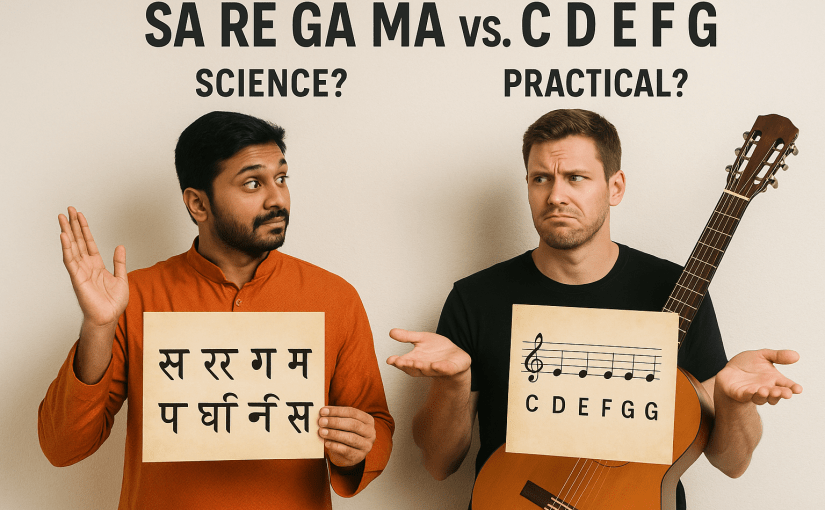
Sa Re Ga Ma Pa Dha Ni Sa

Sargam is that genial uncle who says, “Just come, beta, we’ll adjust,” and actually means it. No fuss about where you start—today Sa might be C, tomorrow Sa might be D, and next week it could be on a note only the neighbourhood cat can hear.

  • Relative Pitch = Chill Vibes If Sa is the first step, the rest of the staircase adjusts itself. It’s musical jugaad at its finest.
  • Vocal-Friendly No singer has ever said, “Oh no, I can’t sing today because Sa is stuck on 261.63 Hz.” You just shift it, smile, and carry on.
  • Ornaments Galore Sargam doesn’t just give you notes—it lets you bend them, slide them, and add so much gamaka that even the note doesn’t know where it started.

Think of Sargam as the filter coffee of music—warm, strong, flexible, and doesn’t come with an instruction manual.

Contestant Two: The Western Notation

C D E F G A B C

Now here comes the second cousin—neat haircut, wearing a suit, and carrying a folder. Everything has to be exact. If C is 261.63 Hz, that’s where it stays. If you dare move it, there will be meetings, memos, and possibly a sternly worded email from a conductor.

  • Absolute Pitch = Discipline It’s the GPS of music—you know exactly where you are at all times.
  • Visual Map of Sound Those five lines, dots, flags, and squiggles are like an architect’s blueprint. You can rebuild the Taj Mahal in notes if you know how to read them.
  • International Passport Whether you’re in Madras, Madrid, or Madagascar, this script will be understood. (Except maybe by your local auto driver.)

Western notation is like ordering pizza—fixed recipe, precise toppings, and yes, people will notice if you replace mozzarella with paneer.

Which is More “Scientific”?

Here is where Uncle Rajan wades into the conversation. “All that is fine saar, but which one is more scientific?”

Western notation wins if “scientific” means standardisation and precision—like laboratory coffee: exact temperature, exact brew time, exact bitterness.

But Sargam has its own science—more like grandma’s cooking. She doesn’t measure, yet every dish tastes exactly right. The science is in the relationship between notes, not their fixed coordinates.

Which is Easier and More Practical?

  • If you’re starting out: Sargam is the easy entry—like learning cricket in your backyard before playing in a stadium.
  • If you’re handling an orchestra: Western notation keeps the chaos in check. Without it, your 40-piece ensemble might sound like 40 street vendors shouting in different keys.
  • If you’re doing fusion: Learn both. Sargam keeps your Indian side, Western notation keeps your drummer from walking off stage.

Final Verdict

Neither is “better”—they’re just designed for different musical worlds.

Sargam is like filter coffee at the corner kaapi kadai: flexible, soulful, forgiving.

Western notation is like an espresso from an Italian café: intense, precise, and possibly served with a side of attitude.

If you can master both, you’re musically bilingual. And like knowing how to make both idly and pasta, you’ll never go hungry—either for food or for tunes.

Freebies and the Unsung Heroes: When “Thanks” Doesn’t Pay the Bills

Freebies and the Unsung Heroes: When “Thanks” Doesn’t Pay the Bills

Ah, the life of a musician or recording engineer – it’s glamorous, isn’t it? Flashing lights, screaming fans, and… endless requests for free background tracks? Wait, what?

If you’re a musician or a recording engineer, chances are you’ve heard it all too often: “Hey, could you whip up a quick track for me?” or “I need some music for my new YouTube channel. Can you help?” But the kicker? More often than not, all you get in return is a quick “thanks” (if you’re lucky) and a pat on the back.

Now, don’t get me wrong. “Thank you” is a beautiful phrase that warms the heart and soul – but unfortunately, it doesn’t warm the pockets or pay the bills.

Let’s take a moment to compare with other professionals.

Imagine strolling up to a doctor at a social gathering and saying, “Hey, I’ve had this cough for a while. Can you just quickly check it out?” Or cornering an architect at a birthday party with blueprints in hand, hoping for a free consultation. Would they be met with the same expectations of ‘gratis’ expertise?

Let’s be honest, it does happen. Many professionals, regardless of their field, get bombarded with pro-bono requests from friends, family, and the occasional audacious acquaintance. But there’s a peculiar sting that musicians and recording engineers feel, given the perception that their craft is “easy” or “just a hobby.”

But who’s really to blame here?

1. The Perpetrator (a.k.a. The “Friend”)

Let’s face it, most of us are guilty of wanting something for nothing. In a world of instant gratification and streaming services, the value we place on individual expertise can sometimes wane. To the untrained eye (or ear), creating a background track might seem as simple as pushing a few buttons. But as any seasoned musician or engineer knows, it’s hours of work, years of training, and a bottomless well of patience.

2. The Enabler (a.k.a. The “Professional”)

Sometimes, professionals are their own worst enemies. By occasionally offering freebies to win favor or out of sheer kindness, they unwittingly set a precedent. The occasional free consultation or quick background track can quickly snowball into a mountain of expectations.

So, what’s the solution?

For starters, recognizing and respecting the craft is essential. Whether it’s music, medicine, or masonry, every profession requires expertise that deserves acknowledgment. And for professionals, it’s essential to establish boundaries. It’s okay to say no, or to kindly point out that expertise has a price. After all, you wouldn’t just grab a candy bar from a store and walk out with a mere “thank you”, would you?

In the end, let’s remember the timeless wisdom: If you’re good at something, never do it for free. So, to all our unsung heroes, keep strumming, keep mixing, and most importantly, keep valuing your worth!

Is the modern-day stand-up inspired by 10th-century Chakiyar Koothu?

Was chakyar koothu the earliest form of stand-up comedy?

The first stage productions of Chakyar Koothu appeared in the tenth and eleventh centuries. It is believed that Kutiyattam, the earliest surviving form of Sanskrit theater, is the ancestor of Chakyar Koothu.

Historically, the koothambalam,  a performance area in a temple built to specifications in the Natyashastra (a detailed manual about dance and allied subjects), was the only venue for Kutiyattam and koothu performances. Painkulam Raman Chakyar (active 1905–1980), a rebel with a cause, was responsible for the first public performance of koothu outside of the koothambalam, which caused widespread outrage and earned him social isolation. He also played a crucial role in adding it to the Kalamandalam ( a premier dance and music school of Kerala) curriculum.

Chakyar koothu accords great importance to the vidushaka (jester/ narrator, very much like the modern stand-up comedian), and his monologues combine prose and poetry. The vidushaka’s commentary is full of biting sarcasm and witty asides. Although the choreography is light, he makes his point clearly through his facial expressions. He makes the act more contemporary and inclusive by getting responses from the audience, making analogies, and commenting on current socio-political events. Minus the profanity and the cussing, doesn’t this describe a stand-up comedy show?

Here is an invitation to witness a chakiyar koothu by a modern-day artist.

The artist begins with a Sanskrit verse and invites people to watch him perform in Malayalam as spoken by the Namboothiris and Chakyars!

Typically, the vidushaka or the performer would first offer his prayers to the presiding deity. He then chants a shloka or verse in Sanskrit, which is an outline of the theme he is going to perform. The verse is then translated into the local language for everyone to understand. Although a central theme is specific to the performance, nothing stops him from dragging various contemporary subjects like politics into it. He is accompanied by the mizhi, a large copper vessel with it’s mouth covered by a taut skin on which the drummer plays and a pair of large cymbals.

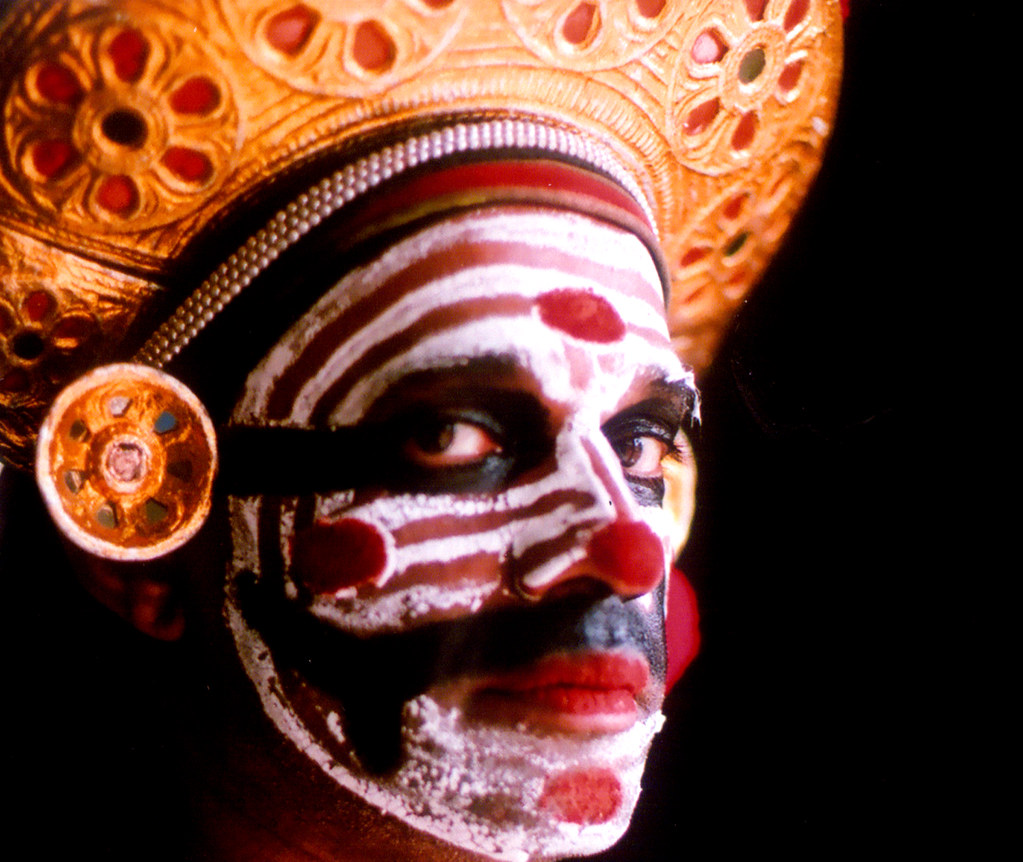
It is a ritual specific to the Chakyar people (a priestly caste). The performer wears a colorful headdress, has a bushy black mustache, which is deliberately exaggerated, and is covered in sandalwood paste with bright red spots. His very appearance is quite comical.

It is only the male members of the Chakyar who perform the koothu.  Not to be outdone, there is also a female version called Nangyar Koothu, which is by the Nambiar community of Kerala.

So, it would be safe to say that modern-day stand-up shows originated in Kerala in the tenth century. 

The costume of the modern clown is very similar in color combination to the performer of the koothu.

What say you? Write to me if you don’t agree!


Photo credits

koothu” by Paul Varuni is licensed under CC BY 2.0.

mizhav” by Arayil is licensed under CC BY 2.0.

File:Vidushaka-Mani Madhava Chakyar.jpg” by Sreekanth Vis licensed under CC BY-SA 3.0.

Bring on the clowns” by markleepower is licensed under CC BY-NC-ND 2.0.

Suyash Dwivedi, CC BY-SA 4.0 https://creativecommons.org/licenses/by-sa/4.0, via Wikimedia Commons

Sources

https://prepp.in/news/e-492-chakyar-koothu-indian-folk-dance-art-and-culture-notes

https://www.thehindu.com/entertainment/dance/the-necessary-nuances-of-chakyar-koothu/article26078823.ece