The Empty Beat Is Not Empty

Where Music, Silence and Consciousness Meet

When I first started learning music seriously, I thought music was made of notes.

This is a very common beginner’s disease. Fortunately, it is curable, though the treatment can take several years and may involve many stern looks from music teachers.

In the beginning, we are obsessed with the visible parts of music: the swaras, chords, tempo, raga, lyrics, tala, fingering, pronunciation, and the correct place to come in without looking like we just missed the bus.

All of that is necessary.

But somewhere along the way, if one is lucky, music quietly opens a side door and reveals something more mysterious.

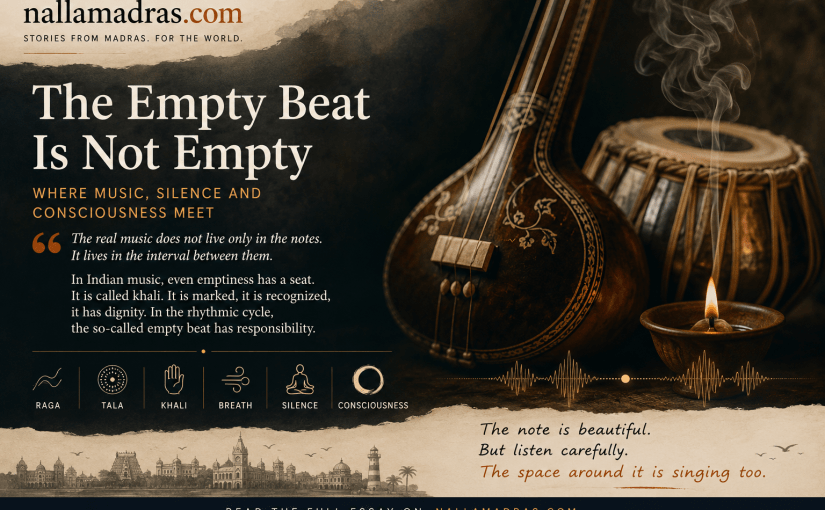
The real music does not live only in the notes.

It lives in the interval between them.


The Space That Sings

It lives in the breath before the phrase.
The hesitation before the sam.
The lingering after a meend.
The silence after a temple bell.
The moment just before the mridangam lands.
The tiny pause where the listener’s heart leans forward.

That space is not empty.

It is alive.

Indian music has always known this. We may not always discuss it in fancy language, but the tradition itself breathes this truth.

Take the alap in Hindustani music. Before the tabla enters, before tala announces its authority, before anyone starts calculating whether this is Teental, Ektaal, Jhaptaal or “please don’t ask me, I am just here for the tea,” the raga slowly reveals itself.

There is no hurry.

A phrase appears. It rests. Another phrase answers. A note is approached, not attacked. The raga does not behave like a government office file being pushed from one table to another. It unfolds like dawn.

In that unhurried space, one begins to understand that rhythm is not merely counting.

Rhythm is breath.


Khali: When Emptiness Has a Seat

Then comes tala, and we imagine tala means beat.

Clap here. Wave there. Come back to sam without falling into the ditch. Very good.

But tala is far more profound than a counting system. It is cyclical time. It is memory returning. It is departure and homecoming.

And then there is khali — the so-called empty beat.

What a magnificent idea.

Only Indian music could look at emptiness and say, “We should give this fellow a proper seat in the cycle.”

Khali is not a mistake. It is not absence. It is marked. It is recognized. It has dignity. In a rhythmic cycle, even emptiness has responsibility.

This is a very deep spiritual statement hiding in plain sight.

Because life also has khali.

The pauses. The waiting periods. The years when nothing seems to move. The phone that does not ring. The prayer that appears unanswered. The project that refuses to take shape. The silence after loss. The strange empty space before the next chapter begins.

We usually panic during these periods.

We think nothing is happening.

But any good musician knows that silence is not necessarily the absence of music. Sometimes silence is where the next phrase is gathering strength.


Breath, Groove and the Human Pause

A bansuri player understands this intimately. In flute music, breath is not separate from the composition. The phrase exists because breath exists. The pause is not decorative. It is biological, musical and almost spiritual.

Pandit Hariprasad Chaurasia can make a single note feel like it has arrived from somewhere beyond the visible world. But equally important is the breath around the note. The bamboo does not sing by force. It sings because air passes through emptiness.

That itself is a teaching.

A flute is mostly emptiness.

Yet look what happens when breath enters it.

The same principle appears in rhythm. A great tabla player does not merely play strokes. He plays expectation. He knows when to land, when to tease, when to disappear, and when to return with such inevitability that the listener smiles before the phrase is even complete.

The joy is not only in the bol.

The joy is in knowing where the bol is going.

This is why mechanical perfection alone rarely moves us. A computer can place every beat correctly. It can quantize rhythm until every note stands in line like passengers at airport immigration. Perfect, yes. Alive, not always.

Groove needs relationship.

A little leaning forward.
A little holding back.
A little human imperfection.
A little mercy from the metronome.


Ilaiyaraaja, Rahman and the Architecture of Space

In film music too, the masters understood this in different ways.

Ilaiyaraaja often fills the space between notes with astonishing inner architecture. His bass lines are not merely bass lines. They walk around like characters in the story. His counter-melodies answer the main melody. His strings do not simply decorate; they think.

A folk phrase, a Western harmonic movement, a Carnatic instinct, a rustic pulse — all of them somehow converse inside the same house without calling a family meeting.

With Ilaiyaraaja, the space between notes is often wired with invisible intelligence.

You may think you are listening to a simple melody. Then suddenly the bass moves, the flute responds, the strings open a window, and you realize there was an entire city operating beneath the surface.

A. R. Rahman approaches space differently.

Rahman often allows the space to remain open. His music frequently gives the listener room to enter. A pad floats. A voice appears as if from memory. A rhythm does not always announce itself immediately. Something distant glows before the song becomes fully visible.

Rahman once spoke of finding something special in the stillness of silence. That is not surprising. His best music often understands silence not as a gap, but as atmosphere.

And of course, one cannot speak of Rahman’s sound world without remembering H. Sridhar, the great recording engineer who helped sculpt that space. In a good mix, every instrument does not fight for the same chair. Each frequency is given room to live. The result is not clutter, but depth.

This too is philosophy disguised as engineering.

When everything shouts, nothing is heard.

When each sound has space, music becomes three-dimensional.


The Spiritual Interval

This is also true of devotion.

In bhajan and kirtan, repetition is not mere repetition. A line returns again and again, but each return is different because the listener is different. The space between repetitions does the work. The name is sung, received, absorbed, and returned.

Call and response is not only a musical format.

It is a spiritual model.

The devotee calls.
The universe responds.
Sometimes immediately.
Sometimes after several uncomfortable years.

Even japa works this way. The mantra is repeated, but the transformation often happens in the spaces between repetitions. One bead. Then another. Then another. At some point, the mantra continues even when the tongue stops moving.

The sound has entered silence.

Or perhaps silence has revealed itself as the source of sound.


Drowning in Notes, Starving for Music

Modern life has very little respect for intervals.

We fill everything.

We are drowning in notes:

  • notifications,
  • opinions,
  • content,
  • noise,
  • urgency,
  • endless stimulation.

Every silence must be interrupted. Every waiting room must have a television. Every elevator must have music. Every spare moment must be fed to a screen. Even boredom has been outsourced to algorithms.

No wonder so many people feel exhausted.

Life has become over-arranged.

No rests. No khali. No breath. Just constant input.

But music teaches another way.

Leave space.

Let the phrase breathe.

Do not rush to the sam before its time.

Do not be afraid of the empty beat.


The Space Around the Note

The empty beat is not empty.

It is where the next movement gathers. It is where memory and expectation meet. It is where the listener participates. It is where consciousness quietly does its work.

Maybe the same is true of spiritual life.

We search for dramatic experiences — visions, signs, breakthroughs, cosmic fireworks, some divine customer service representative finally answering our pending ticket.

But the real transformation may be happening in the intervals.

Between two thoughts.
Between two breaths.
Between the chant and the silence after it.
Between longing and surrender.
Between what we planned and what actually unfolded.

That is where music becomes prayer.

That is where silence becomes teacher.

That is where consciousness stops being an idea and becomes something quietly obvious.

The note is beautiful.

But listen carefully.

The space around it is singing too.
Sa Re Ga Ma vs C D E F G – The Fun Guide to Indian Sargam and Western Notation

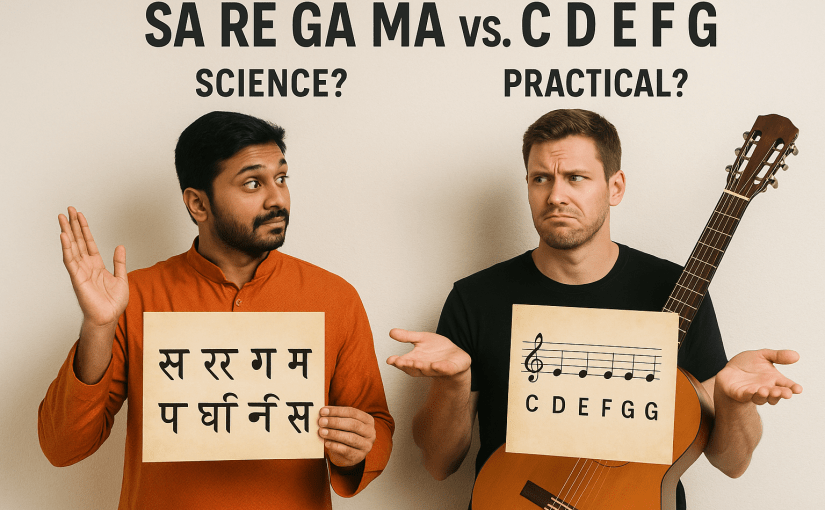
If you’ve ever been stuck at a wedding between the nadaswaram/shehnai player and the Western band belting out “Summer of ’69”, you’ve probably asked yourself the deep, philosophical question:

Why on earth are there two ways to write music, and which one should I bother learning before my next rebirth?

So, let’s introduce our two contestants.

Contestant One: The Indian Sargam

Sa Re Ga Ma Pa Dha Ni Sa

Sargam is that genial uncle who says, “Just come, beta, we’ll adjust,” and actually means it. No fuss about where you start—today Sa might be C, tomorrow Sa might be D, and next week it could be on a note only the neighbourhood cat can hear.

  • Relative Pitch = Chill Vibes If Sa is the first step, the rest of the staircase adjusts itself. It’s musical jugaad at its finest.
  • Vocal-Friendly No singer has ever said, “Oh no, I can’t sing today because Sa is stuck on 261.63 Hz.” You just shift it, smile, and carry on.
  • Ornaments Galore Sargam doesn’t just give you notes—it lets you bend them, slide them, and add so much gamaka that even the note doesn’t know where it started.

Think of Sargam as the filter coffee of music—warm, strong, flexible, and doesn’t come with an instruction manual.

Contestant Two: The Western Notation

C D E F G A B C

Now here comes the second cousin—neat haircut, wearing a suit, and carrying a folder. Everything has to be exact. If C is 261.63 Hz, that’s where it stays. If you dare move it, there will be meetings, memos, and possibly a sternly worded email from a conductor.

  • Absolute Pitch = Discipline It’s the GPS of music—you know exactly where you are at all times.
  • Visual Map of Sound Those five lines, dots, flags, and squiggles are like an architect’s blueprint. You can rebuild the Taj Mahal in notes if you know how to read them.
  • International Passport Whether you’re in Madras, Madrid, or Madagascar, this script will be understood. (Except maybe by your local auto driver.)

Western notation is like ordering pizza—fixed recipe, precise toppings, and yes, people will notice if you replace mozzarella with paneer.

Which is More “Scientific”?

Here is where Uncle Rajan wades into the conversation. “All that is fine saar, but which one is more scientific?”

Western notation wins if “scientific” means standardisation and precision—like laboratory coffee: exact temperature, exact brew time, exact bitterness.

But Sargam has its own science—more like grandma’s cooking. She doesn’t measure, yet every dish tastes exactly right. The science is in the relationship between notes, not their fixed coordinates.

Which is Easier and More Practical?

  • If you’re starting out: Sargam is the easy entry—like learning cricket in your backyard before playing in a stadium.
  • If you’re handling an orchestra: Western notation keeps the chaos in check. Without it, your 40-piece ensemble might sound like 40 street vendors shouting in different keys.
  • If you’re doing fusion: Learn both. Sargam keeps your Indian side, Western notation keeps your drummer from walking off stage.

Final Verdict

Neither is “better”—they’re just designed for different musical worlds.

Sargam is like filter coffee at the corner kaapi kadai: flexible, soulful, forgiving.

Western notation is like an espresso from an Italian café: intense, precise, and possibly served with a side of attitude.

If you can master both, you’re musically bilingual. And like knowing how to make both idly and pasta, you’ll never go hungry—either for food or for tunes.

Freebies and the Unsung Heroes: When “Thanks” Doesn’t Pay the Bills

Freebies and the Unsung Heroes: When “Thanks” Doesn’t Pay the Bills

Ah, the life of a musician or recording engineer – it’s glamorous, isn’t it? Flashing lights, screaming fans, and… endless requests for free background tracks? Wait, what?

If you’re a musician or a recording engineer, chances are you’ve heard it all too often: “Hey, could you whip up a quick track for me?” or “I need some music for my new YouTube channel. Can you help?” But the kicker? More often than not, all you get in return is a quick “thanks” (if you’re lucky) and a pat on the back.

Now, don’t get me wrong. “Thank you” is a beautiful phrase that warms the heart and soul – but unfortunately, it doesn’t warm the pockets or pay the bills.

Let’s take a moment to compare with other professionals.

Imagine strolling up to a doctor at a social gathering and saying, “Hey, I’ve had this cough for a while. Can you just quickly check it out?” Or cornering an architect at a birthday party with blueprints in hand, hoping for a free consultation. Would they be met with the same expectations of ‘gratis’ expertise?

Let’s be honest, it does happen. Many professionals, regardless of their field, get bombarded with pro-bono requests from friends, family, and the occasional audacious acquaintance. But there’s a peculiar sting that musicians and recording engineers feel, given the perception that their craft is “easy” or “just a hobby.”

But who’s really to blame here?

1. The Perpetrator (a.k.a. The “Friend”)

Let’s face it, most of us are guilty of wanting something for nothing. In a world of instant gratification and streaming services, the value we place on individual expertise can sometimes wane. To the untrained eye (or ear), creating a background track might seem as simple as pushing a few buttons. But as any seasoned musician or engineer knows, it’s hours of work, years of training, and a bottomless well of patience.

2. The Enabler (a.k.a. The “Professional”)

Sometimes, professionals are their own worst enemies. By occasionally offering freebies to win favor or out of sheer kindness, they unwittingly set a precedent. The occasional free consultation or quick background track can quickly snowball into a mountain of expectations.

So, what’s the solution?

For starters, recognizing and respecting the craft is essential. Whether it’s music, medicine, or masonry, every profession requires expertise that deserves acknowledgment. And for professionals, it’s essential to establish boundaries. It’s okay to say no, or to kindly point out that expertise has a price. After all, you wouldn’t just grab a candy bar from a store and walk out with a mere “thank you”, would you?

In the end, let’s remember the timeless wisdom: If you’re good at something, never do it for free. So, to all our unsung heroes, keep strumming, keep mixing, and most importantly, keep valuing your worth!

Is the modern-day stand-up inspired by 10th-century Chakiyar Koothu?

Was chakyar koothu the earliest form of stand-up comedy?

The first stage productions of Chakyar Koothu appeared in the tenth and eleventh centuries. It is believed that Kutiyattam, the earliest surviving form of Sanskrit theater, is the ancestor of Chakyar Koothu.

Historically, the koothambalam,  a performance area in a temple built to specifications in the Natyashastra (a detailed manual about dance and allied subjects), was the only venue for Kutiyattam and koothu performances. Painkulam Raman Chakyar (active 1905–1980), a rebel with a cause, was responsible for the first public performance of koothu outside of the koothambalam, which caused widespread outrage and earned him social isolation. He also played a crucial role in adding it to the Kalamandalam ( a premier dance and music school of Kerala) curriculum.

Chakyar koothu accords great importance to the vidushaka (jester/ narrator, very much like the modern stand-up comedian), and his monologues combine prose and poetry. The vidushaka’s commentary is full of biting sarcasm and witty asides. Although the choreography is light, he makes his point clearly through his facial expressions. He makes the act more contemporary and inclusive by getting responses from the audience, making analogies, and commenting on current socio-political events. Minus the profanity and the cussing, doesn’t this describe a stand-up comedy show?

Here is an invitation to witness a chakiyar koothu by a modern-day artist.

The artist begins with a Sanskrit verse and invites people to watch him perform in Malayalam as spoken by the Namboothiris and Chakyars!

Typically, the vidushaka or the performer would first offer his prayers to the presiding deity. He then chants a shloka or verse in Sanskrit, which is an outline of the theme he is going to perform. The verse is then translated into the local language for everyone to understand. Although a central theme is specific to the performance, nothing stops him from dragging various contemporary subjects like politics into it. He is accompanied by the mizhi, a large copper vessel with it’s mouth covered by a taut skin on which the drummer plays and a pair of large cymbals.

It is a ritual specific to the Chakyar people (a priestly caste). The performer wears a colorful headdress, has a bushy black mustache, which is deliberately exaggerated, and is covered in sandalwood paste with bright red spots. His very appearance is quite comical.

It is only the male members of the Chakyar who perform the koothu.  Not to be outdone, there is also a female version called Nangyar Koothu, which is by the Nambiar community of Kerala.

So, it would be safe to say that modern-day stand-up shows originated in Kerala in the tenth century. 

The costume of the modern clown is very similar in color combination to the performer of the koothu.

What say you? Write to me if you don’t agree!


Photo credits

koothu” by Paul Varuni is licensed under CC BY 2.0.

mizhav” by Arayil is licensed under CC BY 2.0.

File:Vidushaka-Mani Madhava Chakyar.jpg” by Sreekanth Vis licensed under CC BY-SA 3.0.

Bring on the clowns” by markleepower is licensed under CC BY-NC-ND 2.0.

Suyash Dwivedi, CC BY-SA 4.0 https://creativecommons.org/licenses/by-sa/4.0, via Wikimedia Commons

Sources

https://prepp.in/news/e-492-chakyar-koothu-indian-folk-dance-art-and-culture-notes

https://www.thehindu.com/entertainment/dance/the-necessary-nuances-of-chakyar-koothu/article26078823.ece