Unlocking the Divine Power: The God Frequency of 963 Hz

Introduction

The world is abuzz with “The God Frequency,” a term coined to describe a specific sound frequency, 963 Hz, believed to possess extraordinary healing and transformative powers. This elusive frequency is said to resonate with the natural frequency of the universe, opening a gateway to spiritual growth, healing, and self-realization. So let’s delve into the mystical world of sound frequencies and discover the magic of 963 Hz.

The Power of Sound Frequencies

Sound frequencies have long been known to have healing and spiritual growth. The ancient Indian tradition of yoga, for example, has used sound frequencies, or “mantras,” for thousands of years to promote meditation and mental focus. Similarly, the ancient Egyptians, Greeks, and Chinese used sound therapy to treat various ailments and enhance spiritual development.

Modern science has also recognized the potential of sound frequencies in promoting wellness. For example, studies have shown that specific frequencies can help alleviate stress, enhance concentration, and even promote the production of certain hormones. The God Frequency of 963 Hz is a unique frequency that has captured the attention of spiritual seekers and healers alike.

The God Frequency of 963 Hz

The 963 Hz frequency is often called the “God Frequency” because it is believed to resonate with the natural frequency of the universe. This frequency is said to have powerful healing properties, promote spiritual growth, and facilitate deep meditation. But what makes the God Frequency genuinely unique? Let’s explore some examples of how this mysterious frequency can transform your life.

  1. Deep Healing and Regeneration

When exposed to the 963 Hz frequency, the body and mind are said to enter a state of deep relaxation, allowing the healing process to commence. This frequency helps repair damaged tissues, reduce inflammation, and stimulate the production of endorphins, promoting a sense of well-being and happiness. Many healers and practitioners use the God Frequency to assist in physical and emotional healing.

  1. Spiritual Growth and Enlightenment

The God Frequency is said to help individuals connect with their higher selves and open themselves to spiritual experiences. In addition, this frequency aids in releasing energy blockages and balancing chakras, allowing for a free flow of energy throughout the body. As a result, individuals may experience increased intuition, heightened creativity, and profound spiritual insights.

  1. Enhanced Meditation and Mental Clarity

Meditating with the 963 Hz frequency can lead to more profound relaxation and mental clarity. As the mind becomes more focused and calm, it becomes easier to access the subconscious mind and explore one’s inner world. In addition, many individuals who use the God Frequency during meditation report increased feelings of peace, love, and oneness with the universe.

  1. Manifesting Desires

The 963 Hz frequency is also said to be a powerful tool for manifesting desires and aligning oneself with the natural abundance of the universe. Individuals can raise their vibrational frequency by meditating with this frequency and attracting more positive experiences.

Some composers who have used this frequency

While the God Frequency of 933 Hz concept is relatively new and not widely adopted in mainstream music, several composers and artists have started exploring this unique frequency to create transformative and healing music. Some of these composers and artists include:

  1. Michael Tyrrell: Michael Tyrrell founded Wholetones, a healing frequency music project. He is a musician, author, and speaker exploring the power of music frequencies, including the 933 Hz frequency, for healing and personal transformation.
  2. John Stuart Reid: John Stuart Reid is an English acoustics engineer and inventor of the CymaScope, a device that makes sound visible. He has composed music in various healing frequencies, including the 933 Hz, to create soundscapes to promote well-being and spiritual growth.
  3. Gary Malkin: Gary Malkin is an Emmy award-winning composer, public speaker, and music and health innovator. He has created compositions in various healing frequencies, including the 933 Hz frequency, to help individuals achieve a state of deep relaxation and inner peace.
  4. Ananda Bosman: Ananda Bosman is a visionary musician and researcher who has explored the power of sound frequencies for spiritual and healing purposes. He has composed music using the 933 Hz and other specific frequencies to facilitate spiritual awakening and transformation.

These composers and artists have recognized the potential of the 933 Hz God Frequency and are incorporating it into their music to create a powerful and transformative listening experience. As awareness of this frequency grows, more composers will likely begin experimenting with the God Frequency, creating a new healing and spiritually focused music genre.

Conclusion

The God Frequency of 963 Hz holds the potential to unlock the divine power within each of us, transforming our lives through healing, spiritual growth, and self-realization. Whether you are a seasoned spiritual seeker or just beginning your journey, incorporating the 963 Hz frequency into your meditation and healing practices may be the key to unlocking a world of profound wisdom and limitless possibilities.
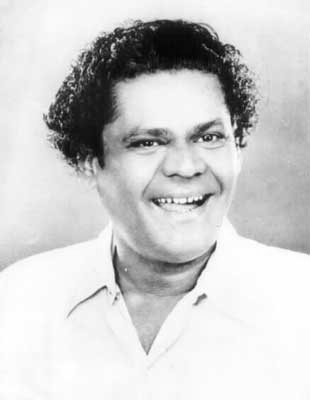
N S Krishnan: The Legendary Comedian of Tamil Cinema

Introduction:

In Tamil cinema, the name N S Krishnan stands tall as one of the most iconic comedians to have graced the silver screen. With an impeccable sense of comic timing and a natural flair for acting, Krishnan redefined the comedy genre in the early years of the Tamil film industry. In this blog post, we take a closer look at the life, career, and fascinating real-life anecdotes of the legendary N S Krishnan.

Early Life:

Born on November 29, 1908, in the small village of Nagercoil, Tamil Nadu, Nagercoil Sudalaimuthu Krishnan, fondly known as N S Krishnan or NSK, began his career as a stage actor in a drama troupe. He was a man of many talents and worked as a playwright, singer, and dancer before entering the film industry. His passion for the arts and strong work ethic laid the foundation for his successful career in cinema.

Career and Notable Movies:

NSK debuted in the Tamil film industry with the movie “Sathi Leelavathi” (1936), directed by the legendary A.V. Meiyappan. This began a successful partnership with leading lady T. A. Madhuram, who later became his wife. The duo became a hit pair on-screen, working together in over 150 films and inseparable in real life.

Some of NSK’s most notable movies include:

  1. Ambikapathy (1937) – This historical drama based on the Tamil epic poem by the same name featured NSK in a significant role, showcasing his versatility as an actor.
  2. Haridas (1944) – NSK played a memorable role in this blockbuster movie, which ran for a record-breaking 110 weeks in Chennai’s Gaiety Theatre.
  3. Nallathambi (1949) – NSK starred as the protagonist in this film, portraying a humorous and lovable character that won over the audience’s hearts.
  4. Avvaiyar (1953) – NSK’s comic timing and engaging performance in this biographical film about the life of the famous Tamil poet Avvaiyar was highly appreciated.

Real-life Anecdotes:


NSK was an exceptional actor and a man of great wit and wisdom. His wisdom and quick thinking saved him from potential embarrassment on multiple occasions. Here are some fascinating real-life anecdotes that illustrate NSK’s remarkable wit:

  1. During a stage performance, NSK noticed that a small part of the set had caught fire. Instead of panicking, he cleverly incorporated the fire into his act, making the audience laugh and saving the show. He calmly put out the fire while making the audience believe it was all part of the act.
  2. In another instance, NSK was caught without a ticket on a train journey. When the ticket inspector confronted him, NSK humorously replied, “I am an actor who can bring joy to millions. Can’t I travel without a ticket for a few miles?” His wit and charm worked, and the ticket inspector let him go without penalty.
A nice video byV. Sriram about N S Krishnan

Conclusion:


N S Krishnan’s contributions to Tamil cinema remain unparalleled. His natural talent, comic timing, and on-screen chemistry with T. A. Madhuram made him a beloved figure in the industry. He also supported his co-actors and others. He resurrected Thangavelu’s career when Thangavelu was down and out by offering him a role in his movie, Singari.

Unfortunately, he was a co-accused along with another superstar of those time, M K Thiagaraja Bhagavathar and was sentenced to a 30-month jail time. He couldn’t get back to his stature after his release from jail and died a broken man, drained of his finances.

His real-life anecdotes and experiences show us that NSK was not just an actor but a quick-witted and humble human being. As we remember his legacy, it is evident that his work continues to inspire and entertain generations of audiences.

Manorama – The Unstoppable Legend of Tamil Cinema

Introduction:

Manorama Aachi, a name that is synonymous with the golden era of Tamil cinema, has been an inseparable part of the industry for over five decades. With a career spanning over 1,000 films, she has left an indelible mark on Indian cinema with her impeccable acting skills and a personality that never fails to amaze her. In this blog, we celebrate the life and accomplishments of this legendary actress and delve into some exciting episodes from her real life.

Early Life and Career:

Manorama, born Gopishantha in 1943, grew up in a small village in Tamil Nadu. Her passion for acting was evident from a young age, and she started her career as a stage artist before venturing into films. She debuted in 1958 with the movie “Malayitta Mangai” and quickly rose to fame with her exceptional acting skills, earning her the nickname “Aachi.”

Aachi soon became a household name in the Tamil film industry, earning critical acclaim and immense popularity for her roles in movies like “Thillana Mohanambal,” “Samsaram Adhu Minsaram,” and “Chinna Gounder.” She was known for her impeccable comic timing and versatility, which allowed her to play a wide range of roles, from comedy to serious drama.

Notable Performances:
Over her long and illustrious career, Manorama Aachi delivered countless memorable performances that won the hearts of audiences and critics alike. Some of her most iconic roles include:

  1. Thillana Mohanambal (1968) – As Jil Jil Ramamani, Aachi played a feisty and independent woman who added a touch of humor and drama to this classic film.
  2. Samsaram Adhu Minsaram (1986) – As Godavari, Manorama Aachi portrayed a strong and loving mother who strives to keep her family together despite their differences.
  3. Singaravelan (1992) – Manorama Aachi delivered a hilarious performance as a quick-witted woman who helps the protagonist (played by Kamal Haasan) in his mission.
  4. Avvai Shanmugi (1996) – Aachi’s role as a sharp-tongued mother-in-law in this Kamal Haasan starrer showcased her ability to deliver humor with impeccable timing.

Interesting Episodes from Manorama aachi’s Life:

  1. Turning down a role from MGR:
    A little-known fact about Aachi’s career is that she once turned down an offer from the legendary M.G. Ramachandran (MGR) for a role in his film “Engal Thangam.” Manorama Aachi was suffering from typhoid then and could not accept the offer. Despite MGR’s insistence, Aachi chose not to compromise her health, and the role eventually went to another actress.
  2. The Guinness World Record:
    Manorama Aachi holds the Guinness World Record for acting in the most number of films by a female actor. She achieved this feat in 2008 when she completed her 1,000th film, “Thunaivan.” This is a testament to her dedication and passion for her craft.
  3. Personal Life and Philanthropy:
    Manorama Aachi was known not only for her on-screen performances but also for her generosity and kindness off-screen. She was actively involved in charitable activities, supporting causes close to her heart, such as the welfare of the elderly and the differently-abled. Aachi adopted several orphanages in Tamil Nadu, providing financial support to ensure the children received proper education and upbringing.
  4. Aachi’s Love for Languages: Manorama Aachi was a polyglot, fluent in several languages, including Tamil, Telugu, Malayalam, Kannada, and Hindi. This linguistic prowess allowed her to work in films across different South Indian industries, earning her a pan-Indian fan following. Aachi’s ability to adapt to various dialects and accents made her an invaluable asset in the film industry.
  5. The Bharat Ratna Nomination: Manorama Aachi’s contribution to the Tamil film industry did not go unnoticed. In 2008, she was nominated for the Bharat Ratna, India’s highest civilian award. Though she did not receive the award, the nomination was a significant recognition of her immense contribution to Indian cinema.

Conclusion:

Manorama Aachi’s unparalleled dedication to her craft, versatile acting skills, and inspiring off-screen persona have left an indelible mark on the Tamil film industry. Her legacy inspires new generations of actors and filmmakers, ensuring that her name will forever be etched in the annals of Indian cinema.

G. D. Naidu – The Pioneering Inventor from Coimbatore

Introduction

In the annals of Indian inventors, there lies a hidden gem whose remarkable contributions to engineering and invention deserve more recognition: Gopalswamy Doraiswamy Naidu, or G. D. Naidu. Born in Coimbatore, G. D. Naidu was influenced by the Stanes Group of Institutions, among other mentors and visionaries, who guided him throughout his career. In this blog, we take a closer look at the life, achievements, and people who shaped G. D. Naidu’s illustrious journey, from his humble beginnings as a server in a hotel to becoming a successful inventor and entrepreneur.

Early Life and Background

G. D. Naidu was born in Coimbatore on March 23, 1893, and displayed an extraordinary aptitude for machines and mechanics from an early age. Although he faced numerous challenges, including financial constraints and limited access to formal education, his passion for learning and inventing remained undeterred.

Driven by his love for machines, Naidu obtained work as a server in a hotel in Coimbatore to save money to buy a motorcycle. After purchasing the vehicle, he spent time dismantling and reassembling it, eventually becoming a mechanic. This hands-on experience with machinery laid the foundation for his future career.


The motorcycle G. D. Naidu bought from a British Revenue officer to understand how it worked


In 1920, Naidu began his transport business by purchasing an automobile coach, driving it between Pollachi and Palani. His venture, Universal Motor Service (UMS), quickly grew and, in a few years, owned the country’s most efficient fleet of public transport vehicles.

Influence of Stanes and Other Visionaries

The Stanes Group of Institutions, founded by Sir Robert Stanes in 1862, played a significant role in shaping Coimbatore’s growth as an industrial hub. These institutions provided hands-on training and education in various technical fields, and the Stanes Motor School, in particular, captivated young Naidu.

Apart from the Stanes Group, several visionaries and mentors influenced G. D. Naidu’s journey. One such influential figure was Diwan Bahadur R. K. Shanmugam Chettiar, a successful businessman and philanthropist who recognized Naidu’s potential and provided financial assistance to pursue his passion.

Later, Naidu traveled to Germany, where he met German inventor and industrialist Richard Küchen. Küchen’s work on safety razors and other cutting tools inspired Naidu to develop his own Rasant Razor, which would gain international attention.

Inventions and Innovations

G. D. Naidu’s inventive spirit led him to create over 100 patents in various fields. Some of his most notable inventions include:

  1. The Rasant Razor (1930): The safety razor with replaceable blades, which garnered international acclaim and helped Naidu establish a long-lasting business relationship with Richard Küchen.
  2. India’s First Electric Motor (1937): This indigenous electric motor was used in domestic appliances, fans, and other machines, paving the way for Indian self-reliance in electrical engineering.
  3. The Universal Grinding Machine (1954): Naidu’s versatile grinding machine could grind complex shapes and profiles with precision, making it a valuable asset in the manufacturing sector.
  4. Contributions to the Indian Film Industry: Naidu’s passion for cinematography led him to design a portable film projector called the “Filmadora” and a movie camera named “Naiduscope.” His work in this field was instrumental in shaping India’s burgeoning film industry.
  5. Naidu’s Self-starting Two-stroke Engine: This innovative engine provided a cost-effective and fuel-efficient solution for two-wheelers and three-wheelers, revolutionizing the Indian automobile industry.

Philanthropy and Legacy

G. D. Naidu was not only an inventor but also a dedicated philanthropist. In 1945, he established the G. D. Naidu Charities to support educational and healthcare initiatives in Coimbatore. The G. D. Naidu Industrial Exhibition, held annually, showcases the inventions and innovations of young engineers and entrepreneurs.

Conclusion

The story of G. D. Naidu’s life and achievements is a testament to the power of passion, perseverance, and the impact of influential mentors.

The easy button

So, we were all in the sunroom, slouching in our respective, well-upholstered, deep sofas. By all, I mean the family; me, the missus, and three of our off-spring.

It’s at times like this ‘ recreational argumentativeness’ takes over and possesses us. Once such sprang forth when one of us casually remarked as to how these weight loss shots er….shots for A1C regulation for Type 2 diabetes were for lazy people.

“Nothing like exercise and a controlled diet,” said the daughter.

“That’s an over-simplification,” said I, the slouch that I was. “Obesity and diabetes can happen to very fit and active people too”

While two of the off-springs were in the health industry, I was what you would call a Google medicine man. But that didn’t stop me from taking them on!

“In any case, laziness is not a bad thing, so much of good has come about due to laziness”

“Prove it,” said she, not to give in easily

And so, here goes the sermon. For those of you who don’t want a lengthy spiel, there is a concise list after this verbiage.

The story of how laziness caused inventions

Some of the most significant inventions have been born out of laziness. People have always been looking for ways to make their lives easier and more comfortable, and this desire for convenience has often led to remarkable discoveries.

The wheel is one of the earliest examples of an invention born out of laziness. The wheel was first used by early humans around 3500 BC and was a game-changer for transportation. Prior to the invention of the wheel, people would have to carry heavy loads by hand, which was both time-consuming and physically demanding. The invention of the wheel allowed people to move heavier loads with less effort, making it possible to build larger structures and expand trade networks.

Another example of an invention born out of laziness is the remote control. Invented by Eugene Polley in 1955, the remote control was initially created to make it easier for people to change channels on their TV without having to get up from their chairs. While it may seem like a simple invention, the remote control has become an essential part of our daily lives, allowing us to control everything from our TVs to our air conditioning units with the touch of a button.

In more recent times, robotic vacuum cleaners like the Roomba have become increasingly popular. The Roomba was invented by iRobot in 2002 and was designed to help people avoid having to vacuum their homes manually. With its autonomous navigation system, the Roomba can clean floors without any human intervention, making it a favorite among busy homeowners.

Similarly, automatic pet feeders have become a popular choice for pet owners who are too lazy to feed their pets regularly. These feeders dispense food at preset times, ensuring that pets are fed even if their owners are away from home.

In conclusion, many of the inventions that we use today were born out of laziness. While some may view laziness as a negative trait, it has led to some remarkable discoveries that have made our lives easier and more comfortable. From the wheel to the Roomba, these inventions have had a profound impact on society, and it will be interesting to see what other innovations come about in the future due to our desire for convenience.

List of inventions born from laziness

  1. Remote control: Invented by Eugene Polley in 1955 because he was too lazy to get up from his chair to change the channel on his TV.
  2. Roomba: A robotic vacuum cleaner that was created by iRobot in 2002. It was invented to help people avoid having to vacuum their homes manually.
  3. Self-stirring mug: For those who don’t like stirring their coffee, this invention is perfect. The mug has a built-in motor that spins a small plastic disk at the bottom, stirring the drink.
  4. Lazy glasses: These glasses use prisms to change the angle of vision, allowing the wearer to read or watch TV without having to tilt their head.
  5. Automatic pet feeder: Invented for pet owners who are too lazy to feed their pets regularly, the automatic pet feeder dispenses food at preset times.
  6. Electric can opener: The first electric can opener was invented in the 1930s to make opening cans easier and less labor-intensive.
  7. Microwave oven: Invented by Percy Spencer in 1945, the microwave oven was initially developed to heat food quickly and conveniently, allowing people to avoid spending time cooking.
  8. Segway: Designed by Dean Kamen in 2001, the Segway was intended to be a more efficient and effortless way of getting around than walking.
  9. Power windows: Power windows were introduced in cars in the 1940s to allow drivers to roll their windows up and down without having to use a hand crank.
  10. Video conferencing: While video conferencing has become essential during the pandemic, it was initially developed as a way for businesses to avoid travel costs and the hassle of in-person meetings.

No prizes for guessing who or what created this sermon or list. AI did it! Artificial Intelligence and not Air India bhaiya! The crown invention stemmed from sheer laziness!

The one-lung celestial singer

I am dividing this blog into two parts – the mythological part and the fact-checked part.

I can already sense a few hackles rising.

“So, do you say that all mythological books are not based on facts?” “What about the Ramayana, the Gita, the Bible?”

Dear Sir/Madam – a thousand apologies – let’s leave all this for the stringent right, okay va?

Mythology

A child prodigy whose starts to sing as early as five is the apple of everybody’s eye. The child grows up and becomes a young adult.

This young man has a passion for seeking meaning. A meaning for his existence in all things unseen. His explorations connect him with a group of wandering minstrels of Bengal, the Bauls.

Who are the Bauls? The actual term ‘Baul’ means madman. In this context, there is a group or a band of singing minstrels who are crazy about spirituality and God. There are elements of Sufism, Vaishnavism, and Tantra, and they also inhabit areas of West Bengal, Assam, and Bangladesh.

Returning to our young man, he decides to go with the Bauls in their wandering. Just the music or the spiritual aspect would have been enough to drag him along, but with music and spirituality, it was inconceivable that our young man would have come unstuck. He stuck with them like a limpet to rock – and I don’t mean this in a derogatory way, as the word association of limpet is not exactly complimentary.

Long story short – the young man, who is not so young – roughened by the complete absence of creature comforts – remember this was not a trip on a mobile home hitched to an SUV. This was the real McCoy of wandering. Apart from heavily calloused feet and tousled, matted hair, the not-so-young man had contracted a raging infection.

Tuberculosis

The myth within this mythology is that the infection, the disease, caused him to return to ‘civilization.’

As luck would have it, the doctors had to remove a damaged lung to cure him of tuberculosis. Many would have just resigned to fate and plod along till the end of their time, but not the not-so-young man. He continued with his singing. He changed his style of singing to short phrases instead of long aalaps. If anything, he got more fans.

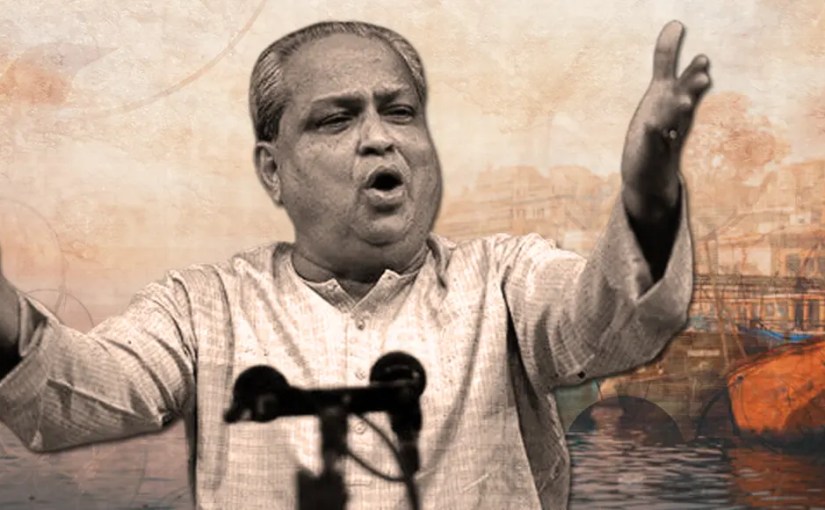
The name he was most popularly known as – Kumar Gandharva.

FACT: Kumar Gandharva: A Musical Genius of India

Kumar Gandharva was a legendary Indian classical singer known for his unique style and innovative approach to classical music. Born as Shivaputra Siddharamayya Komkali on 8 April 1924, he was a revered figure in the world of Hindustani classical music and is still remembered today for his contributions to the genre.

Gandharva’s musical journey began at a young age when he showed an early interest in music and began singing bhajans at the age of five. He went on to study under several renowned music teachers and eventually developed his own style, which combined traditional classical music with elements of folk and devotional music. This fusion of styles gave his music a unique and captivating quality that set him apart from other classical singers of his time.

One of the most distinctive aspects of Gandharva’s music was his use of a unique, nasal voice, unlike anything in classical music. Despite being criticized by some traditionalists, Gandharva’s innovative style was embraced by audiences worldwide and helped to bring classical music to a broader audience.

In addition to his musical contributions, Gandharva was also known for his devotion to his art and deep spiritual connection to music. He was deeply influenced by the Bhakti movement, which emphasizes the individual’s devotion to God, and this spiritual dimension is evident in the emotional intensity of his performances.

Despite his success and popularity, Gandharva’s life was challenging. He struggled with health issues throughout his career, including tuberculosis, eventually leading to his death at 63. However, despite his early passing, his legacy lives on, and he is remembered as one of the greatest classical musicians of all time.

In conclusion, Kumar Gandharva was a musical genius who revolutionized the world of Hindustani classical music with his unique style and innovative approach. His devotion to his art and deep spiritual connection to music has made him a beloved figure in classical music. His contributions will continue to be remembered and celebrated for generations to come.

The talent that was underrated – Thangavelu

Madras wasn’t a hotbed of job opportunities in the late sixties and probably most of the seventies. While I was lucky to find a job in the erstwhile Indian Airlines, many of my college mates were still searching for a job.

I did run into many of my mates, and the conversation would go like this.

” Dey, machhan, how are you? It’s been a while since I saw you last. Where are you working now?”

Reply: ” I am fine, enjoying life!”

That should have given me a clue that the poor lad is unemployed. But the idiot in me keeps plowing on.

Me: ” That’s great, but where do you work?”

Reply: “I work as a manager in a company.”

Me: “That’s great. Which company?”

Most times, the reply would be Mannar and company! Which meant he didn’t have a job! We would burst out laughing.

In those good days, we didn’t have to worry about being politically correct. You just expressed yourself, and that’s it.

The lads of today, who I am sure would be scratching their heads about what all this is about, here’s the explanation.

Mannar & Co.

Mannar & Co. is a fictitious firm that the character played by the prolific Thangavelu would answer if he were asked about employment in the film Kalyana Parisu (Tamizh). So, to most of us, who lived during that memory time frame, Mannar & Co. was an honorable way of saying the person is unemployed. It also had shades of deceit, but let’s leave that aside now.

Mannar & Co

So, back to Thangavelu, the actor who should have had much more recognition and fame than he got.

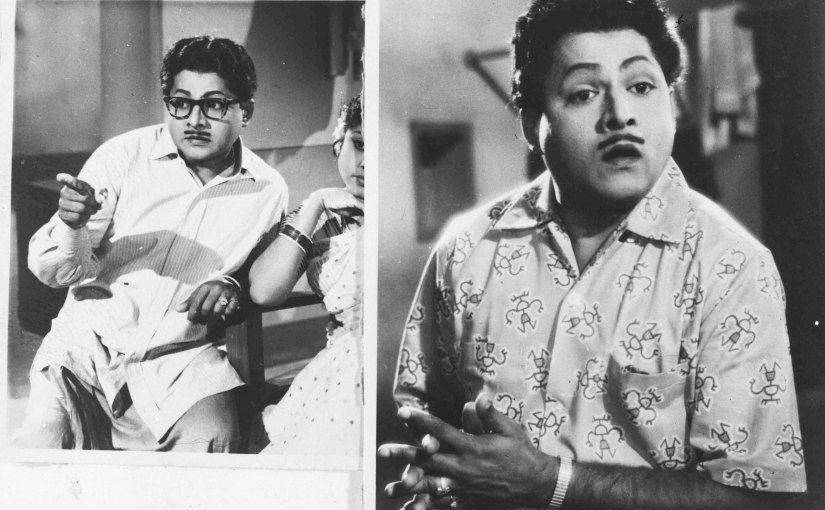
K. A. Thangavelu was an actor who excelled in almost every role he played. While his comedy relied on timing and facial expressions, it did not have the physicality of a Chandrababu or Nagesh. His humor was subtle but expressive enough for anyone to understand. In other words, you didn’t need to include a caption card with the word ‘JOKE’ emblazoned in it with poster colors.

Early days

The man suffered a lot as a child and even in early adulthood. His father was an alcoholic, and his refuge, his mother, died when Thangavelu was about six. His father left Thangavelu in the care of a relative and sailed off to Singapore in search of better days.

The young Thangavelu was a servant. He had to do all the menial jobs, like washing the cattle, cleaning the house, washing vessels, and the like. The only thing that kept him sane was his love for music and dance, which he would break into whenever he felt like it.

This singing and dancing would turn on the wrath of his foster parents, but Thangavelu soldiered on. He eventually joined the Rajambal Company troupe and was taught acting and mentored initially by Yedhartham Ponnuswamy Pillai and later by M. Kandaswamy Mudaliar.

For nine years, he worked in theatre. When Kandaswamy Mudaliar moved over to the cinema, Thangavelu followed him. His first break was a small role in the film Sathi Leelavathi, the 1936 version, which was the remake of the play Pathi Bhakti. Elis R. Dungan directed the film.

Sathi Leelavathi launched the career of M.G.R., T.S.Baliah, and N.S. Krishnan, all of them became very successful actors. However, this didn’t prove a lucky break for Thangavelu, so he quit movies and had to beg at a nearby temple to feed himself. M M Marappa, an actor, spotted him at the temple and brought him back to the theatre. He became a little stable this time, and coincidentally, his errant father returned from Singapore and lived with him.

N.S. Krishnan – the superstar who saved him

N. S. Krishnan, the superstar actor-director, spotted Thangavelu in theater and gave him another lease of life in cinema. He cast him in a comical role in the film Singari. His comedic timing impressed N.S.K. so much that N.S.K reportedly gave Thangavelu an advance of Rs. 5,000. Thangavelu’s relative thought he had stolen the money from N.S.K and promptly headed out to N.S.K’s house to apologize for his ward’s stealing. It was then the relative came to know the actual worth of Thangavelu.

Thangavelu was ever thankful to N.S.K for resurrecting his career and bringing him back to films, dancing, and acting, something he loved doing. Thangavelu wore a locket that had N.S.K’s picture in it as a tribute to the man who picked him from the dumps and gave him stature.

No role fazed Thangavelu. At one time, he was pitted against P. Bhanumathi, the reigning superstar, in the movie Rambayin Kadalan. He could hold his own and not let Bhanumathi overshadow him despite her more considerable stature (and I don’t mean being obese) and star billing.

Circling back to my opening paragraph about the film Kalyana Parisu, Thangavelu married the lady that played his wife in the movie, M. Saroja, who was his second wife and several years his junior in age. They lived a happy life.

His autumn years

During his autumn years, he got a few acting jobs, which he could have had more if he had reduced his fee. He refused to do this, and so too his adamancy to act in only Tamizh films. He won the Tamil Nadu government’s Kalaimamani in 1968 and Kalaivanar award in 1989.

He shed his mortal coil in his house in Chennai in September 1994. His wife Saroja lived on until April 2012.

Karaoke, a Dunning-Kruger effect?

It was past the time the cows came home. The good missus and I were squeezing out the few minutes between verticality and horizontality.

Jeez!

It was time to go to bed because the next day was a working day. However, The good wife was on her phone, scrolling through the various videos that social media algorithms were feeding her device.

There was this dude who was singing away to glory. That video was to entice people to a local bar that hosted karaoke events every weekend.

I use the word ‘entice’ with care because he was doing such a horrible job of singing the song that it probably was bait to get people over; two, er..three classes of people.

  • One, those who think they can do a better job and
  • Two, those who felt if he can do it, I can.
  • Three, those repulsed by the singing, muttering, if this is the standard, then even wild horses cannot drag me there.

Now, how can you find wild horses in a city? Exactly.

“Doesn’t he know he can’t sing?” asked my wife.

My reply was, “the poor bloke may not even know enough to know that he can’t sing.”

As soon as those words popped out, I had a surreal experience. I heard myself speak something I never knew existed in my knowledge bank.

The next day, after all the necessary expulsions and intakes, I headed straight to my laptop to find out why people sometimes overestimate their capabilities.

It was then that I stumbled upon the Dunning-Kruger effect.

What is the DK effect? And I am not talking about Dinesh Kartik, you cricket crazies.

The Dunning-Kruger effect

Here it is, courtesy Chat.openAI

Quote:
The Dunning-Kruger effect is a cognitive bias in which people with low ability at a task overestimate their ability. It is named after a 1999 study by David Dunning and Justin Kruger, in which they found that people who scored poorly on a test of their sense of humor also tended to overestimate their sense of humor. The effect is related to metacognition, or the ability to think about one’s thinking. People with low ability at a task may be unable to accurately assess their knowledge because they lack the metacognitive skills needed to do so. This can lead to a phenomenon known as “illusory superiority,” in which people believe they are more skilled or knowledgeable than they really are.
Unquote

The DK effect pervades the entire universe, irrespective of gender, race, or color.

Rombo, sorry, saar/madam, but that includes you and me.

Consider a scenario. You are flying at 30,000 ft and into your third glass of wine. The PA system crackles into life.

“Is there a pilot on board?”

A smart aleck pipes up. ” Actually, there should be two in the cockpit.”

He looks around for applause for the beautiful joke. Or so he thinks.

The steward is not amused.

“We have an emergency on board, and the pilots are incapacitated. I repeat, is there anyone here who can land a plane safely?”

If you raise your arm to volunteer to fly the plane because you watched a few videos on YouTube or if you played a flight simulation game, don’t blame it on the wine.

It’s a case of a full-blown Dunning-Kruger effect.

What has the heart to do with love?

Consider this:

A boy has been pining for a girl in his class.  Unfortunately, he doesn’t have the nerve to profess his love to her.  Several times, he approaches the girl, but his knees quake, and his mouth dries up.  All he can manage is a ‘hi,’ and that in a raspy voice. The school term is over, and she doesn’t show up the following year.

The boy is utterly heartbroken.

The wife is pregnant with their second child.  The husband strays and has an affair with another woman.  The wife is devasted, and she ends up having an abortion. 

The wife is utterly heartbroken.

So, what is the recurring theme here? Heartbreak. 

Heart and emotions

Now arises the question, why does everyone refer to the heart when there is a strong emotional loss or, for that matter, a great joy?  I grieve with all my heart, a heartful thanks for what you did for me; it’s with a heavy heart that I have to tell you this and so on.

The logical man stands up and says that all this is horse poop.  A brain is necessary to feel emotion.  A heart is a muscle mass responding to periodic electrical impulses that make it beat.   And many nodding heads give more credence to the statement.  Much sentimental baloney, right?

The ‘little brain’

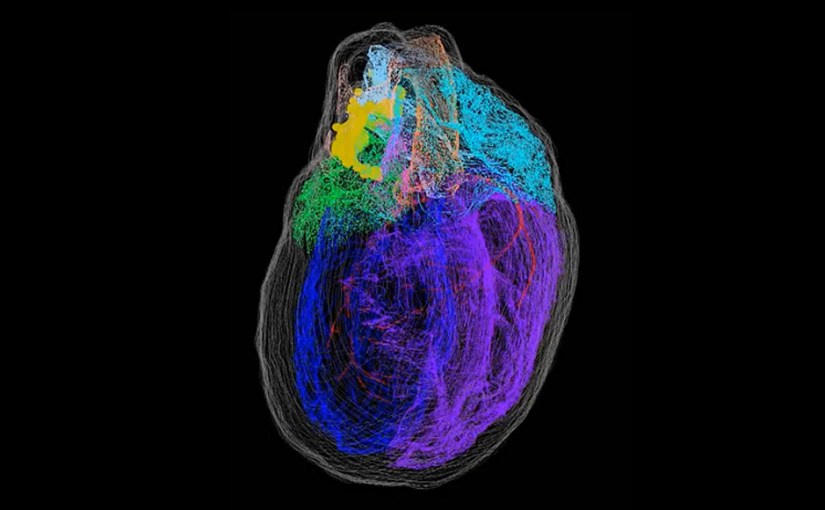
And lo and behold, recent findings by Dr. Armour in 1991 discovered that the heart has its “little brain” or “intrinsic cardiac nervous system.” This “heart brain” is composed of approximately 40,000 neurons that are alike in the brain, meaning that the heart has its own nervous system.

Reference: https://pubmed.ncbi.nlm.nih.gov/31728781/

This is an extract of the article referred to.

Quote: Scientists have reported that pain is always created by the brain. This may not be entirely true. Pain is not only a sensory experience but also can be associated with emotional, cognitive, and social components. The heart is considered the source of emotions, desire, and wisdom. Therefore, the aim of this article was to review the available evidence about the role of the heart in pain modulation. End quote

At his point, the logical man has an egg on his face, a gooey duck egg at that.

Not only does the heart have its own brain, but it also acts independently. 

Personality changes after a heart transplant?

Not to be outdone, the logical man pipes up again.  “So, what happens when a heart is transplanted?” “Does the recipient exhibit the traits and desires of the owner?”

There is the case of Claire Sylvia, a professional dancer, who was the recipient of the heart of an eighteen-year-old boy who died in a motorcycle accident. After the transplant, Claire craved Kentucky Fried Chicken and beer.  The hallmarks of an eighteen-year-old.  The family didn’t pay much attention to this until when Claire started walking, she had the purposeful stride of a man.  That led to an investigation as to who the donor was. It usually is not easy to find the donor, but with the right amount of persuasive pressure, the secrecy was lifted, and the truth unfolded.

Reference: https://www.psychologytoday.com/us/blog/explorations-the-mind/202110/heart-transplants-personality-transplants

A layman’s point of view

Me no physician, but this leads me to think that if the heart feels and stores memories and emotions, there is a need to cure the ache in the heart and not just in the logical brain. 

  • Put another way, is the pain or the emotion in the heart, the subconsciousness that has been bandied about for so long?
  • Since the emotive heart is probably not in sync with the brain in the head most of the time, is there a way to sync the two?
  • Does music help?
  • If the brain and the heart are not in sync, do we live life in conflict always?
  • Would syncing be the way to attain a superconscious state?

I tried asking these questions to the logical man.  He just gave me a blank stare and walked away.

Sigh!

A boy who ran away from home

The family sat down for lunch. All were being served. An eleven-year-old boy wanted ghee (clarified butter), but was refused. He created a scene and walked out of the house.

Everyone thought he would return once the hunger pangs started gnawing at his innards.
The boy had other ideas. He headed to the nearest railway station and boarded a train to Gwalior with not a penny in his pocket. When the train conductor went around, checking for free boarders, this boy would sing songs of Panditrao Nagarkar and Narayanrao Vyas and impress them. Most Maharashtrian folks used to be connoisseurs of popular music, so he got away and rode for free. Some conductors did not appreciate music, and they handed him over to the authorities. He did spend a few nights in jail!

Reach Gwalior or bust

So, long story short, it took the boy nearly two months to reach Gwalior.

Why Gwalior? Because Gadag, where the boy lived, had no music teachers. And he wanted to sing like Abdul Karim Khan Sahib, whose song he first heard on a gramophone recording. Gwalior was famous for the arts. It was also where Ustad Hafiz Ali Khan sahib lived, the father of Amjad Ali Khan, the renowned sarod player. Gwalior used to serve one meal for all who were learning music, obviously as an encouragement to the arts. That kept him alive. The rest of the time, he was with his guru.

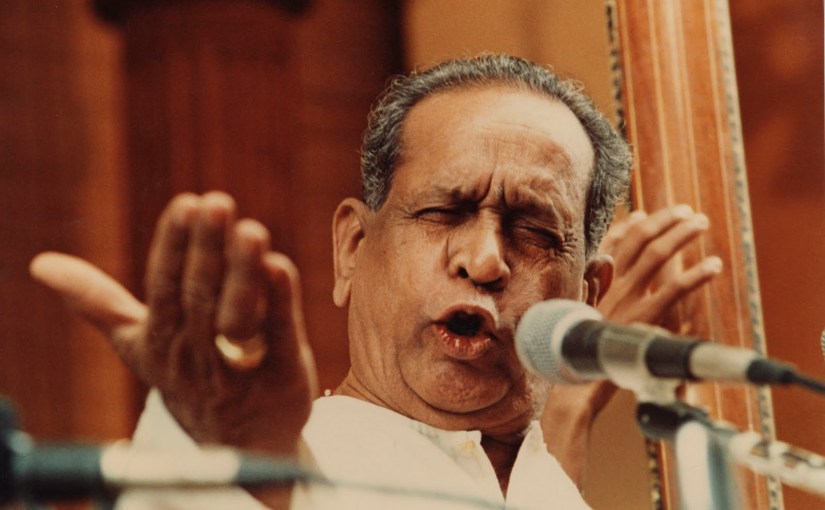
This is how the journey began for Bhimsen Gururaj Joshi, who later became the renowned Pandit Bhimsen Joshi, the first Indian singer to win the Bharat Ratna (2008), who emerged as the face of Khayal Gayaki.

Once during an interview with Gulzar, the famous lyricist of Indian films, about why he walked away from home after being denied a spoonful of ghee, the maestro explained that the ghee was just an excuse to walk away from home.

Kolkata, here we come

When he realized that Hafiz Ali Khan sahib was busy traveling to various cities for concerts, the young Joshi took off to Kolkata and landed as a domestic servant to Pahari Sanyal, a Bengali singer, and film actor. Joshi used to listen to all the rehearsals and grab whatever he could learn.
In later years, Pandit Bhimsen Joshi was singing at a conference of musicians, and Pahari Sanyal was in the audience. Pahari Sanyal had no clue that this was the same boy, now a famous artist, who was once a domestic help in his house. After the concert, Pahari Sanyal went over to congratulate Pandit Bhimsen Joshi for an outstanding recital. The maestro then told Pahari Sanyal that he was the same Joshi, a domestic help at the Sanyal’s household! I am sure many would have given an arm and a leg to glimpse Pahari Sanyal’s face at that moment!

Anyway, getting back on track, the middle-aged Joshi headed to Delhi, where he heard of the father and uncle of Ustad Nasiruddin Dagar, to learn the dhrupad singing style. He had no money to pay fees, so he headed to Jalandhar to meet with Bhakt Mangat Ram, a visually handicapped singer, to learn dhrupad.

Life takes a full circle

At the Hariballab conference, he came across Vinayak Rao Patwardhan, who asked him what his purpose for all this travel was. Almost akin to the story of the musk deer searching the forest for the origin of the scent, when all along the deer had it on its tail, Patwardhan told him that there was Sawai Gandharva a teacher near his very village at Gadag, in the Dharwar district. At this point, his life took a full circle, and returned to his native land and enrolled in the Gandharva Mahavidyalaya, headed by Sawai Gandharva, a disciple of Ustad Abdul Karim Khan, the singer who inspired the young Joshi to start his music career.

Kirana Gharana

Pandit Bhimsen Joshi followed the aesthetics of Kirana Gharana. The word Kirana comes from the village near Sonepur/Panipat, where the mythological character Karna was born. Karna was mispronounced as Kirana. According to Pandit Bhimsen Joshi, the gharana tradition is like Karna, the warrior prince; do or die!

Kirana Gharana boasts of a proud lineage of artists; Roshanara Begum, Ustad Kale Khan, incidentally, her father, Ustad Vilayat Khan sahib, and many others.

His Bollywood foray

Pandit Bhimsen Joshi abhorred the title ‘pandit’ as he felt too many half-baked musicians started calling themselves pandit. He much preferred to be called Bhimsen Joshi without any honorifics.
He wasn’t a film music fan. His forays into the industry were rare. One such occasion was when he sang for the film Basant Bahar.

When Manna Dey had the jitters!

The scene was a competition; the resident Ustad’s voice was Pandit Bhimsen Joshi, and the hero Bharat Bushan’s voice was Manna Dey. In true Bollywood style, the hero could never lose a competition, so it comes down to Manna Dey being pitted against Pandit Bhimsen Joshi and Manna Dey winning. Manna Dey recalls how petrified he was and flatly refused. It was Pandit Bhimsen Joshi who encouraged and encouraged him to sing. The sheer magnanimity and the absolute confidence in the art!

Fast cars were his passion

Besides being an outstanding singer, Pandit Bhimsen Joshi was a car aficionado. He used to drive fast and was a mechanic too! When his car broke down, he would repair the vehicle himself. He had a Fiat, a Ford, and later a Mercedes. He used to travel mainly by air and by train, but certain towns did not have an airport, and train ticket reservations were difficult. So, he bought a used car, hired a driver, and the whole family set out to Mysore for a Dusherra concert. The driver, who barely knew driving, and didn’t have a license, plunged into a 40ft ravine on his way back. Fortunately, Pandit Joshi and his family survived the crash without a scratch. Pandit Joshi attributed it to the quality of cars then. He then decided to drive his cars – the motto was that if he were fated to die in a road crash, it had better be when he had his hands on the steering wheel!

Some highlights

  •  HMV released his first album of devotional songs in 1942.
  •  He was the first musician from India whose concerts were advertised through posters in New York City, United States.
  •  Pt. Joshi is remembered for his famous ragas, including Shuddha Kalyan, Miyan Ki Todi, Puriya Dhanashri, Multani, Bhimpalasi, Darbari, Malkauns, Yaman, Asavari Todi, Miyan Ki Malhar, and others.
  •  He was instrumental in organizing the Sawai Gandharva Music Festival annually as a homage to his guru, Pandit Sawai Gandharva.
  •  In 1998, he was awarded the Sangeet Natak Akademi Fellowship.
  •  Subsequently, he received the Bharat Ratna, India’s highest civilian honor, in 2009.

The maestro passed into eternity on January 24, 2011. He was 88

His thoughts on modern-day singers

When asked what he thought of the modern-day singers, he said they were a talented lot, intelligent and worldly-wise, but none of their renditions lived in the ears of the listeners for long. They are heard and forgotten.

Now that’s a pretty broad brush he used there. Dear reader, what do you think?