Sa Re Ga Ma vs C D E F G – The Fun Guide to Indian Sargam and Western Notation

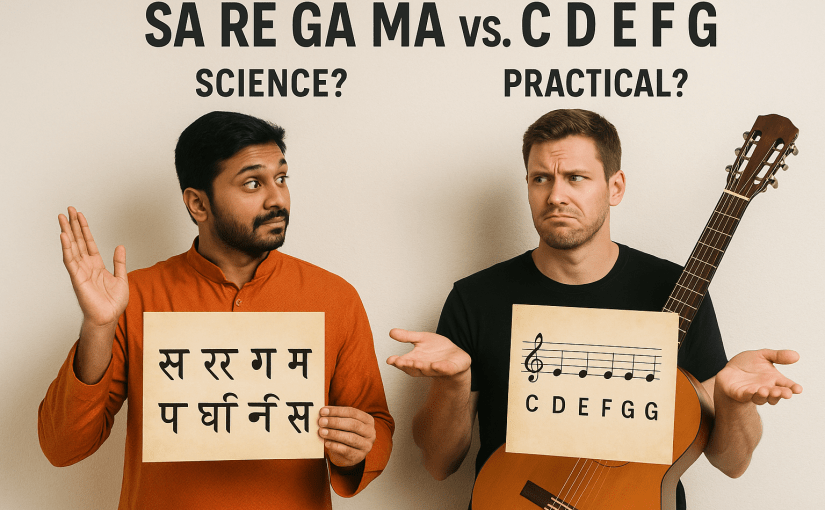
If you’ve ever been stuck at a wedding between the nadaswaram/shehnai player and the Western band belting out “Summer of ’69”, you’ve probably asked yourself the deep, philosophical question:

Why on earth are there two ways to write music, and which one should I bother learning before my next rebirth?

So, let’s introduce our two contestants.

Contestant One: The Indian Sargam

Sa Re Ga Ma Pa Dha Ni Sa

Sargam is that genial uncle who says, “Just come, beta, we’ll adjust,” and actually means it. No fuss about where you start—today Sa might be C, tomorrow Sa might be D, and next week it could be on a note only the neighbourhood cat can hear.

  • Relative Pitch = Chill Vibes If Sa is the first step, the rest of the staircase adjusts itself. It’s musical jugaad at its finest.
  • Vocal-Friendly No singer has ever said, “Oh no, I can’t sing today because Sa is stuck on 261.63 Hz.” You just shift it, smile, and carry on.
  • Ornaments Galore Sargam doesn’t just give you notes—it lets you bend them, slide them, and add so much gamaka that even the note doesn’t know where it started.

Think of Sargam as the filter coffee of music—warm, strong, flexible, and doesn’t come with an instruction manual.

Contestant Two: The Western Notation

C D E F G A B C

Now here comes the second cousin—neat haircut, wearing a suit, and carrying a folder. Everything has to be exact. If C is 261.63 Hz, that’s where it stays. If you dare move it, there will be meetings, memos, and possibly a sternly worded email from a conductor.

  • Absolute Pitch = Discipline It’s the GPS of music—you know exactly where you are at all times.
  • Visual Map of Sound Those five lines, dots, flags, and squiggles are like an architect’s blueprint. You can rebuild the Taj Mahal in notes if you know how to read them.
  • International Passport Whether you’re in Madras, Madrid, or Madagascar, this script will be understood. (Except maybe by your local auto driver.)

Western notation is like ordering pizza—fixed recipe, precise toppings, and yes, people will notice if you replace mozzarella with paneer.

Which is More “Scientific”?

Here is where Uncle Rajan wades into the conversation. “All that is fine saar, but which one is more scientific?”

Western notation wins if “scientific” means standardisation and precision—like laboratory coffee: exact temperature, exact brew time, exact bitterness.

But Sargam has its own science—more like grandma’s cooking. She doesn’t measure, yet every dish tastes exactly right. The science is in the relationship between notes, not their fixed coordinates.

Which is Easier and More Practical?

  • If you’re starting out: Sargam is the easy entry—like learning cricket in your backyard before playing in a stadium.
  • If you’re handling an orchestra: Western notation keeps the chaos in check. Without it, your 40-piece ensemble might sound like 40 street vendors shouting in different keys.
  • If you’re doing fusion: Learn both. Sargam keeps your Indian side, Western notation keeps your drummer from walking off stage.

Final Verdict

Neither is “better”—they’re just designed for different musical worlds.

Sargam is like filter coffee at the corner kaapi kadai: flexible, soulful, forgiving.

Western notation is like an espresso from an Italian café: intense, precise, and possibly served with a side of attitude.

If you can master both, you’re musically bilingual. And like knowing how to make both idly and pasta, you’ll never go hungry—either for food or for tunes.

Bollywood Beats: When Hip-Hop Took Center Stage in Bollywood

Bollywood, known for its vibrant and diverse music scene, has always been open to global influences. One of the most exciting musical fusions in recent decades has been the incorporation of hip-hop into Bollywood soundtracks. This blend has created a unique and energetic sound that resonates with younger audiences and adds a fresh flavor to the traditional Bollywood music landscape.

Hip-hop’s journey into Bollywood started in the late 1990s and early 2000s, initially in underground scenes and gradually making its way into mainstream Bollywood movies. Today, it’s not uncommon to hear rap verses, hip-hop beats, and distinctive hip-hop styles in Bollywood songs, adding a modern and edgy touch to the films.

Here are a few examples of Bollywood songs that showcase the exciting use of hip-hop:

  1. “Apna Time Aayega” from Gully Boy (2019)This anthem from the movie Gully Boy, which itself is inspired by the underground hip-hop scene in Mumbai, is a powerful example of hip-hop’s raw energy in Bollywood. Rapper Ranveer Singh delivers impactful verses with a strong message, set to a compelling hip-hop beat.Apna Time Aayega – Gully Boy
  2. “Saturday Saturday” from Humpty Sharma Ki Dulhania (2014)This high-energy party track perfectly blends Bollywood melodies with a catchy hip-hop rhythm and rap verses by Indeep Bakshi and Badshah. It’s a quintessential example of how hip-hop can inject a fun and contemporary vibe into Bollywood dance numbers.Saturday Saturday – Humpty Sharma Ki Dulhania
  3. “Chaar Baj Gaye Party Abhi Baaki Hai” from F.A.L.T.U (2011)This song is a classic example of early Bollywood hip-hop tracks that became incredibly popular. With its infectious beat and rap portions, it became a party anthem and showcased the growing acceptance of hip-hop elements in Bollywood music.Chaar Baj Gaye Party Abhi Baaki Hai – F.A.L.T.U
  4. “Move Your Body” from Johnny Gaddaar (2007)Often cited as one of the early Bollywood songs to prominently feature rap, “Move Your Body” by Hard Kaur was a breakthrough in integrating hip-hop into the mainstream. Its edgy sound and Hard Kaur’s rapping brought a distinct hip-hop flavor to Bollywood.Move Your Body – Johnny Gaddaar
  5. “Thanda Thanda Pani” by Baba Sehgal (1990)While technically not a Bollywood film song, “Thanda Thanda Pani” by Baba Sehgal is considered by many to be the first Hindi rap song that gained mainstream popularity in India. Baba Sehgal is known as the pioneer of rap in Indian pop music, and his early work paved the way for hip-hop’s eventual integration into Bollywood.Thanda Thanda Pani – Baba Sehgal

TMK, DMK, and Nagarathnamma

Introduction

Unless you have been living under a rock or have never heard about Carnatic music, you could not have missed the huge controversy surrounding the current events involving the Music Academy, musician T.M. Krishna, the spate of boycotts, and Chitraveena Ravikiran’s return of the Sangeetha Kalanidhi award. 

Adding the proverbial fuel to the fire is the still echoing uproar surrounding the remarks of a current minister in the DMK about abolishing Sanatana Dharma, which, in his view, is encouraging caste discrimination. The political party DMK, came to power espousing the cause of social justice and equality as espoused by another leader, E.V. Ramaswamy a.k.a Periyar.

A quick flashback

Eons ago, a Devadasi faced a similar cultural boycott. Bangalore Nagarathnamma was the target then. The irony is that the sister duo Ranjani-Gayathri, who were quick off the block in the current controversy, would have never been allowed to perform but for Bangalore Nagarathnamma’s crusade to allow women to perform on stage.

Who was Bangalore Nagarathnamma?

Bangalore Nagarathnamma (1878–1952) is a remarkable figure in the history of Carnatic music. Not only did she make exceptional contributions to preserving the legacy of Saint Tyagaraja, but she also played a pioneering role in challenging and transforming the societal norms of her time. Her life and work initiated several social revolutions within the Carnatic music community and beyond, advocating for inclusivity, equality, and the recognition of talent irrespective of gender or caste. This blog post delves into her contributions and the social revolutions she sparked while addressing the current controversies surrounding contemporary Carnatic musician T.M. Krishna.

Bangalore Nagarathnamma’s Contributions and Social Revolutions

Preservation and Promotion of Tyagaraja’s Legacy

  • Nagarathnamma’s unwavering devotion to Tyagaraja, one of the Trinity of Carnatic music, is well-documented.
  • She was crucial in establishing the Tyagaraja Aradhana, an annual music festival held in Thiruvaiyaru, Tamil Nadu, to celebrate Tyagaraja’s compositions.
  • This festival has become a cornerstone event for Carnatic music enthusiasts worldwide, where artists pay homage to the great composer through soul-stirring renditions.

Establishment of Tyagaraja’s Memorial

  • Recognizing the significance of preserving Tyagaraja’s memory, Nagarathnamma took a bold step.
  • She purchased land around Tyagaraja’s samadhi in Thiruvaiyaru and constructed a temple in his honor.
  • This space became the epicenter for the annual Aradhana festival, ensuring that Tyagaraja’s contributions to Indian classical music were celebrated for generations.
  • Her initial efforts to organize an all-inclusive music festival met with resistance

How her Thygaraja festival was boycotted

The boycott of Bangalore Nagarathnammal’s Tyagaraja Aradhana festival by caste-based musicians primarily stemmed from the orthodox and conservative sections of the Carnatic music community, particularly from higher caste Brahmins. This resistance was deeply rooted in the prevailing caste hierarchies and social norms of early 20th-century India, which often dictated access to cultural and religious practices, including music. Nagarathnammal’s festival, which was groundbreaking in its inclusivity, challenged these entrenched norms by welcoming musicians and attendees regardless of their caste or gender. Here’s a closer look at how the boycott unfolded and its implications:

Mechanisms of the Boycott

  • Caste-Based Exclusivity: The elite musicians and patrons, who were predominantly from the upper-caste Brahmin community, viewed the participation of lower-caste individuals and women, especially those from marginalized communities, in such a sacred event as a violation of their traditionalist views of purity and sanctity.
  • Parallel Festivals: In response to Nagarathnammal’s inclusive festival, these conservative factions organized their versions of the Tyagaraja Aradhana, which adhered strictly to caste-based exclusivity. These parallel festivals aimed to maintain the traditional caste hierarchies within Carnatic music, effectively segregating the music community along caste lines.
  • Social and Religious Justifications: The boycott was often justified through religious and social rhetoric, claiming to protect the sanctity and tradition of Carnatic music and its associated rituals. This stance reflected societal tensions between maintaining caste purity and embracing social reform.

Implications of the Boycott

  • Highlighting Societal Divides: The boycott not only exposed the deep-rooted caste prejudices within the Carnatic music community but also mirrored the larger societal divisions based on caste and gender. It brought to the forefront the need for reform and inclusivity within traditional cultural practices.
  • Solidifying Nagarathnammal’s Resolve: Despite significant opposition and boycott, Nagarathnammal remained undeterred. Her resolve to maintain the inclusivity of the Tyagaraja Aradhana festival only strengthened, solidifying her legacy as a champion of social reform and inclusivity in Carnatic music.
  • Legacy of Inclusivity: Over time, Nagarathnammal’s inclusive approach has been vindicated, with the Tyagaraja Aradhana festival at Thiruvaiyaru symbolizing unity and diversity within the Carnatic music community. Her efforts paved the way for a broader acceptance of inclusivity, influencing subsequent generations to challenge and dismantle caste and gender barriers in the arts.

Bangalore Nagarathnammal’s confrontation with caste-based boycotts of her Tyagaraja Aradhana festival underscored her pioneering role in challenging societal norms and advocating for inclusivity and equality in Carnatic music. Her legacy continues to inspire efforts towards creating a more inclusive and equitable cultural landscape in India.

Advocacy for Women Musicians

  • Nagarathnamma shattered societal barriers by providing platforms for women musicians to perform publicly.
  • Women’s participation in public performances was marginalized during her time, especially for those from specific communities.
  • She challenged prevailing norms, opening doors for future generations of women musicians and advocating for their rightful place on the stage.

Challenging Caste Discrimination

  • Nagarathnamma’s activism extended beyond gender equality.
  • She fearlessly confronted caste discrimination within the Carnatic music community.
  • Her efforts paved the way for a more inclusive and egalitarian musical landscape, where talent triumphed over social hierarchies.

T.M. Krishna and the Ongoing Debate

  • Contemporary Carnatic musician T.M. Krishna shares similarities with Nagarathnamma.
  • Like her, he challenges established norms and advocates for a more inclusive and socially aware Carnatic music scene.
  • Krishna’s performances in non-traditional venues and emphasis on social justice mirror Nagarathnamma’s fight for equality.

Conclusion

Bangalore Nagarathnamma’s life was a symphony of courage, talent, and social reform. Her legacy reminds us that music transcends boundaries and can be a powerful force for change. When all the trolls, for and against die down, maybe the brilliance of a casteless, all inclusive society dawns upon us. Many of the current musicians who are boycotting, are like ostriches; turning a blind eye to the truth of a discrimination that exists, and I would daresay, feel threatened about the danger to their elitist positions in their perceived cultural ladder, probably the same way the current flock of MAGA cultists in the USA.

As we navigate the complexities of tradition and progress, let us draw inspiration from her unwavering spirit—a spirit that resonates through the ages and echoes in the soul-stirring notes of Carnatic music. 🎵🌟


References:

  1. Wikipedia: Bangalore Nagarathnamma
  2. The Hindu: The Activist Behind the Music
  3. Deccan Herald: Bangalore Nagarathnamma’s Reformist Zeal
  4. Dharma Dispatch: Bangalore Nagarathnamma: A Life Dedicated to Tyagaraja.