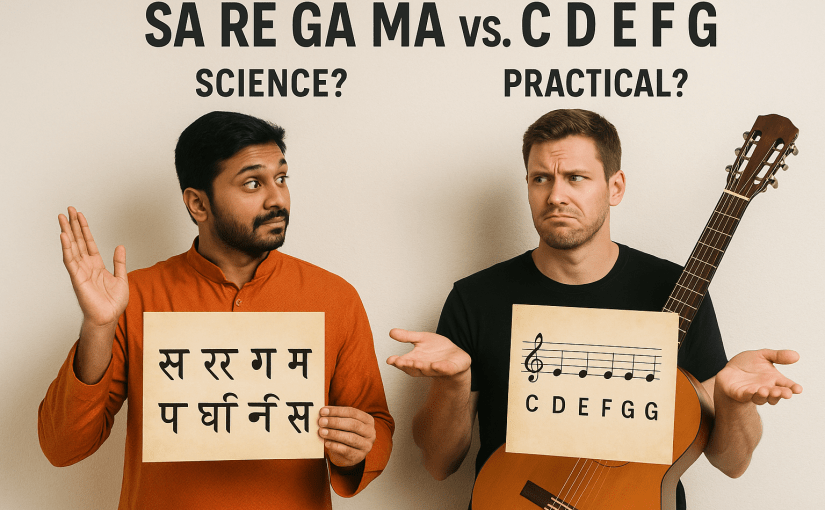
Sa Re Ga Ma vs C D E F G – The Fun Guide to Indian Sargam and Western Notation

If you’ve ever been stuck at a wedding between the nadaswaram/shehnai player and the Western band belting out “Summer of ’69”, you’ve probably asked yourself the deep, philosophical question:

Why on earth are there two ways to write music, and which one should I bother learning before my next rebirth?

So, let’s introduce our two contestants.

Contestant One: The Indian Sargam

Sa Re Ga Ma Pa Dha Ni Sa

Sargam is that genial uncle who says, “Just come, beta, we’ll adjust,” and actually means it. No fuss about where you start—today Sa might be C, tomorrow Sa might be D, and next week it could be on a note only the neighbourhood cat can hear.

  • Relative Pitch = Chill Vibes If Sa is the first step, the rest of the staircase adjusts itself. It’s musical jugaad at its finest.
  • Vocal-Friendly No singer has ever said, “Oh no, I can’t sing today because Sa is stuck on 261.63 Hz.” You just shift it, smile, and carry on.
  • Ornaments Galore Sargam doesn’t just give you notes—it lets you bend them, slide them, and add so much gamaka that even the note doesn’t know where it started.

Think of Sargam as the filter coffee of music—warm, strong, flexible, and doesn’t come with an instruction manual.

Contestant Two: The Western Notation

C D E F G A B C

Now here comes the second cousin—neat haircut, wearing a suit, and carrying a folder. Everything has to be exact. If C is 261.63 Hz, that’s where it stays. If you dare move it, there will be meetings, memos, and possibly a sternly worded email from a conductor.

  • Absolute Pitch = Discipline It’s the GPS of music—you know exactly where you are at all times.
  • Visual Map of Sound Those five lines, dots, flags, and squiggles are like an architect’s blueprint. You can rebuild the Taj Mahal in notes if you know how to read them.
  • International Passport Whether you’re in Madras, Madrid, or Madagascar, this script will be understood. (Except maybe by your local auto driver.)

Western notation is like ordering pizza—fixed recipe, precise toppings, and yes, people will notice if you replace mozzarella with paneer.

Which is More “Scientific”?

Here is where Uncle Rajan wades into the conversation. “All that is fine saar, but which one is more scientific?”

Western notation wins if “scientific” means standardisation and precision—like laboratory coffee: exact temperature, exact brew time, exact bitterness.

But Sargam has its own science—more like grandma’s cooking. She doesn’t measure, yet every dish tastes exactly right. The science is in the relationship between notes, not their fixed coordinates.

Which is Easier and More Practical?

  • If you’re starting out: Sargam is the easy entry—like learning cricket in your backyard before playing in a stadium.
  • If you’re handling an orchestra: Western notation keeps the chaos in check. Without it, your 40-piece ensemble might sound like 40 street vendors shouting in different keys.
  • If you’re doing fusion: Learn both. Sargam keeps your Indian side, Western notation keeps your drummer from walking off stage.

Final Verdict

Neither is “better”—they’re just designed for different musical worlds.

Sargam is like filter coffee at the corner kaapi kadai: flexible, soulful, forgiving.

Western notation is like an espresso from an Italian café: intense, precise, and possibly served with a side of attitude.

If you can master both, you’re musically bilingual. And like knowing how to make both idly and pasta, you’ll never go hungry—either for food or for tunes.

M. S. Subbalakshmi – the nightingale

BIRTH

Born on September 16, 1916, in Madurai to Subramania Iyer and Shanmukhavadivu, Madurai Shanmukhavadivu Subbulakshmi, her brother Saktivel, and her sister Vadivambal grew up surrounded by classical music. Her grandmother Akkammal was a violinist, and her mother was a veena artist. M.S., as she became known, was introduced to music at a young age, learning her first lessons from her mother. She made her stage debut when she was only 13 years old.

RELOCATION

She was already a well-known Carnatic vocalist when she relocated to Chennai in 1936. Then, she met T. Sadasivam, a senior executive at Ananda Vikatan, a Tamil weekly. They married in 1940. During her more than 50-year career, M.S. received numerous awards. In 1998, she was awarded India’s highest civilian honor, the Bharat Ratna.

AWARDS

M.S. was the first woman musician to be awarded the Sangita Kalanidhi title by the Music Academy in Chennai in 1968. She returned to music after a brief stint in film. M.S. also received the Padma Bhushan (1954), Padma Vibhushan (1975), Kaalidas Samman (1988), and Ramon Magsaysay Award (1974). She performed at the inaugural India Festival in London in 1982 and in Tokyo, Bangkok, Hong Kong, Manila, Singapore, and Malaysia. She introduced Carnatic music to the West at the Edinburgh Festival in 1963 and the United Nations in 1964. (1966). Many universities awarded her the Doctor of Letters degree, including Sri Venkateswara University (1971), Delhi University (1973), Benaras Hindu University (1980), and the University of Madras (1987). The Viswa-Bharati University, Santiniketan, bestowed her with the Desihothama (doctoral degree).

CHARITY

MS donated the proceeds from his recordings and concerts to various charities. M.S. raised crores of rupees for charity through her shows, with the help of her husband. In 1944, the first charity concert was held for the Kasturba Memorial Fund. The other beneficiaries were

  • The Tirumala Tirupati Devasthanams
  • The Ramakrishna Math
  • The Nanak Foundation
  • The Subramanya Bharati memorial at Ettayapuram
  • The Hindu Temple in Flushing, New York
  • Bharatiya Vidya Bhavan
  • The Kamakshi temple in Kancheepuram
  • Sankara Nethralaya 
  • Cancer Institute
  • Voluntary Health Services
  • The Music Academy

FILM CAREER

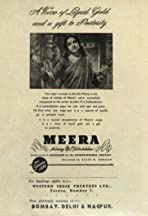
Subbulakshmi appeared in four films directed by Ellis Dungan: Sevasadanam, Sakuntalai, Savithri (1941), and Meera (1945), two of which were successful. Sevasadanam, directed by C. Subramaniam and based on Premchand’s novel Bazar-e-Husn, was released in 1938. Meera, which first appeared in Tamil cinema in 1945, established Subbulakshmi as a national icon.

Following the film’s success, Indian classical singer MS Subbulakshmi left the industry to pursue live music full-time.

DEVOTIONAL MUSIC

Subbulakshmi dedicated herself completely to her chosen field, film or music, and her progress was meteoric. Movies did not interest her but her husband persuaded her to do some, keeping the concrete financial objectives, ensuring idealistic, saccharine themes, and emphasizing music. Subbulakshmi had reigned supreme for nearly ten years and five films.

She has sung bhajans in ten languages, each setting high standards for diction, purity and emotional content. Many leaders and political giants of the time, including Mahatma Gandhi, Jawaharlal Nehru, and Rajaji, praised her vocal abilities. M.S. was a devout follower of Kanchi Paramacharya. The Paramacharya wrote the benediction “Maitreem Bhajata,” which M.S. sang at the end of her concerts at the United Nations and Carnegie Hall. She recorded Venkatesa Suprabhatam for HMV, and the royalties go to the Tirupati Tirumala.

Devasthanam’s Veda Patasala (school).  Another of her recordings was Bhaja Govindam, a hymn by Adi Shankaracharya and Vishnu Sahasranamam, which contains 1000 names of Vishnu. I grew up listening to this particular vinyl since my parents would play this record every day, early morning!

THE END

ACCORDING TO HOSPITAL AND FAMILY SOURCES, M S Subbulakshmi died in Chennai on Saturday night, December 11, 2004, due to complications. She was 88 years old.

Sadasivam, her husband, died in 1997.