Pop-Up Cards and Liberation: A Morning Metaphor for Reality

You know those pop-up greeting cards — the ones that look flat and innocent until you open them, and suddenly bam!— an entire Taj Mahal made of paper springs out, usually accompanied by glitter and guilt for not buying a simpler one?

That’s sort of what happens every morning when we open our eyes.

After a good night’s sleep (the rare kind where no one from your childhood WhatsApp group appears in your dreams asking for donations), the moment you wake up, a full 3D world unfolds — people, places, problems, pending bills — all popping up like that elaborate paper diorama.

It’s quite the show.


The Great Morning Unfolding

When you open your eyes, you also pop up — the “me” character, complete with opinions, breakfast preferences, and mild existential anxiety. The whole identity kit just unfolds smoothly like it’s been waiting all night under your pillow.

Some people say, “But Nanda, the world doesn’t vanish when you sleep! It’s still there!”

Maybe. But here’s the trick — the very someone making that argument is also part of your conscious field. That clever, philosophical person pointing out your ‘flaw in logic’? Yep, also a pop-up.

It’s like arguing with a character inside the card about whether the card exists.


Flat When Closed

When the pop-up card is closed, nothing is destroyed. The scene is just folded — the palace, the trees, the smiling couple in matching paper sarees and kurtas — all compacted into flatness.

Similarly, when you’re asleep or in deep meditation, the world — with all its drama and color — folds back into stillness. Not gone, but dormant. Like your boss on a Sunday.

And when you “wake up,” the grand production begins again: light, sound, identity, memory — everything leaps up, shouting “Surprise!” like an overeager birthday card.


The Trick of Believability

The funny thing about pop-up cards is how convincing they can be, especially to children (and occasionally to adults before coffee). You forget it’s just paper cleverly cut and glued.

Likewise, consciousness projects such a convincing show that we forget it’s a projection at all. The mind doesn’t just open the card — it hires a full cast, builds sets, adds background music, and gives you the lead role.

The irony? You’re both the audience and the actor.


Liberation as Folding Back

So what is liberation then? It’s not burning the card or running away from it. It’s simply realizing that whether the card is open or closed — nothing truly new appears or disappears.

The essence was never in the paper palace or the pop-up people; it was always in the space that allowed it to unfold.

That awareness — silent, spacious, unbothered — is the real greeting.

Everything else is just… decoration with a bit of glitter.


Closing Thought

Next time you wake up, watch the show unfold. Don’t rush to start the day. Just notice how the world pops up — your name, your room, your phone, your to-do list — all springing to life from nowhere.

And maybe, before diving in, smile and whisper to yourself:

“Ah, there it is — the morning card. Let’s see what scene consciousness is sending me today.”

(Just don’t try to fold your spouse back into the card when they ask you to make coffee. Enlightenment has limits.)

The Ego: Friend, Foe, or Just Misunderstood?

For centuries, sages, saints, and that one uncle at weddings who insists he knows “the truth of everything” have been shouting in unison: shed the ego! According to them, the ego is the villain of the spiritual soap opera, the moustache-twirling bad guy who blocks us from enlightenment. One modern guru even turned it into a neat acronym: E.G.O = Edging God Out.

Sounds convincing, right? But here’s the twist: without the ego, you wouldn’t even know there was a truth to realize in the first place.

The Double Life of Ego

Think of ego like your neighborhood auto driver. On one day, he’s weaving dangerously through traffic, shouting at pedestrians, and playing film songs at full volume—annoying, loud, and best avoided. On another day, he’s the one who drops you exactly where you need to be, gives you change without grumbling, and even warns you about the pothole near the signal. Same guy, two different roles.

Ego works like that. If you identify it with your endless stream of random thoughts—“what’s for dinner?”, “does my WhatsApp DP look fat?”, “why hasn’t Netflix released Season 2 yet?”—then yes, ego is the troublemaker. But if you recognize ego as the quiet sense of “I am” that sits beneath all this noise, suddenly it becomes a signpost pointing straight toward Truth.

The Shopping Mall Analogy

Picture yourself in a shopping mall. Every shop window is blaring for attention: “Buy me! Eat me! Discount 50%!” These are your thoughts. Your ego, depending on how you use it, can do one of two things:

  1. Chase the mannequins—run around from Zara to Apple Store to the food court, completely distracted.
  2. Stand in the middle of the mall—aware that all these shops exist, but not compelled to enter. Just resting in the fact that you are present in the mall, not the stuff inside it.

One leads to exhaustion (and an empty wallet). The other leads to realization.

The Cosmic Stage Show

Think of life as a stage play. The thoughts, emotions, aches, and identities are like actors. The ego can either insist, “I’m the hero, the villain, the comedian, and also the audience—give me all the parts!” Or it can sit back as the stage itself—the screen upon which the entire drama plays.

It’s the same ego, but which way you flip it makes all the difference.

Why We Need Ego to Drop Ego

Here’s the paradox no one tells you: you need ego to even decide to shed ego. Who else is sitting there reading blogs about spirituality at 11:47 p.m. on a Tuesday? The “I” that seeks the Truth is still ego—but it’s the refined version, the ego that points beyond itself, like a GPS that tells you, “Recalculating route to Infinity.”

So maybe the sages weren’t wrong about letting go of ego. But until you use it to realize what’s beyond, dropping it too soon is like throwing away the car keys because you’re frustrated about potholes. The car’s still the way to get home.

Everyday Example: The Alarm Clock

Think of your alarm clock. It’s annoying, intrusive, and loud. You want to smash it against the wall every morning. But without it, you wouldn’t even wake up to know there is a morning. Ego’s the same. It wakes you up to the sense of “I am”—and from there, you get to see that you are more than the random noise of thoughts and identities.

In short: Ego isn’t the villain. It’s the slightly irritating but ultimately helpful character that gets you to the truth. Shed the noisy part, keep the “I am” part, and you might just find that what you thought was blocking God was really pointing to God all along.

How to Tune Into Your Inner Steady Hum

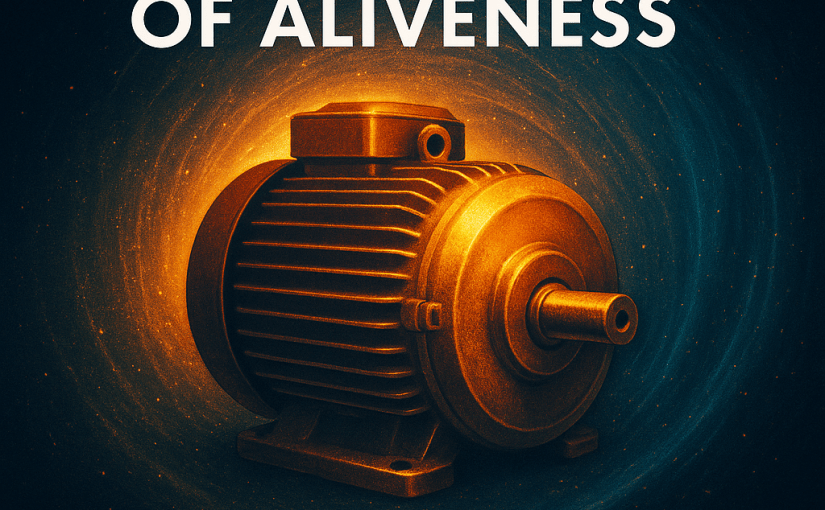
Have you ever walked past a giant generator or one of those industrial motors and felt it in your bones before you even heard it? That low, steady hum… reassuring, powerful, unbothered. It’s just there. Not shouting for attention, not needing to prove itself, but quietly powering the whole building.

That, my friend, is exactly what the sense of “aliveness” feels like.

We’re so used to identifying with thoughts—this endless parade of “should I…”, “what if…”, “oh no…”, “why me…”—that we forget there’s something far more fundamental buzzing underneath. A current that’s been running since before you knew your name, before you knew you had knees that creak when you get up too fast, before you had a list of worries that could rival a grocery bill.

The Dynamo Within

Sit still for a moment. Drop the drama. Forget the story of “you.” What’s left? A hum. Not metaphorical, but a very real sense that something is alive in you. Breathing, pulsing, steady as a ceiling fan in a summer power cut (when the current isn’t steady, you really notice!).

From that humming place, you’ll see your thoughts like little fireflies outside a streetlamp—pretty maybe, sometimes irritating, but clearly not the light itself. Even your precious “identity”—that carefully curated name, job title, Instagram bio—sits outside this hum. The aliveness doesn’t care if you’re CEO of the world or Chief Operator of the Remote Control. It just hums.

Aches, Pains, and Invincibility

Here’s the wild part: even the body’s complaints—sore shoulders, stiff back, that knee that behaves like it’s auditioning for a horror movie soundtrack—can be observed from here. You notice them, yes. But they’re not you. They’re like background noise in a café where the espresso machine hisses, chairs scrape, and the couple at the next table is arguing over pineapple on pizza. None of it stops the café from being a café.

And from here, strangely enough, there’s a feeling of invincibility. Not the Marvel superhero kind where you dodge bullets, but a deeper invincibility. Even mortality feels… well, slightly overrated. Because the hum doesn’t really start or stop—it just is.

Everyday Example: The Fridge

Think of your refrigerator. You don’t stand there all day listening for the motor. But if the hum stops, you immediately sense something’s wrong. Suddenly, all the thoughts appear: “Do I need to call the repair guy? Will my ice cream melt? How fast can I eat three tubs of Ben & Jerry’s?”

Our aliveness is like that fridge motor. It’s constant, reliable, and easily overlooked because it’s always there. But notice it, and suddenly the thoughts about melted ice cream (or anything else) are just noise outside that steady hum.

The Easy Part

Here’s the best news: nobody can deny being alive. This isn’t some mystical achievement reserved for monks in Himalayan caves. You’re alive, right now. The hum is running. Tuning into it doesn’t take effort—it takes not effort. Just notice.

The hard part? We forget. The easy part? We can remember again, any time.

So the next time you find yourself spiraling in thought or getting stuck in an ache, pause. Step back. Listen for the dynamo. That quiet, invincible hum of aliveness.

It’s been there all along, and unlike your fridge, you don’t need to call a repair guy.

The Ostrich, the Sand, and the Secret of the Universe

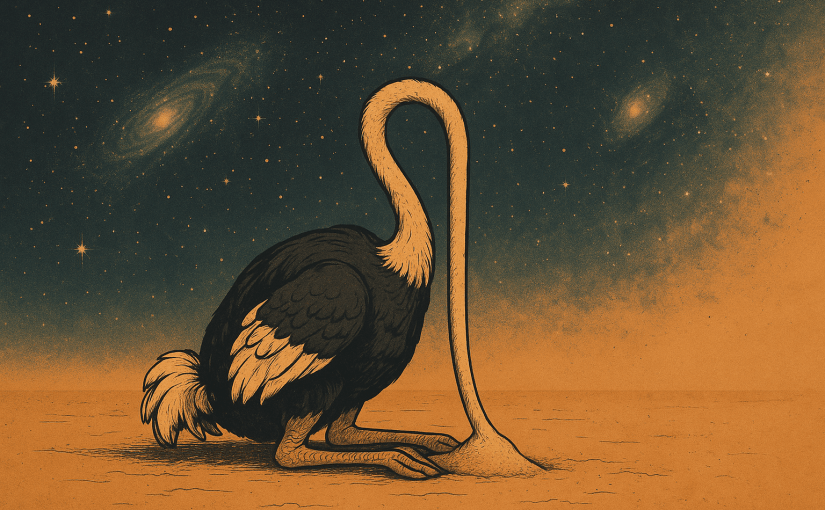
They say the ostrich buries its head in the sand to avoid danger.

That’s not true, of course — it’s a myth.

The ostrich does no such thing.

But if it did… ah, then we’d have a bird with a very promising career in philosophy.

Because the idea behind the myth — that shutting out the world makes it vanish — is actually a rather elegant pointer to one of the oldest truths in spiritual thought:

Everything you experience exists only in consciousness.

Sand as a Spiritual Tool

Let’s say you really were an ostrich (just for argument’s sake — no offence to your current species). You poke your head into the sand, and suddenly your vision is filled with warm, brown nothingness. No predators. No sky. No grass. No desert. The universe, for all practical purposes, is gone.

You didn’t destroy it — you just stopped perceiving it.

And here’s the big leap: the same is true for your waking life.

The so-called “objective world” is actually stitched together inside your mind. Without the light of consciousness shining on it, the whole grand spectacle collapses into… well, nothing.

The Sleep Experiment You’ve Been Running Every Night

This isn’t just poetic speculation. You prove it to yourself every single night.

When you slip into deep, dreamless sleep — that mysterious stage where there are no mental movies playing — the entire cosmos disappears. Not just your problems, not just your to-do list, but the Himalayas, the Pacific Ocean, the Milky Way — poof.

No you, no neighbour’s dog barking at 2 a.m., no neighbour either.

And yet, you wake up in the morning convinced the world “was there all along.”

But here’s the uncomfortable question: was it? Or is it that the world only exists when you are conscious of it?

Ancient Wisdom and Ostrich Wisdom

Philosophers from Advaita Vedanta to modern-day consciousness researchers have been politely trying to tell us the same thing: the “world” is an appearance in awareness, not an independent reality.

The ostrich myth, despite being zoologically false, has a certain charm here. If putting your head in the sand can make the predators vanish (from your point of view), isn’t that just the avian equivalent of closing your eyes in meditation? The outer scene fades, and you are left with the awareness that contains it all.

Why This Matters (Beyond Bird Comparisons)

If the universe only exists in consciousness, then our frantic attempts to “fix” the outside world before we’re happy might be a bit backwards.

Instead, we could turn inward and examine the one constant — the awareness in which all this appears.

That doesn’t mean you stop paying your bills or feeding the cat (even enlightened beings have to clean the litter box). But it does mean you stop clinging to the idea that the world is a fixed, external “thing” and start seeing it as a living, breathing projection in the cinema of your mind.

So the next time someone mocks the ostrich for “burying its head in the sand,” you might smile and think:

Maybe that ostrich isn’t avoiding reality.

Maybe it’s just contemplating the profound truth that without perception, the world as we know it… simply isn’t there.

And perhaps, like that mythical ostrich, we could all use a moment to put our heads down — not in sand, but in stillness — and watch the universe quietly dissolve back into the infinite awareness from which it came.

Shiva, Shakti, and the Silicon Soul: A Modern Take on Ancient Energies

Modern Take on Ancient Energies

In the cosmic dance of creation, Shiva and Shakti whirl in an eternal embrace, their energies shaping the universe. But what if we told you that this divine duo has a surprisingly modern parallel in the world of technology? Buckle up, dear readers, because we’re about to take a wild ride from the Himalayas to Silicon Valley—where ancient philosophy meets the digital age. Today, we’re exploring the theory that Shiva is potential energy and Shakti is kinetic energy, and whether this idea extends to the relationship between computers and software. Spoiler alert: it’s more connected than you might think.


Shiva: The Stillness of Potential Energy

Shiva, the great yogi, sits in deep meditation, embodying stillness and quiet power. He’s like a coiled spring, full of energy just waiting to be unleashed. In physics, potential energy is the stored energy an object holds due to its position or state—like a boulder perched on a cliff, ready to roll. Similarly, Shiva represents the universe’s unmanifested potential, the quiet force behind all that is yet to be.

In Hindu philosophy, Shiva is often described as the static, unchanging consciousness—the silent witness to the world’s unfolding. He’s the ultimate introvert, content to sit in blissful detachment, holding infinite possibilities within. But here’s the catch: without a nudge, that potential remains just that—potential. Enter Shakti.


Shakti: The Dance of Kinetic Energy

Shakti, the divine feminine, is the force that brings Shiva’s stillness to life. She’s movement, action, and transformation—the kinetic energy that turns potential into reality. In physics, kinetic energy is the energy of motion, like that boulder finally tumbling down the hill, unstoppable and full of force. In the same way, Shakti is the dynamic power that creates, sustains, and (when necessary) destroys.

Imagine Shiva without Shakti—he’d probably just sit there, deep in meditation. Shakti is the spark, the activator, the one who says, “Alright, enough meditating—let’s make something happen!” Together, their union is the perfect balance of stillness and motion, potential and action.


Is This Idea Correct?

So, does the idea of Shiva as potential energy and Shakti as kinetic energy hold water? Metaphorically speaking, yes—it’s a brilliant fit. Ancient Hindu texts don’t use the language of physics, but the philosophical essence aligns beautifully. Shiva’s stillness mirrors the latent power of potential energy, while Shakti’s vibrancy captures the essence of kinetic energy in action. It’s not a scientific definition straight out of the Vedas, but rather a poetic interpretation that bridges ancient wisdom with modern concepts. And honestly, it’s too cool an idea not to run with.


Computers and Software: A Technological Parallel?

Now, let’s teleport to the 21st century and test this analogy in the tech world. Picture your computer. The hardware—the motherboard, processor, RAM—is like Shiva. It’s the static platform, the potential waiting to be harnessed. Without software, it’s just a hunk of metal and silicon, much like Shiva in deep meditation, unmoved and unmanifested. It looks impressive, but it doesn’t do much—like a really expensive paperweight.

Software, on the other hand, is Shakti. It’s the code that breathes life into the hardware, making it perform tasks, run applications, and connect us to the digital world. Just as Shakti activates Shiva’s potential, software activates the computer’s capabilities. It’s the kinetic force that turns a dormant machine into a powerhouse of productivity (or, let’s be honest, endless cat videos).

Does this correspondence work? Absolutely. The computer hardware sits there, full of potential, but it’s the software that puts it into motion—creating, calculating, and sometimes crashing (because even Shakti has her chaotic days). In the tech world, we even have our own version of festivals celebrating this union—think software launches and tech expos, where the latest programs and apps are unveiled, bringing new life to our devices. It’s like a digital Maha Shivaratri, minus the incense and chanting (though, hey, maybe that’s next).


A Dash of Quantum Spice

For those who like their philosophy with a side of science, here’s a bonus: some modern thinkers link Shiva and Shakti to quantum physics. Shiva’s dance, the Tandava, is sometimes compared to the unpredictable, wave-like behavior of subatomic particles—pure potential until observed. Shakti, then, could be seen as the force that collapses that potential into reality. It’s a heady mix of mythology and quantum mechanics, but it adds a fascinating layer to the analogy. (Just don’t ask me to explain Schrödinger’s cat in Sanskrit.)


Conclusion: The Dance Continues

Next time you boot up your computer, think of it as a mini-cosmic dance. The hardware, your Shiva, holds the potential, while the software, your Shakti, brings it to life. The idea of Shiva as potential energy and Shakti as kinetic energy isn’t just correct in a metaphorical sense—it’s a lens that reveals harmony between ancient spirituality and modern technology. It’s a reminder that even in our digital age, the timeless wisdom of balance between stillness and action still holds true.

So, what do you think? Does this analogy resonate with you? Or do you have your own spin on how Shiva and Shakti play out in the tech world? Drop your thoughts in the comments below—let’s keep the dance going!

Disclaimer:

This blog post is written with deep respect for the sacred nature of Shiva and Shakti, revered figures in Hindu mythology symbolizing consciousness and energy. There is no intention to trivialize or diminish their profound spiritual significance. The modern language, contemporary references, and choice of words used here are solely intended to make the content relevant and relatable to today’s readers. By connecting timeless wisdom to the present day, we aim to engage and inspire curiosity about these ancient concepts in a way that resonates with modern times.

We hope readers will see this as a respectful effort to bring the essence of Shiva and Shakti into a current context, fostering understanding and appreciation without altering their divine importance.

Understanding Chris Langan’s CTMU: A Cosmic Perspective

Decoding the CTMU: Chris Langan’s Universe-Sized Brainchild

At nallamadras.com, we often explore fascinating intersections of science, spirituality, and philosophy. From the mysteries of meditation to the connection between music and higher consciousness, we love diving into big ideas that challenge us to think differently. Today, we venture into one of the most ambitious theories out there—the Cognitive-Theoretic Model of the Universe (CTMU) by Chris Langan, often dubbed “the smartest man in America.”

If you’ve enjoyed our previous posts, like “The Interplay of Music and the Cosmos” or Exploring the Philosophy of Oneness”, then buckle up—because the CTMU takes the idea of interconnectedness to a whole new level.

What Is the CTMU? (Breaking It Down)

The CTMU—short for Cognitive-Theoretic Model of the Universe—is Chris Langan’s attempt to explain everything. Yes, everything. It’s a bold framework that combines science, philosophy, and metaphysics into one cohesive theory. In Langan’s words, the CTMU offers a way to “connect mind, matter, and the laws of the universe.” Sounds epic, right? It is. But let’s break it down into digestible pieces.

The Big Ideas of the CTMU

1. Reality as a Self-Simulation

Imagine the universe as the ultimate game of Minecraft, but instead of being created by a programmer, it programs itself. The CTMU suggests that reality isn’t just a physical system—it’s a self-simulating, self-defining process. It’s like the universe is its own coder, constantly evolving and updating itself.

2. The Unity of Mind and Matter

You’ve probably heard debates about whether the mind is separate from the physical world. The CTMU says, “Why not both?” Langan argues that mind and matter are two aspects of the same system. Think of it like a smartphone: the hardware (matter) and the software (mind) work together seamlessly to make the system function.

3. Reality Speaks Its Own Language

Here’s where things get poetic. Langan describes reality as a kind of language. But instead of using words or grammar, it uses logic and structure to “speak itself” into existence. That means every atom, every galaxy, and yes, even you, are part of an ongoing cosmic conversation.

4. The Universe Is Its Own Creator

Who or what created the universe? The CTMU’s answer: the universe created itself. Think of it as a cosmic Russian nesting doll—except this one is infinite, constantly redefining and containing itself.

Why Should You Care About the CTMU?

You might be thinking, “This is fascinating, but how does it apply to me?” Great question. The CTMU isn’t just an intellectual exercise; it offers profound implications for how we see ourselves and our place in the universe.

You’re Not Just in the Universe—You Are the Universe

According to the CTMU, you’re part of the system that defines reality. Everything you think, feel, and do contributes to the greater whole.

Your Thoughts Have Power

If reality is a self-simulating system where mind and matter are intertwined, then your thoughts might play a bigger role than you realize. In essence, the universe might not just be observing you—you’re shaping it, too.

Connecting CTMU to Spirituality

At nallamadras.com, we often explore themes of spirituality and interconnectedness, from meditation techniques to the power of bhajans and kirtans. The CTMU adds a fascinating layer to these discussions.

For example, the idea that the universe is self-aware aligns with spiritual traditions that emphasize oneness and the unity of all existence. Whether you’re drawn to the chants of Krishna Das or the meditative rhythms of shamanic drumming, the CTMU suggests that these practices tap into something fundamental about the universe itself.

Criticism and Why It Doesn’t Diminish Its Value

Of course, the CTMU isn’t without its critics. Some argue it’s too abstract or philosophical to be considered a proper scientific theory. Others say it’s nearly impossible to test or prove.

But let’s be real: when you’re trying to explain everything, a little pushback is inevitable. What makes the CTMU fascinating isn’t whether it’s flawless—it’s the fact that it challenges us to think bigger.

Making It Fun: CTMU and Everyday Life

Let’s lighten things up. If the CTMU is true, it means:

You’re Part of a Giant Simulation: Next time you’re stuck in traffic, just remember—you’re contributing to the cosmic code.

The Universe Is Watching: Not in a creepy way, but in a “we’re all connected” kind of way. Maybe that’s why your coffee tastes better when you’re in a good mood.

Black Holes Are Drama Queens: According to the CTMU, even the universe loves a bit of mystery.

Why the CTMU Matters

Whether you’re a science enthusiast, a spiritual seeker, or just someone who loves asking big questions, the CTMU has something to offer. It’s a reminder that we’re all part of something far bigger than ourselves—a vast, interconnected system that’s constantly evolving.

Chris Langan’s work invites us to see the universe not just as a collection of atoms and forces but as a living, breathing system of which we’re an integral part. And that, in itself, is a pretty profound takeaway.

Curious about how this ties into other concepts we’ve explored? Check out more on spirituality and daily living or the philosophy of interconnectedness.

Let me know what you think—does this cosmic theory expand your perspective, or leave you scratching your head? Either way, the conversation is worth having!

Let me know if you’d like further edits, more links, or tweaks to the tone!

Sharanagati: Life’s Algorithm, Synchronicity, and Surrender

In case you feel lazy to read, here’s an audio synopsis of this article!

Have you ever wondered if life operates on some hidden algorithm, much like the ones YouTube and Facebook use to serve us cat videos and conspiracy theories? One minute, you’re innocently scrolling, and the next, you’re sucked into a rabbit hole of “10 Ways to Bake Banana Bread.” But what if our body-mind complex works on a similar system, curating our experiences based on our focus? And what if Hindu philosophy has been telling us this for millennia through concepts like sharanagati or surrender?

Trouble Begets Trouble—The Universe’s Auto-Suggestions

There’s an old saying: “Trouble begets trouble.” It’s almost as if the universe runs on the same principle as an algorithm: “If you liked worrying about that minor inconvenience, here are five more crises to spiral into.” Sound familiar? Hindu philosophy would call this the power of the mind’s focus, aptly explained in the Bhagavad Gita (Chapter 6, Verse 5):

“One must elevate, not degrade, oneself by one’s own mind. The mind is the friend of the conditioned soul, and its enemy as well.”

In other words, your mind can be your best friend or that nosy neighbor who keeps bringing up your most embarrassing moments. The choice, apparently, is yours.

The Great Car Color Conundrum

Allow me to confess a minor existential crisis: the time I couldn’t decide between leasing a black or steel-grey car. As if this decision would somehow alter the course of human history, I agonized over it. And then, as if the universe were trolling me, every car I saw on the road was black. It was like a cosmic nudge saying, “Pick black already and move on with your life!”

Psychologists call this the Baader-Meinhof phenomenon, or frequency illusion. Hindu sages, of course, knew this eons ago. They called it smarana—what you hold in your mind manifests in your reality. My fixation on black cars tuned my mental antenna to spot every single one on the road. The universe wasn’t trolling me; it was just playing by the rules of perception. That’s some algorithmic precision!

Parking Spots and Divine Surrender

Now let’s talk about parking. There’s this notoriously crowded street near where I live. Getting a spot there is akin to winning a cosmic lottery. Naturally, I avoided it. But life has a way of forcing us to confront what we despise. Whether it was a dinner invitation or some unavoidable errand, I kept finding myself on that street. At first, I resisted, grumbled, and railed against my bad luck. Then I thought, “Okay, Universe, I give up. You win.”

And just like that, parking spots started appearing out of nowhere. The Gita beautifully captures this shift (Chapter 18, Verse 66):

“Abandon all varieties of duty and simply surrender unto Me. I shall deliver you from all sinful reactions. Do not fear.”

Surrender, or sharanagati, is not about waving a white flag. It’s about aligning with the bigger picture, trusting that the Supreme Algorithm (a.k.a. the Universe, God, or your term of choice) has got this. When I let go of control, the parking gods smiled upon me. Coincidence? Perhaps. But surrendering felt a lot better than fuming.

Synchronicity: Cosmic Humor at Work

Carl Jung called it synchronicity; Hindu philosophy simply calls it lila—the divine play. It’s when events align so perfectly, it feels like a wink from the cosmos. The Isha Upanishad offers profound insight into this interconnectedness:

“The Self is everywhere, within and without. Whoever sees all beings in the Self and the Self in all beings feels no hatred.”

When you recognize the interconnectedness of everything, life stops feeling random and starts feeling orchestrated. Like when you think about an old friend, and they call you out of the blue. Or when you’re searching for answers, and a random podcast or book gives you just the clarity you need. It’s the cosmic algorithm in action, personalized just for you.

The Universe’s Sense of Humor

Let’s not forget that life’s algorithm comes with a built-in sense of humor. It’s like that mischievous friend who knows exactly how to push your buttons but ultimately has your back. You’re trying to plan every detail, and life goes, “How cute. Here’s a completely unexpected curveball.”

Take my parking saga. I spent months stressing over something entirely out of my control, only to realize that surrendering—truly letting go—opened the door to solutions I couldn’t have imagined. The universe, it seems, rewards those who stop micromanaging.

The Vedantic Takeaway

Hindu philosophy isn’t just about renunciation or abstract wisdom; it’s profoundly practical. Whether it’s the Bhagavad Gita urging us to master our minds, the Upanishads reminding us of our interconnectedness, or the concept of sharanagati teaching us the art of surrender, these ideas are as relevant today as ever.

So, do we all have a programmable algorithm within us? Absolutely. Is synchronicity real, or is it just our minds playing tricks? Maybe a bit of both. Is surrender the secret to peace of mind? Definitely worth a try.

In the end, life’s algorithm has a sense of humor. You might as well laugh along with it, trust the process, and enjoy the ride. Who knows? The universe might even throw in a good parking spot as a bonus.

Escaping the Matrix: A Journey to Authentic Living

Here’s my take, based on some real-life trial and error. I’ve dabbled in deep religiosity and ritualism—think priests at home, elaborate worship sessions, and enough incense smoke to trigger a fire alarm. Did all that effort bring eternal happiness? Spoiler alert: not even close.

Like everyone else on a quest for answers, I tried all kinds of remedies—even experimenting with medicinal herbs (yes, the kind that makes you question the nature of existence). The outcome? A whole lot of nothing. Zero. Nada. Or as my uncle loves to say, “One big, fat zero!”

Then one day, I stumbled upon something—an idea, a perspective—and it was like trumpets blaring and bells ringing in my head. Suddenly, there it was: the Matrix, clear as day.

Is Everything Part of the Matrix?

Before we talk escape plans, let’s address the elephant in the room: religion, spirituality, and their shiny promises of salvation. Every religion seems to pitch its own flavor of God, saints, angels, heaven, and hell. It’s like a spiritual buffet—but isn’t it all just part of the Matrix?

  • The Concept of God: Is this all-powerful being sitting in the cosmic director’s chair, orchestrating your life like a reality TV show? Or is God just the Matrix’s version of the tech support team—available only when things go horribly wrong?
  • Saints and Angels: Middle management. They’re like the IT guys of the divine world—”Have you tried praying?”
  • Heaven and Hell: The ultimate carrot and stick. Behave, and you get the VIP suite. Mess up, and you’re in the basement forever. Doesn’t this feel suspiciously like part of the control system?

If these concepts are part of the Matrix, then looking to them for escape might be like asking the prison guard for the keys.

The Big Question: Why Escape?

Before you make a jailbreak, ask yourself—why? What’s so bad about this Matrix? Sure, it has its share of heartbreak, traffic jams, and questionable reality TV, but it also has pizza and Wi-Fi. Are we just looking for a way out because we’re wired to think there’s something better?

Escaping isn’t just about leaving the bad behind; it’s about finding something real. So how do we do that? Glad you asked.

Steps to Escape the Matrix (Or at Least Bend It to Your Will)

1. Wake Up (Literally and Figuratively)

  • Practicing Mindfulness: Stop scrolling Instagram like a caffeinated squirrel and pay attention to your life. Meditation can help here. Sit still, breathe, and try not to think about snacks.
  • Questioning Everything: Why do you do what you do? Is it because you want to or because society (read: the Matrix) expects it? From your job to your relationships, start asking, “Is this me?”

2. Detach from the Drama

The Matrix thrives on drama. It’s like that one friend who’s always embroiled in some ridiculous soap opera.

  • Embrace Impermanence: Happiness, sadness, success, failure—they’re all just passing clouds. Stop clinging to them like a toddler with a balloon.
  • Let Go of Labels: Stop defining yourself by your job title, relationship status, or how many followers you have. You’re not a brand; you’re a human.

3. Turn Down the Noise

Modern life is basically the Matrix on steroids—a nonstop barrage of notifications, ads, and unsolicited advice. Silence it.

  • Digital Detox: Try spending a day without your phone. You’ll feel like a lost puppy, but it’s worth it.
  • Simplify: Do you really need 37 pairs of shoes or that subscription box for exotic tea leaves? Probably not. Simplify your life, and you’ll feel less trapped.

4. Connect with the Real

  • Nature: Step outside and connect with nature. Hug a tree—yes, actually hug it. It might feel silly, but it’s surprisingly grounding (just check for ants first; trust me on this one). Watch the sunset, let the colors wash over you, and feel the earth beneath your feet. Nature is like a cheat code for escaping the artificial.
  • Community: Talk to actual humans. Not in a group chat—in person. Share a meal, a laugh, or an awkward silence. Real connection beats digital likes any day.

5. Master Your Mind

The Matrix is strongest where it controls your thoughts. Think about it: every fear, every doubt, every limitation starts in your mind. If you can master your mind—recognize the patterns, question the narratives, and rewrite your inner script—you’re halfway out.

6. Serve Something Bigger

Want to feel like Neo? Do something that matters.

  • Help Others: Volunteer, mentor, or just be kind to that grumpy neighbor. Serving others can break the illusion of separateness.
  • Pursue Your Purpose: What lights you up? Find it and do it.

Will You Ever Fully Escape?

Here’s the kicker: Maybe you can’t completely escape. I remember this one time, nearing the end of a grueling 10-day Vipassana meditation camp. After days of silence and self-reflection, the realization hit me—what if the very pursuit of escape is just another layer of the trap?

So, fellow seeker, the question isn’t just how to escape the Matrix but how to live fully within it without being a prisoner. You’ve got the keys. Now go unlock something magical—just try not to break the Wi-Fi on your way out.