Veedu Varai Uravu, JFK Terminal 4, and the Long Flight Home

Or: why life is basically an international holiday, and everyone eventually stops walking with you at a different gate.

There is a Kannadasan song that has been quietly following me around for about fifty years, like a well-behaved dog that occasionally sits on your foot to remind you it exists. You know the one — Veedu Varai Uravu, from Paadha Kaanikkai, TMS in that impossibly grave voice, Viswanathan–Ramamoorthy leaving space around every syllable the way a good chef leaves space around a piece of fish on the plate.

Four lines. That’s all. Kannadasan didn’t need eight.

Veedu varai uravu
Veedhi varai manaivi
Kaadu varai pillai
Kadaisi varai yaaro?

Relatives come as far as the house. The wife comes as far as the street. The children come as far as the cemetery. And then — that beautiful, slightly terrifying question mark — who comes with you all the way to the end?

Kannadasan, being Kannadasan, refuses to answer. He just leaves you sitting there with your coffee going cold.

I have been thinking about this song again, but from a very unpoetic angle, because I am a modern man and I fly Economy.

Life is a return trip you didn’t quite plan

Here is the thought that will not leave me alone.

Life, from the moment we arrive to the moment we leave, is structured exactly like an international holiday. Not the yoga-retreat kind. The messy kind. The kind where somebody forgets the adapter and somebody else insists on packing three kilos of murukku (a crunchy South Indian snack twisted out of rice and urad dal flour and deep-fried into little edible spirals — the kind of thing aunties smuggle across international borders in Tupperware) “just in case.”

Consider the arrival.

You land. The plane doors open. You are wheeled or carried out — because let us be honest, nobody walks off their first flight — and there, waiting at the gate, is your entire welcoming committee. In this case, the “airport” is a hospital, the “arrivals lounge” is a delivery room, and the welcoming committee wears surgical masks and holds you upside down until you announce yourself with a scream.

The doctor is the immigration officer. (“Papers, please. Weight, length, APGAR score.”)
The nurse is the ground staff. (“Sir, madam, this way to baggage claim, which is you.”)
The parents are the family who drove three hours to pick you up and are now weeping in the parking lot for reasons neither of you fully understand yet.

They take you home. They make sure you are comfortable. Someone puts a blanket on you that is objectively too warm. Someone else insists you eat something. This is the veedu varai uravu phase, and it lasts, if you are lucky, about eighty years.

The middle of the holiday, or: why we fight over the AC remote

Now — anyone who has ever been on a family holiday knows that the middle of the trip is where things go interesting.

Day one, everyone is delightful. “Shall we all have dosa?” (a thin, crisp fermented rice-and-lentil crepe; the South Indian answer to the pancake, only with more opinions attached to it.) “Yes, dosa is a wonderful idea.” “You take the window seat, no no you take it.”

Day four, someone is not speaking to someone else because of a comment made at breakfast about the correct way to eat curd rice (thayir sadam — cooked rice mixed with yogurt, tempered with mustard seeds and curry leaves; simultaneously the most comforting food on earth and the most fiercely litigated recipe in every South Indian household). Day six, there is a full diplomatic incident about who booked which taxi. By day nine, two people are communicating exclusively through a third person, who is themselves not on speaking terms with a fourth.

This is life. This is the entire arc between the veedu and the kaadu. Ego, opinions, small betrayals, big betrayals, the terrible things we say because we are tired and it is 41 degrees and the kulfi (the Indian ice cream cousin — denser, chewier, usually flavoured with cardamom, pistachio, or mango, and constitutionally incapable of surviving an Indian afternoon) has melted. And underneath it all, the strange and slightly embarrassing fact that we love these people so much we cannot quite bear it, which is precisely why we are fighting with them.

You never fight this hard with strangers. Have you noticed? Nobody has ever had a shouting match with the person selling coconuts on the beach. We reserve our finest performances for the people we plan to weep for.

The departure gate

And then the holiday ends.

You know this part. Somebody has to catch the flight back. The luggage is heavier than it was on the way in — it always is; this is one of the immutable laws of the universe, along with entropy and the fact that any samosa (a fried triangular pastry stuffed with spiced potatoes and peas — the samosa is to India what the sandwich is to England, except with better structural engineering) you drop will land chutney-side down.

Some people come to see you off at the door of the house — veedu varai. They stand in the driveway. They wave. They are already thinking about lunch.

A smaller, more loyal contingent comes to the street — veedhi varai (veedhi = street, in Tamil). They help you load the bags. They make jokes to cover the fact that they are sad. They insist you text when you land.

An even smaller, even more loyal contingent comes all the way to the airport — kaadu varai, in Kannadasan’s more austere vocabulary (kaadu literally means forest or wilderness, and in this context, the cremation ground — the last stop before there is no more road). They stand at the departure gate, that peculiar liminal space where you are neither here nor there, neither with them nor without them, and they hug you one more time than is strictly necessary. And you turn around and walk toward the security line, and they wave, and you wave back, and then — this is the part nobody warns you about — you have to stop waving and just walk.

And then it’s just you, your carry-on, and the long line to the metal detector.

The flight itself

Now, friend, here is where the song and the airline seat conspire against you.

You are in seat 34K. The person next to you is already asleep with their mouth open. The screen in front of you offers you three action movies, one romantic comedy, and a documentary about penguins that you know from experience will make you cry. You choose none of them.

Because at some point over the Atlantic — usually around hour four, when the lights have dimmed and the cabin has taken on that submarine hush — the ruminating begins.

Why did I say that to her at breakfast on day four?
What was the actual point of that argument about the taxi?
He was only trying to help. I made it about my ego. Why?
She said something kind and I heard it as criticism. Why?
I had eighty years. I spent forty minutes of it not speaking to my own brother because of a chair.

You cannot fight with anyone at 37,000 feet. There is nobody to fight with. There is only you, a small plastic cup of water, and a slowly dawning suspicion that most of what you took so seriously down there was — how does one put this politely — not that serious.

The plane is an accidental confessional. The tray table is an altar. The seatbelt sign is a mild but persistent guru: please remain seated. Please, please, remain seated.

The French have a phrase — l’esprit de l’escalier — the wit of the staircase. The perfect reply you think of only after you’ve left the party. The Tamil equivalent is even better and does not have a name: the wisdom of the return flight. The clarity you find only after the door has closed and the cabin has been pressurised and it is far, far too late to go back and un-say the thing.

Kadaisi varai yaaro?

And then Kannadasan’s question, which has been waiting patiently in the overhead bin the whole time, gently opens.

Who comes with you all the way to the end?

The relatives came as far as the house. The wife came as far as the street. The children came as far as the cemetery — or, if you prefer the modern edit, as far as the drop-off lane at Terminal 4, where they were shooed away by a very serious man in a fluorescent vest.

But someone is on the plane with you. That is the strange bit. That is the bit Kannadasan leaves as a question mark because he is too much of a poet to ruin it with an answer.

Pattinathar, who was less of a diplomat, said it outright a thousand years ago: what travels with you is what you did. The paavam and the punniyam (paavam = sin, the debits; punniyam = merit, the credits; between them, the only luggage the universe actually lets you check in). The way you treated the person at the coconut stall. Whether you let go of the taxi argument. Whether you called your brother back after the chair incident. Whether you were, on balance, kind — not to the people you were trying to impress, but to the people you had already stopped bothering to impress, which is the only real test.

The rishis would put it more mysteriously and say the witness in seat 34K is the same witness who was there in the delivery room, watching the whole holiday from the beginning, unbothered by the AC remote, uninvolved in the curd rice debate, present through every fight and every reconciliation, and — here is the punchline — not actually going anywhere at all.

The plane lands somewhere. The witness stays.

So what does one do on day four?

I don’t know. I really don’t. I am, as I have confessed elsewhere on this blog, an amateur at all of this. But here is what the return flight has been quietly whispering to me lately, and I offer it in the spirit of one economy-class passenger to another:

The next time somebody at breakfast says the thing about the curd rice — pause for exactly one breath before you answer. That is all. One breath. The length of a soham, if you like (soham — the natural sound of the breath itself: sa on the inhale, ham on the exhale; the mantra you’ve apparently been chanting since the delivery room without ever signing up for it). In that gap, you can sometimes hear the hum of the return flight already. You can sometimes see, faintly, how this scene will look at hour four over the Atlantic. And nine times out of ten, you will choose the reply of the person you’ll be at 37,000 feet — not the person you are at the breakfast table.

That is not enlightenment. That is just packing lighter.

Because veedu varai uravu is true. The relatives really do stop at the house. The wife really does stop at the street. The children really do stop at the cemetery. And that is fine. That is how holidays end. That is how they were always going to end. There was never a version of the trip where everyone got on the plane with you.

But the samosas you shared, the arguments you dropped, the person you were kind to when nobody was watching — those, apparently, come along as carry-on.

And they don’t count against your baggage allowance.

Kadaisi varai yaaro? Perhaps you already know. Perhaps you’ve always known. Drop it in the comments, or better yet, drop it in the driveway before the taxi arrives.

Shree Matre Namaha. (Salutations to the Divine Mother — the closing bow, in case She is the one in seat 34J.)

#NallaMadras #VeeduVaraiUravu #Kannadasan #TamilSongs #Pattinathar #IndianPhilosophy #NonDuality #Advaita #Kirtan #Devotional #TamilLiterature #Vairagya #LifeAndDeath #Impermanence #Spirituality #SouthIndian #Rumination #MindfulLiving #WitnessConsciousness #Soham

The Many Forms of the Mother

There are some forces in life that quietly shape us long before we fully understand them.

For me, that force was always Devi — the Divine Mother.

Even as a young boy growing up in India, I felt an unexplainable pull toward Her. Not out of fear, nor because of strict religious conditioning, but from something much deeper and strangely familiar. Looking back now, I sometimes feel it may have been the quiet continuation of spiritual impressions carried across lifetimes — a culmination of punya that naturally drew my heart toward the Mother.

And perhaps, like many of us, my first glimpse of the Divine Mother came through my own mother — through her care, sacrifice, protection, and quiet strength. Before we understand philosophy or spirituality, we first understand love through a mother’s presence.

Life eventually carried me far away from home. Nearly three decades ago, I relocated to the United States. Like many immigrants, I became absorbed in the practical realities of building a life — work, responsibilities, survival, family, adapting to a new culture. Yet through all the movement and noise of life, one thing remained constant:

My connection to Her.

Prayer continued. Worship continued. Even when life became turbulent, Devi remained the silent center I returned to again and again.

Then, through what first appeared to be a chance encounter with a professor at Rutgers University, life opened another unexpected door. One thing led to another, and I was blessed to meet Sri Amritananda Natha Saraswati of Devipuram, who initiated me into the Shakti path through the sacred Panchadashakshari mantra.

Years later, Guruji asked me to help clean up some audio recordings; Viraja Homam and Rashmi Mala Mantras, and add musical interludes to them. During that process, I heard chants and invocations to Matangi Devi. Something within me immediately responded. It did not feel like discovering someone new. It felt like remembering someone ancient and intimate.

I was irresistibly drawn to Her.

Life, of course, did not suddenly become free from difficulty. Like everyone else, I have experienced uncertainty, disappointments, emotional upheavals, and periods where the road ahead seemed unclear.

But through every rise and fall, my faith in the Divine Mother has remained unwavering.

And perhaps that is what motherhood truly represents.

Not perfection.
Not control.
But unconditional presence.

The ability to nurture life even while carrying one’s own burdens. The ability to comfort, protect, sacrifice, forgive, and continue loving despite exhaustion and pain. The world often celebrates power loudly, but the quiet strength of a mother sustains humanity itself.

Over time, I began to realize that the Mother I worshipped in temples and mantras was also present in the women around me — in their resilience, compassion, intuition, creativity, and immense capacity to give of themselves.

To all women, I say this with great reverence:

You are blessed to embody Her Shakti.

Whether you are raising children, caring for family, supporting others emotionally, creating beauty, healing hearts, or simply carrying love into a difficult world — you are expressing the Divine Feminine in ways both seen and unseen.

And even if you are not a biological mother, the nurturing principle still lives within you. The ability to create, protect, inspire, and nourish life is itself sacred.

What greater gift can there be?

On this Mother’s Day, I bow to the Divine Mother in all Her forms — and with gratitude remember my own mother, through whom I first experienced Her love.

Shree Matre Namaha.

Happy Mother’s Day to all.

Pop-Up Cards and Liberation: A Morning Metaphor for Reality

You know those pop-up greeting cards — the ones that look flat and innocent until you open them, and suddenly bam!— an entire Taj Mahal made of paper springs out, usually accompanied by glitter and guilt for not buying a simpler one?

That’s sort of what happens every morning when we open our eyes.

After a good night’s sleep (the rare kind where no one from your childhood WhatsApp group appears in your dreams asking for donations), the moment you wake up, a full 3D world unfolds — people, places, problems, pending bills — all popping up like that elaborate paper diorama.

It’s quite the show.


The Great Morning Unfolding

When you open your eyes, you also pop up — the “me” character, complete with opinions, breakfast preferences, and mild existential anxiety. The whole identity kit just unfolds smoothly like it’s been waiting all night under your pillow.

Some people say, “But Nanda, the world doesn’t vanish when you sleep! It’s still there!”

Maybe. But here’s the trick — the very someone making that argument is also part of your conscious field. That clever, philosophical person pointing out your ‘flaw in logic’? Yep, also a pop-up.

It’s like arguing with a character inside the card about whether the card exists.


Flat When Closed

When the pop-up card is closed, nothing is destroyed. The scene is just folded — the palace, the trees, the smiling couple in matching paper sarees and kurtas — all compacted into flatness.

Similarly, when you’re asleep or in deep meditation, the world — with all its drama and color — folds back into stillness. Not gone, but dormant. Like your boss on a Sunday.

And when you “wake up,” the grand production begins again: light, sound, identity, memory — everything leaps up, shouting “Surprise!” like an overeager birthday card.


The Trick of Believability

The funny thing about pop-up cards is how convincing they can be, especially to children (and occasionally to adults before coffee). You forget it’s just paper cleverly cut and glued.

Likewise, consciousness projects such a convincing show that we forget it’s a projection at all. The mind doesn’t just open the card — it hires a full cast, builds sets, adds background music, and gives you the lead role.

The irony? You’re both the audience and the actor.


Liberation as Folding Back

So what is liberation then? It’s not burning the card or running away from it. It’s simply realizing that whether the card is open or closed — nothing truly new appears or disappears.

The essence was never in the paper palace or the pop-up people; it was always in the space that allowed it to unfold.

That awareness — silent, spacious, unbothered — is the real greeting.

Everything else is just… decoration with a bit of glitter.


Closing Thought

Next time you wake up, watch the show unfold. Don’t rush to start the day. Just notice how the world pops up — your name, your room, your phone, your to-do list — all springing to life from nowhere.

And maybe, before diving in, smile and whisper to yourself:

“Ah, there it is — the morning card. Let’s see what scene consciousness is sending me today.”

(Just don’t try to fold your spouse back into the card when they ask you to make coffee. Enlightenment has limits.)

The Ego: Friend, Foe, or Just Misunderstood?

For centuries, sages, saints, and that one uncle at weddings who insists he knows “the truth of everything” have been shouting in unison: shed the ego! According to them, the ego is the villain of the spiritual soap opera, the moustache-twirling bad guy who blocks us from enlightenment. One modern guru even turned it into a neat acronym: E.G.O = Edging God Out.

Sounds convincing, right? But here’s the twist: without the ego, you wouldn’t even know there was a truth to realize in the first place.

The Double Life of Ego

Think of ego like your neighborhood auto driver. On one day, he’s weaving dangerously through traffic, shouting at pedestrians, and playing film songs at full volume—annoying, loud, and best avoided. On another day, he’s the one who drops you exactly where you need to be, gives you change without grumbling, and even warns you about the pothole near the signal. Same guy, two different roles.

Ego works like that. If you identify it with your endless stream of random thoughts—“what’s for dinner?”, “does my WhatsApp DP look fat?”, “why hasn’t Netflix released Season 2 yet?”—then yes, ego is the troublemaker. But if you recognize ego as the quiet sense of “I am” that sits beneath all this noise, suddenly it becomes a signpost pointing straight toward Truth.

The Shopping Mall Analogy

Picture yourself in a shopping mall. Every shop window is blaring for attention: “Buy me! Eat me! Discount 50%!” These are your thoughts. Your ego, depending on how you use it, can do one of two things:

  1. Chase the mannequins—run around from Zara to Apple Store to the food court, completely distracted.
  2. Stand in the middle of the mall—aware that all these shops exist, but not compelled to enter. Just resting in the fact that you are present in the mall, not the stuff inside it.

One leads to exhaustion (and an empty wallet). The other leads to realization.

The Cosmic Stage Show

Think of life as a stage play. The thoughts, emotions, aches, and identities are like actors. The ego can either insist, “I’m the hero, the villain, the comedian, and also the audience—give me all the parts!” Or it can sit back as the stage itself—the screen upon which the entire drama plays.

It’s the same ego, but which way you flip it makes all the difference.

Why We Need Ego to Drop Ego

Here’s the paradox no one tells you: you need ego to even decide to shed ego. Who else is sitting there reading blogs about spirituality at 11:47 p.m. on a Tuesday? The “I” that seeks the Truth is still ego—but it’s the refined version, the ego that points beyond itself, like a GPS that tells you, “Recalculating route to Infinity.”

So maybe the sages weren’t wrong about letting go of ego. But until you use it to realize what’s beyond, dropping it too soon is like throwing away the car keys because you’re frustrated about potholes. The car’s still the way to get home.

Everyday Example: The Alarm Clock

Think of your alarm clock. It’s annoying, intrusive, and loud. You want to smash it against the wall every morning. But without it, you wouldn’t even wake up to know there is a morning. Ego’s the same. It wakes you up to the sense of “I am”—and from there, you get to see that you are more than the random noise of thoughts and identities.

In short: Ego isn’t the villain. It’s the slightly irritating but ultimately helpful character that gets you to the truth. Shed the noisy part, keep the “I am” part, and you might just find that what you thought was blocking God was really pointing to God all along.

How to Tune Into Your Inner Steady Hum

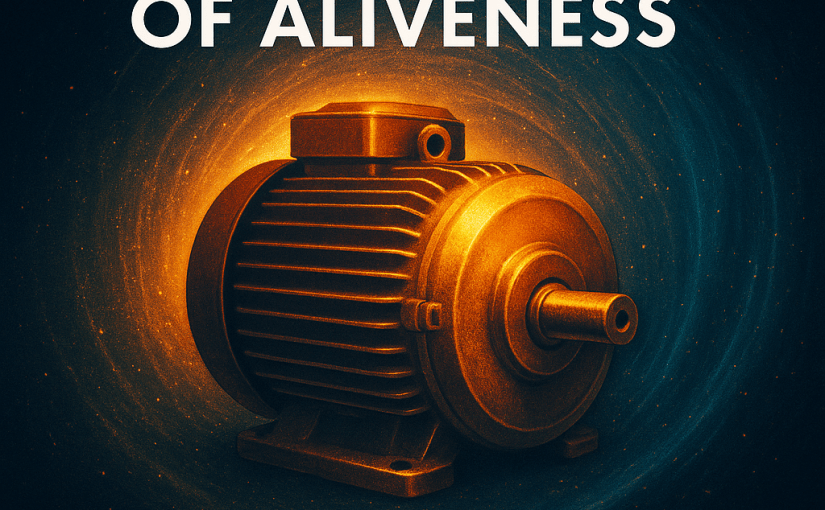
Have you ever walked past a giant generator or one of those industrial motors and felt it in your bones before you even heard it? That low, steady hum… reassuring, powerful, unbothered. It’s just there. Not shouting for attention, not needing to prove itself, but quietly powering the whole building.

That, my friend, is exactly what the sense of “aliveness” feels like.

We’re so used to identifying with thoughts—this endless parade of “should I…”, “what if…”, “oh no…”, “why me…”—that we forget there’s something far more fundamental buzzing underneath. A current that’s been running since before you knew your name, before you knew you had knees that creak when you get up too fast, before you had a list of worries that could rival a grocery bill.

The Dynamo Within

Sit still for a moment. Drop the drama. Forget the story of “you.” What’s left? A hum. Not metaphorical, but a very real sense that something is alive in you. Breathing, pulsing, steady as a ceiling fan in a summer power cut (when the current isn’t steady, you really notice!).

From that humming place, you’ll see your thoughts like little fireflies outside a streetlamp—pretty maybe, sometimes irritating, but clearly not the light itself. Even your precious “identity”—that carefully curated name, job title, Instagram bio—sits outside this hum. The aliveness doesn’t care if you’re CEO of the world or Chief Operator of the Remote Control. It just hums.

Aches, Pains, and Invincibility

Here’s the wild part: even the body’s complaints—sore shoulders, stiff back, that knee that behaves like it’s auditioning for a horror movie soundtrack—can be observed from here. You notice them, yes. But they’re not you. They’re like background noise in a café where the espresso machine hisses, chairs scrape, and the couple at the next table is arguing over pineapple on pizza. None of it stops the café from being a café.

And from here, strangely enough, there’s a feeling of invincibility. Not the Marvel superhero kind where you dodge bullets, but a deeper invincibility. Even mortality feels… well, slightly overrated. Because the hum doesn’t really start or stop—it just is.

Everyday Example: The Fridge

Think of your refrigerator. You don’t stand there all day listening for the motor. But if the hum stops, you immediately sense something’s wrong. Suddenly, all the thoughts appear: “Do I need to call the repair guy? Will my ice cream melt? How fast can I eat three tubs of Ben & Jerry’s?”

Our aliveness is like that fridge motor. It’s constant, reliable, and easily overlooked because it’s always there. But notice it, and suddenly the thoughts about melted ice cream (or anything else) are just noise outside that steady hum.

The Easy Part

Here’s the best news: nobody can deny being alive. This isn’t some mystical achievement reserved for monks in Himalayan caves. You’re alive, right now. The hum is running. Tuning into it doesn’t take effort—it takes not effort. Just notice.

The hard part? We forget. The easy part? We can remember again, any time.

So the next time you find yourself spiraling in thought or getting stuck in an ache, pause. Step back. Listen for the dynamo. That quiet, invincible hum of aliveness.

It’s been there all along, and unlike your fridge, you don’t need to call a repair guy.

How Dropping “Me” Can Set You Free (and Why Cows Don’t Care About Your Opinions)

Let’s start with a simple experiment.

Look at a tree. Any tree. Don’t label it. Don’t call it beautifulugly, or a neem tree near uncle’s house. Just… see it.

You’ll notice something strange.

For a fleeting second, there’s only tree. Not your memory of a tree, not your opinion of it, not even you looking at it. Just… tree.

Now imagine living like that, always. That, my friend, is what some call liberation.


The Problem with “Me” (And All Its Cousins)

Your mind is like a chatty radio host who won’t take a breath.

“I like this.”

“I hate that.”

“This reminds me of that summer in Goa.”

“This cow looks tired.”

But who’s this “I”?

J. Krishnamurti once said:

“The observer is the observed.”

It’s not a riddle. It means when you say, “I am anxious,” you’ve created a false duality. In truth, there’s just anxiety—no owner required. The moment you label it as yours, you’ve claimed it like a Netflix account.


Liberation Isn’t a Mountaintop, It’s a Mute Button

Non-duality teachers say it beautifully.

Rupert Spira reminds us:

“The belief in a separate self is like imagining a wave is separate from the ocean.”

Mooji says, with a grin:

“Don’t take your thoughts so seriously. They’re not paying rent.”

When we drop our constant labeling—our me, mine, my—we return to what just is.

A cow grazing becomes just… cow. Not a “lazy cow” or “my cow.” Just cow. And in that seeing, you’re free.


A Little Practice (But Not a Method, Please)

Krishnamurti hated methods. But here’s a loose suggestion:

  • Just observe.
  • Don’t label.
  • Don’t claim.
  • Don’t objectify.

It’s not about doing something. It’s about stopping the habit of always being someone.


In Conclusion: Leave Your “I.D.” at the Door

You don’t have to meditate in the Himalayas or chant your way to freedom.

Just stop owning everything.

Stop saying “my thoughts,” “my anger,” “my truth.” Just notice—without naming.

Krishnamurti again, for the win:

“To understand what is, there must be no condemnation of what is.”

Including yourself.

And if you see a cow today—resist the urge to say moo.

Who Am I? Exploring the True Owner of Your Inner House

Hey everyone, great hanging out with you all in the comments on yesterday’s post! It seems like the idea of our life resonated with quite a few of you. Our body, roles, and even our thoughts are kinda like a temporary house we inhabit. We talked about keeping a “chill take” on it all. We shouldn’t get too attached to the structure or the furniture. It’s all part of the journey.

But that naturally leads to the next big question, doesn’t it? If all that stuff is the “house”… then who is the ‘I’ that’s actually living inside it? Who is experiencing the leaky faucets, the sunny rooms, the whole deal?

Today, let’s explore that resident. Here’s a heads-up. We will share some cool old ideas from ancient wisdom. These will help us unpack it. Stay chill, though – it’s all part of the adventure!

Meet the Busy ‘Resident Manager’ (Ahamkara)

Think about who runs the show in your “house” day-to-day. There’s this constant sense of ‘me’ that seems to be in charge, right? It worries about upkeep, feels proud of the decor, gets annoyed when things aren’t perfect. Ancient Indian thought has a name for this busy manager: अहंकार (Ahamkara).

  • अहंकार (Ahamkara): Remember this one? We touched on it briefly. It literally means the “I-maker.” It’s the role within us. It creates the strong feeling of being a separate individual. It makes us feel like the one who owns the house and everything linked to it.

This Ahamkara isn’t just aware that the house exists. It identifies as the house manager. Sometimes it even thinks it is the house! It’s the voice saying:

  • “This is MY room!” (My opinion, my beliefs)
  • “Don’t scratch MY floors!” (My feelings got hurt)
  • “Look at MY beautiful garden!” (My accomplishments, my status)
  • I need to fix that leaky faucet!” (My problems, my worries)

It’s the part of us that feels fundamentally separate and often quite stressed about managing this whole “house” situation.

Asking the Landlord (Koham?)

But is this busy, often stressed-out resident manager the actual owner of the property? Or just… the manager? This is where a fascinating practice comes in, highlighted by the sage Sri Ramana Maharshi. He suggested a change in approach. Instead of just listening to the manager’s constant chatter and anxieties, we should try to find the real source. We should seek the ultimate “landlord” by asking: “Who Am I?

In Sanskrit: कोऽहम्? (Koham?).

  • कोऽहम्? (Koham?): “Who Am I?”

This isn’t about the manager giving their job title (“I am the manager,” “I am a parent,” “I am successful”). It’s about tracing that ‘I’ feeling itself back to its origin. When the manager (Ahamkara) starts freaking out – “I am overwhelmed!” “I need this!” “I hate that noise!” – the practice is to gently inquire inwardly: “Okay, who is this ‘I’ that’s feeling overwhelmed? Where does this ‘I’ actually come from?”

Ramana suggested this inquiry is incredibly powerful. Why? Because it bypasses the manager and looks for the silent owner. Finding that source, he said, is the key to real peace. It stands in contrast to the constant low-grade stress of just managing the house. He stated something profound: “The inquiry ‘Who am I?’ is the principal means to the removal of all misery and the attainment of the supreme bliss.”

Hook: Imagine being capable of quieting the frantic manager by simply looking for the calm, underlying owner! What happens if we stop taking the manager’s word for everything and investigate the source?

All This “My House, My Stuff” Stress

Let’s be real, being the resident manager (Ahamkara) is stressful! Much of our daily anxiety comes from clinging to the “house.” It also comes from defending everything we’ve labeled “mine” inside it.

  • Worrying about the house’s appearance (“my reputation,” “my image”).
  • Getting angry when someone parks in “my driveway” or disrespects “my space.”
  • Feeling anxious about the house’s future (“my job security,” “my health,” “my retirement”).
  • Comparing “my house” to the neighbor’s bigger, fancier one.

Sound familiar? The Ahamkara is hard at work. It identifies completely with the house and its contents. It is convinced that its own well-being depends entirely on the state of the property.

Hook: Think about your day so far. Whether you are right here in your town or somewhere else, think about the energy you use. You are managing aspects of “your house.” Consider on how much you defend or worry about the things you call “mine.”

When the Manager Sleeps & The Empty House (Awareness/Atman)

Now, here’s where it gets really interesting, connecting back to our “chill take” from yesterday. How permanent, how solid, is this resident manager (Ahamkara)?

Consider deep, dreamless sleep. The house (your body) is still there, resting. But where did the manager go? That distinct feeling of “I am managing this life” completely vanishes. Poof! The office is empty. This shows the Ahamkara needs certain conditions – like the waking state or even a dream state – to function.

And dreams? The manager rebuilds a whole dream house and runs around managing that! This highlights that the manager is more like a role being played than a permanent fixture.

If the manager can just disappear every night, they can’t be the fundamental reality, right? They are transient, dependent. And what about the house itself (the body)? Does a brick know it’s a brick? Does the house feel its own existence? No. Like we said yesterday, the house is just the structure. It needs something else to be known, to be experienced.

So, if the manager comes and goes, and the house itself is just structure, what is constant?

It seems to be awareness itself. The silent, unchanging space in which the house exists. The fundamental knowing that perceives the house, the manager, the thoughts, the feelings, everything. This ever-present, underlying reality, the true Self, has a name in Sanskrit: आत्मन् (Atman).

  • आत्मन् (Atman): The Self (with a capital S). Think of it as the silent, true owner of the property. It is like the very ground and space the house is built upon. It is pure, witnessing consciousness.

The nature of this Atman, this fundamental reality, is often described as सच्चिदानन्द (Sat-Chit-Ananda).

  • सच्चिदानन्द (Sat-Chit-Ananda): Existence-Consciousness-Bliss. It suggests that the very nature of this underlying awareness or space is pure being. It is pure knowing. It embodies inherent, causeless peace or joy.

Who Feels the Drafts and Sunshine? (Feelings)

Okay, so if we are fundamentally this peaceful awareness (Atman), why do we feel bothered by drafts (pain, sadness) or delighted by sunshine (pleasure, joy) in the house?

Maybe it happens like this: Awareness (Atman, the space/owner) perceives sensations related to the house (a cold draft, warm sunshine). The busy resident manager (Ahamkara) immediately rushes over, identifies with the sensation, and declares, “I am cold!” or “I love this sunny spot!” It claims ownership of the experience happening within the aware space via the house’s condition.

This reframes our feelings. They aren’t necessarily who we are. They are like weather conditions affecting the house. The underlying awareness (Atman) perceives them. Then, the temporary manager (Ahamkara) loudly claims and reacts to them.

Seeing this helps us follow Ramana’s advice: “There is no need to get rid of the wrong ‘I’ [Ahamkara/manager]. All that is required is to find out the source of the ‘I’ and abide in it.” We move away from reacting frantically like the manager. Instead, we rest as the calm, aware space or owner that perceives everything.

Living Lighter in the House

So, where does this leave us? Yesterday, we talked about the house. Today, we’ve explored the difference between the busy, stressed manager (Ahamkara) who thinks they are the house. The silent, aware space/owner (Atman) is our true foundation.

The manager comes and goes. Its attachment to “my house, my stuff” causes stress. But the underlying awareness is constant, peaceful by nature. Practices like asking “Who Am I?” help us see past the manager and connect with that deeper reality.

This doesn’t mean we neglect the house! We still take care of our bodies, our lives, our responsibilities. But we can do it with a lighter touch, with that “chill take” we talked about. We know we are fundamentally the spacious awareness. We are not just the temporary house or its frantic manager. These insights allow us to navigate the inevitable leaks. They help us enjoy the sunshine with more ease and a lot more peace.

It’s an ongoing exploration, not a final answer. What does this “resident manager” vs. “silent owner” idea spark for you? Does it change how you view the ‘I’ living in your ‘house’? Share your thoughts below – always great to learn together!

Your House, Your Self: A Chill Take on Life and Beyond

Picture this: you’re standing in the middle of nowhere, just wide-open land stretching out forever. There’s mountains in the distance, a big ol’ sky above, and the ground under your feet. Birds are flapping around up high. Ants are doing their thing on the dirt. There’s some grass and bushes sprinkled around. It’s raw, it’s real, it’s just… there. So, you decide to build a house. You slap up four walls, fence off a chunk of this endless land, and call it yours. Inside, you add more walls—rooms, spaces, your own little world. Boom, it feels like your spot now, separate from all that wild stuff outside.

But here’s the thing about “owning” something—you get attached. Those birds? Their chirping starts to bug you. The ants? Suddenly they’re invaders creeping into your space. You shoo them out. Then, you lock the doors. Finally, you turn your house into a fortress to keep the outside world at bay.

Then one night, a massive thunderstorm rolls through. It’s loud, it’s scary, and it’s shaking your house like it’s made of toothpicks. You start freaking out, thinking, “What if this storm wrecks everything? My house, my space, my whole vibe—gone!” In that panic, you start imagining some big, powerful force that can save you. You call it God, give it a name, maybe even a face. You start tossing out prayers or offerings, like you’re paying for some cosmic insurance to keep your house standing.

Along comes someone else, claiming they’ve got the inside scoop on this God thing. They’re like, “Nah, you’re doing it wrong. I’m tighter with the Big Guy, so listen to me.” You are desperate to keep your house safe. You start trying to impress this person. You hope they’ll put in a good word for you.

But then another storm hits—bigger, badder. Your walls come crashing down, your rooms are toast, and you’re back standing in that same wide-open land. The birds are still flying, the ants are still marching, the grass is still swaying. It’s like nothing changed, but you feel different. Part of you recalls this entire cycle. It feels like déjà vu when you try to hold onto something that was never really yours.

And that’s when you start wondering: Was that space ever mine? Were those walls just a trick I played on myself? This is where things get kinda wild, because this whole setup is like a big metaphor for who we are.

Your House Is Your Body, the Land Is Your Mind

Think of the house as your body, the thing you’re walking around in every day. You build up this idea of “me”—your personality, your likes, your fears, your story. It’s like putting up walls to carve out a little “you” from the giant, endless consciousness that’s all around. Those walls are your skin, your thoughts, your beliefs, all the stuff that makes you feel like a separate person. Inside, you’ve got rooms—your job, your relationships, your dreams, all neatly organized.

The birds and ants? Those are the random thoughts, feelings, or distractions that pop up. They’re only annoying when you’re super attached to keeping your “house” just the way you like it. In the big picture, those thoughts and feelings are just part of the flow. They are like birds in the sky or ants on the ground.

The thunderstorm? That’s life’s way of reminding you nothing lasts forever—change, loss, even death. It shakes up your house, your body, your whole sense of “me.” Scared of losing it all, you turn to something bigger, like God, hoping it’ll keep you safe. You pray, you do rituals, whatever feels right. Then someone comes along saying they’ve got a direct line to that higher power. You follow them, thinking they’ve got the key to keeping your house standing.

But when the storm finally wipes it all out, you’re back in that wide-open land—that big, limitless consciousness. Your body is gone, your “me” fade, but that awareness, that land? It’s still there. It was never yours to own because, guess what? It’s what you are.

The Loop We Keep Living

This whole story is like a loop we’ve been running for ages. We build our houses—our bodies, our identities, our communities, our beliefs—trying to grab a piece of something infinite. We stress about keeping it safe. We pray to powers we hope will protect us. We listen to people who claim they’ve got the answers. But storms always come, and they always take down what we built.

That little memory you feel in the story? That’s your gut telling you this loop doesn’t have to keep going. You start asking: Was it ever mine? Is this “me” I’m so attached to even real? Is that big, endless consciousness something I’m just floating in, or is it actually me?

That’s when things start to shift. You realize the house isn’t a cage—it’s just a temporary setup, a way to experience this wild, infinite land. Your body, your “me,” your walls—they’re tools for living, not for owning. The birds, the ants, the storms? They’re not against you—they’re part of the same big picture you’re in.

Living Free and Easy

Living without clinging to the walls means chilling out in the big, open land without trying to fence it off. It’s about seeing your house—your body, your life—as this cool, temporary thing that’s awesome while it lasts. Let the birds chirp, let the ants march, let the storms roll through. They’re all part of you, like your thoughts and feelings.

You don’t have to ditch the house. Build it, love it, make it yours. Just don’t grip it so tight. When the storm comes, let it do its thing. When the walls fall, no big deal. You’re not just the house—you’re the land, the sky, the mountains, the whole dang scene.

And when you get that, you don’t need a God to save you. You don’t need some guru to show you the way. It’s just you and this big, beautiful, endless vibe—and you’re already right at home.

Put on Your Oxygen Mask First – Life’s Ultimate Rule

We’ve all been there. Settling into our airplane seat, adjusting the seatbelt with an air of false confidence, nodding sagely at the safety demonstration we have absolutely no intention of following unless the plane turns into a submarine. And then comes the golden piece of wisdom, disguised as a simple instruction:

“In case of a loss of cabin pressure, oxygen masks will drop from the overhead panel. Please secure your own mask before assisting others.”

Sounds reasonable, right? But think about it—this is not just an in-flight safety precaution; this is a life philosophy masquerading as aviation protocol.

Selfish or Sensible?

At first glance, it may seem selfish. Why should I put on my mask first? Shouldn’t I be the noble soul, helping my fellow passengers, rescuing kittens, and ensuring world peace?

Absolutely not. Because if you pass out from lack of oxygen while trying to help others, you’re no help to anyone. In fact, you’ve just become another unconscious person who now needs to be helped. Great job.

This is exactly how life works. You can’t pour from an empty cup. You can’t donate from an empty bank account. And you definitely can’t inspire others if you’re gasping for breath—literally or figuratively.

Life Applications of the Oxygen Mask Rule

1. Financial Oxygen – The Money Talk

We’ve all heard it: Money isn’t everything! True. But try telling that to your landlord when rent is due. Try explaining to the grocery store cashier that your “positive energy” should cover the bill.

It is far better to be rich and miserable than poor and miserable. At least with wealth, you can be miserable in comfort, with a therapist, a spa day, and an overpriced cup of artisanal coffee. Being financially secure means you can help others without sinking yourself.

I once knew a man who donated generously to charity—even when his own finances were a mess. He prided himself on being selfless, until one day, he couldn’t pay his own rent. Who came to his rescue? The very people he had been donating to. See the irony? If he had secured his own financial oxygen mask first, he could have continued helping others without needing help himself.

2. Emotional Oxygen – The Art of Saying No

You know that friend who always says “yes” to everything? The one who volunteers, helps everyone move, covers extra shifts at work, and babysits other people’s unruly kids? Ever notice how that same person often looks exhausted, frustrated, and one “Can you do me a favor?” away from a nervous breakdown?

Helping others is noble, but not at the cost of your own mental health. If you’re drowning, you can’t be a lifeguard.Learn to say no. Prioritize your well-being. Even Buddha didn’t try to enlighten people while he was still figuring himself out—he sat under a tree, meditated, and then started sharing wisdom.

3. Health Oxygen – The Body Keeps the Score

We all know someone who works 18-hour days, survives on caffeine, and insists, “I’ll rest when I’m dead.” Spoiler: That’s a fast-track way to meet that deadline sooner than expected.

You need to take care of your health before you can take care of others. A sick person can’t be an effective caregiver. A sleep-deprived employee can’t be productive. If your body is screaming for rest and you ignore it, you’re setting yourself up for a spectacular crash—just like ignoring a flashing fuel light in your car.

I once met an overworked CEO who prided himself on being “too busy for vacations.” He ended up collapsing in his office due to exhaustion. The company? It survived without him. His health? Took years to recover. Secure your ownoxygen mask before trying to run a marathon for others.

Final Descent: Prioritize Yourself, Then Help Others

The next time you hear the airplane oxygen mask announcement, don’t roll your eyes—internalize it. It’s not about being selfish; it’s about being strategically self-sufficient. If you’re thriving, you can uplift others. If you’re barely surviving, you’re just another person needing help.

Take care of your finances. Protect your mental health. Prioritize your well-being. Because once your oxygen mask is securely in place, you can truly make a difference in the lives of others.

Now, sit back, relax, and enjoy the flight.

Would love to hear your thoughts—especially if you’ve ever had to put your own “oxygen mask” on first in real life!

Escaping the Matrix: A Journey to Authentic Living

Here’s my take, based on some real-life trial and error. I’ve dabbled in deep religiosity and ritualism—think priests at home, elaborate worship sessions, and enough incense smoke to trigger a fire alarm. Did all that effort bring eternal happiness? Spoiler alert: not even close.

Like everyone else on a quest for answers, I tried all kinds of remedies—even experimenting with medicinal herbs (yes, the kind that makes you question the nature of existence). The outcome? A whole lot of nothing. Zero. Nada. Or as my uncle loves to say, “One big, fat zero!”

Then one day, I stumbled upon something—an idea, a perspective—and it was like trumpets blaring and bells ringing in my head. Suddenly, there it was: the Matrix, clear as day.

Is Everything Part of the Matrix?

Before we talk escape plans, let’s address the elephant in the room: religion, spirituality, and their shiny promises of salvation. Every religion seems to pitch its own flavor of God, saints, angels, heaven, and hell. It’s like a spiritual buffet—but isn’t it all just part of the Matrix?

  • The Concept of God: Is this all-powerful being sitting in the cosmic director’s chair, orchestrating your life like a reality TV show? Or is God just the Matrix’s version of the tech support team—available only when things go horribly wrong?
  • Saints and Angels: Middle management. They’re like the IT guys of the divine world—”Have you tried praying?”
  • Heaven and Hell: The ultimate carrot and stick. Behave, and you get the VIP suite. Mess up, and you’re in the basement forever. Doesn’t this feel suspiciously like part of the control system?

If these concepts are part of the Matrix, then looking to them for escape might be like asking the prison guard for the keys.

The Big Question: Why Escape?

Before you make a jailbreak, ask yourself—why? What’s so bad about this Matrix? Sure, it has its share of heartbreak, traffic jams, and questionable reality TV, but it also has pizza and Wi-Fi. Are we just looking for a way out because we’re wired to think there’s something better?

Escaping isn’t just about leaving the bad behind; it’s about finding something real. So how do we do that? Glad you asked.

Steps to Escape the Matrix (Or at Least Bend It to Your Will)

1. Wake Up (Literally and Figuratively)

  • Practicing Mindfulness: Stop scrolling Instagram like a caffeinated squirrel and pay attention to your life. Meditation can help here. Sit still, breathe, and try not to think about snacks.
  • Questioning Everything: Why do you do what you do? Is it because you want to or because society (read: the Matrix) expects it? From your job to your relationships, start asking, “Is this me?”

2. Detach from the Drama

The Matrix thrives on drama. It’s like that one friend who’s always embroiled in some ridiculous soap opera.

  • Embrace Impermanence: Happiness, sadness, success, failure—they’re all just passing clouds. Stop clinging to them like a toddler with a balloon.
  • Let Go of Labels: Stop defining yourself by your job title, relationship status, or how many followers you have. You’re not a brand; you’re a human.

3. Turn Down the Noise

Modern life is basically the Matrix on steroids—a nonstop barrage of notifications, ads, and unsolicited advice. Silence it.

  • Digital Detox: Try spending a day without your phone. You’ll feel like a lost puppy, but it’s worth it.
  • Simplify: Do you really need 37 pairs of shoes or that subscription box for exotic tea leaves? Probably not. Simplify your life, and you’ll feel less trapped.

4. Connect with the Real

  • Nature: Step outside and connect with nature. Hug a tree—yes, actually hug it. It might feel silly, but it’s surprisingly grounding (just check for ants first; trust me on this one). Watch the sunset, let the colors wash over you, and feel the earth beneath your feet. Nature is like a cheat code for escaping the artificial.
  • Community: Talk to actual humans. Not in a group chat—in person. Share a meal, a laugh, or an awkward silence. Real connection beats digital likes any day.

5. Master Your Mind

The Matrix is strongest where it controls your thoughts. Think about it: every fear, every doubt, every limitation starts in your mind. If you can master your mind—recognize the patterns, question the narratives, and rewrite your inner script—you’re halfway out.

6. Serve Something Bigger

Want to feel like Neo? Do something that matters.

  • Help Others: Volunteer, mentor, or just be kind to that grumpy neighbor. Serving others can break the illusion of separateness.
  • Pursue Your Purpose: What lights you up? Find it and do it.

Will You Ever Fully Escape?

Here’s the kicker: Maybe you can’t completely escape. I remember this one time, nearing the end of a grueling 10-day Vipassana meditation camp. After days of silence and self-reflection, the realization hit me—what if the very pursuit of escape is just another layer of the trap?

So, fellow seeker, the question isn’t just how to escape the Matrix but how to live fully within it without being a prisoner. You’ve got the keys. Now go unlock something magical—just try not to break the Wi-Fi on your way out.