
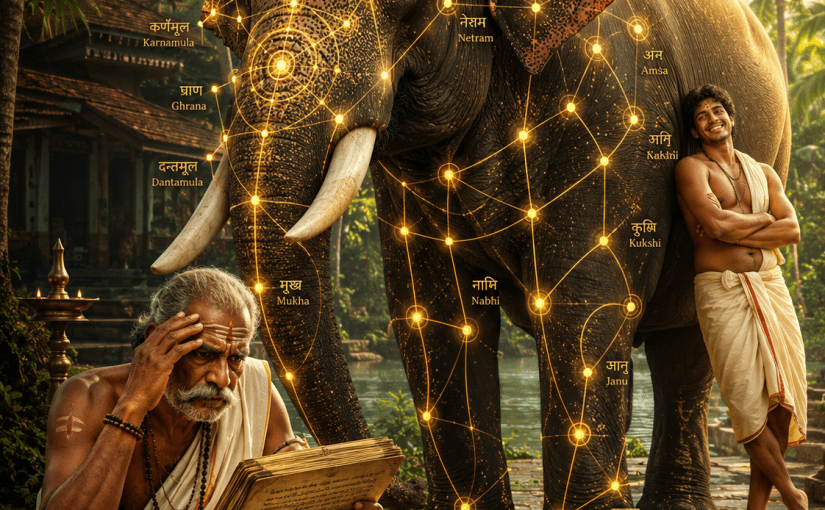
There is an old Indian legend about elephant trainers—mahouts—that perfectly explains why I sometimes sit in my studio staring at a Logic Pro session, completely paralyzed, while the rest of the world just goes ahead and makes music.
Let me paint the picture. You have an Expert Mahout and an Inexperienced Mahout. The Expert has spent decades studying the ancient texts. He knows every single marma point on the elephant. (For the uninitiated, marma points are the vital, vulnerable energy centers in Ayurvedic anatomy. Strike the wrong one, and you either permanently injure the animal or, more likely, it turns you into a human dosa).
So, when the elephant misbehaves, the Expert stands there calculating: “If I tap him behind the ear, I might hit the Sringataka marma… If I strike the flank, I might damage his spleen…” To his educated eyes, the elephant is basically a giant, walking minefield. There is hardly a single square inch of the beast that is safe to touch. By the time he calculates the optimal trajectory for applying discipline without causing a catastrophe, the elephant has already eaten a banana grove and wandered off to Kerala.
Then you have the Inexperienced Mahout. He hasn’t read the texts. He doesn’t know what a marma point is. The elephant acts up? Whack. He just taps it on the rump with his stick. No calculation. No Ayurvedic consultation. No existential dread.
And the absolute best part? He gets away with it. The elephant just grunts, accepts the correction, and gets back in line.
This story isn’t a critique of the beginner; it’s a tragedy of the expert. Why does knowing your subject inside and out make you lose your confidence? Psychologists call it the Dunning-Kruger effect, but honestly, I often find myself envying that early stage. The beauty of not knowing the rules is that you aren’t terrified of breaking them. The more you know, the more hesitant you get. The curse of expertise is that you see marma points everywhere.
Have you seen that viral video of the Malayali uncle, Reji Annan, singing the classic Yesudas track “Gange Thudiyil”? He isn’t in a treated acoustic room. He isn’t worrying about phase alignment, breath control, or whether his EQ masking is clashing with a backing track. He just opens his mouth and belts it out with pure, uninhibited joy and absolute conviction. He isn’t looking at the marma points. He’s just riding the elephant. And millions of people loved it, completely hooked by his raw authenticity.
Meanwhile, I look at my own vocal tracks in Logic Pro and freeze. I’ll spend three days agonizing over whether to use Waves Tune, terrified to send a mix to the sound engineer unless my TC-Helicon is dialed in to the exact millimeter. What if the venue’s acoustics hit a sonic marma point?! The knowledge that was supposed to empower my music ends up acting like a pair of handcuffs.
You see it in spiritual sadhana, too. We study the scriptures and worry if we are pronouncing the Shyamala Dandakamwith the exact right phonetic intonation, terrified of offending the cosmic grammar police. We hesitate to chant because our Sanskrit isn’t flawless. Meanwhile, someone else is cheerfully butchering the grammar with pure, overwhelming devotion—and they are the ones getting all the grace.
Knowing the marma points is a beautiful thing; it is what makes you a master. But the legend of the mahout is a humbling reminder. The goal of acquiring knowledge shouldn’t be to build a prison of hesitation around yourself. Sometimes, you have to realize that the elephant—whether that’s your audience, your art, or the universe itself—is a lot thicker-skinned than you think.
Sometimes, we need to stop overthinking the marma points, let go of our expert hesitation, and just sing the song.

