
The Ego: Friend, Foe, or Just Misunderstood?

For centuries, sages, saints, and that one uncle at weddings who insists he knows “the truth of everything” have been shouting in unison: shed the ego! According to them, the ego is the villain of the spiritual soap opera, the moustache-twirling bad guy who blocks us from enlightenment. One modern guru even turned it into a neat acronym: E.G.O = Edging God Out.

Sounds convincing, right? But here’s the twist: without the ego, you wouldn’t even know there was a truth to realize in the first place.

The Double Life of Ego

Think of ego like your neighborhood auto driver. On one day, he’s weaving dangerously through traffic, shouting at pedestrians, and playing film songs at full volume—annoying, loud, and best avoided. On another day, he’s the one who drops you exactly where you need to be, gives you change without grumbling, and even warns you about the pothole near the signal. Same guy, two different roles.

Ego works like that. If you identify it with your endless stream of random thoughts—“what’s for dinner?”, “does my WhatsApp DP look fat?”, “why hasn’t Netflix released Season 2 yet?”—then yes, ego is the troublemaker. But if you recognize ego as the quiet sense of “I am” that sits beneath all this noise, suddenly it becomes a signpost pointing straight toward Truth.

The Shopping Mall Analogy

Picture yourself in a shopping mall. Every shop window is blaring for attention: “Buy me! Eat me! Discount 50%!” These are your thoughts. Your ego, depending on how you use it, can do one of two things:

  1. Chase the mannequins—run around from Zara to Apple Store to the food court, completely distracted.
  2. Stand in the middle of the mall—aware that all these shops exist, but not compelled to enter. Just resting in the fact that you are present in the mall, not the stuff inside it.

One leads to exhaustion (and an empty wallet). The other leads to realization.

The Cosmic Stage Show

Think of life as a stage play. The thoughts, emotions, aches, and identities are like actors. The ego can either insist, “I’m the hero, the villain, the comedian, and also the audience—give me all the parts!” Or it can sit back as the stage itself—the screen upon which the entire drama plays.

It’s the same ego, but which way you flip it makes all the difference.

Why We Need Ego to Drop Ego

Here’s the paradox no one tells you: you need ego to even decide to shed ego. Who else is sitting there reading blogs about spirituality at 11:47 p.m. on a Tuesday? The “I” that seeks the Truth is still ego—but it’s the refined version, the ego that points beyond itself, like a GPS that tells you, “Recalculating route to Infinity.”

So maybe the sages weren’t wrong about letting go of ego. But until you use it to realize what’s beyond, dropping it too soon is like throwing away the car keys because you’re frustrated about potholes. The car’s still the way to get home.

Everyday Example: The Alarm Clock

Think of your alarm clock. It’s annoying, intrusive, and loud. You want to smash it against the wall every morning. But without it, you wouldn’t even wake up to know there is a morning. Ego’s the same. It wakes you up to the sense of “I am”—and from there, you get to see that you are more than the random noise of thoughts and identities.

In short: Ego isn’t the villain. It’s the slightly irritating but ultimately helpful character that gets you to the truth. Shed the noisy part, keep the “I am” part, and you might just find that what you thought was blocking God was really pointing to God all along.

How to Tune Into Your Inner Steady Hum

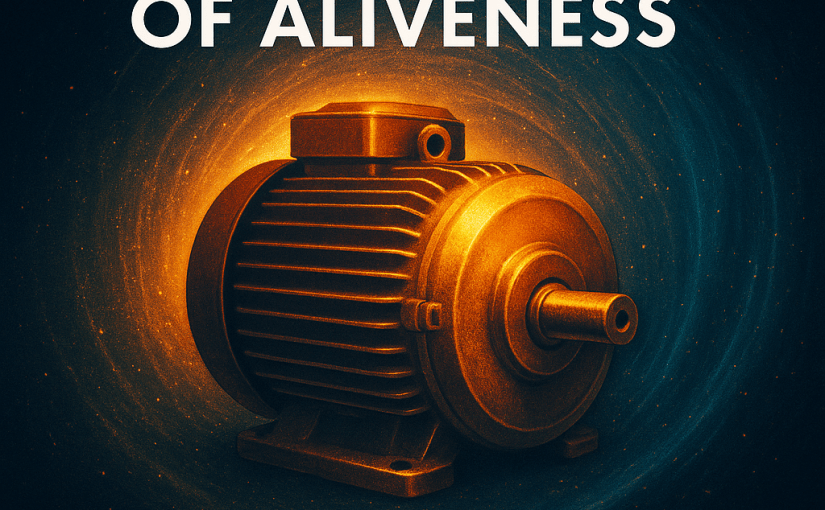
Have you ever walked past a giant generator or one of those industrial motors and felt it in your bones before you even heard it? That low, steady hum… reassuring, powerful, unbothered. It’s just there. Not shouting for attention, not needing to prove itself, but quietly powering the whole building.

That, my friend, is exactly what the sense of “aliveness” feels like.

We’re so used to identifying with thoughts—this endless parade of “should I…”, “what if…”, “oh no…”, “why me…”—that we forget there’s something far more fundamental buzzing underneath. A current that’s been running since before you knew your name, before you knew you had knees that creak when you get up too fast, before you had a list of worries that could rival a grocery bill.

The Dynamo Within

Sit still for a moment. Drop the drama. Forget the story of “you.” What’s left? A hum. Not metaphorical, but a very real sense that something is alive in you. Breathing, pulsing, steady as a ceiling fan in a summer power cut (when the current isn’t steady, you really notice!).

From that humming place, you’ll see your thoughts like little fireflies outside a streetlamp—pretty maybe, sometimes irritating, but clearly not the light itself. Even your precious “identity”—that carefully curated name, job title, Instagram bio—sits outside this hum. The aliveness doesn’t care if you’re CEO of the world or Chief Operator of the Remote Control. It just hums.

Aches, Pains, and Invincibility

Here’s the wild part: even the body’s complaints—sore shoulders, stiff back, that knee that behaves like it’s auditioning for a horror movie soundtrack—can be observed from here. You notice them, yes. But they’re not you. They’re like background noise in a café where the espresso machine hisses, chairs scrape, and the couple at the next table is arguing over pineapple on pizza. None of it stops the café from being a café.

And from here, strangely enough, there’s a feeling of invincibility. Not the Marvel superhero kind where you dodge bullets, but a deeper invincibility. Even mortality feels… well, slightly overrated. Because the hum doesn’t really start or stop—it just is.

Everyday Example: The Fridge

Think of your refrigerator. You don’t stand there all day listening for the motor. But if the hum stops, you immediately sense something’s wrong. Suddenly, all the thoughts appear: “Do I need to call the repair guy? Will my ice cream melt? How fast can I eat three tubs of Ben & Jerry’s?”

Our aliveness is like that fridge motor. It’s constant, reliable, and easily overlooked because it’s always there. But notice it, and suddenly the thoughts about melted ice cream (or anything else) are just noise outside that steady hum.

The Easy Part

Here’s the best news: nobody can deny being alive. This isn’t some mystical achievement reserved for monks in Himalayan caves. You’re alive, right now. The hum is running. Tuning into it doesn’t take effort—it takes not effort. Just notice.

The hard part? We forget. The easy part? We can remember again, any time.

So the next time you find yourself spiraling in thought or getting stuck in an ache, pause. Step back. Listen for the dynamo. That quiet, invincible hum of aliveness.

It’s been there all along, and unlike your fridge, you don’t need to call a repair guy.

The Ostrich, the Sand, and the Secret of the Universe

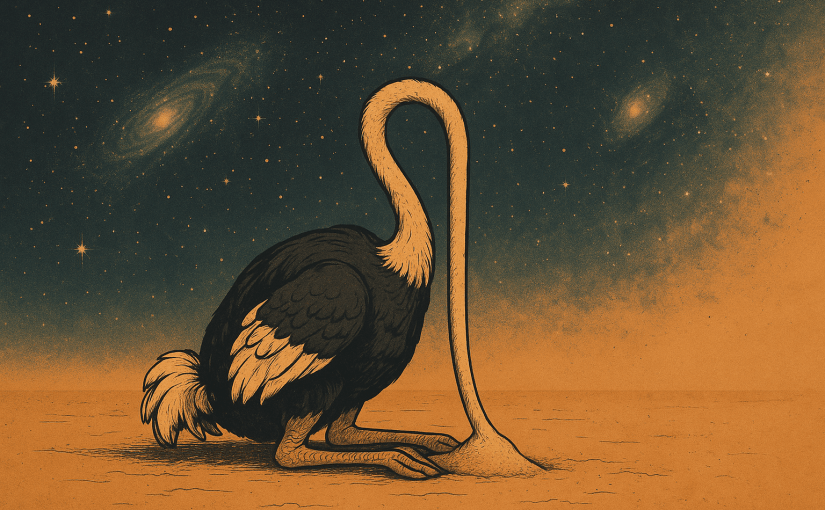
They say the ostrich buries its head in the sand to avoid danger.

That’s not true, of course — it’s a myth.

The ostrich does no such thing.

But if it did… ah, then we’d have a bird with a very promising career in philosophy.

Because the idea behind the myth — that shutting out the world makes it vanish — is actually a rather elegant pointer to one of the oldest truths in spiritual thought:

Everything you experience exists only in consciousness.

Sand as a Spiritual Tool

Let’s say you really were an ostrich (just for argument’s sake — no offence to your current species). You poke your head into the sand, and suddenly your vision is filled with warm, brown nothingness. No predators. No sky. No grass. No desert. The universe, for all practical purposes, is gone.

You didn’t destroy it — you just stopped perceiving it.

And here’s the big leap: the same is true for your waking life.

The so-called “objective world” is actually stitched together inside your mind. Without the light of consciousness shining on it, the whole grand spectacle collapses into… well, nothing.

The Sleep Experiment You’ve Been Running Every Night

This isn’t just poetic speculation. You prove it to yourself every single night.

When you slip into deep, dreamless sleep — that mysterious stage where there are no mental movies playing — the entire cosmos disappears. Not just your problems, not just your to-do list, but the Himalayas, the Pacific Ocean, the Milky Way — poof.

No you, no neighbour’s dog barking at 2 a.m., no neighbour either.

And yet, you wake up in the morning convinced the world “was there all along.”

But here’s the uncomfortable question: was it? Or is it that the world only exists when you are conscious of it?

Ancient Wisdom and Ostrich Wisdom

Philosophers from Advaita Vedanta to modern-day consciousness researchers have been politely trying to tell us the same thing: the “world” is an appearance in awareness, not an independent reality.

The ostrich myth, despite being zoologically false, has a certain charm here. If putting your head in the sand can make the predators vanish (from your point of view), isn’t that just the avian equivalent of closing your eyes in meditation? The outer scene fades, and you are left with the awareness that contains it all.

Why This Matters (Beyond Bird Comparisons)

If the universe only exists in consciousness, then our frantic attempts to “fix” the outside world before we’re happy might be a bit backwards.

Instead, we could turn inward and examine the one constant — the awareness in which all this appears.

That doesn’t mean you stop paying your bills or feeding the cat (even enlightened beings have to clean the litter box). But it does mean you stop clinging to the idea that the world is a fixed, external “thing” and start seeing it as a living, breathing projection in the cinema of your mind.

So the next time someone mocks the ostrich for “burying its head in the sand,” you might smile and think:

Maybe that ostrich isn’t avoiding reality.

Maybe it’s just contemplating the profound truth that without perception, the world as we know it… simply isn’t there.

And perhaps, like that mythical ostrich, we could all use a moment to put our heads down — not in sand, but in stillness — and watch the universe quietly dissolve back into the infinite awareness from which it came.

Neville Goddard vs. Ramana Maharshi: The Truth About Reality

One of the most fascinating questions in spirituality is whether we create our own reality or whether everything is already predetermined. On one hand, Neville Goddard’s Law of Manifestation tells us that we can manifest anything we desire by assuming the feeling of already having it. On the other, Ramana Maharshi teaches that everything is dictated by destiny and that trying to change our fate is futile.

At first glance, these two views seem contradictory. If everything is already written, then what is the point of manifesting? But if manifestation truly works, does that mean fate is not real? Let’s explore both perspectives and see if they can actually be reconciled.

Neville Goddard: You Are the Creator of Your Reality

Neville Goddard’s teachings emphasize that imagination is the divine creative force. He believed that by living as if our desires are already fulfilled, we bring them into reality. According to this view, our external world is simply a reflection of our internal state. The universe responds to our feelings and beliefs, making manifestation a conscious and deliberate process.

For example, if you believe and feel that you are already successful, the world will eventually mirror that belief. The key is to fully embody the state of having what you desire, without doubt or resistance.

Ramana Maharshi: Surrender to the Divine and Accept Destiny

Ramana Maharshi, one of India’s greatest sages, had a completely different approach. He often spoke about prarabdha karma (the karma that unfolds in one’s lifetime) and how everything is predetermined by the divine will. From this perspective, trying to change our external reality through personal effort is meaningless because what is meant to happen will happen, no matter what.

Ramana advocated the path of self-inquiry (Who am I?), urging seekers to transcend their sense of individuality and surrender to the higher Self. Instead of chasing desires, he encouraged us to dissolve the ego and recognize that the true Self is beyond manifestation and destiny alike.

How Can These Two Views Coexist?

At first, it seems impossible to reconcile these two perspectives, but a deeper look reveals a potential harmony:

  1. Manifestation and Destiny Can Be Two Sides of the Same Coin
  • What we desire and try to manifest may itself be part of our predetermined path. If something is meant for us, we may naturally feel drawn to it and manifest it with ease.
  • If something is truly not in our destiny, we may struggle no matter how much we try to manifest it.
  1. Inner vs. Outer Reality
  • Neville’s teachings help us navigate and shape our external world through belief and feeling.
  • Ramana’s wisdom teaches us to go beyond the external world and recognize the deeper reality where nothing needs to be manifested because we already are complete.
  1. The Role of Self-Realization
  • Neville’s approach is useful when operating as an individual in the world, helping us improve our life circumstances.
  • Ramana’s path leads to the dissolution of the ego itself, where the concepts of manifestation and destiny dissolve into the eternal truth.

So, Which One is True?

The answer depends on how we see ourselves:

  • If we see ourselves as individuals navigating life, manifestation seems real and powerful.
  • If we seek ultimate truth, Ramana’s teaching shows that everything, including manifestation, is just part of the greater play of consciousness.

Perhaps the best approach is to blend both perspectives:
✨ Use Neville’s teachings to create a fulfilling life in the material world.
🕉 Follow Ramana’s wisdom to transcend attachment and accept life as it unfolds.

Both paths lead to greater awareness—one through creation, the other through surrender. The choice, perhaps, is also part of destiny!

What do you think? Have you experienced moments where manifestation worked? Or do you feel that life unfolds as per destiny no matter what?

Understanding Chris Langan’s CTMU: A Cosmic Perspective

Decoding the CTMU: Chris Langan’s Universe-Sized Brainchild

At nallamadras.com, we often explore fascinating intersections of science, spirituality, and philosophy. From the mysteries of meditation to the connection between music and higher consciousness, we love diving into big ideas that challenge us to think differently. Today, we venture into one of the most ambitious theories out there—the Cognitive-Theoretic Model of the Universe (CTMU) by Chris Langan, often dubbed “the smartest man in America.”

If you’ve enjoyed our previous posts, like “The Interplay of Music and the Cosmos” or Exploring the Philosophy of Oneness”, then buckle up—because the CTMU takes the idea of interconnectedness to a whole new level.

What Is the CTMU? (Breaking It Down)

The CTMU—short for Cognitive-Theoretic Model of the Universe—is Chris Langan’s attempt to explain everything. Yes, everything. It’s a bold framework that combines science, philosophy, and metaphysics into one cohesive theory. In Langan’s words, the CTMU offers a way to “connect mind, matter, and the laws of the universe.” Sounds epic, right? It is. But let’s break it down into digestible pieces.

The Big Ideas of the CTMU

1. Reality as a Self-Simulation

Imagine the universe as the ultimate game of Minecraft, but instead of being created by a programmer, it programs itself. The CTMU suggests that reality isn’t just a physical system—it’s a self-simulating, self-defining process. It’s like the universe is its own coder, constantly evolving and updating itself.

2. The Unity of Mind and Matter

You’ve probably heard debates about whether the mind is separate from the physical world. The CTMU says, “Why not both?” Langan argues that mind and matter are two aspects of the same system. Think of it like a smartphone: the hardware (matter) and the software (mind) work together seamlessly to make the system function.

3. Reality Speaks Its Own Language

Here’s where things get poetic. Langan describes reality as a kind of language. But instead of using words or grammar, it uses logic and structure to “speak itself” into existence. That means every atom, every galaxy, and yes, even you, are part of an ongoing cosmic conversation.

4. The Universe Is Its Own Creator

Who or what created the universe? The CTMU’s answer: the universe created itself. Think of it as a cosmic Russian nesting doll—except this one is infinite, constantly redefining and containing itself.

Why Should You Care About the CTMU?

You might be thinking, “This is fascinating, but how does it apply to me?” Great question. The CTMU isn’t just an intellectual exercise; it offers profound implications for how we see ourselves and our place in the universe.

You’re Not Just in the Universe—You Are the Universe

According to the CTMU, you’re part of the system that defines reality. Everything you think, feel, and do contributes to the greater whole.

Your Thoughts Have Power

If reality is a self-simulating system where mind and matter are intertwined, then your thoughts might play a bigger role than you realize. In essence, the universe might not just be observing you—you’re shaping it, too.

Connecting CTMU to Spirituality

At nallamadras.com, we often explore themes of spirituality and interconnectedness, from meditation techniques to the power of bhajans and kirtans. The CTMU adds a fascinating layer to these discussions.

For example, the idea that the universe is self-aware aligns with spiritual traditions that emphasize oneness and the unity of all existence. Whether you’re drawn to the chants of Krishna Das or the meditative rhythms of shamanic drumming, the CTMU suggests that these practices tap into something fundamental about the universe itself.

Criticism and Why It Doesn’t Diminish Its Value

Of course, the CTMU isn’t without its critics. Some argue it’s too abstract or philosophical to be considered a proper scientific theory. Others say it’s nearly impossible to test or prove.

But let’s be real: when you’re trying to explain everything, a little pushback is inevitable. What makes the CTMU fascinating isn’t whether it’s flawless—it’s the fact that it challenges us to think bigger.

Making It Fun: CTMU and Everyday Life

Let’s lighten things up. If the CTMU is true, it means:

You’re Part of a Giant Simulation: Next time you’re stuck in traffic, just remember—you’re contributing to the cosmic code.

The Universe Is Watching: Not in a creepy way, but in a “we’re all connected” kind of way. Maybe that’s why your coffee tastes better when you’re in a good mood.

Black Holes Are Drama Queens: According to the CTMU, even the universe loves a bit of mystery.

Why the CTMU Matters

Whether you’re a science enthusiast, a spiritual seeker, or just someone who loves asking big questions, the CTMU has something to offer. It’s a reminder that we’re all part of something far bigger than ourselves—a vast, interconnected system that’s constantly evolving.

Chris Langan’s work invites us to see the universe not just as a collection of atoms and forces but as a living, breathing system of which we’re an integral part. And that, in itself, is a pretty profound takeaway.

Curious about how this ties into other concepts we’ve explored? Check out more on spirituality and daily living or the philosophy of interconnectedness.

Let me know what you think—does this cosmic theory expand your perspective, or leave you scratching your head? Either way, the conversation is worth having!

Let me know if you’d like further edits, more links, or tweaks to the tone!

Blast Off to Enlightenment: A Cosmic Journey Within

Ever watched a SpaceX launch and thought, “Man, I wish that was me blasting off?” The rumbling engines, the sheer power, the escape from Earth’s clutches…it’s the ultimate adventure, right? Well, get ready to trade your spacesuit for a meditation cushion, because there’s another journey that’s even more mind-blowing: the journey to enlightenment.

Think of enlightenment as the ultimate “un-tethering” from planet You. No more getting sucked into the black hole of your own drama, no more emotional turbulence, just pure bliss and inner peace. You’re basically a cosmic astronaut, floating in the vast expanse of your own being. Sounds pretty epic, right?

But just like a rocket needs those monstrous boosters to break free from Earth’s gravitational pull, you need some serious fuel to escape the clutches of your ego. And that fuel, my friend, is intention. Think of it as the rocket fuel of your soul.

So, how exactly are blasting off into space and reaching enlightenment similar? Buckle up, because we’re about to go on a wild ride:

1. Fueling Up:

  • Rocket: Tons of liquid hydrogen and oxygen, meticulously calculated and carefully loaded.
  • You: A burning desire to transcend the limitations of your mind. This is where your daily practices come in: meditation, mindfulness, self-reflection, maybe even a yoga class or two. Think of these as your fuel pumps, constantly filling your tank with the energy you need to break free.

2. Guidance System:

  • Rocket: Cutting-edge algorithms, GPS systems, and a team of brilliant engineers at Mission Control ensuring it stays on course.
  • You: A trusted teacher, a spiritual community, or a solid philosophical framework to guide you through the inner workings of your mind. They’re your ground crew, providing support and helping you navigate the complexities of your inner landscape.

3. Stages of the Journey:

  • Rocket: Different stages fire off at specific times, each providing the necessary thrust to reach the next level.
  • You: You’ll also go through different stages of growth and understanding on your path to enlightenment. You might start by becoming more aware of your thoughts and emotions, then work on releasing old patterns and limiting beliefs. Each stage brings you closer to your ultimate goal.

4. Escape Velocity:

  • Rocket: That magic speed needed to overcome Earth’s gravitational pull and soar into the cosmos.
  • You: The point where you’re no longer weighed down by desires, attachments, and the constant churn of negative emotions. You’re free from the drama, free from the suffering, free to simply be.

5. The Destination:

  • Rocket: The International Space Station, the Moon, Mars…the possibilities are endless!
  • You: A state of lasting peace, joy, and a deep connection to something larger than yourself. Some call it oneness, some call it God, some call it universal consciousness. Whatever the label, it’s a state of profound freedom and fulfillment.

6. The View:

  • Rocket: Astronauts get to see Earth in all its glory, a breathtaking perspective shift that changes their understanding of our planet.
  • You: Enlightenment offers a similar shift in perspective. You see the world with fresh eyes, appreciating the interconnectedness of all things and the beauty in every moment.

Now, before you start picturing yourself in a loincloth, meditating on a mountaintop for the next decade, let’s be real. Enlightenment isn’t just for monks in caves or yogis who can twist themselves into pretzels. It’s for anyone who’s ready to ditch the drama, live a more meaningful life, and experience true inner peace.

So, are you ready to blast off on the ultimate inner space adventure? Start fueling your intention, find your guidance system, and prepare for liftoff! The cosmos of your consciousness awaits!