
It’s 11:30 PM. You are doom-scrolling on Amazon, and suddenly, you see it. A noise-canceling headphone that promises to silence not just the traffic outside, but arguably your own thoughts. Or maybe it’s Saturday night, and that second slice of chocolate truffle cake is looking at you with the intensity of a long-lost lover.
In that moment, a powerful wave rises. The ancient texts call it Kama (desire), but let’s just call it what it is: The Itch.
The Itch says, “If I get this, I will be happy.”
And you know what? It’s not entirely lying. You will be happy. For about fourteen minutes. Maybe twenty if the cake is really good. But then? The happiness evaporates, leaving you exactly where you were, perhaps with just a slightly lighter wallet or a heavier stomach.
This is the trap of the sensory world. It sells us rental happiness and charges us ownership prices.
But there is a little game you can play to hack this system. I call it “This or That.”
The Two Menus
Imagine life is a restaurant with only two items on the menu.
Item 1: “This”
Ingredients: Sensory pleasures, shopping sprees, that extra glass of wine, the dopamine hit of a new gadget.
Guarantee: Instant gratification.
Side Effects: Transient. It fades quickly, leaving a vacuum that demands to be filled again. It is the hamster wheel of happiness.
Guarantee: Eternal peace. A subtle, unshakeable joy that doesn’t depend on what is in your driveway or your refrigerator.
Side Effects: A sense of invincibility. The realization that you are already full.
How to Play the Game
The game is deceptively simple. The moment a craving arises—whether it’s for a new car, a harsh retort to a colleague, or just mindless consumption—you pause.
Take a breath. Create a tiny gap between the urge and the action. And in that gap, ask yourself:
“Do I want This… or That?”
Do I want the fleeting thrill of the object (“This”)? Or do I want the eternal stability of my own Self (“That”)?
When you choose “This,” you are choosing to be a beggar, asking the world to drop a coin of happiness into your bowl. When you choose “That,” you remember you are the Emperor.
The “That” is Always There
Here is the secret the marketing departments don’t want you to know: The peace you are looking for in the object is actually what remains when the wanting of the object drops.
When you finally buy that gadget, you feel a moment of relief. You think the gadget gave you joy. It didn’t! The gadget simply removed the craving for a moment, revealing the natural joy (Satchitananda) that was already there underneath.
So why take the detour through the shopping mall? Go straight to the source.
The Practice
Next time the urge hits, catch it mid-air.
Craving for approval? Ask: This (someone else’s opinion) or That (my own inner fullness)?
Craving for distraction? Ask: This (social media noise) or That (the silence of being)?
You might still choose the cake. And that’s fine! We aren’t trying to be monks overnight. But simply asking the question breaks the trance. It reminds you that you have a choice.
You are standing at the crossroads of the momentary and the eternal fifty times a day.
You know those pop-up greeting cards — the ones that look flat and innocent until you open them, and suddenly bam!— an entire Taj Mahal made of paper springs out, usually accompanied by glitter and guilt for not buying a simpler one?
That’s sort of what happens every morning when we open our eyes.
After a good night’s sleep (the rare kind where no one from your childhood WhatsApp group appears in your dreams asking for donations), the moment you wake up, a full 3D world unfolds — people, places, problems, pending bills — all popping up like that elaborate paper diorama.
It’s quite the show.
The Great Morning Unfolding
When you open your eyes, you also pop up — the “me” character, complete with opinions, breakfast preferences, and mild existential anxiety. The whole identity kit just unfolds smoothly like it’s been waiting all night under your pillow.
Some people say, “But Nanda, the world doesn’t vanish when you sleep! It’s still there!”
Maybe. But here’s the trick — the very someone making that argument is also part of your conscious field. That clever, philosophical person pointing out your ‘flaw in logic’? Yep, also a pop-up.
It’s like arguing with a character inside the card about whether the card exists.
Flat When Closed
When the pop-up card is closed, nothing is destroyed. The scene is just folded — the palace, the trees, the smiling couple in matching paper sarees and kurtas — all compacted into flatness.
Similarly, when you’re asleep or in deep meditation, the world — with all its drama and color — folds back into stillness. Not gone, but dormant. Like your boss on a Sunday.
And when you “wake up,” the grand production begins again: light, sound, identity, memory — everything leaps up, shouting “Surprise!” like an overeager birthday card.
The Trick of Believability
The funny thing about pop-up cards is how convincing they can be, especially to children (and occasionally to adults before coffee). You forget it’s just paper cleverly cut and glued.
Likewise, consciousness projects such a convincing show that we forget it’s a projection at all. The mind doesn’t just open the card — it hires a full cast, builds sets, adds background music, and gives you the lead role.
The irony? You’re both the audience and the actor.
Liberation as Folding Back
So what is liberation then? It’s not burning the card or running away from it. It’s simply realizing that whether the card is open or closed — nothing truly new appears or disappears.
The essence was never in the paper palace or the pop-up people; it was always in the space that allowed it to unfold.
That awareness — silent, spacious, unbothered — is the real greeting.
Everything else is just… decoration with a bit of glitter.
Closing Thought
Next time you wake up, watch the show unfold. Don’t rush to start the day. Just notice how the world pops up — your name, your room, your phone, your to-do list — all springing to life from nowhere.
And maybe, before diving in, smile and whisper to yourself:
“Ah, there it is — the morning card. Let’s see what scene consciousness is sending me today.”
(Just don’t try to fold your spouse back into the card when they ask you to make coffee. Enlightenment has limits.)
For centuries, sages, saints, and that one uncle at weddings who insists he knows “the truth of everything” have been shouting in unison: shed the ego! According to them, the ego is the villain of the spiritual soap opera, the moustache-twirling bad guy who blocks us from enlightenment. One modern guru even turned it into a neat acronym: E.G.O = Edging God Out.
Sounds convincing, right? But here’s the twist: without the ego, you wouldn’t even know there was a truth to realize in the first place.
The Double Life of Ego
Think of ego like your neighborhood auto driver. On one day, he’s weaving dangerously through traffic, shouting at pedestrians, and playing film songs at full volume—annoying, loud, and best avoided. On another day, he’s the one who drops you exactly where you need to be, gives you change without grumbling, and even warns you about the pothole near the signal. Same guy, two different roles.
Ego works like that. If you identify it with your endless stream of random thoughts—“what’s for dinner?”, “does my WhatsApp DP look fat?”, “why hasn’t Netflix released Season 2 yet?”—then yes, ego is the troublemaker. But if you recognize ego as the quiet sense of “I am” that sits beneath all this noise, suddenly it becomes a signpost pointing straight toward Truth.
The Shopping Mall Analogy
Picture yourself in a shopping mall. Every shop window is blaring for attention: “Buy me! Eat me! Discount 50%!” These are your thoughts. Your ego, depending on how you use it, can do one of two things:
Chase the mannequins—run around from Zara to Apple Store to the food court, completely distracted.
Stand in the middle of the mall—aware that all these shops exist, but not compelled to enter. Just resting in the fact that you are present in the mall, not the stuff inside it.
One leads to exhaustion (and an empty wallet). The other leads to realization.
The Cosmic Stage Show
Think of life as a stage play. The thoughts, emotions, aches, and identities are like actors. The ego can either insist, “I’m the hero, the villain, the comedian, and also the audience—give me all the parts!” Or it can sit back as the stage itself—the screen upon which the entire drama plays.
It’s the same ego, but which way you flip it makes all the difference.
Why We Need Ego to Drop Ego
Here’s the paradox no one tells you: you need ego to even decide to shed ego. Who else is sitting there reading blogs about spirituality at 11:47 p.m. on a Tuesday? The “I” that seeks the Truth is still ego—but it’s the refined version, the ego that points beyond itself, like a GPS that tells you, “Recalculating route to Infinity.”
So maybe the sages weren’t wrong about letting go of ego. But until you use it to realize what’s beyond, dropping it too soon is like throwing away the car keys because you’re frustrated about potholes. The car’s still the way to get home.
Everyday Example: The Alarm Clock
Think of your alarm clock. It’s annoying, intrusive, and loud. You want to smash it against the wall every morning. But without it, you wouldn’t even wake up to know there is a morning. Ego’s the same. It wakes you up to the sense of “I am”—and from there, you get to see that you are more than the random noise of thoughts and identities.
In short: Ego isn’t the villain. It’s the slightly irritating but ultimately helpful character that gets you to the truth. Shed the noisy part, keep the “I am” part, and you might just find that what you thought was blocking God was really pointing to God all along.
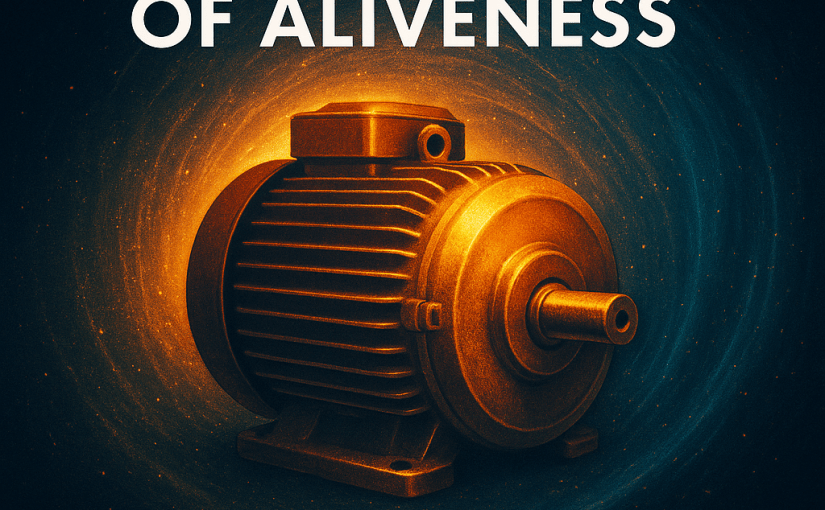
Have you ever walked past a giant generator or one of those industrial motors and felt it in your bones before you even heard it? That low, steady hum… reassuring, powerful, unbothered. It’s just there. Not shouting for attention, not needing to prove itself, but quietly powering the whole building.
That, my friend, is exactly what the sense of “aliveness” feels like.
We’re so used to identifying with thoughts—this endless parade of “should I…”, “what if…”, “oh no…”, “why me…”—that we forget there’s something far more fundamental buzzing underneath. A current that’s been running since before you knew your name, before you knew you had knees that creak when you get up too fast, before you had a list of worries that could rival a grocery bill.
The Dynamo Within
Sit still for a moment. Drop the drama. Forget the story of “you.” What’s left? A hum. Not metaphorical, but a very real sense that something is alive in you. Breathing, pulsing, steady as a ceiling fan in a summer power cut (when the current isn’t steady, you really notice!).
From that humming place, you’ll see your thoughts like little fireflies outside a streetlamp—pretty maybe, sometimes irritating, but clearly not the light itself. Even your precious “identity”—that carefully curated name, job title, Instagram bio—sits outside this hum. The aliveness doesn’t care if you’re CEO of the world or Chief Operator of the Remote Control. It just hums.
Aches, Pains, and Invincibility
Here’s the wild part: even the body’s complaints—sore shoulders, stiff back, that knee that behaves like it’s auditioning for a horror movie soundtrack—can be observed from here. You notice them, yes. But they’re not you. They’re like background noise in a café where the espresso machine hisses, chairs scrape, and the couple at the next table is arguing over pineapple on pizza. None of it stops the café from being a café.
And from here, strangely enough, there’s a feeling of invincibility. Not the Marvel superhero kind where you dodge bullets, but a deeper invincibility. Even mortality feels… well, slightly overrated. Because the hum doesn’t really start or stop—it just is.
Everyday Example: The Fridge
Think of your refrigerator. You don’t stand there all day listening for the motor. But if the hum stops, you immediately sense something’s wrong. Suddenly, all the thoughts appear: “Do I need to call the repair guy? Will my ice cream melt? How fast can I eat three tubs of Ben & Jerry’s?”
Our aliveness is like that fridge motor. It’s constant, reliable, and easily overlooked because it’s always there. But notice it, and suddenly the thoughts about melted ice cream (or anything else) are just noise outside that steady hum.
The Easy Part
Here’s the best news: nobody can deny being alive. This isn’t some mystical achievement reserved for monks in Himalayan caves. You’re alive, right now. The hum is running. Tuning into it doesn’t take effort—it takes not effort. Just notice.
The hard part? We forget. The easy part? We can remember again, any time.
So the next time you find yourself spiraling in thought or getting stuck in an ache, pause. Step back. Listen for the dynamo. That quiet, invincible hum of aliveness.
It’s been there all along, and unlike your fridge, you don’t need to call a repair guy.
Hey everyone, great hanging out with you all in the comments on yesterday’s post! It seems like the idea of our life resonated with quite a few of you. Our body, roles, and even our thoughts are kinda like a temporary house we inhabit. We talked about keeping a “chill take” on it all. We shouldn’t get too attached to the structure or the furniture. It’s all part of the journey.
But that naturally leads to the next big question, doesn’t it? If all that stuff is the “house”… then who is the ‘I’ that’s actually living inside it? Who is experiencing the leaky faucets, the sunny rooms, the whole deal?
Today, let’s explore that resident. Here’s a heads-up. We will share some cool old ideas from ancient wisdom. These will help us unpack it. Stay chill, though – it’s all part of the adventure!
Meet the Busy ‘Resident Manager’ (Ahamkara)
Think about who runs the show in your “house” day-to-day. There’s this constant sense of ‘me’ that seems to be in charge, right? It worries about upkeep, feels proud of the decor, gets annoyed when things aren’t perfect. Ancient Indian thought has a name for this busy manager: अहंकार (Ahamkara).
अहंकार (Ahamkara): Remember this one? We touched on it briefly. It literally means the “I-maker.” It’s the role within us. It creates the strong feeling of being a separate individual. It makes us feel like the one who owns the house and everything linked to it.
This Ahamkara isn’t just aware that the house exists. It identifies as the house manager. Sometimes it even thinks it is the house! It’s the voice saying:
“This is MY room!” (My opinion, my beliefs)
“Don’t scratch MY floors!” (My feelings got hurt)
“Look at MY beautiful garden!” (My accomplishments, my status)
“I need to fix that leaky faucet!” (My problems, my worries)
It’s the part of us that feels fundamentally separate and often quite stressed about managing this whole “house” situation.
Asking the Landlord (Koham?)
But is this busy, often stressed-out resident manager the actual owner of the property? Or just… the manager? This is where a fascinating practice comes in, highlighted by the sage Sri Ramana Maharshi. He suggested a change in approach. Instead of just listening to the manager’s constant chatter and anxieties, we should try to find the real source. We should seek the ultimate “landlord” by asking: “Who Am I?“
In Sanskrit: कोऽहम्? (Koham?).
कोऽहम्? (Koham?): “Who Am I?”
This isn’t about the manager giving their job title (“I am the manager,” “I am a parent,” “I am successful”). It’s about tracing that ‘I’ feeling itself back to its origin. When the manager (Ahamkara) starts freaking out – “I am overwhelmed!” “I need this!” “I hate that noise!” – the practice is to gently inquire inwardly: “Okay, who is this ‘I’ that’s feeling overwhelmed? Where does this ‘I’ actually come from?”
Ramana suggested this inquiry is incredibly powerful. Why? Because it bypasses the manager and looks for the silent owner. Finding that source, he said, is the key to real peace. It stands in contrast to the constant low-grade stress of just managing the house. He stated something profound: “The inquiry ‘Who am I?’ is the principal means to the removal of all misery and the attainment of the supreme bliss.”
Hook: Imagine being capable of quieting the frantic manager by simply looking for the calm, underlying owner! What happens if we stop taking the manager’s word for everything and investigate the source?
All This “My House, My Stuff” Stress
Let’s be real, being the resident manager (Ahamkara) is stressful! Much of our daily anxiety comes from clinging to the “house.” It also comes from defending everything we’ve labeled “mine” inside it.
Worrying about the house’s appearance (“my reputation,” “my image”).
Getting angry when someone parks in “my driveway” or disrespects “my space.”
Feeling anxious about the house’s future (“my job security,” “my health,” “my retirement”).
Comparing “my house” to the neighbor’s bigger, fancier one.
Sound familiar? The Ahamkara is hard at work. It identifies completely with the house and its contents. It is convinced that its own well-being depends entirely on the state of the property.
Hook: Think about your day so far. Whether you are right here in your town or somewhere else, think about the energy you use. You are managing aspects of “your house.” Consider on how much you defend or worry about the things you call “mine.”
When the Manager Sleeps & The Empty House (Awareness/Atman)
Now, here’s where it gets really interesting, connecting back to our “chill take” from yesterday. How permanent, how solid, is this resident manager (Ahamkara)?
Consider deep, dreamless sleep. The house (your body) is still there, resting. But where did the manager go? That distinct feeling of “I am managing this life” completely vanishes. Poof! The office is empty. This shows the Ahamkara needs certain conditions – like the waking state or even a dream state – to function.
And dreams? The manager rebuilds a whole dream house and runs around managing that! This highlights that the manager is more like a role being played than a permanent fixture.
If the manager can just disappear every night, they can’t be the fundamental reality, right? They are transient, dependent. And what about the house itself (the body)? Does a brick know it’s a brick? Does the house feel its own existence? No. Like we said yesterday, the house is just the structure. It needs something else to be known, to be experienced.
So, if the manager comes and goes, and the house itself is just structure, what is constant?
It seems to be awareness itself. The silent, unchanging space in which the house exists. The fundamental knowing that perceives the house, the manager, the thoughts, the feelings, everything. This ever-present, underlying reality, the true Self, has a name in Sanskrit: आत्मन् (Atman).
आत्मन् (Atman): The Self (with a capital S). Think of it as the silent, true owner of the property. It is like the very ground and space the house is built upon. It is pure, witnessing consciousness.
The nature of this Atman, this fundamental reality, is often described as सच्चिदानन्द (Sat-Chit-Ananda).
सच्चिदानन्द (Sat-Chit-Ananda): Existence-Consciousness-Bliss. It suggests that the very nature of this underlying awareness or space is pure being. It is pure knowing. It embodies inherent, causeless peace or joy.
Who Feels the Drafts and Sunshine? (Feelings)
Okay, so if we are fundamentally this peaceful awareness (Atman), why do we feel bothered by drafts (pain, sadness) or delighted by sunshine (pleasure, joy) in the house?
Maybe it happens like this: Awareness (Atman, the space/owner) perceives sensations related to the house (a cold draft, warm sunshine). The busy resident manager (Ahamkara) immediately rushes over, identifies with the sensation, and declares, “I am cold!” or “I love this sunny spot!” It claims ownership of the experience happening within the aware space via the house’s condition.
This reframes our feelings. They aren’t necessarily who we are. They are like weather conditions affecting the house. The underlying awareness (Atman) perceives them. Then, the temporary manager (Ahamkara) loudly claims and reacts to them.
Seeing this helps us follow Ramana’s advice: “There is no need to get rid of the wrong ‘I’ [Ahamkara/manager]. All that is required is to find out the source of the ‘I’ and abide in it.” We move away from reacting frantically like the manager. Instead, we rest as the calm, aware space or owner that perceives everything.
Living Lighter in the House
So, where does this leave us? Yesterday, we talked about the house. Today, we’ve explored the difference between the busy, stressed manager (Ahamkara) who thinks they are the house. The silent, aware space/owner (Atman) is our true foundation.
The manager comes and goes. Its attachment to “my house, my stuff” causes stress. But the underlying awareness is constant, peaceful by nature. Practices like asking “Who Am I?” help us see past the manager and connect with that deeper reality.
This doesn’t mean we neglect the house! We still take care of our bodies, our lives, our responsibilities. But we can do it with a lighter touch, with that “chill take” we talked about. We know we are fundamentally the spacious awareness. We are not just the temporary house or its frantic manager. These insights allow us to navigate the inevitable leaks. They help us enjoy the sunshine with more ease and a lot more peace.
It’s an ongoing exploration, not a final answer. What does this “resident manager” vs. “silent owner” idea spark for you? Does it change how you view the ‘I’ living in your ‘house’? Share your thoughts below – always great to learn together!
We’ve all been there. Settling into our airplane seat, adjusting the seatbelt with an air of false confidence, nodding sagely at the safety demonstration we have absolutely no intention of following unless the plane turns into a submarine. And then comes the golden piece of wisdom, disguised as a simple instruction:
“In case of a loss of cabin pressure, oxygen masks will drop from the overhead panel. Please secure your own mask before assisting others.”
Sounds reasonable, right? But think about it—this is not just an in-flight safety precaution; this is a life philosophy masquerading as aviation protocol.
Selfish or Sensible?
At first glance, it may seem selfish. Why should I put on my mask first? Shouldn’t I be the noble soul, helping my fellow passengers, rescuing kittens, and ensuring world peace?
Absolutely not. Because if you pass out from lack of oxygen while trying to help others, you’re no help to anyone. In fact, you’ve just become another unconscious person who now needs to be helped. Great job.
This is exactly how life works. You can’t pour from an empty cup. You can’t donate from an empty bank account. And you definitely can’t inspire others if you’re gasping for breath—literally or figuratively.
Life Applications of the Oxygen Mask Rule
1. Financial Oxygen – The Money Talk
We’ve all heard it: Money isn’t everything! True. But try telling that to your landlord when rent is due. Try explaining to the grocery store cashier that your “positive energy” should cover the bill.
It is far better to be rich and miserable than poor and miserable. At least with wealth, you can be miserable in comfort, with a therapist, a spa day, and an overpriced cup of artisanal coffee. Being financially secure means you can help others without sinking yourself.
I once knew a man who donated generously to charity—even when his own finances were a mess. He prided himself on being selfless, until one day, he couldn’t pay his own rent. Who came to his rescue? The very people he had been donating to. See the irony? If he had secured his own financial oxygen mask first, he could have continued helping others without needing help himself.
2. Emotional Oxygen – The Art of Saying No
You know that friend who always says “yes” to everything? The one who volunteers, helps everyone move, covers extra shifts at work, and babysits other people’s unruly kids? Ever notice how that same person often looks exhausted, frustrated, and one “Can you do me a favor?” away from a nervous breakdown?
Helping others is noble, but not at the cost of your own mental health. If you’re drowning, you can’t be a lifeguard.Learn to say no. Prioritize your well-being. Even Buddha didn’t try to enlighten people while he was still figuring himself out—he sat under a tree, meditated, and then started sharing wisdom.
3. Health Oxygen – The Body Keeps the Score
We all know someone who works 18-hour days, survives on caffeine, and insists, “I’ll rest when I’m dead.” Spoiler: That’s a fast-track way to meet that deadline sooner than expected.
You need to take care of your health before you can take care of others. A sick person can’t be an effective caregiver. A sleep-deprived employee can’t be productive. If your body is screaming for rest and you ignore it, you’re setting yourself up for a spectacular crash—just like ignoring a flashing fuel light in your car.
I once met an overworked CEO who prided himself on being “too busy for vacations.” He ended up collapsing in his office due to exhaustion. The company? It survived without him. His health? Took years to recover. Secure your ownoxygen mask before trying to run a marathon for others.
Final Descent: Prioritize Yourself, Then Help Others
The next time you hear the airplane oxygen mask announcement, don’t roll your eyes—internalize it. It’s not about being selfish; it’s about being strategically self-sufficient. If you’re thriving, you can uplift others. If you’re barely surviving, you’re just another person needing help.
Take care of your finances. Protect your mental health. Prioritize your well-being. Because once your oxygen mask is securely in place, you can truly make a difference in the lives of others.
Now, sit back, relax, and enjoy the flight.
Would love to hear your thoughts—especially if you’ve ever had to put your own “oxygen mask” on first in real life!