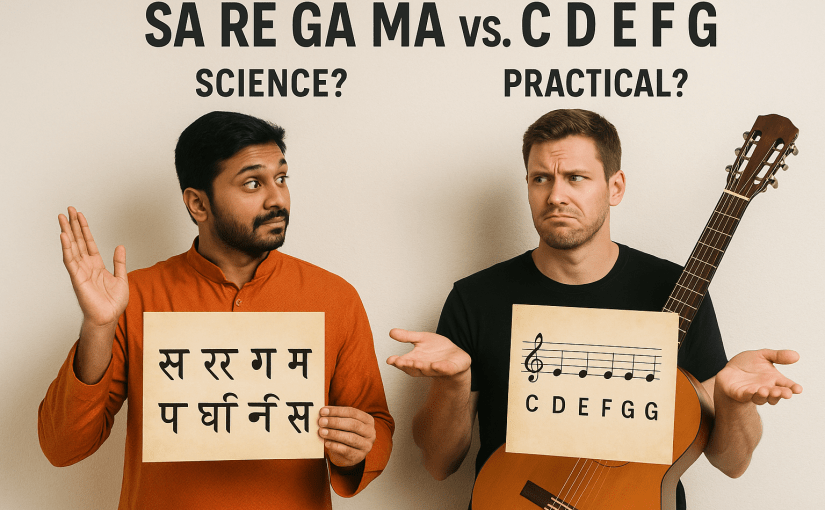
If you’ve ever been stuck at a wedding between the nadaswaram/shehnai player and the Western band belting out “Summer of ’69”, you’ve probably asked yourself the deep, philosophical question:
Why on earth are there two ways to write music, and which one should I bother learning before my next rebirth?
So, let’s introduce our two contestants.
Contestant One: The Indian Sargam
Sa Re Ga Ma Pa Dha Ni Sa
Sargam is that genial uncle who says, “Just come, beta, we’ll adjust,” and actually means it. No fuss about where you start—today Sa might be C, tomorrow Sa might be D, and next week it could be on a note only the neighbourhood cat can hear.
Relative Pitch = Chill Vibes If Sa is the first step, the rest of the staircase adjusts itself. It’s musical jugaad at its finest.
Vocal-Friendly No singer has ever said, “Oh no, I can’t sing today because Sa is stuck on 261.63 Hz.” You just shift it, smile, and carry on.
Ornaments Galore Sargam doesn’t just give you notes—it lets you bend them, slide them, and add so much gamaka that even the note doesn’t know where it started.
Think of Sargam as the filter coffee of music—warm, strong, flexible, and doesn’t come with an instruction manual.
Contestant Two: The Western Notation
C D E F G A B C
Now here comes the second cousin—neat haircut, wearing a suit, and carrying a folder. Everything has to be exact. If C is 261.63 Hz, that’s where it stays. If you dare move it, there will be meetings, memos, and possibly a sternly worded email from a conductor.
Absolute Pitch = Discipline It’s the GPS of music—you know exactly where you are at all times.
Visual Map of Sound Those five lines, dots, flags, and squiggles are like an architect’s blueprint. You can rebuild the Taj Mahal in notes if you know how to read them.
International Passport Whether you’re in Madras, Madrid, or Madagascar, this script will be understood. (Except maybe by your local auto driver.)
Western notation is like ordering pizza—fixed recipe, precise toppings, and yes, people will notice if you replace mozzarella with paneer.
Which is More “Scientific”?
Here is where Uncle Rajan wades into the conversation. “All that is fine saar, but which one is more scientific?”
Western notation wins if “scientific” means standardisation and precision—like laboratory coffee: exact temperature, exact brew time, exact bitterness.
But Sargam has its own science—more like grandma’s cooking. She doesn’t measure, yet every dish tastes exactly right. The science is in the relationship between notes, not their fixed coordinates.
Which is Easier and More Practical?
If you’re starting out: Sargam is the easy entry—like learning cricket in your backyard before playing in a stadium.
If you’re handling an orchestra: Western notation keeps the chaos in check. Without it, your 40-piece ensemble might sound like 40 street vendors shouting in different keys.
If you’re doing fusion: Learn both. Sargam keeps your Indian side, Western notation keeps your drummer from walking off stage.
Final Verdict
Neither is “better”—they’re just designed for different musical worlds.
Sargam is like filter coffee at the corner kaapi kadai: flexible, soulful, forgiving.
Western notation is like an espresso from an Italian café: intense, precise, and possibly served with a side of attitude.
If you can master both, you’re musically bilingual. And like knowing how to make both idly and pasta, you’ll never go hungry—either for food or for tunes.
The family sat down for lunch. All were being served. An eleven-year-old boy wanted ghee (clarified butter), but was refused. He created a scene and walked out of the house.
Everyone thought he would return once the hunger pangs started gnawing at his innards. The boy had other ideas. He headed to the nearest railway station and boarded a train to Gwalior with not a penny in his pocket. When the train conductor went around, checking for free boarders, this boy would sing songs of Panditrao Nagarkar and Narayanrao Vyas and impress them. Most Maharashtrian folks used to be connoisseurs of popular music, so he got away and rode for free. Some conductors did not appreciate music, and they handed him over to the authorities. He did spend a few nights in jail!
Reach Gwalior or bust
So, long story short, it took the boy nearly two months to reach Gwalior.
Why Gwalior? Because Gadag, where the boy lived, had no music teachers. And he wanted to sing like Abdul Karim Khan Sahib, whose song he first heard on a gramophone recording. Gwalior was famous for the arts. It was also where Ustad Hafiz Ali Khan sahib lived, the father of Amjad Ali Khan, the renowned sarod player. Gwalior used to serve one meal for all who were learning music, obviously as an encouragement to the arts. That kept him alive. The rest of the time, he was with his guru.
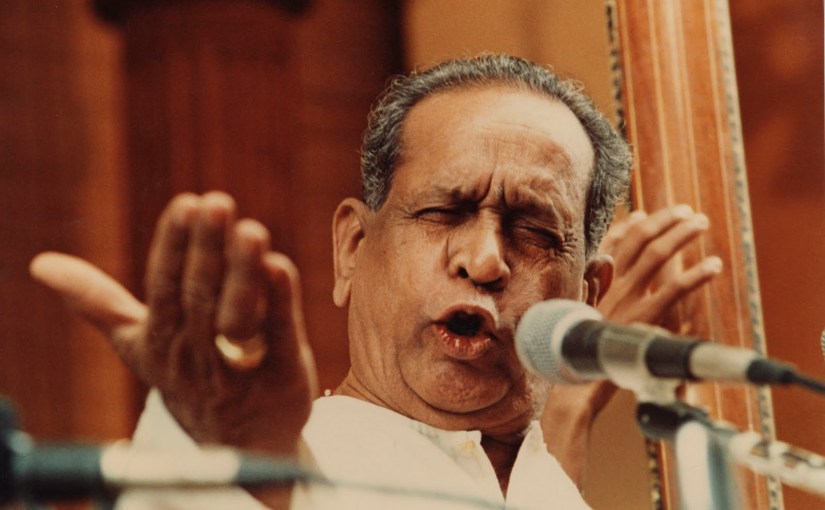
This is how the journey began for Bhimsen Gururaj Joshi, who later became the renowned Pandit Bhimsen Joshi, the first Indian singer to win the Bharat Ratna (2008), who emerged as the face of Khayal Gayaki.
Once during an interview with Gulzar, the famous lyricist of Indian films, about why he walked away from home after being denied a spoonful of ghee, the maestro explained that the ghee was just an excuse to walk away from home.
Kolkata, here we come
When he realized that Hafiz Ali Khan sahib was busy traveling to various cities for concerts, the young Joshi took off to Kolkata and landed as a domestic servant to Pahari Sanyal, a Bengali singer, and film actor. Joshi used to listen to all the rehearsals and grab whatever he could learn. In later years, Pandit Bhimsen Joshi was singing at a conference of musicians, and Pahari Sanyal was in the audience. Pahari Sanyal had no clue that this was the same boy, now a famous artist, who was once a domestic help in his house. After the concert, Pahari Sanyal went over to congratulate Pandit Bhimsen Joshi for an outstanding recital. The maestro then told Pahari Sanyal that he was the same Joshi, a domestic help at the Sanyal’s household! I am sure many would have given an arm and a leg to glimpse Pahari Sanyal’s face at that moment!
Anyway, getting back on track, the middle-aged Joshi headed to Delhi, where he heard of the father and uncle of Ustad Nasiruddin Dagar, to learn the dhrupad singing style. He had no money to pay fees, so he headed to Jalandhar to meet with Bhakt Mangat Ram, a visually handicapped singer, to learn dhrupad.
Life takes a full circle
At the Hariballab conference, he came across Vinayak Rao Patwardhan, who asked him what his purpose for all this travel was. Almost akin to the story of the musk deer searching the forest for the origin of the scent, when all along the deer had it on its tail, Patwardhan told him that there was Sawai Gandharva a teacher near his very village at Gadag, in the Dharwar district. At this point, his life took a full circle, and returned to his native land and enrolled in the Gandharva Mahavidyalaya, headed by Sawai Gandharva, a disciple of Ustad Abdul Karim Khan, the singer who inspired the young Joshi to start his music career.
Kirana Gharana
Pandit Bhimsen Joshi followed the aesthetics of Kirana Gharana. The word Kirana comes from the village near Sonepur/Panipat, where the mythological character Karna was born. Karna was mispronounced as Kirana. According to Pandit Bhimsen Joshi, the gharana tradition is like Karna, the warrior prince; do or die!
Kirana Gharana boasts of a proud lineage of artists; Roshanara Begum, Ustad Kale Khan, incidentally, her father, Ustad Vilayat Khan sahib, and many others.
His Bollywood foray
Pandit Bhimsen Joshi abhorred the title ‘pandit’ as he felt too many half-baked musicians started calling themselves pandit. He much preferred to be called Bhimsen Joshi without any honorifics. He wasn’t a film music fan. His forays into the industry were rare. One such occasion was when he sang for the film Basant Bahar.
When Manna Dey had the jitters!
The scene was a competition; the resident Ustad’s voice was Pandit Bhimsen Joshi, and the hero Bharat Bushan’s voice was Manna Dey. In true Bollywood style, the hero could never lose a competition, so it comes down to Manna Dey being pitted against Pandit Bhimsen Joshi and Manna Dey winning. Manna Dey recalls how petrified he was and flatly refused. It was Pandit Bhimsen Joshi who encouraged and encouraged him to sing. The sheer magnanimity and the absolute confidence in the art!
Fast cars were his passion
Besides being an outstanding singer, Pandit Bhimsen Joshi was a car aficionado. He used to drive fast and was a mechanic too! When his car broke down, he would repair the vehicle himself. He had a Fiat, a Ford, and later a Mercedes. He used to travel mainly by air and by train, but certain towns did not have an airport, and train ticket reservations were difficult. So, he bought a used car, hired a driver, and the whole family set out to Mysore for a Dusherra concert. The driver, who barely knew driving, and didn’t have a license, plunged into a 40ft ravine on his way back. Fortunately, Pandit Joshi and his family survived the crash without a scratch. Pandit Joshi attributed it to the quality of cars then. He then decided to drive his cars – the motto was that if he were fated to die in a road crash, it had better be when he had his hands on the steering wheel!
Some highlights
HMV released his first album of devotional songs in 1942.
He was the first musician from India whose concerts were advertised through posters in New York City, United States.
Pt. Joshi is remembered for his famous ragas, including Shuddha Kalyan, Miyan Ki Todi, Puriya Dhanashri, Multani, Bhimpalasi, Darbari, Malkauns, Yaman, Asavari Todi, Miyan Ki Malhar, and others.
He was instrumental in organizing the Sawai Gandharva Music Festival annually as a homage to his guru, Pandit Sawai Gandharva.
In 1998, he was awarded the Sangeet Natak Akademi Fellowship.
Subsequently, he received the Bharat Ratna, India’s highest civilian honor, in 2009.
The maestro passed into eternity on January 24, 2011. He was 88
His thoughts on modern-day singers
When asked what he thought of the modern-day singers, he said they were a talented lot, intelligent and worldly-wise, but none of their renditions lived in the ears of the listeners for long. They are heard and forgotten.
Now that’s a pretty broad brush he used there. Dear reader, what do you think?


 Nalla Madras