If you’ve ever been stuck at a wedding between the nadaswaram/shehnai player and the Western band belting out “Summer of ’69”, you’ve probably asked yourself the deep, philosophical question:
Why on earth are there two ways to write music, and which one should I bother learning before my next rebirth?
So, let’s introduce our two contestants.
Contestant One: The Indian Sargam
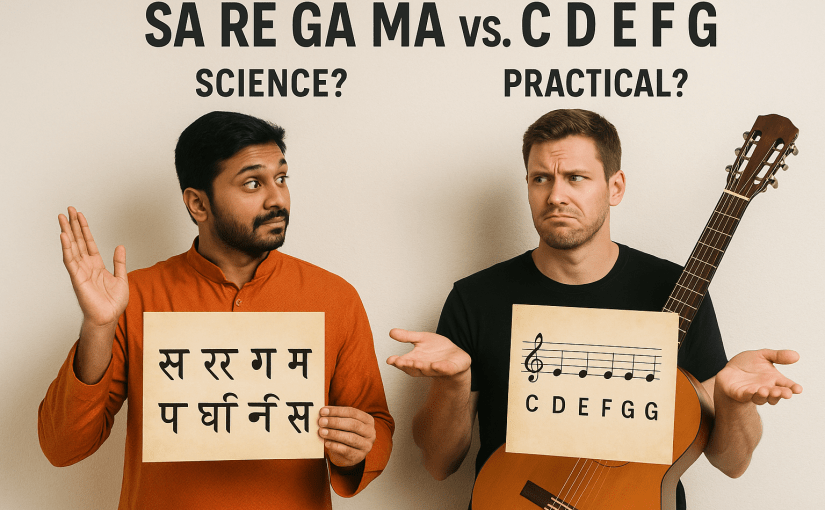
Sa Re Ga Ma Pa Dha Ni Sa
Sargam is that genial uncle who says, “Just come, beta, we’ll adjust,” and actually means it. No fuss about where you start—today Sa might be C, tomorrow Sa might be D, and next week it could be on a note only the neighbourhood cat can hear.
- Relative Pitch = Chill Vibes If Sa is the first step, the rest of the staircase adjusts itself. It’s musical jugaad at its finest.
- Vocal-Friendly No singer has ever said, “Oh no, I can’t sing today because Sa is stuck on 261.63 Hz.” You just shift it, smile, and carry on.
- Ornaments Galore Sargam doesn’t just give you notes—it lets you bend them, slide them, and add so much gamaka that even the note doesn’t know where it started.
Think of Sargam as the filter coffee of music—warm, strong, flexible, and doesn’t come with an instruction manual.
Contestant Two: The Western Notation
C D E F G A B C
Now here comes the second cousin—neat haircut, wearing a suit, and carrying a folder. Everything has to be exact. If C is 261.63 Hz, that’s where it stays. If you dare move it, there will be meetings, memos, and possibly a sternly worded email from a conductor.
- Absolute Pitch = Discipline It’s the GPS of music—you know exactly where you are at all times.
- Visual Map of Sound Those five lines, dots, flags, and squiggles are like an architect’s blueprint. You can rebuild the Taj Mahal in notes if you know how to read them.
- International Passport Whether you’re in Madras, Madrid, or Madagascar, this script will be understood. (Except maybe by your local auto driver.)
Western notation is like ordering pizza—fixed recipe, precise toppings, and yes, people will notice if you replace mozzarella with paneer.
Which is More “Scientific”?
Here is where Uncle Rajan wades into the conversation. “All that is fine saar, but which one is more scientific?”
Western notation wins if “scientific” means standardisation and precision—like laboratory coffee: exact temperature, exact brew time, exact bitterness.
But Sargam has its own science—more like grandma’s cooking. She doesn’t measure, yet every dish tastes exactly right. The science is in the relationship between notes, not their fixed coordinates.
Which is Easier and More Practical?
- If you’re starting out: Sargam is the easy entry—like learning cricket in your backyard before playing in a stadium.
- If you’re handling an orchestra: Western notation keeps the chaos in check. Without it, your 40-piece ensemble might sound like 40 street vendors shouting in different keys.
- If you’re doing fusion: Learn both. Sargam keeps your Indian side, Western notation keeps your drummer from walking off stage.
Final Verdict
Neither is “better”—they’re just designed for different musical worlds.
Sargam is like filter coffee at the corner kaapi kadai: flexible, soulful, forgiving.
Western notation is like an espresso from an Italian café: intense, precise, and possibly served with a side of attitude.
If you can master both, you’re musically bilingual. And like knowing how to make both idly and pasta, you’ll never go hungry—either for food or for tunes.

 Nalla Madras