
Pop-Up Cards and Liberation: A Morning Metaphor for Reality

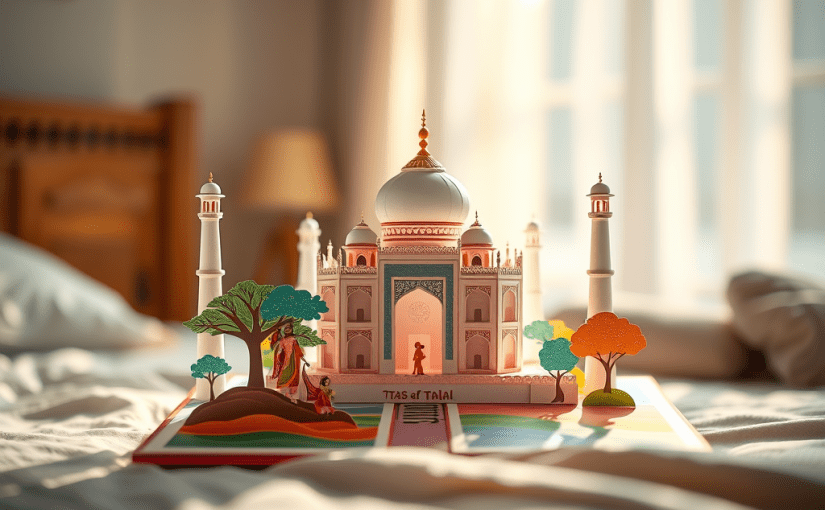
You know those pop-up greeting cards — the ones that look flat and innocent until you open them, and suddenly bam!— an entire Taj Mahal made of paper springs out, usually accompanied by glitter and guilt for not buying a simpler one?

That’s sort of what happens every morning when we open our eyes.

After a good night’s sleep (the rare kind where no one from your childhood WhatsApp group appears in your dreams asking for donations), the moment you wake up, a full 3D world unfolds — people, places, problems, pending bills — all popping up like that elaborate paper diorama.

It’s quite the show.


The Great Morning Unfolding

When you open your eyes, you also pop up — the “me” character, complete with opinions, breakfast preferences, and mild existential anxiety. The whole identity kit just unfolds smoothly like it’s been waiting all night under your pillow.

Some people say, “But Nanda, the world doesn’t vanish when you sleep! It’s still there!”

Maybe. But here’s the trick — the very someone making that argument is also part of your conscious field. That clever, philosophical person pointing out your ‘flaw in logic’? Yep, also a pop-up.

It’s like arguing with a character inside the card about whether the card exists.


Flat When Closed

When the pop-up card is closed, nothing is destroyed. The scene is just folded — the palace, the trees, the smiling couple in matching paper sarees and kurtas — all compacted into flatness.

Similarly, when you’re asleep or in deep meditation, the world — with all its drama and color — folds back into stillness. Not gone, but dormant. Like your boss on a Sunday.

And when you “wake up,” the grand production begins again: light, sound, identity, memory — everything leaps up, shouting “Surprise!” like an overeager birthday card.


The Trick of Believability

The funny thing about pop-up cards is how convincing they can be, especially to children (and occasionally to adults before coffee). You forget it’s just paper cleverly cut and glued.

Likewise, consciousness projects such a convincing show that we forget it’s a projection at all. The mind doesn’t just open the card — it hires a full cast, builds sets, adds background music, and gives you the lead role.

The irony? You’re both the audience and the actor.


Liberation as Folding Back

So what is liberation then? It’s not burning the card or running away from it. It’s simply realizing that whether the card is open or closed — nothing truly new appears or disappears.

The essence was never in the paper palace or the pop-up people; it was always in the space that allowed it to unfold.

That awareness — silent, spacious, unbothered — is the real greeting.

Everything else is just… decoration with a bit of glitter.


Closing Thought

Next time you wake up, watch the show unfold. Don’t rush to start the day. Just notice how the world pops up — your name, your room, your phone, your to-do list — all springing to life from nowhere.

And maybe, before diving in, smile and whisper to yourself:

“Ah, there it is — the morning card. Let’s see what scene consciousness is sending me today.”

(Just don’t try to fold your spouse back into the card when they ask you to make coffee. Enlightenment has limits.)

The Ostrich, the Sand, and the Secret of the Universe

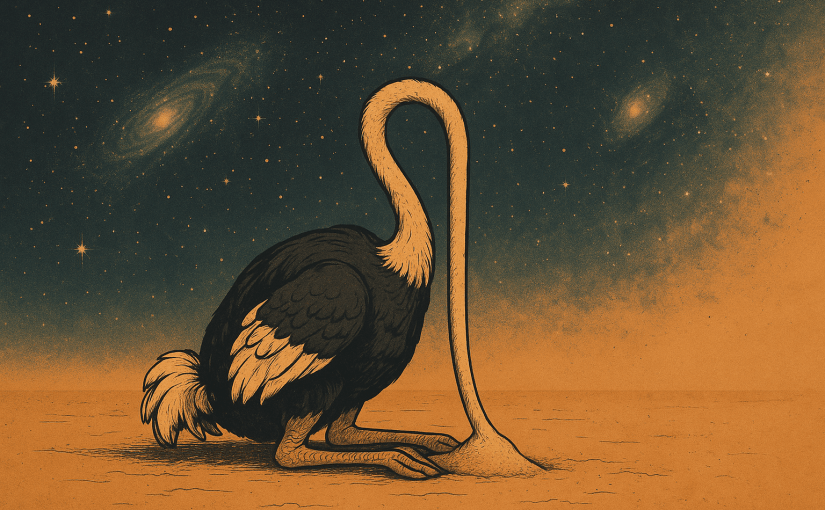
They say the ostrich buries its head in the sand to avoid danger.

That’s not true, of course — it’s a myth.

The ostrich does no such thing.

But if it did… ah, then we’d have a bird with a very promising career in philosophy.

Because the idea behind the myth — that shutting out the world makes it vanish — is actually a rather elegant pointer to one of the oldest truths in spiritual thought:

Everything you experience exists only in consciousness.

Sand as a Spiritual Tool

Let’s say you really were an ostrich (just for argument’s sake — no offence to your current species). You poke your head into the sand, and suddenly your vision is filled with warm, brown nothingness. No predators. No sky. No grass. No desert. The universe, for all practical purposes, is gone.

You didn’t destroy it — you just stopped perceiving it.

And here’s the big leap: the same is true for your waking life.

The so-called “objective world” is actually stitched together inside your mind. Without the light of consciousness shining on it, the whole grand spectacle collapses into… well, nothing.

The Sleep Experiment You’ve Been Running Every Night

This isn’t just poetic speculation. You prove it to yourself every single night.

When you slip into deep, dreamless sleep — that mysterious stage where there are no mental movies playing — the entire cosmos disappears. Not just your problems, not just your to-do list, but the Himalayas, the Pacific Ocean, the Milky Way — poof.

No you, no neighbour’s dog barking at 2 a.m., no neighbour either.

And yet, you wake up in the morning convinced the world “was there all along.”

But here’s the uncomfortable question: was it? Or is it that the world only exists when you are conscious of it?

Ancient Wisdom and Ostrich Wisdom

Philosophers from Advaita Vedanta to modern-day consciousness researchers have been politely trying to tell us the same thing: the “world” is an appearance in awareness, not an independent reality.

The ostrich myth, despite being zoologically false, has a certain charm here. If putting your head in the sand can make the predators vanish (from your point of view), isn’t that just the avian equivalent of closing your eyes in meditation? The outer scene fades, and you are left with the awareness that contains it all.

Why This Matters (Beyond Bird Comparisons)

If the universe only exists in consciousness, then our frantic attempts to “fix” the outside world before we’re happy might be a bit backwards.

Instead, we could turn inward and examine the one constant — the awareness in which all this appears.

That doesn’t mean you stop paying your bills or feeding the cat (even enlightened beings have to clean the litter box). But it does mean you stop clinging to the idea that the world is a fixed, external “thing” and start seeing it as a living, breathing projection in the cinema of your mind.

So the next time someone mocks the ostrich for “burying its head in the sand,” you might smile and think:

Maybe that ostrich isn’t avoiding reality.

Maybe it’s just contemplating the profound truth that without perception, the world as we know it… simply isn’t there.

And perhaps, like that mythical ostrich, we could all use a moment to put our heads down — not in sand, but in stillness — and watch the universe quietly dissolve back into the infinite awareness from which it came.

How Dropping “Me” Can Set You Free (and Why Cows Don’t Care About Your Opinions)

Let’s start with a simple experiment.

Look at a tree. Any tree. Don’t label it. Don’t call it beautifulugly, or a neem tree near uncle’s house. Just… see it.

You’ll notice something strange.

For a fleeting second, there’s only tree. Not your memory of a tree, not your opinion of it, not even you looking at it. Just… tree.

Now imagine living like that, always. That, my friend, is what some call liberation.


The Problem with “Me” (And All Its Cousins)

Your mind is like a chatty radio host who won’t take a breath.

“I like this.”

“I hate that.”

“This reminds me of that summer in Goa.”

“This cow looks tired.”

But who’s this “I”?

J. Krishnamurti once said:

“The observer is the observed.”

It’s not a riddle. It means when you say, “I am anxious,” you’ve created a false duality. In truth, there’s just anxiety—no owner required. The moment you label it as yours, you’ve claimed it like a Netflix account.


Liberation Isn’t a Mountaintop, It’s a Mute Button

Non-duality teachers say it beautifully.

Rupert Spira reminds us:

“The belief in a separate self is like imagining a wave is separate from the ocean.”

Mooji says, with a grin:

“Don’t take your thoughts so seriously. They’re not paying rent.”

When we drop our constant labeling—our me, mine, my—we return to what just is.

A cow grazing becomes just… cow. Not a “lazy cow” or “my cow.” Just cow. And in that seeing, you’re free.


A Little Practice (But Not a Method, Please)

Krishnamurti hated methods. But here’s a loose suggestion:

  • Just observe.
  • Don’t label.
  • Don’t claim.
  • Don’t objectify.

It’s not about doing something. It’s about stopping the habit of always being someone.


In Conclusion: Leave Your “I.D.” at the Door

You don’t have to meditate in the Himalayas or chant your way to freedom.

Just stop owning everything.

Stop saying “my thoughts,” “my anger,” “my truth.” Just notice—without naming.

Krishnamurti again, for the win:

“To understand what is, there must be no condemnation of what is.”

Including yourself.

And if you see a cow today—resist the urge to say moo.

Grammar Police and the Case of the Missing “S”

Ah, English grammar. That sacred rulebook that some of us—especially the old-timers—still clutch onto as if it were the last bastion of civilization. The spelling, the usage, the syntax… it all matters, doesn’t it?

Or does it?

This train of thought began chugging down the tracks when I received a forward of a popular yesteryear song. I remarked that it was a favorite of mine. But lo and behold, the vigilant friend (let’s call her The Guardian of Grammar) swiftly corrected me:

“It should be ‘one of my favorites,’ not ‘one of my favorite.’”

To me, it felt like the difference between potayto and potahto—a muchness of a muchness, if you will. But it got me wondering…

And to this dear friend of mine, in case you come across this blog and you read it, it’s all said in good humor!

Is Success in Life Based on the Grammar of Your Prose?

Will a misplaced comma derail your career?

Will an extra “S” stop you from achieving greatness?

Would Shakespeare have been laughed out of town for writing “to be or not to be, that is the question?” instead of “To be or not to be; that is the question.”

And yet, there’s a certain breed of people who cannot resist correcting grammar. We all know them. They lurk in emails, they prowl on WhatsApp, and they pounce on Facebook posts with the precision of a cat spotting a laser dot.

You say, “I could care less.”

They say, “You mean you couldn’t care less.”

You type, “Your welcome.”

They reply, “It’s you’re welcome.”

You casually say, “Me and my friend went to the market.”

They swoop in with, “My friend and I.”

A Tribute to Everyday Grammar Battles

To be fair, sometimes these corrections are lifesaving. Consider the classic case of “Let’s eat, Grandma!” versus “Let’s eat Grandma!” One is an invitation to dinner, the other is a crime scene.

And then there’s the dreaded apostrophe abuse. It turns up uninvited in places where it has no business being:

• “Fresh Mango’s for Sale” (Mango’s what, exactly?)

• “Happy Anniversary to the Smith’s” (The Smith’s what?)

• “Your going to love this!” (No, you’re not.)

But at the same time, does a minor slip in grammar mean we are less of a person? Should we be judged by our ability to tell effect from affect in casual conversation?

The Great Grammar Divide

There are two kinds of people in this world:

1. Those who can read “I ain’t got no time for that” and move on.

2. Those who feel a physical twitch and MUST correct it.

The second group, my friends, are the ones who send passive-aggressive texts like, “I think you meant ‘their,’ not ‘there.’” And while I admire their dedication, I often wonder—do they have an internal red alarm that goes off every time they see “loose” instead of “lose”?

A Final Thought (or Thought’s?

At the end of the day, success in life isn’t necessarily measured by flawless grammar. If that were the case, Shakespeare, Mark Twain, and even Steve Jobs—who famously once said, “Think Different” instead of “Think Differently”—would have all been failures.

So, to my dear Grammar Guardian, I thank you for keeping our language from descending into chaos. But if I say, “one of my favorite” instead of “one of my favorites,” let’s just call it poetic license and move on, shall we?

After all, language is meant to connect us, not divide us.

(Unless, of course, you insist on using “irregardless.” Then, my friend, we may have a problem.)

What do you think? Should we let minor grammar slips slide, or should we continue fighting the good fight? Let me know in the comments (or should I say, “comment’s”?

The Absurdities of Life: A Comedic Exploration

Life is the most elaborate practical joke ever pulled, and the punchline? Well, we’re it. Every twist, every turn, every ridiculous desire, and every existential crisis is one big cosmic “gotcha!” And what do we do? We soldier on, pretending it all makes sense. Spoiler alert: it doesn’t.Let’s break down this tragicomedy, one absurdity at a time.


Your Body: The Ultimate Lemon

The human body is a marvel of engineering—if that engineering was done by a drunk intern on their first day. Sure, it works most of the time, but it’s also ridiculously fragile.

  • Stub your toe? Your entire day is ruined.
  • Catch a cold? Your body turns into a snot factory overnight.
  • Eat the wrong thing? Enjoy spending the next 48 hours praying to the porcelain gods.

And then there’s the grand finale—death. It’s inevitable, no matter how much green juice you drink, how many yoga classes you take, or how many supplements you shove down your throat. The irony? Most of us spend our entire lives trying to avoid the one thing that’s guaranteed to happen.


Chasing Carrots: The Never-Ending Cycle of Want

If life were a movie, desires would be the recurring villain—always popping up, always causing chaos. No sooner do you satisfy one craving than another comes stomping in like a toddler demanding attention.

Let’s break it down:

  • Want a promotion? Great! But now you want to quit because your boss is unbearable.
  • Want a new car? Sure, but now you need a better house to park it in.
  • Want to find love? Perfect! But now you’re wondering why they leave the cap off the toothpaste every. single. time.

It’s like we’re all hamsters on a wheel, running toward a carrot that keeps moving further away. And when we finally get the carrot? Surprise! There’s another carrot right behind it.


Hormones: Nature’s Comedy Writers

Let’s talk about nature’s cruelest joke: reproduction. Nature took one look at us and said, “Here’s an idea—make them desperate to find a mate.” And then it threw in hormones to make the process even messier.

The absurdity of mating rituals:

  • You dress up, swipe right, and pray the person doesn’t ghost you after you awkwardly overshare about your cat’s dental problems.
  • You go on dates where you pretend to like jazz or sushi or hiking, all to impress someone who might not even like you back.
  • And if it all works out, congratulations! You now have to spend the rest of your life arguing about how to load the dishwasher.

And why do we do this? Because our bodies demand it. They don’t care about love or compatibility—they just want us to pass on our genes. It’s biology, baby. And it’s ridiculous.


Loneliness: The Frenemy That Keeps Us Company

Humans are social creatures, which is just a fancy way of saying we’re terrified of being alone. That fear drives us into relationships—sometimes good, sometimes… well, not so good.


Signs you’re in it for the wrong reasons:

  • You stay because “at least they text me back.”
  • You ignore red flags like they’re decorative banners at a party.
  • You convince yourself that everyone argues about who left the milk out for three days.

But hey, it’s better than being lonely, right? Wrong. Toxic relationships are like drinking expired milk—you know it’s bad for you, but you keep going because you’re too afraid to throw it out. And yet, we stay. Because at the end of the day, loneliness whispers, “At least expired milk is something.”


Validation: The Drug We’re All Addicted To

We all want to be special. We want to be seen, admired, and applauded. But life has other plans.

Here’s how this usually goes:

  • You work hard on a project, pour your heart into it, and present it with pride.
  • The response? “Hmm, it’s okay, I guess.”
  • Or worse, someone says, “You should’ve done it this way instead.”

It’s like baking a beautiful cake and having someone say, “Oh, it’s a little dry.” Thanks, Brenda. I wasn’t trying to win The Great British Bake Off.And yet, we keep chasing validation, like moths to a flame. Because deep down, we all secretly hope someone will look at us and say, “Wow, you’re amazing.” Instead, they usually say, “Could you not?”


From Goo to Grief: The Bookends of Existence

Let’s talk about the two bookends of life: birth and death. Neither one is particularly pleasant.

Birth:

  • You start your life being squeezed out of a human body like a tube of toothpaste.
  • You’re covered in goo, crying uncontrollably, and surrounded by strangers holding scissors.
  • Your first experience in the world is people poking and prodding you while you scream, “What is happening?!”

Death:

  • If you’re lucky, it’s peaceful. If not, well… it’s probably embarrassing. (“He choked on a grape? Seriously?”)
  • And then there’s the aftermath: people crying, awkward eulogies, and someone inevitably saying, “They’re in a better place now,” even though no one really knows.

And sandwiched between these two events is a lifetime of stubbed toes, bad haircuts, and awkward small talk at office parties. Life: the gift that keeps on giving.


Keeping Up With the Cohorts

Humans are competitive by nature. It’s why we invented things like the Olympics, reality TV, and LinkedIn.

The exhausting cycle of one-upmanship:

  • Your coworker buys a new car, so now you feel like your car is trash.
  • Your friend goes to Bali, so now you’re Googling “cheap flights to anywhere exotic.”
  • Your neighbor renovates their kitchen, so now you’re suddenly obsessed with granite countertops.

It’s a never-ending game of “Who’s Winning at Life?” The catch? No one is. Because even if you’re on top today, someone else will outdo you tomorrow. It’s like playing Monopoly but with real money and actual tears.


There Is No Point, and That’s the Point

Life is absurd. It’s messy, chaotic, and often feels like a joke we don’t quite understand. But maybe that’s the point.

Here’s the truth:

  • Life doesn’t make sense, and it probably never will.
  • We’re all just winging it, pretending we have it together, while secretly Googling “how to be a functioning adult.”
  • And that’s okay.

So, laugh at the absurdity. Embrace the chaos. And when life feels like it’s too much, just remember: we’re all in this ridiculous farce together. And honestly? It’s a pretty funny show.