It’s 11:30 PM. You are doom-scrolling on Amazon, and suddenly, you see it. A noise-canceling headphone that promises to silence not just the traffic outside, but arguably your own thoughts. Or maybe it’s Saturday night, and that second slice of chocolate truffle cake is looking at you with the intensity of a long-lost lover.
In that moment, a powerful wave rises. The ancient texts call it Kama (desire), but let’s just call it what it is: The Itch.
The Itch says, “If I get this, I will be happy.”
And you know what? It’s not entirely lying. You will be happy. For about fourteen minutes. Maybe twenty if the cake is really good. But then? The happiness evaporates, leaving you exactly where you were, perhaps with just a slightly lighter wallet or a heavier stomach.
This is the trap of the sensory world. It sells us rental happiness and charges us ownership prices.
But there is a little game you can play to hack this system. I call it “This or That.”
The Two Menus
Imagine life is a restaurant with only two items on the menu.
Item 1: “This”
Ingredients: Sensory pleasures, shopping sprees, that extra glass of wine, the dopamine hit of a new gadget.
Guarantee: Instant gratification.
Side Effects: Transient. It fades quickly, leaving a vacuum that demands to be filled again. It is the hamster wheel of happiness.
Guarantee: Eternal peace. A subtle, unshakeable joy that doesn’t depend on what is in your driveway or your refrigerator.
Side Effects: A sense of invincibility. The realization that you are already full.
How to Play the Game
The game is deceptively simple. The moment a craving arises—whether it’s for a new car, a harsh retort to a colleague, or just mindless consumption—you pause.
Take a breath. Create a tiny gap between the urge and the action. And in that gap, ask yourself:
“Do I want This… or That?”
Do I want the fleeting thrill of the object (“This”)? Or do I want the eternal stability of my own Self (“That”)?
When you choose “This,” you are choosing to be a beggar, asking the world to drop a coin of happiness into your bowl. When you choose “That,” you remember you are the Emperor.
The “That” is Always There
Here is the secret the marketing departments don’t want you to know: The peace you are looking for in the object is actually what remains when the wanting of the object drops.
When you finally buy that gadget, you feel a moment of relief. You think the gadget gave you joy. It didn’t! The gadget simply removed the craving for a moment, revealing the natural joy (Satchitananda) that was already there underneath.
So why take the detour through the shopping mall? Go straight to the source.
The Practice
Next time the urge hits, catch it mid-air.
Craving for approval? Ask: This (someone else’s opinion) or That (my own inner fullness)?
Craving for distraction? Ask: This (social media noise) or That (the silence of being)?
You might still choose the cake. And that’s fine! We aren’t trying to be monks overnight. But simply asking the question breaks the trance. It reminds you that you have a choice.
You are standing at the crossroads of the momentary and the eternal fifty times a day.
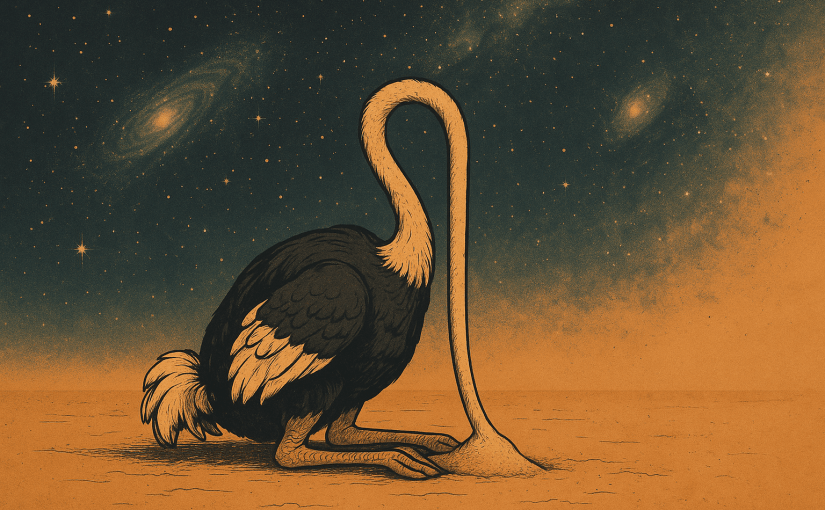
They say the ostrich buries its head in the sand to avoid danger.
That’s not true, of course — it’s a myth.
The ostrich does no such thing.
But if it did… ah, then we’d have a bird with a very promising career in philosophy.
Because the idea behind the myth — that shutting out the world makes it vanish — is actually a rather elegant pointer to one of the oldest truths in spiritual thought:
Everything you experience exists only in consciousness.
Sand as a Spiritual Tool
Let’s say you really were an ostrich (just for argument’s sake — no offence to your current species). You poke your head into the sand, and suddenly your vision is filled with warm, brown nothingness. No predators. No sky. No grass. No desert. The universe, for all practical purposes, is gone.
You didn’t destroy it — you just stopped perceiving it.
And here’s the big leap: the same is true for your waking life.
The so-called “objective world” is actually stitched together inside your mind. Without the light of consciousness shining on it, the whole grand spectacle collapses into… well, nothing.
The Sleep Experiment You’ve Been Running Every Night
This isn’t just poetic speculation. You prove it to yourself every single night.
When you slip into deep, dreamless sleep — that mysterious stage where there are no mental movies playing — the entire cosmos disappears. Not just your problems, not just your to-do list, but the Himalayas, the Pacific Ocean, the Milky Way — poof.
No you, no neighbour’s dog barking at 2 a.m., no neighbour either.
And yet, you wake up in the morning convinced the world “was there all along.”
But here’s the uncomfortable question: was it? Or is it that the world only exists when you are conscious of it?
Ancient Wisdom and Ostrich Wisdom
Philosophers from Advaita Vedanta to modern-day consciousness researchers have been politely trying to tell us the same thing: the “world” is an appearance in awareness, not an independent reality.
The ostrich myth, despite being zoologically false, has a certain charm here. If putting your head in the sand can make the predators vanish (from your point of view), isn’t that just the avian equivalent of closing your eyes in meditation? The outer scene fades, and you are left with the awareness that contains it all.
Why This Matters (Beyond Bird Comparisons)
If the universe only exists in consciousness, then our frantic attempts to “fix” the outside world before we’re happy might be a bit backwards.
Instead, we could turn inward and examine the one constant — the awareness in which all this appears.
That doesn’t mean you stop paying your bills or feeding the cat (even enlightened beings have to clean the litter box). But it does mean you stop clinging to the idea that the world is a fixed, external “thing” and start seeing it as a living, breathing projection in the cinema of your mind.
So the next time someone mocks the ostrich for “burying its head in the sand,” you might smile and think:
Maybe that ostrich isn’t avoiding reality.
Maybe it’s just contemplating the profound truth that without perception, the world as we know it… simply isn’t there.
And perhaps, like that mythical ostrich, we could all use a moment to put our heads down — not in sand, but in stillness — and watch the universe quietly dissolve back into the infinite awareness from which it came.
If you’ve ever been stuck at a wedding between the nadaswaram/shehnai player and the Western band belting out “Summer of ’69”, you’ve probably asked yourself the deep, philosophical question:
Why on earth are there two ways to write music, and which one should I bother learning before my next rebirth?
So, let’s introduce our two contestants.
Contestant One: The Indian Sargam
Sa Re Ga Ma Pa Dha Ni Sa
Sargam is that genial uncle who says, “Just come, beta, we’ll adjust,” and actually means it. No fuss about where you start—today Sa might be C, tomorrow Sa might be D, and next week it could be on a note only the neighbourhood cat can hear.
Relative Pitch = Chill Vibes If Sa is the first step, the rest of the staircase adjusts itself. It’s musical jugaad at its finest.
Vocal-Friendly No singer has ever said, “Oh no, I can’t sing today because Sa is stuck on 261.63 Hz.” You just shift it, smile, and carry on.
Ornaments Galore Sargam doesn’t just give you notes—it lets you bend them, slide them, and add so much gamaka that even the note doesn’t know where it started.
Think of Sargam as the filter coffee of music—warm, strong, flexible, and doesn’t come with an instruction manual.
Contestant Two: The Western Notation
C D E F G A B C
Now here comes the second cousin—neat haircut, wearing a suit, and carrying a folder. Everything has to be exact. If C is 261.63 Hz, that’s where it stays. If you dare move it, there will be meetings, memos, and possibly a sternly worded email from a conductor.
Absolute Pitch = Discipline It’s the GPS of music—you know exactly where you are at all times.
Visual Map of Sound Those five lines, dots, flags, and squiggles are like an architect’s blueprint. You can rebuild the Taj Mahal in notes if you know how to read them.
International Passport Whether you’re in Madras, Madrid, or Madagascar, this script will be understood. (Except maybe by your local auto driver.)
Western notation is like ordering pizza—fixed recipe, precise toppings, and yes, people will notice if you replace mozzarella with paneer.
Which is More “Scientific”?
Here is where Uncle Rajan wades into the conversation. “All that is fine saar, but which one is more scientific?”
Western notation wins if “scientific” means standardisation and precision—like laboratory coffee: exact temperature, exact brew time, exact bitterness.
But Sargam has its own science—more like grandma’s cooking. She doesn’t measure, yet every dish tastes exactly right. The science is in the relationship between notes, not their fixed coordinates.
Which is Easier and More Practical?
If you’re starting out: Sargam is the easy entry—like learning cricket in your backyard before playing in a stadium.
If you’re handling an orchestra: Western notation keeps the chaos in check. Without it, your 40-piece ensemble might sound like 40 street vendors shouting in different keys.
If you’re doing fusion: Learn both. Sargam keeps your Indian side, Western notation keeps your drummer from walking off stage.
Final Verdict
Neither is “better”—they’re just designed for different musical worlds.
Sargam is like filter coffee at the corner kaapi kadai: flexible, soulful, forgiving.
Western notation is like an espresso from an Italian café: intense, precise, and possibly served with a side of attitude.
If you can master both, you’re musically bilingual. And like knowing how to make both idly and pasta, you’ll never go hungry—either for food or for tunes.
Look at a tree. Any tree. Don’t label it. Don’t call it beautiful, ugly, or a neem tree near uncle’s house. Just… see it.
You’ll notice something strange.
For a fleeting second, there’s only tree. Not your memory of a tree, not your opinion of it, not even you looking at it. Just… tree.
Now imagine living like that, always. That, my friend, is what some call liberation.
The Problem with “Me” (And All Its Cousins)
Your mind is like a chatty radio host who won’t take a breath.
“I like this.”
“I hate that.”
“This reminds me of that summer in Goa.”
“This cow looks tired.”
But who’s this “I”?
J. Krishnamurti once said:
“The observer is the observed.”
It’s not a riddle. It means when you say, “I am anxious,” you’ve created a false duality. In truth, there’s just anxiety—no owner required. The moment you label it as yours, you’ve claimed it like a Netflix account.
Liberation Isn’t a Mountaintop, It’s a Mute Button
Non-duality teachers say it beautifully.
Rupert Spira reminds us:
“The belief in a separate self is like imagining a wave is separate from the ocean.”
Mooji says, with a grin:
“Don’t take your thoughts so seriously. They’re not paying rent.”
When we drop our constant labeling—our me, mine, my—we return to what just is.
A cow grazing becomes just… cow. Not a “lazy cow” or “my cow.” Just cow. And in that seeing, you’re free.
A Little Practice (But Not a Method, Please)
Krishnamurti hated methods. But here’s a loose suggestion:
Just observe.
Don’t label.
Don’t claim.
Don’t objectify.
It’s not about doing something. It’s about stopping the habit of always being someone.
In Conclusion: Leave Your “I.D.” at the Door
You don’t have to meditate in the Himalayas or chant your way to freedom.
Hey everyone, great hanging out with you all in the comments on yesterday’s post! It seems like the idea of our life resonated with quite a few of you. Our body, roles, and even our thoughts are kinda like a temporary house we inhabit. We talked about keeping a “chill take” on it all. We shouldn’t get too attached to the structure or the furniture. It’s all part of the journey.
But that naturally leads to the next big question, doesn’t it? If all that stuff is the “house”… then who is the ‘I’ that’s actually living inside it? Who is experiencing the leaky faucets, the sunny rooms, the whole deal?
Today, let’s explore that resident. Here’s a heads-up. We will share some cool old ideas from ancient wisdom. These will help us unpack it. Stay chill, though – it’s all part of the adventure!
Meet the Busy ‘Resident Manager’ (Ahamkara)
Think about who runs the show in your “house” day-to-day. There’s this constant sense of ‘me’ that seems to be in charge, right? It worries about upkeep, feels proud of the decor, gets annoyed when things aren’t perfect. Ancient Indian thought has a name for this busy manager: अहंकार (Ahamkara).
अहंकार (Ahamkara): Remember this one? We touched on it briefly. It literally means the “I-maker.” It’s the role within us. It creates the strong feeling of being a separate individual. It makes us feel like the one who owns the house and everything linked to it.
This Ahamkara isn’t just aware that the house exists. It identifies as the house manager. Sometimes it even thinks it is the house! It’s the voice saying:
“This is MY room!” (My opinion, my beliefs)
“Don’t scratch MY floors!” (My feelings got hurt)
“Look at MY beautiful garden!” (My accomplishments, my status)
“I need to fix that leaky faucet!” (My problems, my worries)
It’s the part of us that feels fundamentally separate and often quite stressed about managing this whole “house” situation.
Asking the Landlord (Koham?)
But is this busy, often stressed-out resident manager the actual owner of the property? Or just… the manager? This is where a fascinating practice comes in, highlighted by the sage Sri Ramana Maharshi. He suggested a change in approach. Instead of just listening to the manager’s constant chatter and anxieties, we should try to find the real source. We should seek the ultimate “landlord” by asking: “Who Am I?“
In Sanskrit: कोऽहम्? (Koham?).
कोऽहम्? (Koham?): “Who Am I?”
This isn’t about the manager giving their job title (“I am the manager,” “I am a parent,” “I am successful”). It’s about tracing that ‘I’ feeling itself back to its origin. When the manager (Ahamkara) starts freaking out – “I am overwhelmed!” “I need this!” “I hate that noise!” – the practice is to gently inquire inwardly: “Okay, who is this ‘I’ that’s feeling overwhelmed? Where does this ‘I’ actually come from?”
Ramana suggested this inquiry is incredibly powerful. Why? Because it bypasses the manager and looks for the silent owner. Finding that source, he said, is the key to real peace. It stands in contrast to the constant low-grade stress of just managing the house. He stated something profound: “The inquiry ‘Who am I?’ is the principal means to the removal of all misery and the attainment of the supreme bliss.”
Hook: Imagine being capable of quieting the frantic manager by simply looking for the calm, underlying owner! What happens if we stop taking the manager’s word for everything and investigate the source?
All This “My House, My Stuff” Stress
Let’s be real, being the resident manager (Ahamkara) is stressful! Much of our daily anxiety comes from clinging to the “house.” It also comes from defending everything we’ve labeled “mine” inside it.
Worrying about the house’s appearance (“my reputation,” “my image”).
Getting angry when someone parks in “my driveway” or disrespects “my space.”
Feeling anxious about the house’s future (“my job security,” “my health,” “my retirement”).
Comparing “my house” to the neighbor’s bigger, fancier one.
Sound familiar? The Ahamkara is hard at work. It identifies completely with the house and its contents. It is convinced that its own well-being depends entirely on the state of the property.
Hook: Think about your day so far. Whether you are right here in your town or somewhere else, think about the energy you use. You are managing aspects of “your house.” Consider on how much you defend or worry about the things you call “mine.”
When the Manager Sleeps & The Empty House (Awareness/Atman)
Now, here’s where it gets really interesting, connecting back to our “chill take” from yesterday. How permanent, how solid, is this resident manager (Ahamkara)?
Consider deep, dreamless sleep. The house (your body) is still there, resting. But where did the manager go? That distinct feeling of “I am managing this life” completely vanishes. Poof! The office is empty. This shows the Ahamkara needs certain conditions – like the waking state or even a dream state – to function.
And dreams? The manager rebuilds a whole dream house and runs around managing that! This highlights that the manager is more like a role being played than a permanent fixture.
If the manager can just disappear every night, they can’t be the fundamental reality, right? They are transient, dependent. And what about the house itself (the body)? Does a brick know it’s a brick? Does the house feel its own existence? No. Like we said yesterday, the house is just the structure. It needs something else to be known, to be experienced.
So, if the manager comes and goes, and the house itself is just structure, what is constant?
It seems to be awareness itself. The silent, unchanging space in which the house exists. The fundamental knowing that perceives the house, the manager, the thoughts, the feelings, everything. This ever-present, underlying reality, the true Self, has a name in Sanskrit: आत्मन् (Atman).
आत्मन् (Atman): The Self (with a capital S). Think of it as the silent, true owner of the property. It is like the very ground and space the house is built upon. It is pure, witnessing consciousness.
The nature of this Atman, this fundamental reality, is often described as सच्चिदानन्द (Sat-Chit-Ananda).
सच्चिदानन्द (Sat-Chit-Ananda): Existence-Consciousness-Bliss. It suggests that the very nature of this underlying awareness or space is pure being. It is pure knowing. It embodies inherent, causeless peace or joy.
Who Feels the Drafts and Sunshine? (Feelings)
Okay, so if we are fundamentally this peaceful awareness (Atman), why do we feel bothered by drafts (pain, sadness) or delighted by sunshine (pleasure, joy) in the house?
Maybe it happens like this: Awareness (Atman, the space/owner) perceives sensations related to the house (a cold draft, warm sunshine). The busy resident manager (Ahamkara) immediately rushes over, identifies with the sensation, and declares, “I am cold!” or “I love this sunny spot!” It claims ownership of the experience happening within the aware space via the house’s condition.
This reframes our feelings. They aren’t necessarily who we are. They are like weather conditions affecting the house. The underlying awareness (Atman) perceives them. Then, the temporary manager (Ahamkara) loudly claims and reacts to them.
Seeing this helps us follow Ramana’s advice: “There is no need to get rid of the wrong ‘I’ [Ahamkara/manager]. All that is required is to find out the source of the ‘I’ and abide in it.” We move away from reacting frantically like the manager. Instead, we rest as the calm, aware space or owner that perceives everything.
Living Lighter in the House
So, where does this leave us? Yesterday, we talked about the house. Today, we’ve explored the difference between the busy, stressed manager (Ahamkara) who thinks they are the house. The silent, aware space/owner (Atman) is our true foundation.
The manager comes and goes. Its attachment to “my house, my stuff” causes stress. But the underlying awareness is constant, peaceful by nature. Practices like asking “Who Am I?” help us see past the manager and connect with that deeper reality.
This doesn’t mean we neglect the house! We still take care of our bodies, our lives, our responsibilities. But we can do it with a lighter touch, with that “chill take” we talked about. We know we are fundamentally the spacious awareness. We are not just the temporary house or its frantic manager. These insights allow us to navigate the inevitable leaks. They help us enjoy the sunshine with more ease and a lot more peace.
It’s an ongoing exploration, not a final answer. What does this “resident manager” vs. “silent owner” idea spark for you? Does it change how you view the ‘I’ living in your ‘house’? Share your thoughts below – always great to learn together!
Hanumankind, born Sooraj Cherukat on October 17, 1992, in Malappuram, Kerala, India, has emerged as a significant figure in the global hip-hop scene, blending Indian and American musical influences with a touch of possible Middle Eastern flair. His journey from a diverse childhood to a viral sensation with “Big Dawgs” in 2024 offers a compelling narrative of cultural fusion and artistic growth. This blog delves into his early days, career trajectory, musical style, and the reasons behind his widespread appeal, providing a comprehensive overview for music enthusiasts and casual listeners alike.
Early Life and Influences
Hanumankind’s formative years were marked by mobility, as his father’s job with an oil company led the family to live in Egypt, Nigeria, France, and the UAE before settling in Houston, Texas, when he was in fourth grade. This global exposure likely introduced him to a rich tapestry of musical traditions, from Middle Eastern rhythms to American hip-hop. In Houston, he was immersed in the Southern hip-hop scene, citing influences like Three 6 Mafia, Project Pat, UGK, and DJ Screw, which shaped his understanding of rhythm and flow. His Indian heritage, particularly from Kerala, also played a crucial role, exposing him to traditional Indian music that would later inform his work.
After completing high school in the US, he returned to India in 2012 to pursue a degree in business administration at PSG College in Coimbatore, Tamil Nadu. During this period, he worked as an intern at Goldman Sachs and later as an Operations Analyst, balancing a corporate career with his growing passion for music. His early freestyling in high school, inspired by American hip-hop, laid the groundwork for his future endeavors, with additional influences from artists like Kendrick Lamar, J. Cole, and A.R. Rahman, as noted in various profiles (10 Facts About Hanumankind).
Musical Beginnings and Career Growth
Hanumankind’s professional music career began in earnest in 2019 with the release of his debut EP, “Kalari,” on December 27, 2019, coinciding with a performance at NH7 Weekender, a prominent Indian music festival. This EP, featuring tracks like “Daily Dose,” showcased his raw talent and unique style, blending hip-hop with Indian musical elements. It marked his entry into the Indian hip-hop scene, establishing him as an up-and-coming independent artist.
His career saw steady growth through collaborations and singles. In 2020, he featured on “World Domination,” and in 2021, he released the collaborative project “Surface Level” with Kalmi, followed by “Genghis” in the same year, which highlighted his evolving artistic style. His song “The Last Dance” was featured on the official soundtrack for the Malayalam film “Aavesham,” released on April 11, 2024, further expanding his reach into the film industry (Aavesham (2024 film)).
The pivotal moment came with “Big Dawgs,” released on July 12, 2024, featuring Kalmi and directed by Bijoy Shetty. The music video, shot in Malappuram, Kerala, inside a “wall of death” attraction, went viral, garnering over 132 million streams on Spotify and 83 million views on YouTube by August 2024 (Hanumankind: the India-born, Houston-raised rapper riding high on southern pride). This track, with its high-energy beats and creative visuals, propelled him to international fame, earning co-signs from artists like Project Pat and attention from global entities like Arsenal FC, as noted in a Guardian article (One to watch: Hanumankind).
His discography, as seen on platforms like Apple Music and Deezer, includes singles like “Run It Up” (June 28, 2024), “Southside” (May 19, 2023), “Damnson” (April 21, 2023), and “Skyline” (March 11, 2022), reflecting a consistent output of music that has built his fan base over the years (Hanumankind on Apple Music).
Musical Style and Appeal
Hanumankind’s music is a fusion of Indo-American influences, characterized by a fiery flow and lyrics that often explore themes of cultural identity, personal struggles, and social commentary. His style is heavily influenced by Southern hip-hop, with a drawl reminiscent of Project Pat, and incorporates Indian elements like the nadaswaram, a south Indian wind instrument, as seen in tracks like “Go to Sleep” and “Ayyayyo” (One to watch: Hanumankind). This blend creates a genre-hopping sound that resonates with a global audience, as noted by fans and critics alike.
The appeal of his music lies in its authenticity and energy. In interviews, he has mentioned that tracks like “Big Dawgs” were written quickly, focusing on the vibe rather than intricate lyrics, which contributes to their infectious energy (We Need to Talk About Hanumankind — The Chakkar). His music videos, particularly “Big Dawgs,” with its death-defying stunts, add a visual spectacle that enhances listener engagement. Fans appreciate his unapologetic approach, as he doesn’t cater solely to an Indian audience, making his music universally relatable, as highlighted by a Delhi-based psychiatrist in a BBC article (Hanumankind: Indian Rapper on Viral Hit ‘Big Dawgs’ and What’s Next).
Possible Middle Eastern Influences
While not explicitly stated in his music, Hanumankind’s childhood in Middle Eastern countries like Egypt and the UAE likely contributed to his diverse sound. His global upbringing, including time in these regions, may have introduced him to Middle Eastern rhythms and melodies, subtly influencing his work. Although specific references are scarce, his ability to blend various cultural elements suggests a broad palette, potentially including Middle Eastern influences, adding depth to his Indo-American hip-hop fusion.
Detailed Discography and Milestones
To provide a clearer picture, here is a table summarizing key releases and milestones in Hanumankind’s career:
Year
Release/Milestone
Details
2019
Debut EP “Kalari”
Released December 27, featured “Daily Dose,” marked entry into hip-hop scene
2020
“World Domination” (feat.)
Featured track, expanded collaborations
2021
“Surface Level” with Kalmi
Collaborative project, showcased evolving style
2021
“Genghis”
Single, highlighted artistic growth
2023
“The Last Dance”
Featured on “Aavesham” film soundtrack, released April 11, 2024
2024
“Big Dawgs” (feat. Kalmi)
Released July 12, viral hit with over 132M Spotify streams, global fame
This table illustrates his progression from local performances to international recognition, with “Big Dawgs” being a turning point.
Conclusion
Hanumankind’s rise from a Kerala-born, Houston-raised rapper to a global music sensation is a story of cultural fusion and artistic dedication. His music, blending Southern hip-hop with Indian elements and possibly influenced by Middle Eastern exposure, appeals to audiences worldwide due to its authenticity, energy, and universal themes. As he continues to evolve, with plans for a debut album as mentioned in a 2024 Rolling Stone India interview (Hanumankind – Future of Music – Rolling Stone India), Hanumankind is poised to leave a lasting impact on the hip-hop genre, inspiring future artists with his journey.
Picture this: March 8, 2025, London’s Eventim Apollo theatre, all decked up, and our very own Isaignani Ilaiyaraaja dropping his first-ever western classical symphony, Valiant, with the Royal Philharmonic Concert Orchestra. Bro, idhu nijamave oru periya vishayam! (Man, this is truly a big deal!) The 81-year-old legend took the stage—or rather, his music did—and gave the world a 45-minute symphony that’s got everyone talking. Add some of his mass film songs, and the concert stretched to a solid 90 minutes of pure goosebumps. For us Tamizh folks, it’s like seeing our Raaja Sir conquer the world, vera level da!
Raaja Sir: The Man, The Myth, The Maestro
If you’re Indian, especially from the South, you don’t need an intro to Ilaiyaraaja. Born in Pannaipuram, Tamil Nadu, this gaon ka ladka started with a harmonium in a troupe and went on to rule Indian cinema with over 8,500 songs. From Annakili to Thalapathi, his BGM (background music) is what dreams are made of. Padma Bhushan, Padma Vibhushan, Rajya Sabha MP—name it, he’s got it. But Valiant? This is Raaja Sir going international, composing a full-on western classical symphony in just 35 days. Adhu enna speed-u, enna talent-u!
The Symphony: Technical Masala and More
Now, let’s get into the juicy part—Valiant, Symphony No. 1. This isn’t your usual kuthu paatu (dance number); it’s a four-movement masterpiece. The first two movements are pure western classical—think sonata form, with a proper exposition, development, and recapitulation. Strings, woodwinds, brass, all in sync, conducted by Mikel Toms with the Royal Philharmonic Concert Orchestra. Clean crescendos and diminuendos, building up that tension and release, semmaya irukku (superb stuff!).
Then comes the twist—movements three and four bring in our desi touch. You can hear shades of Carnatic ragas sneaking in, maybe a hint of Kalyani or Shankarabharanam, blending with the western counterpoint. The polyphony gets a Tamil soul, and suddenly, it’s like Raaja Sir is telling London, “Idhu namma style da!” (This is our style!) At 45 minutes, it’s tight, no dragging, with each movement flowing into the next like a perfect raga alapana.
The concert didn’t stop there. After Valiant, they played some of his evergreen hits—imagine Ilaya Nila or Rakkamma echoing in that grand Apollo hall. Fans ku oru periya treat-u!
Apollo Theatre Vibes
Eventim Apollo, oru stylish venue in London, has seen legends like The Beatles, but on March 8, it was all about Raaja Sir. With a capacity of 5,000, the place was buzzing—NRI crowd, music lovers, everyone soaking in the moment. The Royal Philharmonic Concert Orchestra, known for lighter classics, nailed it. Fans on X went wild—one guy, RASH, tweeted, “Blessed to see Ilaiyaraaja’s Valiant live. History in the making!” Another, pianist Anirudh Krishna, called it “surreal,” and trust me, namma pasanga (our boys) know how to hype it up!
Why This Matters, Bossu?
Ilaiyaraaja isn’t just a film composer; he’s namma pride. First Indian film music director to drop a western classical symphony in London? Adhu Raaja Sir thaan! He’s been mixing violins with veena for decades, but this is him telling the world, “I can play your game too, and win!” Composed in 35 days, recorded earlier with the Royal Scottish National Orchestra, and now live in London—it’s a hat-trick. Kamal Haasan even tweeted it’ll “blaze a trail across genres.” Nijamave, avan solluradhu correct-u!
Final Dhum
Valiant isn’t just a symphony; it’s Raaja Sir’s sangathamizh meeting Beethoven’s turf and shaking hands. For us fans, it’s like watching our thalaivar (leader) take over the globe, one note at a time. If you missed it, check the BTS video on YouTube—it’s Raaja Sir in his element. Inimel, London-um namma area dhan! (From now on, London’s our turf too!)
So, what do you think? Heard any clips yet? Let’s talk Raaja Sir’s magic!
Bollywood, known for its vibrant and diverse music scene, has always been open to global influences. One of the most exciting musical fusions in recent decades has been the incorporation of hip-hop into Bollywood soundtracks. This blend has created a unique and energetic sound that resonates with younger audiences and adds a fresh flavor to the traditional Bollywood music landscape.
Hip-hop’s journey into Bollywood started in the late 1990s and early 2000s, initially in underground scenes and gradually making its way into mainstream Bollywood movies. Today, it’s not uncommon to hear rap verses, hip-hop beats, and distinctive hip-hop styles in Bollywood songs, adding a modern and edgy touch to the films.
Here are a few examples of Bollywood songs that showcase the exciting use of hip-hop:
“Apna Time Aayega” from Gully Boy (2019)This anthem from the movie Gully Boy, which itself is inspired by the underground hip-hop scene in Mumbai, is a powerful example of hip-hop’s raw energy in Bollywood. Rapper Ranveer Singh delivers impactful verses with a strong message, set to a compelling hip-hop beat.Apna Time Aayega – Gully Boy
“Saturday Saturday” from Humpty Sharma Ki Dulhania (2014)This high-energy party track perfectly blends Bollywood melodies with a catchy hip-hop rhythm and rap verses by Indeep Bakshi and Badshah. It’s a quintessential example of how hip-hop can inject a fun and contemporary vibe into Bollywood dance numbers.Saturday Saturday – Humpty Sharma Ki Dulhania
“Chaar Baj Gaye Party Abhi Baaki Hai” from F.A.L.T.U (2011)This song is a classic example of early Bollywood hip-hop tracks that became incredibly popular. With its infectious beat and rap portions, it became a party anthem and showcased the growing acceptance of hip-hop elements in Bollywood music.Chaar Baj Gaye Party Abhi Baaki Hai – F.A.L.T.U
“Move Your Body” from Johnny Gaddaar (2007)Often cited as one of the early Bollywood songs to prominently feature rap, “Move Your Body” by Hard Kaur was a breakthrough in integrating hip-hop into the mainstream. Its edgy sound and Hard Kaur’s rapping brought a distinct hip-hop flavor to Bollywood.Move Your Body – Johnny Gaddaar
“Thanda Thanda Pani” by Baba Sehgal (1990)While technically not a Bollywood film song, “Thanda Thanda Pani” by Baba Sehgal is considered by many to be the first Hindi rap song that gained mainstream popularity in India. Baba Sehgal is known as the pioneer of rap in Indian pop music, and his early work paved the way for hip-hop’s eventual integration into Bollywood.Thanda Thanda Pani – Baba Sehgal
In the cosmic dance of creation, Shiva and Shakti whirl in an eternal embrace, their energies shaping the universe. But what if we told you that this divine duo has a surprisingly modern parallel in the world of technology? Buckle up, dear readers, because we’re about to take a wild ride from the Himalayas to Silicon Valley—where ancient philosophy meets the digital age. Today, we’re exploring the theory that Shiva is potential energy and Shakti is kinetic energy, and whether this idea extends to the relationship between computers and software. Spoiler alert: it’s more connected than you might think.
Shiva: The Stillness of Potential Energy
Shiva, the great yogi, sits in deep meditation, embodying stillness and quiet power. He’s like a coiled spring, full of energy just waiting to be unleashed. In physics, potential energy is the stored energy an object holds due to its position or state—like a boulder perched on a cliff, ready to roll. Similarly, Shiva represents the universe’s unmanifested potential, the quiet force behind all that is yet to be.
In Hindu philosophy, Shiva is often described as the static, unchanging consciousness—the silent witness to the world’s unfolding. He’s the ultimate introvert, content to sit in blissful detachment, holding infinite possibilities within. But here’s the catch: without a nudge, that potential remains just that—potential. Enter Shakti.
Shakti: The Dance of Kinetic Energy
Shakti, the divine feminine, is the force that brings Shiva’s stillness to life. She’s movement, action, and transformation—the kinetic energy that turns potential into reality. In physics, kinetic energy is the energy of motion, like that boulder finally tumbling down the hill, unstoppable and full of force. In the same way, Shakti is the dynamic power that creates, sustains, and (when necessary) destroys.
Imagine Shiva without Shakti—he’d probably just sit there, deep in meditation. Shakti is the spark, the activator, the one who says, “Alright, enough meditating—let’s make something happen!” Together, their union is the perfect balance of stillness and motion, potential and action.
Is This Idea Correct?
So, does the idea of Shiva as potential energy and Shakti as kinetic energy hold water? Metaphorically speaking, yes—it’s a brilliant fit. Ancient Hindu texts don’t use the language of physics, but the philosophical essence aligns beautifully. Shiva’s stillness mirrors the latent power of potential energy, while Shakti’s vibrancy captures the essence of kinetic energy in action. It’s not a scientific definition straight out of the Vedas, but rather a poetic interpretation that bridges ancient wisdom with modern concepts. And honestly, it’s too cool an idea not to run with.
Computers and Software: A Technological Parallel?
Now, let’s teleport to the 21st century and test this analogy in the tech world. Picture your computer. The hardware—the motherboard, processor, RAM—is like Shiva. It’s the static platform, the potential waiting to be harnessed. Without software, it’s just a hunk of metal and silicon, much like Shiva in deep meditation, unmoved and unmanifested. It looks impressive, but it doesn’t do much—like a really expensive paperweight.
Software, on the other hand, is Shakti. It’s the code that breathes life into the hardware, making it perform tasks, run applications, and connect us to the digital world. Just as Shakti activates Shiva’s potential, software activates the computer’s capabilities. It’s the kinetic force that turns a dormant machine into a powerhouse of productivity (or, let’s be honest, endless cat videos).
Does this correspondence work? Absolutely. The computer hardware sits there, full of potential, but it’s the software that puts it into motion—creating, calculating, and sometimes crashing (because even Shakti has her chaotic days). In the tech world, we even have our own version of festivals celebrating this union—think software launches and tech expos, where the latest programs and apps are unveiled, bringing new life to our devices. It’s like a digital Maha Shivaratri, minus the incense and chanting (though, hey, maybe that’s next).
A Dash of Quantum Spice
For those who like their philosophy with a side of science, here’s a bonus: some modern thinkers link Shiva and Shakti to quantum physics. Shiva’s dance, the Tandava, is sometimes compared to the unpredictable, wave-like behavior of subatomic particles—pure potential until observed. Shakti, then, could be seen as the force that collapses that potential into reality. It’s a heady mix of mythology and quantum mechanics, but it adds a fascinating layer to the analogy. (Just don’t ask me to explain Schrödinger’s cat in Sanskrit.)
Conclusion: The Dance Continues
Next time you boot up your computer, think of it as a mini-cosmic dance. The hardware, your Shiva, holds the potential, while the software, your Shakti, brings it to life. The idea of Shiva as potential energy and Shakti as kinetic energy isn’t just correct in a metaphorical sense—it’s a lens that reveals harmony between ancient spirituality and modern technology. It’s a reminder that even in our digital age, the timeless wisdom of balance between stillness and action still holds true.
So, what do you think? Does this analogy resonate with you? Or do you have your own spin on how Shiva and Shakti play out in the tech world? Drop your thoughts in the comments below—let’s keep the dance going!
Disclaimer:
This blog post is written with deep respect for the sacred nature of Shiva and Shakti, revered figures in Hindu mythology symbolizing consciousness and energy. There is no intention to trivialize or diminish their profound spiritual significance. The modern language, contemporary references, and choice of words used here are solely intended to make the content relevant and relatable to today’s readers. By connecting timeless wisdom to the present day, we aim to engage and inspire curiosity about these ancient concepts in a way that resonates with modern times.
We hope readers will see this as a respectful effort to bring the essence of Shiva and Shakti into a current context, fostering understanding and appreciation without altering their divine importance.
If you’ve ever wondered what the essence of Advaita Vedanta is but don’t have the patience to wade through dense scriptures, then Ribhu Gita is your new best friend. Think of it as the “CliffsNotes” version of enlightenment—direct, no-nonsense, and straight to the point. Even Bhagavan Ramana Maharishi himself held it in the highest regard, specifically recommending Chapter 26 as the essence of Self-Realization.
Now, if Ramana Maharishi tells you something is the most important, you pay attention. So, let’s unpack Chapter 26 of the Ribhu Gita in simple, everyday terms—without getting lost in Sanskrit knots.
Wait… What’s the Ribhu Gita Again?
The Ribhu Gita is part of the larger Shiva Rahasya and is essentially a one-way conversation (the best kind of conversation, some might say) where Sage Ribhu teaches his disciple Nidagha the highest truth: You are already Brahman. You are already free. Now stop complicating things.
That’s it. That’s the whole message. But, of course, humans love overthinking, so Ribhu repeats it in about 2,000 verses just to make sure we get the point.
Liberation: A Spiritual Autobiography by Av Neryah is a transformative journey into nondual awakening, blending personal experiences with profound spiritual insights. This compelling memoir serves as both an intimate revelation and a guide for seekers on the path to enlightenment. If you purchase through this link, I earn a small commission at no extra cost to you: Amazon Link.
Chapter 26: The Grand Reveal (Or the Cosmic “Aha!” Moment)
Ramana Maharishi loved Chapter 26 because it’s the ultimate distillation of Advaita Vedanta—it doesn’t bother with rituals, methods, or long philosophical debates. It just drops the truth bomb right in your lap:
✅ You are Brahman.
✅ There is no world, no ego, no suffering—only pure Awareness.
✅ Stop pretending to be anything else.
It’s like when you wake up from a dream where you were being chased by a giant talking banana. The moment you wake up, you instantly know it was all just a dream. You don’t sit around debating whether the banana was real. Similarly, the Ribhu Gita tells you that this waking world is just another illusion—and once you realize that, all your so-called “problems” vanish like morning mist.
Breaking It Down: Ribhu’s Wisdom for the Modern Mind
1. “I am Brahman” – The Ultimate Identity Crisis
Imagine you’re an actor playing a role in a movie. You get so caught up in the character that you forget you’re actually just an actor. Ribhu shakes you awake and says: “Hey, you’re not the role, you’re the pure Awareness behind it all!”
2. “Nothing Ever Happened” – The Cosmic Undo Button
If Brahman is all there is, then whatever we think of as “problems” never really happened in the first place. It’s like getting emotionally involved in a soap opera, only to remember—wait, this is just TV!
3. “Don’t Meditate. Just BE.”
The Ribhu Gita doesn’t ask you to sit in a cave for years chanting mantras (though if you want to, go ahead). Instead, it says, realize you are already That. You don’t become Brahman—you already are. No effort required. It’s like realizing you were wearing your glasses on your head the whole time.
Why This Chapter Matters (And Why You Should Care)
Ramana Maharishi didn’t just love Chapter 26—he recommended chanting it repeatedly until the truth seeps into your bones. Why? Because the human mind is stubborn. It keeps wanting to “do” something to get enlightened. Ribhu says, “Nope, you’re already there. Just realize it!”
So, next time you catch yourself overthinking life, relationships, money, or why WiFi signals are always terrible when you need them most—pause, breathe, and remind yourself:
“I am Brahman. Nothing has ever happened. It’s all good.”
And just like that, the grand cosmic joke is revealed.
Final Thought: If Ribhu Gita were a person, it would be that brutally honest friend who refuses to indulge your drama. Instead of comforting you, they just say, “Dude, wake up. None of this is real.”
And you know what? That’s exactly the kind of tough love we all need.
What do you think? Ready to wake up from the dream? Drop a comment below, unless of course, you’ve already dissolved into pure Awareness. 😆










 Nalla Madras