
The short version (for the busy and the skimmers — the scenic route is below)
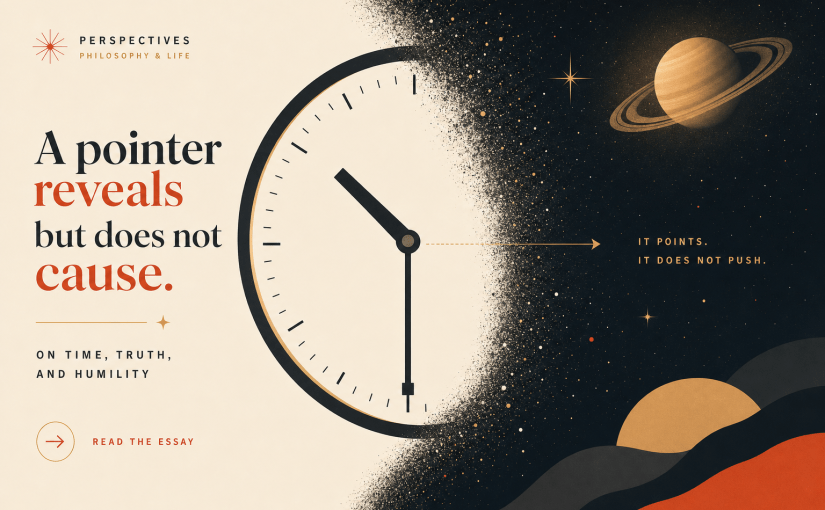
The clock doesn’t make it 10:30; it only points at it. Confuse the pointer with the cause and you’ve made the oldest mistake in the book — like believing windmills create the wind. We do this everywhere, but the costliest version is blaming the planets and stars for our predicament: “Saturn is ruining my life.” Saturn, a ball of gas hundreds of millions of miles away, is no more the author of your hard year than the number 6 is the author of half past ten. The chart, like a mantra or a raga, can be beautiful language for the season you’re in — but it is not the culprit, and it is not the cause. And underneath it sits a quieter question the old non-dual texts love to ask: who is the “you” that’s even being ruined? Look closely and you find that you’re not the hard year — you’re the awareness watching it come and go. The stars can describe your life. They can’t author it, and they can’t touch the one who’s watching. That part is yours.
There’s a question I asked a friend the other day, mid-conversation, the way you sometimes blurt out something that’s been quietly rattling around in your skull for years:
When the little hand sits on the 10 and the big hand points at the 6, is it 10:30 because the hands are there? Or are the hands there because it’s 10:30?
My friend gave me the look people give you when you’ve clearly had one too many cups of chai. But stay with me, because this innocent little question is a doorway — and on the other side of it is one of the most useful, most freeing ideas I know. It begins with a clock and ends, if you’ll walk with me that far, with a much quieter question: who, exactly, is the one looking at the clock at all? Let me take you through. I promise to bring snacks.
The obvious answer (which teaches a not-so-obvious lesson)
The clock does not cause the time. Obviously. If your clock stops, the afternoon does not politely freeze so you can finish your nap. The bus leaves anyway. Your tea still gets cold. The clock is a reporter, not a boss. It points at the morning; it does not manufacture it.
There’s actually a famous one-liner for the mistake of getting this backwards. Reverse causation, the logicians call it, and the classic example is gloriously silly: “The faster windmills spin, the more wind there is — therefore windmills create wind.” (Wikipedia, on reverse causation) Right. And the rooster’s crow causes the sunrise. And my refrigerator light creates the inside of my refrigerator.
So far this is just a cute brain-teaser. But here’s the thing — once you learn to spot the windmill error, you start seeing it everywhere, and in some places it’s doing real damage to real lives.
Because here’s the principle, and I want you to carry it like a little pocket stone for the rest of this piece:
The pointer is not the cause. The thing that shows you something is almost never the thing that made it so.
The clock points at 10:30. The thermometer points at the heat — it doesn’t bake the day. The bathroom scale points at a number — it doesn’t decide your worth on a Monday morning. And the planets, drifting through their houses, point at the seasons of a life. They do not author them.
That last one is where I actually wanted to take you.
The most expensive version of the windmill error
Picture someone going through a brutal stretch. Career wobbling, a relationship under review, the existential 3 a.m. stare at the ceiling. They go to get their chart read, and the astrologer nods gravely: “Ah. Saturn return.” (Saturn loops back to where it sat at your birth roughly every 29 years, and tradition treats it as the cosmic strict teacher who arrives to make you grow up. (Cosmopolitan, “What is Saturn Return?”))
And out it comes, the line I want to gently push back on:
“Saturn is ruining my life.”
Friend — that’s the windmill in cosmic robes. You’ve taken the pointer and handed it the bill. Saturn, a ball of gas hundreds of millions of miles away (it orbits the Sun at roughly 886 million miles, (NASA via Space.com) and never comes closer than about 746 million miles to us), is doing exactly as much to your breakup as the number 6 on your watch is doing to make it half past ten. Which is to say: nothing. It is pointing. It is not pushing.
This isn’t me being a smug skeptic, by the way — and I’d never sneer at the symbolic. I make my living inside symbols; I sing mantras. But there’s a world of difference between a symbol you use and a culprit you blame. Even thoughtful astrologers will tell you the planets don’t do anything to you — that the craft is a symbolic language, not a set of cosmic levers. One of them reaches for the very image we started with: the planets describe a life “in much the same way that the hands on a clock tell you the time, but do not cause the time.” (Mark Flaherty, “A Former Sceptic’s Guide to Astrology”) In fact, whether the sky signifies events or causes them is one of the oldest arguments inside astrology’s own house, thousands of years old. (Taalumot, “Does Astrology Describe Signs or Causes?”) The honest tradition has always known the planets are signs, not switches.
Why blaming the sky feels so right (and costs so much)
Part of why “it’s my Saturn return” lands with such a satisfying thunk is that it’s almost impossible to be wrong. A frame vague enough to say “the next couple of years will test you and force you to grow” is guaranteed to look accurate later — because whose late twenties don’t contain something hard? Psychologists call this the Barnum effect: we read a description loose enough to fit anyone and feel it was written for us alone. (SciTechDaily, “The Barnum Effect”)
That’s harmless when it’s comforting. It turns costly the moment it becomes an exit. Because if Saturn did it, then you didn’t — and if you didn’t, there’s nothing for you to do but wait for the transit to pass. Blame is a beautifully upholstered chair: it’s so comfortable to sit in that you forget you have legs. Hand your hard year to the planets and you’ve also handed them your steering wheel.
And the planets, bless them, are terrible drivers. They weren’t even watching the road.
So keep the language — just don’t hand it the blame
Here’s where I refuse to throw the baby out with the bathwater, because the chart, held rightly, is not nothing. “Saturn return” is a rather lovely, compassionate way of saying: around 29, the scaffolding of your twenties gets stress-tested, that’s normal, and you’ll come out steadier. (Mercury Magazine, “Saturn Return in All Houses”) As language — as a way to name the weather of a life — it can console and steady you, the way a psalm or a raga does, without making a single claim that has to survive a laboratory.
A mantra I sing doesn’t bend the universe; it tunes me. “It’s 10:30” doesn’t summon the morning; it nudges me to stop dawdling and go make my music. “Saturn return” doesn’t sentence you to a hard year; it offers an old, gentle frame for a hard year you were going to walk through anyway. The clock and the chart and the mantra turn out to be the same kind of creature: invented vocabularies for a reality that was never asking our permission. The trouble only ever starts when we forget we made the words, and begin to suspect the words are making us.
The quieter question underneath
And here, if you’ll follow me one step deeper, is the part the clock was secretly pointing at all along.
When we say “Saturn is ruining my life,” there are two characters in that little sentence — the planet, and the “my.” We pour all our energy into interrogating the planet. Is it in the seventh house? Is it retrograde? Did it have it in for me specifically? But the stranger, older traditions I keep returning to — the ones I set to music — would gently lay a finger on the other word and ask the question almost nobody thinks to ask:
Who, exactly, is the “you” that’s being ruined? Who is the one suffering, and who is the one doing the blaming?
Sit with that for a second, because it’s not a trick. It’s the whole thing.
Notice that you can watch your hard year. You can observe the anxiety arrive at 3 a.m. and watch it leave by morning. You can see the career wobble, feel the grief, and — this is the strange part — still be there, aware, after each of those has come and gone. Whatever can be watched is not the watcher. The cold tea, the wobbling career, the breakup, even the thought “Saturn is ruining me” — all of it appears and passes across you the way 10:30 appears and passes across the face of a clock that is itself going nowhere. The hands move. The dial doesn’t.
The Ashtavakra Gita says it without flinching: you are the awareness in which all of it rises and sets, not the rising and setting itself. The Ribhu Gita goes further still and laughs the clock right off the wall — there is no time, it says, there is no world either, only erroneous conception. Which is a 3,000-year-old way of saying: friend, you’ve mistaken the weather for the sky. You’ve mistaken the passing cloud for the vast, quiet space that was only ever watching it drift.
So who is Saturn doing it to? Look honestly and you can’t quite find the victim. There’s the hard year — real enough, like the cold tea. And there’s the one aware of it, who was never on the chart at all, who no planet can reach, who isn’t 10:30 or 10:31 or any hour you could name. The stars can describe the weather of a life. They cannot touch the one who is reading the weather report.
That’s the real freedom hiding inside a silly question about a clock. Not “the stars don’t matter,” but something gentler and far more useful: nothing out there is holding the pen — and the one who could pick it up was never out there to begin with. The pointer was never the cause. It was only ever pointing. And what it was pointing back toward, the whole time, was the one looking.
So, the send-off
The clock does not make it 10:30. The stars do not make your life. Both are just pointing — and we began by asking who is the one looking at the clock at all. Here is the homecoming: the one looking is the same one the planets were pointing back toward the whole time. Not 10:30. Not a Saturn return. Just the quiet, unbothered awareness reading these very words, the dial on which every hour comes and goes without touching it.
So the next time the sky gets blamed for the storm, smile, let the planet off the hook, and remember who was watching the weather. The pen was never in Saturn’s hand. It was never even out there. It was always, only, yours.
Now your turn
Once you start noticing this pattern — the pointer is not the cause — you can’t stop, and I suspect you’ve met versions I haven’t.
Where else do we blame the pointer for the storm? The thermometer we curse for the heat. The scale we let pass judgment on a Monday. The credit score, the horoscope app, the calendar that turns one more lap around the sun into a verdict. Maybe something stranger and more wonderful from your own tradition or corner of the world.
Drop it in the comments. Tell me the windmill someone you know swears is making the wind. I’ll read every one — and the best of them might just become the next post.
It’s 10:31 now, by the way. Or so my windmill tells me.

