You know those pop-up greeting cards — the ones that look flat and innocent until you open them, and suddenly bam!— an entire Taj Mahal made of paper springs out, usually accompanied by glitter and guilt for not buying a simpler one?
That’s sort of what happens every morning when we open our eyes.
After a good night’s sleep (the rare kind where no one from your childhood WhatsApp group appears in your dreams asking for donations), the moment you wake up, a full 3D world unfolds — people, places, problems, pending bills — all popping up like that elaborate paper diorama.
It’s quite the show.
The Great Morning Unfolding
When you open your eyes, you also pop up — the “me” character, complete with opinions, breakfast preferences, and mild existential anxiety. The whole identity kit just unfolds smoothly like it’s been waiting all night under your pillow.
Some people say, “But Nanda, the world doesn’t vanish when you sleep! It’s still there!”
Maybe. But here’s the trick — the very someone making that argument is also part of your conscious field. That clever, philosophical person pointing out your ‘flaw in logic’? Yep, also a pop-up.
It’s like arguing with a character inside the card about whether the card exists.
Flat When Closed
When the pop-up card is closed, nothing is destroyed. The scene is just folded — the palace, the trees, the smiling couple in matching paper sarees and kurtas — all compacted into flatness.
Similarly, when you’re asleep or in deep meditation, the world — with all its drama and color — folds back into stillness. Not gone, but dormant. Like your boss on a Sunday.
And when you “wake up,” the grand production begins again: light, sound, identity, memory — everything leaps up, shouting “Surprise!” like an overeager birthday card.
The Trick of Believability
The funny thing about pop-up cards is how convincing they can be, especially to children (and occasionally to adults before coffee). You forget it’s just paper cleverly cut and glued.
Likewise, consciousness projects such a convincing show that we forget it’s a projection at all. The mind doesn’t just open the card — it hires a full cast, builds sets, adds background music, and gives you the lead role.
The irony? You’re both the audience and the actor.
Liberation as Folding Back
So what is liberation then? It’s not burning the card or running away from it. It’s simply realizing that whether the card is open or closed — nothing truly new appears or disappears.
The essence was never in the paper palace or the pop-up people; it was always in the space that allowed it to unfold.
That awareness — silent, spacious, unbothered — is the real greeting.
Everything else is just… decoration with a bit of glitter.
Closing Thought
Next time you wake up, watch the show unfold. Don’t rush to start the day. Just notice how the world pops up — your name, your room, your phone, your to-do list — all springing to life from nowhere.
And maybe, before diving in, smile and whisper to yourself:
“Ah, there it is — the morning card. Let’s see what scene consciousness is sending me today.”
(Just don’t try to fold your spouse back into the card when they ask you to make coffee. Enlightenment has limits.)
For centuries, sages, saints, and that one uncle at weddings who insists he knows “the truth of everything” have been shouting in unison: shed the ego! According to them, the ego is the villain of the spiritual soap opera, the moustache-twirling bad guy who blocks us from enlightenment. One modern guru even turned it into a neat acronym: E.G.O = Edging God Out.
Sounds convincing, right? But here’s the twist: without the ego, you wouldn’t even know there was a truth to realize in the first place.
The Double Life of Ego
Think of ego like your neighborhood auto driver. On one day, he’s weaving dangerously through traffic, shouting at pedestrians, and playing film songs at full volume—annoying, loud, and best avoided. On another day, he’s the one who drops you exactly where you need to be, gives you change without grumbling, and even warns you about the pothole near the signal. Same guy, two different roles.
Ego works like that. If you identify it with your endless stream of random thoughts—“what’s for dinner?”, “does my WhatsApp DP look fat?”, “why hasn’t Netflix released Season 2 yet?”—then yes, ego is the troublemaker. But if you recognize ego as the quiet sense of “I am” that sits beneath all this noise, suddenly it becomes a signpost pointing straight toward Truth.
The Shopping Mall Analogy
Picture yourself in a shopping mall. Every shop window is blaring for attention: “Buy me! Eat me! Discount 50%!” These are your thoughts. Your ego, depending on how you use it, can do one of two things:
Chase the mannequins—run around from Zara to Apple Store to the food court, completely distracted.
Stand in the middle of the mall—aware that all these shops exist, but not compelled to enter. Just resting in the fact that you are present in the mall, not the stuff inside it.
One leads to exhaustion (and an empty wallet). The other leads to realization.
The Cosmic Stage Show
Think of life as a stage play. The thoughts, emotions, aches, and identities are like actors. The ego can either insist, “I’m the hero, the villain, the comedian, and also the audience—give me all the parts!” Or it can sit back as the stage itself—the screen upon which the entire drama plays.
It’s the same ego, but which way you flip it makes all the difference.
Why We Need Ego to Drop Ego
Here’s the paradox no one tells you: you need ego to even decide to shed ego. Who else is sitting there reading blogs about spirituality at 11:47 p.m. on a Tuesday? The “I” that seeks the Truth is still ego—but it’s the refined version, the ego that points beyond itself, like a GPS that tells you, “Recalculating route to Infinity.”
So maybe the sages weren’t wrong about letting go of ego. But until you use it to realize what’s beyond, dropping it too soon is like throwing away the car keys because you’re frustrated about potholes. The car’s still the way to get home.
Everyday Example: The Alarm Clock
Think of your alarm clock. It’s annoying, intrusive, and loud. You want to smash it against the wall every morning. But without it, you wouldn’t even wake up to know there is a morning. Ego’s the same. It wakes you up to the sense of “I am”—and from there, you get to see that you are more than the random noise of thoughts and identities.
In short: Ego isn’t the villain. It’s the slightly irritating but ultimately helpful character that gets you to the truth. Shed the noisy part, keep the “I am” part, and you might just find that what you thought was blocking God was really pointing to God all along.
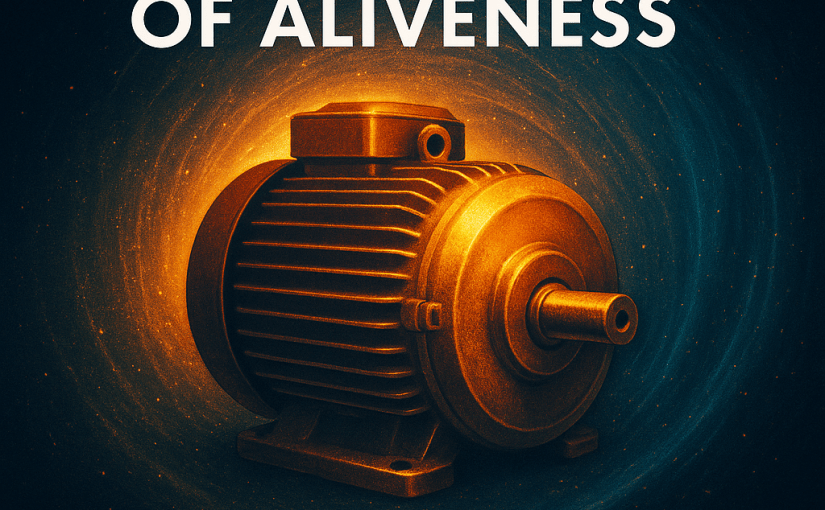
Have you ever walked past a giant generator or one of those industrial motors and felt it in your bones before you even heard it? That low, steady hum… reassuring, powerful, unbothered. It’s just there. Not shouting for attention, not needing to prove itself, but quietly powering the whole building.
That, my friend, is exactly what the sense of “aliveness” feels like.
We’re so used to identifying with thoughts—this endless parade of “should I…”, “what if…”, “oh no…”, “why me…”—that we forget there’s something far more fundamental buzzing underneath. A current that’s been running since before you knew your name, before you knew you had knees that creak when you get up too fast, before you had a list of worries that could rival a grocery bill.
The Dynamo Within
Sit still for a moment. Drop the drama. Forget the story of “you.” What’s left? A hum. Not metaphorical, but a very real sense that something is alive in you. Breathing, pulsing, steady as a ceiling fan in a summer power cut (when the current isn’t steady, you really notice!).
From that humming place, you’ll see your thoughts like little fireflies outside a streetlamp—pretty maybe, sometimes irritating, but clearly not the light itself. Even your precious “identity”—that carefully curated name, job title, Instagram bio—sits outside this hum. The aliveness doesn’t care if you’re CEO of the world or Chief Operator of the Remote Control. It just hums.
Aches, Pains, and Invincibility
Here’s the wild part: even the body’s complaints—sore shoulders, stiff back, that knee that behaves like it’s auditioning for a horror movie soundtrack—can be observed from here. You notice them, yes. But they’re not you. They’re like background noise in a café where the espresso machine hisses, chairs scrape, and the couple at the next table is arguing over pineapple on pizza. None of it stops the café from being a café.
And from here, strangely enough, there’s a feeling of invincibility. Not the Marvel superhero kind where you dodge bullets, but a deeper invincibility. Even mortality feels… well, slightly overrated. Because the hum doesn’t really start or stop—it just is.
Everyday Example: The Fridge
Think of your refrigerator. You don’t stand there all day listening for the motor. But if the hum stops, you immediately sense something’s wrong. Suddenly, all the thoughts appear: “Do I need to call the repair guy? Will my ice cream melt? How fast can I eat three tubs of Ben & Jerry’s?”
Our aliveness is like that fridge motor. It’s constant, reliable, and easily overlooked because it’s always there. But notice it, and suddenly the thoughts about melted ice cream (or anything else) are just noise outside that steady hum.
The Easy Part
Here’s the best news: nobody can deny being alive. This isn’t some mystical achievement reserved for monks in Himalayan caves. You’re alive, right now. The hum is running. Tuning into it doesn’t take effort—it takes not effort. Just notice.
The hard part? We forget. The easy part? We can remember again, any time.
So the next time you find yourself spiraling in thought or getting stuck in an ache, pause. Step back. Listen for the dynamo. That quiet, invincible hum of aliveness.
It’s been there all along, and unlike your fridge, you don’t need to call a repair guy.
Look at a tree. Any tree. Don’t label it. Don’t call it beautiful, ugly, or a neem tree near uncle’s house. Just… see it.
You’ll notice something strange.
For a fleeting second, there’s only tree. Not your memory of a tree, not your opinion of it, not even you looking at it. Just… tree.
Now imagine living like that, always. That, my friend, is what some call liberation.
The Problem with “Me” (And All Its Cousins)
Your mind is like a chatty radio host who won’t take a breath.
“I like this.”
“I hate that.”
“This reminds me of that summer in Goa.”
“This cow looks tired.”
But who’s this “I”?
J. Krishnamurti once said:
“The observer is the observed.”
It’s not a riddle. It means when you say, “I am anxious,” you’ve created a false duality. In truth, there’s just anxiety—no owner required. The moment you label it as yours, you’ve claimed it like a Netflix account.
Liberation Isn’t a Mountaintop, It’s a Mute Button
Non-duality teachers say it beautifully.
Rupert Spira reminds us:
“The belief in a separate self is like imagining a wave is separate from the ocean.”
Mooji says, with a grin:
“Don’t take your thoughts so seriously. They’re not paying rent.”
When we drop our constant labeling—our me, mine, my—we return to what just is.
A cow grazing becomes just… cow. Not a “lazy cow” or “my cow.” Just cow. And in that seeing, you’re free.
A Little Practice (But Not a Method, Please)
Krishnamurti hated methods. But here’s a loose suggestion:
Just observe.
Don’t label.
Don’t claim.
Don’t objectify.
It’s not about doing something. It’s about stopping the habit of always being someone.
In Conclusion: Leave Your “I.D.” at the Door
You don’t have to meditate in the Himalayas or chant your way to freedom.
Hey everyone, great hanging out with you all in the comments on yesterday’s post! It seems like the idea of our life resonated with quite a few of you. Our body, roles, and even our thoughts are kinda like a temporary house we inhabit. We talked about keeping a “chill take” on it all. We shouldn’t get too attached to the structure or the furniture. It’s all part of the journey.
But that naturally leads to the next big question, doesn’t it? If all that stuff is the “house”… then who is the ‘I’ that’s actually living inside it? Who is experiencing the leaky faucets, the sunny rooms, the whole deal?
Today, let’s explore that resident. Here’s a heads-up. We will share some cool old ideas from ancient wisdom. These will help us unpack it. Stay chill, though – it’s all part of the adventure!
Meet the Busy ‘Resident Manager’ (Ahamkara)
Think about who runs the show in your “house” day-to-day. There’s this constant sense of ‘me’ that seems to be in charge, right? It worries about upkeep, feels proud of the decor, gets annoyed when things aren’t perfect. Ancient Indian thought has a name for this busy manager: अहंकार (Ahamkara).
अहंकार (Ahamkara): Remember this one? We touched on it briefly. It literally means the “I-maker.” It’s the role within us. It creates the strong feeling of being a separate individual. It makes us feel like the one who owns the house and everything linked to it.
This Ahamkara isn’t just aware that the house exists. It identifies as the house manager. Sometimes it even thinks it is the house! It’s the voice saying:
“This is MY room!” (My opinion, my beliefs)
“Don’t scratch MY floors!” (My feelings got hurt)
“Look at MY beautiful garden!” (My accomplishments, my status)
“I need to fix that leaky faucet!” (My problems, my worries)
It’s the part of us that feels fundamentally separate and often quite stressed about managing this whole “house” situation.
Asking the Landlord (Koham?)
But is this busy, often stressed-out resident manager the actual owner of the property? Or just… the manager? This is where a fascinating practice comes in, highlighted by the sage Sri Ramana Maharshi. He suggested a change in approach. Instead of just listening to the manager’s constant chatter and anxieties, we should try to find the real source. We should seek the ultimate “landlord” by asking: “Who Am I?“
In Sanskrit: कोऽहम्? (Koham?).
कोऽहम्? (Koham?): “Who Am I?”
This isn’t about the manager giving their job title (“I am the manager,” “I am a parent,” “I am successful”). It’s about tracing that ‘I’ feeling itself back to its origin. When the manager (Ahamkara) starts freaking out – “I am overwhelmed!” “I need this!” “I hate that noise!” – the practice is to gently inquire inwardly: “Okay, who is this ‘I’ that’s feeling overwhelmed? Where does this ‘I’ actually come from?”
Ramana suggested this inquiry is incredibly powerful. Why? Because it bypasses the manager and looks for the silent owner. Finding that source, he said, is the key to real peace. It stands in contrast to the constant low-grade stress of just managing the house. He stated something profound: “The inquiry ‘Who am I?’ is the principal means to the removal of all misery and the attainment of the supreme bliss.”
Hook: Imagine being capable of quieting the frantic manager by simply looking for the calm, underlying owner! What happens if we stop taking the manager’s word for everything and investigate the source?
All This “My House, My Stuff” Stress
Let’s be real, being the resident manager (Ahamkara) is stressful! Much of our daily anxiety comes from clinging to the “house.” It also comes from defending everything we’ve labeled “mine” inside it.
Worrying about the house’s appearance (“my reputation,” “my image”).
Getting angry when someone parks in “my driveway” or disrespects “my space.”
Feeling anxious about the house’s future (“my job security,” “my health,” “my retirement”).
Comparing “my house” to the neighbor’s bigger, fancier one.
Sound familiar? The Ahamkara is hard at work. It identifies completely with the house and its contents. It is convinced that its own well-being depends entirely on the state of the property.
Hook: Think about your day so far. Whether you are right here in your town or somewhere else, think about the energy you use. You are managing aspects of “your house.” Consider on how much you defend or worry about the things you call “mine.”
When the Manager Sleeps & The Empty House (Awareness/Atman)
Now, here’s where it gets really interesting, connecting back to our “chill take” from yesterday. How permanent, how solid, is this resident manager (Ahamkara)?
Consider deep, dreamless sleep. The house (your body) is still there, resting. But where did the manager go? That distinct feeling of “I am managing this life” completely vanishes. Poof! The office is empty. This shows the Ahamkara needs certain conditions – like the waking state or even a dream state – to function.
And dreams? The manager rebuilds a whole dream house and runs around managing that! This highlights that the manager is more like a role being played than a permanent fixture.
If the manager can just disappear every night, they can’t be the fundamental reality, right? They are transient, dependent. And what about the house itself (the body)? Does a brick know it’s a brick? Does the house feel its own existence? No. Like we said yesterday, the house is just the structure. It needs something else to be known, to be experienced.
So, if the manager comes and goes, and the house itself is just structure, what is constant?
It seems to be awareness itself. The silent, unchanging space in which the house exists. The fundamental knowing that perceives the house, the manager, the thoughts, the feelings, everything. This ever-present, underlying reality, the true Self, has a name in Sanskrit: आत्मन् (Atman).
आत्मन् (Atman): The Self (with a capital S). Think of it as the silent, true owner of the property. It is like the very ground and space the house is built upon. It is pure, witnessing consciousness.
The nature of this Atman, this fundamental reality, is often described as सच्चिदानन्द (Sat-Chit-Ananda).
सच्चिदानन्द (Sat-Chit-Ananda): Existence-Consciousness-Bliss. It suggests that the very nature of this underlying awareness or space is pure being. It is pure knowing. It embodies inherent, causeless peace or joy.
Who Feels the Drafts and Sunshine? (Feelings)
Okay, so if we are fundamentally this peaceful awareness (Atman), why do we feel bothered by drafts (pain, sadness) or delighted by sunshine (pleasure, joy) in the house?
Maybe it happens like this: Awareness (Atman, the space/owner) perceives sensations related to the house (a cold draft, warm sunshine). The busy resident manager (Ahamkara) immediately rushes over, identifies with the sensation, and declares, “I am cold!” or “I love this sunny spot!” It claims ownership of the experience happening within the aware space via the house’s condition.
This reframes our feelings. They aren’t necessarily who we are. They are like weather conditions affecting the house. The underlying awareness (Atman) perceives them. Then, the temporary manager (Ahamkara) loudly claims and reacts to them.
Seeing this helps us follow Ramana’s advice: “There is no need to get rid of the wrong ‘I’ [Ahamkara/manager]. All that is required is to find out the source of the ‘I’ and abide in it.” We move away from reacting frantically like the manager. Instead, we rest as the calm, aware space or owner that perceives everything.
Living Lighter in the House
So, where does this leave us? Yesterday, we talked about the house. Today, we’ve explored the difference between the busy, stressed manager (Ahamkara) who thinks they are the house. The silent, aware space/owner (Atman) is our true foundation.
The manager comes and goes. Its attachment to “my house, my stuff” causes stress. But the underlying awareness is constant, peaceful by nature. Practices like asking “Who Am I?” help us see past the manager and connect with that deeper reality.
This doesn’t mean we neglect the house! We still take care of our bodies, our lives, our responsibilities. But we can do it with a lighter touch, with that “chill take” we talked about. We know we are fundamentally the spacious awareness. We are not just the temporary house or its frantic manager. These insights allow us to navigate the inevitable leaks. They help us enjoy the sunshine with more ease and a lot more peace.
It’s an ongoing exploration, not a final answer. What does this “resident manager” vs. “silent owner” idea spark for you? Does it change how you view the ‘I’ living in your ‘house’? Share your thoughts below – always great to learn together!
Picture this: you’re standing in the middle of nowhere, just wide-open land stretching out forever. There’s mountains in the distance, a big ol’ sky above, and the ground under your feet. Birds are flapping around up high. Ants are doing their thing on the dirt. There’s some grass and bushes sprinkled around. It’s raw, it’s real, it’s just… there. So, you decide to build a house. You slap up four walls, fence off a chunk of this endless land, and call it yours. Inside, you add more walls—rooms, spaces, your own little world. Boom, it feels like your spot now, separate from all that wild stuff outside.
But here’s the thing about “owning” something—you get attached. Those birds? Their chirping starts to bug you. The ants? Suddenly they’re invaders creeping into your space. You shoo them out. Then, you lock the doors. Finally, you turn your house into a fortress to keep the outside world at bay.
Then one night, a massive thunderstorm rolls through. It’s loud, it’s scary, and it’s shaking your house like it’s made of toothpicks. You start freaking out, thinking, “What if this storm wrecks everything? My house, my space, my whole vibe—gone!” In that panic, you start imagining some big, powerful force that can save you. You call it God, give it a name, maybe even a face. You start tossing out prayers or offerings, like you’re paying for some cosmic insurance to keep your house standing.
Along comes someone else, claiming they’ve got the inside scoop on this God thing. They’re like, “Nah, you’re doing it wrong. I’m tighter with the Big Guy, so listen to me.” You are desperate to keep your house safe. You start trying to impress this person. You hope they’ll put in a good word for you.
But then another storm hits—bigger, badder. Your walls come crashing down, your rooms are toast, and you’re back standing in that same wide-open land. The birds are still flying, the ants are still marching, the grass is still swaying. It’s like nothing changed, but you feel different. Part of you recalls this entire cycle. It feels like déjà vu when you try to hold onto something that was never really yours.
And that’s when you start wondering: Was that space ever mine? Were those walls just a trick I played on myself? This is where things get kinda wild, because this whole setup is like a big metaphor for who we are.
Your House Is Your Body, the Land Is Your Mind
Think of the house as your body, the thing you’re walking around in every day. You build up this idea of “me”—your personality, your likes, your fears, your story. It’s like putting up walls to carve out a little “you” from the giant, endless consciousness that’s all around. Those walls are your skin, your thoughts, your beliefs, all the stuff that makes you feel like a separate person. Inside, you’ve got rooms—your job, your relationships, your dreams, all neatly organized.
The birds and ants? Those are the random thoughts, feelings, or distractions that pop up. They’re only annoying when you’re super attached to keeping your “house” just the way you like it. In the big picture, those thoughts and feelings are just part of the flow. They are like birds in the sky or ants on the ground.
The thunderstorm? That’s life’s way of reminding you nothing lasts forever—change, loss, even death. It shakes up your house, your body, your whole sense of “me.” Scared of losing it all, you turn to something bigger, like God, hoping it’ll keep you safe. You pray, you do rituals, whatever feels right. Then someone comes along saying they’ve got a direct line to that higher power. You follow them, thinking they’ve got the key to keeping your house standing.
But when the storm finally wipes it all out, you’re back in that wide-open land—that big, limitless consciousness. Your body is gone, your “me” fade, but that awareness, that land? It’s still there. It was never yours to own because, guess what? It’s what you are.
The Loop We Keep Living
This whole story is like a loop we’ve been running for ages. We build our houses—our bodies, our identities, our communities, our beliefs—trying to grab a piece of something infinite. We stress about keeping it safe. We pray to powers we hope will protect us. We listen to people who claim they’ve got the answers. But storms always come, and they always take down what we built.
That little memory you feel in the story? That’s your gut telling you this loop doesn’t have to keep going. You start asking: Was it ever mine? Is this “me” I’m so attached to even real? Is that big, endless consciousness something I’m just floating in, or is it actually me?
That’s when things start to shift. You realize the house isn’t a cage—it’s just a temporary setup, a way to experience this wild, infinite land. Your body, your “me,” your walls—they’re tools for living, not for owning. The birds, the ants, the storms? They’re not against you—they’re part of the same big picture you’re in.
Living Free and Easy
Living without clinging to the walls means chilling out in the big, open land without trying to fence it off. It’s about seeing your house—your body, your life—as this cool, temporary thing that’s awesome while it lasts. Let the birds chirp, let the ants march, let the storms roll through. They’re all part of you, like your thoughts and feelings.
You don’t have to ditch the house. Build it, love it, make it yours. Just don’t grip it so tight. When the storm comes, let it do its thing. When the walls fall, no big deal. You’re not just the house—you’re the land, the sky, the mountains, the whole dang scene.
And when you get that, you don’t need a God to save you. You don’t need some guru to show you the way. It’s just you and this big, beautiful, endless vibe—and you’re already right at home.
We’ve all been there. Settling into our airplane seat, adjusting the seatbelt with an air of false confidence, nodding sagely at the safety demonstration we have absolutely no intention of following unless the plane turns into a submarine. And then comes the golden piece of wisdom, disguised as a simple instruction:
“In case of a loss of cabin pressure, oxygen masks will drop from the overhead panel. Please secure your own mask before assisting others.”
Sounds reasonable, right? But think about it—this is not just an in-flight safety precaution; this is a life philosophy masquerading as aviation protocol.
Selfish or Sensible?
At first glance, it may seem selfish. Why should I put on my mask first? Shouldn’t I be the noble soul, helping my fellow passengers, rescuing kittens, and ensuring world peace?
Absolutely not. Because if you pass out from lack of oxygen while trying to help others, you’re no help to anyone. In fact, you’ve just become another unconscious person who now needs to be helped. Great job.
This is exactly how life works. You can’t pour from an empty cup. You can’t donate from an empty bank account. And you definitely can’t inspire others if you’re gasping for breath—literally or figuratively.
Life Applications of the Oxygen Mask Rule
1. Financial Oxygen – The Money Talk
We’ve all heard it: Money isn’t everything! True. But try telling that to your landlord when rent is due. Try explaining to the grocery store cashier that your “positive energy” should cover the bill.
It is far better to be rich and miserable than poor and miserable. At least with wealth, you can be miserable in comfort, with a therapist, a spa day, and an overpriced cup of artisanal coffee. Being financially secure means you can help others without sinking yourself.
I once knew a man who donated generously to charity—even when his own finances were a mess. He prided himself on being selfless, until one day, he couldn’t pay his own rent. Who came to his rescue? The very people he had been donating to. See the irony? If he had secured his own financial oxygen mask first, he could have continued helping others without needing help himself.
2. Emotional Oxygen – The Art of Saying No
You know that friend who always says “yes” to everything? The one who volunteers, helps everyone move, covers extra shifts at work, and babysits other people’s unruly kids? Ever notice how that same person often looks exhausted, frustrated, and one “Can you do me a favor?” away from a nervous breakdown?
Helping others is noble, but not at the cost of your own mental health. If you’re drowning, you can’t be a lifeguard.Learn to say no. Prioritize your well-being. Even Buddha didn’t try to enlighten people while he was still figuring himself out—he sat under a tree, meditated, and then started sharing wisdom.
3. Health Oxygen – The Body Keeps the Score
We all know someone who works 18-hour days, survives on caffeine, and insists, “I’ll rest when I’m dead.” Spoiler: That’s a fast-track way to meet that deadline sooner than expected.
You need to take care of your health before you can take care of others. A sick person can’t be an effective caregiver. A sleep-deprived employee can’t be productive. If your body is screaming for rest and you ignore it, you’re setting yourself up for a spectacular crash—just like ignoring a flashing fuel light in your car.
I once met an overworked CEO who prided himself on being “too busy for vacations.” He ended up collapsing in his office due to exhaustion. The company? It survived without him. His health? Took years to recover. Secure your ownoxygen mask before trying to run a marathon for others.
Final Descent: Prioritize Yourself, Then Help Others
The next time you hear the airplane oxygen mask announcement, don’t roll your eyes—internalize it. It’s not about being selfish; it’s about being strategically self-sufficient. If you’re thriving, you can uplift others. If you’re barely surviving, you’re just another person needing help.
Take care of your finances. Protect your mental health. Prioritize your well-being. Because once your oxygen mask is securely in place, you can truly make a difference in the lives of others.
Now, sit back, relax, and enjoy the flight.
Would love to hear your thoughts—especially if you’ve ever had to put your own “oxygen mask” on first in real life!
Here’s my take, based on some real-life trial and error. I’ve dabbled in deep religiosity and ritualism—think priests at home, elaborate worship sessions, and enough incense smoke to trigger a fire alarm. Did all that effort bring eternal happiness? Spoiler alert: not even close.
Like everyone else on a quest for answers, I tried all kinds of remedies—even experimenting with medicinal herbs (yes, the kind that makes you question the nature of existence). The outcome? A whole lot of nothing. Zero. Nada. Or as my uncle loves to say, “One big, fat zero!”
Then one day, I stumbled upon something—an idea, a perspective—and it was like trumpets blaring and bells ringing in my head. Suddenly, there it was: the Matrix, clear as day.
Is Everything Part of the Matrix?
Before we talk escape plans, let’s address the elephant in the room: religion, spirituality, and their shiny promises of salvation. Every religion seems to pitch its own flavor of God, saints, angels, heaven, and hell. It’s like a spiritual buffet—but isn’t it all just part of the Matrix?
The Concept of God: Is this all-powerful being sitting in the cosmic director’s chair, orchestrating your life like a reality TV show? Or is God just the Matrix’s version of the tech support team—available only when things go horribly wrong?
Saints and Angels: Middle management. They’re like the IT guys of the divine world—”Have you tried praying?”
Heaven and Hell: The ultimate carrot and stick. Behave, and you get the VIP suite. Mess up, and you’re in the basement forever. Doesn’t this feel suspiciously like part of the control system?
If these concepts are part of the Matrix, then looking to them for escape might be like asking the prison guard for the keys.
The Big Question: Why Escape?
Before you make a jailbreak, ask yourself—why? What’s so bad about this Matrix? Sure, it has its share of heartbreak, traffic jams, and questionable reality TV, but it also has pizza and Wi-Fi. Are we just looking for a way out because we’re wired to think there’s something better?
Escaping isn’t just about leaving the bad behind; it’s about finding something real. So how do we do that? Glad you asked.
Steps to Escape the Matrix (Or at Least Bend It to Your Will)
1. Wake Up (Literally and Figuratively)
Practicing Mindfulness: Stop scrolling Instagram like a caffeinated squirrel and pay attention to your life. Meditation can help here. Sit still, breathe, and try not to think about snacks.
Questioning Everything: Why do you do what you do? Is it because you want to or because society (read: the Matrix) expects it? From your job to your relationships, start asking, “Is this me?”
2. Detach from the Drama
The Matrix thrives on drama. It’s like that one friend who’s always embroiled in some ridiculous soap opera.
Embrace Impermanence: Happiness, sadness, success, failure—they’re all just passing clouds. Stop clinging to them like a toddler with a balloon.
Let Go of Labels: Stop defining yourself by your job title, relationship status, or how many followers you have. You’re not a brand; you’re a human.
3. Turn Down the Noise
Modern life is basically the Matrix on steroids—a nonstop barrage of notifications, ads, and unsolicited advice. Silence it.
Digital Detox: Try spending a day without your phone. You’ll feel like a lost puppy, but it’s worth it.
Simplify: Do you really need 37 pairs of shoes or that subscription box for exotic tea leaves? Probably not. Simplify your life, and you’ll feel less trapped.
4. Connect with the Real
Nature: Step outside and connect with nature. Hug a tree—yes, actually hug it. It might feel silly, but it’s surprisingly grounding (just check for ants first; trust me on this one). Watch the sunset, let the colors wash over you, and feel the earth beneath your feet. Nature is like a cheat code for escaping the artificial.
Community: Talk to actual humans. Not in a group chat—in person. Share a meal, a laugh, or an awkward silence. Real connection beats digital likes any day.
5. Master Your Mind
The Matrix is strongest where it controls your thoughts. Think about it: every fear, every doubt, every limitation starts in your mind. If you can master your mind—recognize the patterns, question the narratives, and rewrite your inner script—you’re halfway out.
6. Serve Something Bigger
Want to feel like Neo? Do something that matters.
Help Others: Volunteer, mentor, or just be kind to that grumpy neighbor. Serving others can break the illusion of separateness.
Pursue Your Purpose: What lights you up? Find it and do it.
Will You Ever Fully Escape?
Here’s the kicker: Maybe you can’t completely escape. I remember this one time, nearing the end of a grueling 10-day Vipassana meditation camp. After days of silence and self-reflection, the realization hit me—what if the very pursuit of escape is just another layer of the trap?
So, fellow seeker, the question isn’t just how to escape the Matrix but how to live fully within it without being a prisoner. You’ve got the keys. Now go unlock something magical—just try not to break the Wi-Fi on your way out.
Ah, the delicate art of cursing. It’s a universal language, a symphony of syllables that transcends borders and cultures. But just like any art form, cursing has its nuances, its regional variations. And in India, my friend, we’ve elevated it to an almost poetic level.
Now, I’m not saying that we Indians have a monopoly on colorful language. Far from it. My American countrymen, for instance, have a rather impressive repertoire of expletives. Take, for example, the classic “son of a…” well, you know the rest. It’s a timeless classic, a go-to phrase for expressing frustration, anger, or just plain old annoyance. And who can forget the ever-reliable “mother…” another versatile term that can be used in a variety of situations.
But here’s the thing: while Americans tend to focus their cussing on, shall we say, less savory aspects of human anatomy, Indians prefer to keep it in the family. Mothers, sisters, daughters – they’re all fair game in our verbal sparring matches.
Take, for instance, the ubiquitous word that rhymes with a certain English cricketer’s name. It’s a crass term, no doubt, but one that’s hurled with alarming regularity across the length and breadth of our country. From the bustling streets of Delhi to the rarified air of the Bollywood elite, it’s a staple of our everyday vocabulary.
Then there’s the Chennai special, a word that shares an unfortunate phonetic resemblance to a popular fizzy drink. This particular gem is a favorite among the city’s auto-rickshaw drivers, who seem to have an endless supply of creative variations.
And let’s not forget the regional variations. Every corner of India has its own unique set of feminine-focused expletives, each more imaginative than the last. It’s as if we’ve collectively decided that the worst possible insult is to associate a man with a woman, to question his masculinity by linking him to the perceived “weaker” sex.
Now, I know what you’re thinking. “This is all very amusing, but isn’t it a bit sexist?” And you’d be right. It is sexist. It’s also hypocritical, considering that we often celebrate men who are, shall we say, “experienced” with women.
But here’s the thing: I don’t think we’re doing it out of malice. I think it’s more a case of ingrained cultural conditioning. We’ve been brought up in a society where women are often seen as second-class citizens, and our language reflects that.
But that doesn’t mean we can’t change. We can start by being more mindful of the words we use. We can challenge ourselves to find new ways to express ourselves without resorting to sexist language. And we can educate our children about the importance of respecting women.
It’s a long road ahead, but I believe we can get there. After all, we Indians are nothing if not resilient. We’ve overcome countless challenges in the past, and I’m confident that we can overcome this one too.
So let’s raise a glass (of non-fizzy beverage, of course) to a future where our language is as diverse and vibrant as our culture, and where women are celebrated, not denigrated. Cheers to that!
Life is the most elaborate practical joke ever pulled, and the punchline? Well, we’re it. Every twist, every turn, every ridiculous desire, and every existential crisis is one big cosmic “gotcha!” And what do we do? We soldier on, pretending it all makes sense. Spoiler alert: it doesn’t.Let’s break down this tragicomedy, one absurdity at a time.
Your Body: The Ultimate Lemon
The human body is a marvel of engineering—if that engineering was done by a drunk intern on their first day. Sure, it works most of the time, but it’s also ridiculously fragile.
Stub your toe? Your entire day is ruined.
Catch a cold? Your body turns into a snot factory overnight.
Eat the wrong thing? Enjoy spending the next 48 hours praying to the porcelain gods.
And then there’s the grand finale—death. It’s inevitable, no matter how much green juice you drink, how many yoga classes you take, or how many supplements you shove down your throat. The irony? Most of us spend our entire lives trying to avoid the one thing that’s guaranteed to happen.
Chasing Carrots: The Never-Ending Cycle of Want
If life were a movie, desires would be the recurring villain—always popping up, always causing chaos. No sooner do you satisfy one craving than another comes stomping in like a toddler demanding attention.
Let’s break it down:
Want a promotion? Great! But now you want to quit because your boss is unbearable.
Want a new car? Sure, but now you need a better house to park it in.
Want to find love? Perfect! But now you’re wondering why they leave the cap off the toothpaste every. single. time.
It’s like we’re all hamsters on a wheel, running toward a carrot that keeps moving further away. And when we finally get the carrot? Surprise! There’s another carrot right behind it.
Hormones: Nature’s Comedy Writers
Let’s talk about nature’s cruelest joke: reproduction. Nature took one look at us and said, “Here’s an idea—make them desperate to find a mate.” And then it threw in hormones to make the process even messier.
The absurdity of mating rituals:
You dress up, swipe right, and pray the person doesn’t ghost you after you awkwardly overshare about your cat’s dental problems.
You go on dates where you pretend to like jazz or sushi or hiking, all to impress someone who might not even like you back.
And if it all works out, congratulations! You now have to spend the rest of your life arguing about how to load the dishwasher.
And why do we do this? Because our bodies demand it. They don’t care about love or compatibility—they just want us to pass on our genes. It’s biology, baby. And it’s ridiculous.
Loneliness: The Frenemy That Keeps Us Company
Humans are social creatures, which is just a fancy way of saying we’re terrified of being alone. That fear drives us into relationships—sometimes good, sometimes… well, not so good.
Signs you’re in it for the wrong reasons:
You stay because “at least they text me back.”
You ignore red flags like they’re decorative banners at a party.
You convince yourself that everyone argues about who left the milk out for three days.
But hey, it’s better than being lonely, right? Wrong. Toxic relationships are like drinking expired milk—you know it’s bad for you, but you keep going because you’re too afraid to throw it out. And yet, we stay. Because at the end of the day, loneliness whispers, “At least expired milk is something.”
Validation: The Drug We’re All Addicted To
We all want to be special. We want to be seen, admired, and applauded. But life has other plans.
Here’s how this usually goes:
You work hard on a project, pour your heart into it, and present it with pride.
The response? “Hmm, it’s okay, I guess.”
Or worse, someone says, “You should’ve done it this way instead.”
It’s like baking a beautiful cake and having someone say, “Oh, it’s a little dry.” Thanks, Brenda. I wasn’t trying to win The Great British Bake Off.And yet, we keep chasing validation, like moths to a flame. Because deep down, we all secretly hope someone will look at us and say, “Wow, you’re amazing.” Instead, they usually say, “Could you not?”
From Goo to Grief: The Bookends of Existence
Let’s talk about the two bookends of life: birth and death. Neither one is particularly pleasant.
Birth:
You start your life being squeezed out of a human body like a tube of toothpaste.
You’re covered in goo, crying uncontrollably, and surrounded by strangers holding scissors.
Your first experience in the world is people poking and prodding you while you scream, “What is happening?!”
Death:
If you’re lucky, it’s peaceful. If not, well… it’s probably embarrassing. (“He choked on a grape? Seriously?”)
And then there’s the aftermath: people crying, awkward eulogies, and someone inevitably saying, “They’re in a better place now,” even though no one really knows.
And sandwiched between these two events is a lifetime of stubbed toes, bad haircuts, and awkward small talk at office parties. Life: the gift that keeps on giving.
Keeping Up With the Cohorts
Humans are competitive by nature. It’s why we invented things like the Olympics, reality TV, and LinkedIn.
The exhausting cycle of one-upmanship:
Your coworker buys a new car, so now you feel like your car is trash.
Your friend goes to Bali, so now you’re Googling “cheap flights to anywhere exotic.”
Your neighbor renovates their kitchen, so now you’re suddenly obsessed with granite countertops.
It’s a never-ending game of “Who’s Winning at Life?” The catch? No one is. Because even if you’re on top today, someone else will outdo you tomorrow. It’s like playing Monopoly but with real money and actual tears.
There Is No Point, and That’s the Point
Life is absurd. It’s messy, chaotic, and often feels like a joke we don’t quite understand. But maybe that’s the point.
Here’s the truth:
Life doesn’t make sense, and it probably never will.
We’re all just winging it, pretending we have it together, while secretly Googling “how to be a functioning adult.”
And that’s okay.
So, laugh at the absurdity. Embrace the chaos. And when life feels like it’s too much, just remember: we’re all in this ridiculous farce together. And honestly? It’s a pretty funny show.










 Nalla Madras