The Many Forms of the Mother

There are some forces in life that quietly shape us long before we fully understand them.

For me, that force was always Devi — the Divine Mother.

Even as a young boy growing up in India, I felt an unexplainable pull toward Her. Not out of fear, nor because of strict religious conditioning, but from something much deeper and strangely familiar. Looking back now, I sometimes feel it may have been the quiet continuation of spiritual impressions carried across lifetimes — a culmination of punya that naturally drew my heart toward the Mother.

And perhaps, like many of us, my first glimpse of the Divine Mother came through my own mother — through her care, sacrifice, protection, and quiet strength. Before we understand philosophy or spirituality, we first understand love through a mother’s presence.

Life eventually carried me far away from home. Nearly three decades ago, I relocated to the United States. Like many immigrants, I became absorbed in the practical realities of building a life — work, responsibilities, survival, family, adapting to a new culture. Yet through all the movement and noise of life, one thing remained constant:

My connection to Her.

Prayer continued. Worship continued. Even when life became turbulent, Devi remained the silent center I returned to again and again.

Then, through what first appeared to be a chance encounter with a professor at Rutgers University, life opened another unexpected door. One thing led to another, and I was blessed to meet Sri Amritananda Natha Saraswati of Devipuram, who initiated me into the Shakti path through the sacred Panchadashakshari mantra.

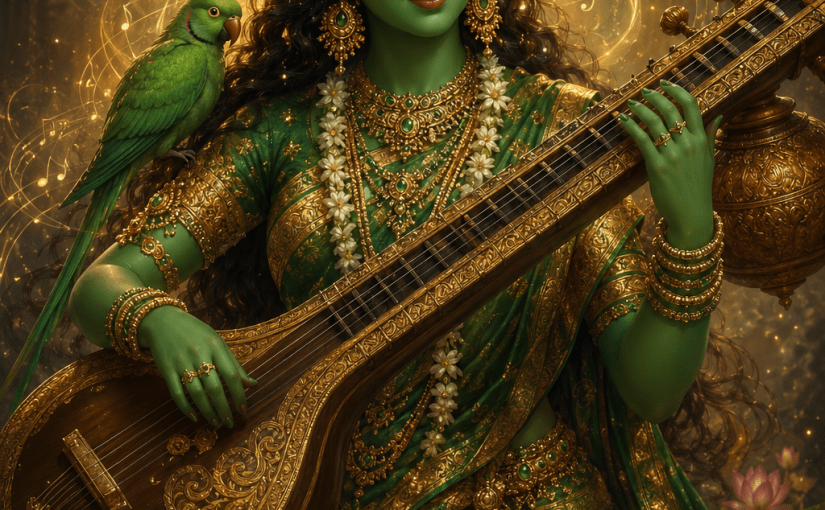
Years later, Guruji asked me to help clean up some audio recordings; Viraja Homam and Rashmi Mala Mantras, and add musical interludes to them. During that process, I heard chants and invocations to Matangi Devi. Something within me immediately responded. It did not feel like discovering someone new. It felt like remembering someone ancient and intimate.

I was irresistibly drawn to Her.

Life, of course, did not suddenly become free from difficulty. Like everyone else, I have experienced uncertainty, disappointments, emotional upheavals, and periods where the road ahead seemed unclear.

But through every rise and fall, my faith in the Divine Mother has remained unwavering.

And perhaps that is what motherhood truly represents.

Not perfection.
Not control.
But unconditional presence.

The ability to nurture life even while carrying one’s own burdens. The ability to comfort, protect, sacrifice, forgive, and continue loving despite exhaustion and pain. The world often celebrates power loudly, but the quiet strength of a mother sustains humanity itself.

Over time, I began to realize that the Mother I worshipped in temples and mantras was also present in the women around me — in their resilience, compassion, intuition, creativity, and immense capacity to give of themselves.

To all women, I say this with great reverence:

You are blessed to embody Her Shakti.

Whether you are raising children, caring for family, supporting others emotionally, creating beauty, healing hearts, or simply carrying love into a difficult world — you are expressing the Divine Feminine in ways both seen and unseen.

And even if you are not a biological mother, the nurturing principle still lives within you. The ability to create, protect, inspire, and nourish life is itself sacred.

What greater gift can there be?

On this Mother’s Day, I bow to the Divine Mother in all Her forms — and with gratitude remember my own mother, through whom I first experienced Her love.

Shree Matre Namaha.

Happy Mother’s Day to all.

Your House, Your Self: A Chill Take on Life and Beyond

Picture this: you’re standing in the middle of nowhere, just wide-open land stretching out forever. There’s mountains in the distance, a big ol’ sky above, and the ground under your feet. Birds are flapping around up high. Ants are doing their thing on the dirt. There’s some grass and bushes sprinkled around. It’s raw, it’s real, it’s just… there. So, you decide to build a house. You slap up four walls, fence off a chunk of this endless land, and call it yours. Inside, you add more walls—rooms, spaces, your own little world. Boom, it feels like your spot now, separate from all that wild stuff outside.

But here’s the thing about “owning” something—you get attached. Those birds? Their chirping starts to bug you. The ants? Suddenly they’re invaders creeping into your space. You shoo them out. Then, you lock the doors. Finally, you turn your house into a fortress to keep the outside world at bay.

Then one night, a massive thunderstorm rolls through. It’s loud, it’s scary, and it’s shaking your house like it’s made of toothpicks. You start freaking out, thinking, “What if this storm wrecks everything? My house, my space, my whole vibe—gone!” In that panic, you start imagining some big, powerful force that can save you. You call it God, give it a name, maybe even a face. You start tossing out prayers or offerings, like you’re paying for some cosmic insurance to keep your house standing.

Along comes someone else, claiming they’ve got the inside scoop on this God thing. They’re like, “Nah, you’re doing it wrong. I’m tighter with the Big Guy, so listen to me.” You are desperate to keep your house safe. You start trying to impress this person. You hope they’ll put in a good word for you.

But then another storm hits—bigger, badder. Your walls come crashing down, your rooms are toast, and you’re back standing in that same wide-open land. The birds are still flying, the ants are still marching, the grass is still swaying. It’s like nothing changed, but you feel different. Part of you recalls this entire cycle. It feels like déjà vu when you try to hold onto something that was never really yours.

And that’s when you start wondering: Was that space ever mine? Were those walls just a trick I played on myself? This is where things get kinda wild, because this whole setup is like a big metaphor for who we are.

Your House Is Your Body, the Land Is Your Mind

Think of the house as your body, the thing you’re walking around in every day. You build up this idea of “me”—your personality, your likes, your fears, your story. It’s like putting up walls to carve out a little “you” from the giant, endless consciousness that’s all around. Those walls are your skin, your thoughts, your beliefs, all the stuff that makes you feel like a separate person. Inside, you’ve got rooms—your job, your relationships, your dreams, all neatly organized.

The birds and ants? Those are the random thoughts, feelings, or distractions that pop up. They’re only annoying when you’re super attached to keeping your “house” just the way you like it. In the big picture, those thoughts and feelings are just part of the flow. They are like birds in the sky or ants on the ground.

The thunderstorm? That’s life’s way of reminding you nothing lasts forever—change, loss, even death. It shakes up your house, your body, your whole sense of “me.” Scared of losing it all, you turn to something bigger, like God, hoping it’ll keep you safe. You pray, you do rituals, whatever feels right. Then someone comes along saying they’ve got a direct line to that higher power. You follow them, thinking they’ve got the key to keeping your house standing.

But when the storm finally wipes it all out, you’re back in that wide-open land—that big, limitless consciousness. Your body is gone, your “me” fade, but that awareness, that land? It’s still there. It was never yours to own because, guess what? It’s what you are.

The Loop We Keep Living

This whole story is like a loop we’ve been running for ages. We build our houses—our bodies, our identities, our communities, our beliefs—trying to grab a piece of something infinite. We stress about keeping it safe. We pray to powers we hope will protect us. We listen to people who claim they’ve got the answers. But storms always come, and they always take down what we built.

That little memory you feel in the story? That’s your gut telling you this loop doesn’t have to keep going. You start asking: Was it ever mine? Is this “me” I’m so attached to even real? Is that big, endless consciousness something I’m just floating in, or is it actually me?

That’s when things start to shift. You realize the house isn’t a cage—it’s just a temporary setup, a way to experience this wild, infinite land. Your body, your “me,” your walls—they’re tools for living, not for owning. The birds, the ants, the storms? They’re not against you—they’re part of the same big picture you’re in.

Living Free and Easy

Living without clinging to the walls means chilling out in the big, open land without trying to fence it off. It’s about seeing your house—your body, your life—as this cool, temporary thing that’s awesome while it lasts. Let the birds chirp, let the ants march, let the storms roll through. They’re all part of you, like your thoughts and feelings.

You don’t have to ditch the house. Build it, love it, make it yours. Just don’t grip it so tight. When the storm comes, let it do its thing. When the walls fall, no big deal. You’re not just the house—you’re the land, the sky, the mountains, the whole dang scene.

And when you get that, you don’t need a God to save you. You don’t need some guru to show you the way. It’s just you and this big, beautiful, endless vibe—and you’re already right at home.