
For centuries, sages, saints, and that one uncle at weddings who insists he knows “the truth of everything” have been shouting in unison: shed the ego! According to them, the ego is the villain of the spiritual soap opera, the moustache-twirling bad guy who blocks us from enlightenment. One modern guru even turned it into a neat acronym: E.G.O = Edging God Out.
Sounds convincing, right? But here’s the twist: without the ego, you wouldn’t even know there was a truth to realize in the first place.
The Double Life of Ego
Think of ego like your neighborhood auto driver. On one day, he’s weaving dangerously through traffic, shouting at pedestrians, and playing film songs at full volume—annoying, loud, and best avoided. On another day, he’s the one who drops you exactly where you need to be, gives you change without grumbling, and even warns you about the pothole near the signal. Same guy, two different roles.
Ego works like that. If you identify it with your endless stream of random thoughts—“what’s for dinner?”, “does my WhatsApp DP look fat?”, “why hasn’t Netflix released Season 2 yet?”—then yes, ego is the troublemaker. But if you recognize ego as the quiet sense of “I am” that sits beneath all this noise, suddenly it becomes a signpost pointing straight toward Truth.
The Shopping Mall Analogy
Picture yourself in a shopping mall. Every shop window is blaring for attention: “Buy me! Eat me! Discount 50%!” These are your thoughts. Your ego, depending on how you use it, can do one of two things:
Chase the mannequins—run around from Zara to Apple Store to the food court, completely distracted.
Stand in the middle of the mall—aware that all these shops exist, but not compelled to enter. Just resting in the fact that you are present in the mall, not the stuff inside it.
One leads to exhaustion (and an empty wallet). The other leads to realization.
The Cosmic Stage Show
Think of life as a stage play. The thoughts, emotions, aches, and identities are like actors. The ego can either insist, “I’m the hero, the villain, the comedian, and also the audience—give me all the parts!” Or it can sit back as the stage itself—the screen upon which the entire drama plays.
It’s the same ego, but which way you flip it makes all the difference.
Why We Need Ego to Drop Ego
Here’s the paradox no one tells you: you need ego to even decide to shed ego. Who else is sitting there reading blogs about spirituality at 11:47 p.m. on a Tuesday? The “I” that seeks the Truth is still ego—but it’s the refined version, the ego that points beyond itself, like a GPS that tells you, “Recalculating route to Infinity.”
So maybe the sages weren’t wrong about letting go of ego. But until you use it to realize what’s beyond, dropping it too soon is like throwing away the car keys because you’re frustrated about potholes. The car’s still the way to get home.
Everyday Example: The Alarm Clock
Think of your alarm clock. It’s annoying, intrusive, and loud. You want to smash it against the wall every morning. But without it, you wouldn’t even wake up to know there is a morning. Ego’s the same. It wakes you up to the sense of “I am”—and from there, you get to see that you are more than the random noise of thoughts and identities.
In short: Ego isn’t the villain. It’s the slightly irritating but ultimately helpful character that gets you to the truth. Shed the noisy part, keep the “I am” part, and you might just find that what you thought was blocking God was really pointing to God all along.
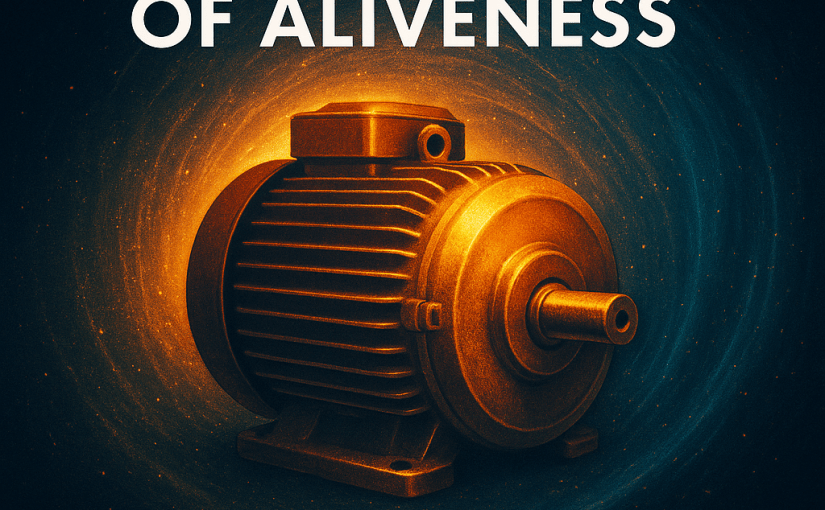
Have you ever walked past a giant generator or one of those industrial motors and felt it in your bones before you even heard it? That low, steady hum… reassuring, powerful, unbothered. It’s just there. Not shouting for attention, not needing to prove itself, but quietly powering the whole building.
That, my friend, is exactly what the sense of “aliveness” feels like.
We’re so used to identifying with thoughts—this endless parade of “should I…”, “what if…”, “oh no…”, “why me…”—that we forget there’s something far more fundamental buzzing underneath. A current that’s been running since before you knew your name, before you knew you had knees that creak when you get up too fast, before you had a list of worries that could rival a grocery bill.
The Dynamo Within
Sit still for a moment. Drop the drama. Forget the story of “you.” What’s left? A hum. Not metaphorical, but a very real sense that something is alive in you. Breathing, pulsing, steady as a ceiling fan in a summer power cut (when the current isn’t steady, you really notice!).
From that humming place, you’ll see your thoughts like little fireflies outside a streetlamp—pretty maybe, sometimes irritating, but clearly not the light itself. Even your precious “identity”—that carefully curated name, job title, Instagram bio—sits outside this hum. The aliveness doesn’t care if you’re CEO of the world or Chief Operator of the Remote Control. It just hums.
Aches, Pains, and Invincibility
Here’s the wild part: even the body’s complaints—sore shoulders, stiff back, that knee that behaves like it’s auditioning for a horror movie soundtrack—can be observed from here. You notice them, yes. But they’re not you. They’re like background noise in a café where the espresso machine hisses, chairs scrape, and the couple at the next table is arguing over pineapple on pizza. None of it stops the café from being a café.
And from here, strangely enough, there’s a feeling of invincibility. Not the Marvel superhero kind where you dodge bullets, but a deeper invincibility. Even mortality feels… well, slightly overrated. Because the hum doesn’t really start or stop—it just is.
Everyday Example: The Fridge
Think of your refrigerator. You don’t stand there all day listening for the motor. But if the hum stops, you immediately sense something’s wrong. Suddenly, all the thoughts appear: “Do I need to call the repair guy? Will my ice cream melt? How fast can I eat three tubs of Ben & Jerry’s?”
Our aliveness is like that fridge motor. It’s constant, reliable, and easily overlooked because it’s always there. But notice it, and suddenly the thoughts about melted ice cream (or anything else) are just noise outside that steady hum.
The Easy Part
Here’s the best news: nobody can deny being alive. This isn’t some mystical achievement reserved for monks in Himalayan caves. You’re alive, right now. The hum is running. Tuning into it doesn’t take effort—it takes not effort. Just notice.
The hard part? We forget. The easy part? We can remember again, any time.
So the next time you find yourself spiraling in thought or getting stuck in an ache, pause. Step back. Listen for the dynamo. That quiet, invincible hum of aliveness.
It’s been there all along, and unlike your fridge, you don’t need to call a repair guy.
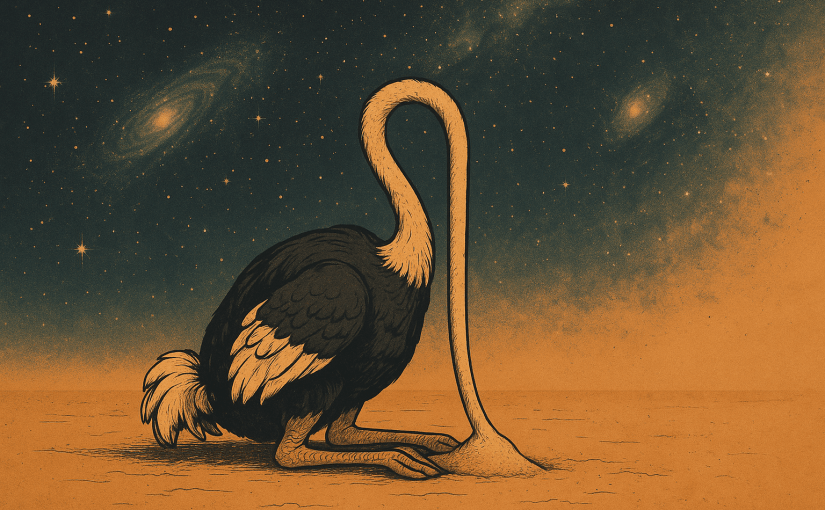
They say the ostrich buries its head in the sand to avoid danger.
That’s not true, of course — it’s a myth.
The ostrich does no such thing.
But if it did… ah, then we’d have a bird with a very promising career in philosophy.
Because the idea behind the myth — that shutting out the world makes it vanish — is actually a rather elegant pointer to one of the oldest truths in spiritual thought:
Everything you experience exists only in consciousness.
Sand as a Spiritual Tool
Let’s say you really were an ostrich (just for argument’s sake — no offence to your current species). You poke your head into the sand, and suddenly your vision is filled with warm, brown nothingness. No predators. No sky. No grass. No desert. The universe, for all practical purposes, is gone.
You didn’t destroy it — you just stopped perceiving it.
And here’s the big leap: the same is true for your waking life.
The so-called “objective world” is actually stitched together inside your mind. Without the light of consciousness shining on it, the whole grand spectacle collapses into… well, nothing.
The Sleep Experiment You’ve Been Running Every Night
This isn’t just poetic speculation. You prove it to yourself every single night.
When you slip into deep, dreamless sleep — that mysterious stage where there are no mental movies playing — the entire cosmos disappears. Not just your problems, not just your to-do list, but the Himalayas, the Pacific Ocean, the Milky Way — poof.
No you, no neighbour’s dog barking at 2 a.m., no neighbour either.
And yet, you wake up in the morning convinced the world “was there all along.”
But here’s the uncomfortable question: was it? Or is it that the world only exists when you are conscious of it?
Ancient Wisdom and Ostrich Wisdom
Philosophers from Advaita Vedanta to modern-day consciousness researchers have been politely trying to tell us the same thing: the “world” is an appearance in awareness, not an independent reality.
The ostrich myth, despite being zoologically false, has a certain charm here. If putting your head in the sand can make the predators vanish (from your point of view), isn’t that just the avian equivalent of closing your eyes in meditation? The outer scene fades, and you are left with the awareness that contains it all.
Why This Matters (Beyond Bird Comparisons)
If the universe only exists in consciousness, then our frantic attempts to “fix” the outside world before we’re happy might be a bit backwards.
Instead, we could turn inward and examine the one constant — the awareness in which all this appears.
That doesn’t mean you stop paying your bills or feeding the cat (even enlightened beings have to clean the litter box). But it does mean you stop clinging to the idea that the world is a fixed, external “thing” and start seeing it as a living, breathing projection in the cinema of your mind.
So the next time someone mocks the ostrich for “burying its head in the sand,” you might smile and think:
Maybe that ostrich isn’t avoiding reality.
Maybe it’s just contemplating the profound truth that without perception, the world as we know it… simply isn’t there.
And perhaps, like that mythical ostrich, we could all use a moment to put our heads down — not in sand, but in stillness — and watch the universe quietly dissolve back into the infinite awareness from which it came.
“Ghoonghat ke pat khol re, tohe piya milenge…” “Lift the veil, beloved — and you shall meet your Eternal Lover.”
The audio version of this blog
In a time divided by caste, creed, and the rigid formalities of religion, one voice emerged from the modest lanes of Kashi. It was not the voice of a scholar, nor of a priest, but that of a weaver — Kabir — whose threads joined the sacred and the everyday, the word and the Wordless.
More than 600 years have passed, and yet his voice rings louder than ever, reminding us of a simple, radical truth: the Divine is within you.
The Weaver and the World: Who Was Kabir?
Born in the 15th century — likely to a Muslim family of the Julaha (weaver) caste — Kabir remains an enigma. Legends say he was found as an infant near a pond in Varanasi and raised by a Muslim couple. Others say he was initiated by the Hindu saint Ramananda. Kabir himself defied labels, calling neither mosque nor temple his home. His religion? Love.
He made his living weaving cloth, but his true vocation was to weave unity across the fragmented landscape of Indian society. Through verses that were sharp, wise, and filled with mystical longing, Kabir sang not about a distant God, but about the Beloved who dwells within the breath.
🎧 Featured Song: “Ghoonghat ke Pat Khol Re” – A Cry of Awakening
In this iconic verse, Kabir speaks directly to the seeker. He says:
“The veil is not on your face, but on your mind. Remove it — and you will see what has always been.”
The word “ghoonghat” refers to the traditional veil worn by women in northern India. But in Kabir’s poetry, it becomes a symbol — of illusion (maya), of ignorance, of the false belief that the Divine is outside us.
🕊️ Kabir’s Core Teachings: Simple, but Not Easy
1. God Has No Religion
Kabir rejected the labels of Hindu and Muslim, choosing instead to follow sahaj path — the path of naturalness and simplicity.
“Allah and Ram are different words, but the One behind them is the same.”
2. Ritual Without Love Is Empty
He poked fun at rituals if they lacked bhakti — heartfelt devotion.
“You went to the temple, rang the bell. But did you ring the bell of your own soul?”
3. The Guru Is the Boat Across the Ocean
Kabir revered the Satguru — the true teacher — as one who can destroy illusion and show the path inward.
“The Guru is greater than God, for he shows you the path to the Divine within.”
4. Live Fully Awake
To Kabir, the real sin was spiritual sleep — not living consciously.
“Kabir soya kya kare, jo jagay so mare. Jo mare so ubrejay, jaga hua kya dare?”
“Why sleep through life? The awakened never fear death.”
🌍 Why Kabir Matters Today
He offers direct experience over dogma.
He affirms that awakening is possible right now.
His poetry is alive across traditions: sung by Sufis, Bhaktas, Bauls, and yogis.
Kabir is not a historical figure to be studied — he is a fire to be caught.
❤️ Kabir’s Love: Fierce, Fiery, and Free
Kabir’s relationship with the Divine was intimate, raw, and immediate. He didn’t seek salvation — he sought the Beloved, not in another world, but in every breath.
“Moko kahan dhoonde re bande, Main to tere paas mein…” “Where are you searching for Me, dear one? I am right next to you. In you.”
🪔 Conclusion: Lift the Veil
To read Kabir is to be challenged. To sing Kabir is to be cleansed. To live Kabir is to tear away the veil and meet the Beloved — not in heaven, but in silence, in song, in surrender.
So once more, close your eyes. Listen:
May Kabir’s voice echo within your soul — until the veil lifts, and the One is seen.
Look at a tree. Any tree. Don’t label it. Don’t call it beautiful, ugly, or a neem tree near uncle’s house. Just… see it.
You’ll notice something strange.
For a fleeting second, there’s only tree. Not your memory of a tree, not your opinion of it, not even you looking at it. Just… tree.
Now imagine living like that, always. That, my friend, is what some call liberation.
The Problem with “Me” (And All Its Cousins)
Your mind is like a chatty radio host who won’t take a breath.
“I like this.”
“I hate that.”
“This reminds me of that summer in Goa.”
“This cow looks tired.”
But who’s this “I”?
J. Krishnamurti once said:
“The observer is the observed.”
It’s not a riddle. It means when you say, “I am anxious,” you’ve created a false duality. In truth, there’s just anxiety—no owner required. The moment you label it as yours, you’ve claimed it like a Netflix account.
Liberation Isn’t a Mountaintop, It’s a Mute Button
Non-duality teachers say it beautifully.
Rupert Spira reminds us:
“The belief in a separate self is like imagining a wave is separate from the ocean.”
Mooji says, with a grin:
“Don’t take your thoughts so seriously. They’re not paying rent.”
When we drop our constant labeling—our me, mine, my—we return to what just is.
A cow grazing becomes just… cow. Not a “lazy cow” or “my cow.” Just cow. And in that seeing, you’re free.
A Little Practice (But Not a Method, Please)
Krishnamurti hated methods. But here’s a loose suggestion:
Just observe.
Don’t label.
Don’t claim.
Don’t objectify.
It’s not about doing something. It’s about stopping the habit of always being someone.
In Conclusion: Leave Your “I.D.” at the Door
You don’t have to meditate in the Himalayas or chant your way to freedom.
Hey everyone, great hanging out with you all in the comments on yesterday’s post! It seems like the idea of our life resonated with quite a few of you. Our body, roles, and even our thoughts are kinda like a temporary house we inhabit. We talked about keeping a “chill take” on it all. We shouldn’t get too attached to the structure or the furniture. It’s all part of the journey.
But that naturally leads to the next big question, doesn’t it? If all that stuff is the “house”… then who is the ‘I’ that’s actually living inside it? Who is experiencing the leaky faucets, the sunny rooms, the whole deal?
Today, let’s explore that resident. Here’s a heads-up. We will share some cool old ideas from ancient wisdom. These will help us unpack it. Stay chill, though – it’s all part of the adventure!
Meet the Busy ‘Resident Manager’ (Ahamkara)
Think about who runs the show in your “house” day-to-day. There’s this constant sense of ‘me’ that seems to be in charge, right? It worries about upkeep, feels proud of the decor, gets annoyed when things aren’t perfect. Ancient Indian thought has a name for this busy manager: अहंकार (Ahamkara).
अहंकार (Ahamkara): Remember this one? We touched on it briefly. It literally means the “I-maker.” It’s the role within us. It creates the strong feeling of being a separate individual. It makes us feel like the one who owns the house and everything linked to it.
This Ahamkara isn’t just aware that the house exists. It identifies as the house manager. Sometimes it even thinks it is the house! It’s the voice saying:
“This is MY room!” (My opinion, my beliefs)
“Don’t scratch MY floors!” (My feelings got hurt)
“Look at MY beautiful garden!” (My accomplishments, my status)
“I need to fix that leaky faucet!” (My problems, my worries)
It’s the part of us that feels fundamentally separate and often quite stressed about managing this whole “house” situation.
Asking the Landlord (Koham?)
But is this busy, often stressed-out resident manager the actual owner of the property? Or just… the manager? This is where a fascinating practice comes in, highlighted by the sage Sri Ramana Maharshi. He suggested a change in approach. Instead of just listening to the manager’s constant chatter and anxieties, we should try to find the real source. We should seek the ultimate “landlord” by asking: “Who Am I?“
In Sanskrit: कोऽहम्? (Koham?).
कोऽहम्? (Koham?): “Who Am I?”
This isn’t about the manager giving their job title (“I am the manager,” “I am a parent,” “I am successful”). It’s about tracing that ‘I’ feeling itself back to its origin. When the manager (Ahamkara) starts freaking out – “I am overwhelmed!” “I need this!” “I hate that noise!” – the practice is to gently inquire inwardly: “Okay, who is this ‘I’ that’s feeling overwhelmed? Where does this ‘I’ actually come from?”
Ramana suggested this inquiry is incredibly powerful. Why? Because it bypasses the manager and looks for the silent owner. Finding that source, he said, is the key to real peace. It stands in contrast to the constant low-grade stress of just managing the house. He stated something profound: “The inquiry ‘Who am I?’ is the principal means to the removal of all misery and the attainment of the supreme bliss.”
Hook: Imagine being capable of quieting the frantic manager by simply looking for the calm, underlying owner! What happens if we stop taking the manager’s word for everything and investigate the source?
All This “My House, My Stuff” Stress
Let’s be real, being the resident manager (Ahamkara) is stressful! Much of our daily anxiety comes from clinging to the “house.” It also comes from defending everything we’ve labeled “mine” inside it.
Worrying about the house’s appearance (“my reputation,” “my image”).
Getting angry when someone parks in “my driveway” or disrespects “my space.”
Feeling anxious about the house’s future (“my job security,” “my health,” “my retirement”).
Comparing “my house” to the neighbor’s bigger, fancier one.
Sound familiar? The Ahamkara is hard at work. It identifies completely with the house and its contents. It is convinced that its own well-being depends entirely on the state of the property.
Hook: Think about your day so far. Whether you are right here in your town or somewhere else, think about the energy you use. You are managing aspects of “your house.” Consider on how much you defend or worry about the things you call “mine.”
When the Manager Sleeps & The Empty House (Awareness/Atman)
Now, here’s where it gets really interesting, connecting back to our “chill take” from yesterday. How permanent, how solid, is this resident manager (Ahamkara)?
Consider deep, dreamless sleep. The house (your body) is still there, resting. But where did the manager go? That distinct feeling of “I am managing this life” completely vanishes. Poof! The office is empty. This shows the Ahamkara needs certain conditions – like the waking state or even a dream state – to function.
And dreams? The manager rebuilds a whole dream house and runs around managing that! This highlights that the manager is more like a role being played than a permanent fixture.
If the manager can just disappear every night, they can’t be the fundamental reality, right? They are transient, dependent. And what about the house itself (the body)? Does a brick know it’s a brick? Does the house feel its own existence? No. Like we said yesterday, the house is just the structure. It needs something else to be known, to be experienced.
So, if the manager comes and goes, and the house itself is just structure, what is constant?
It seems to be awareness itself. The silent, unchanging space in which the house exists. The fundamental knowing that perceives the house, the manager, the thoughts, the feelings, everything. This ever-present, underlying reality, the true Self, has a name in Sanskrit: आत्मन् (Atman).
आत्मन् (Atman): The Self (with a capital S). Think of it as the silent, true owner of the property. It is like the very ground and space the house is built upon. It is pure, witnessing consciousness.
The nature of this Atman, this fundamental reality, is often described as सच्चिदानन्द (Sat-Chit-Ananda).
सच्चिदानन्द (Sat-Chit-Ananda): Existence-Consciousness-Bliss. It suggests that the very nature of this underlying awareness or space is pure being. It is pure knowing. It embodies inherent, causeless peace or joy.
Who Feels the Drafts and Sunshine? (Feelings)
Okay, so if we are fundamentally this peaceful awareness (Atman), why do we feel bothered by drafts (pain, sadness) or delighted by sunshine (pleasure, joy) in the house?
Maybe it happens like this: Awareness (Atman, the space/owner) perceives sensations related to the house (a cold draft, warm sunshine). The busy resident manager (Ahamkara) immediately rushes over, identifies with the sensation, and declares, “I am cold!” or “I love this sunny spot!” It claims ownership of the experience happening within the aware space via the house’s condition.
This reframes our feelings. They aren’t necessarily who we are. They are like weather conditions affecting the house. The underlying awareness (Atman) perceives them. Then, the temporary manager (Ahamkara) loudly claims and reacts to them.
Seeing this helps us follow Ramana’s advice: “There is no need to get rid of the wrong ‘I’ [Ahamkara/manager]. All that is required is to find out the source of the ‘I’ and abide in it.” We move away from reacting frantically like the manager. Instead, we rest as the calm, aware space or owner that perceives everything.
Living Lighter in the House
So, where does this leave us? Yesterday, we talked about the house. Today, we’ve explored the difference between the busy, stressed manager (Ahamkara) who thinks they are the house. The silent, aware space/owner (Atman) is our true foundation.
The manager comes and goes. Its attachment to “my house, my stuff” causes stress. But the underlying awareness is constant, peaceful by nature. Practices like asking “Who Am I?” help us see past the manager and connect with that deeper reality.
This doesn’t mean we neglect the house! We still take care of our bodies, our lives, our responsibilities. But we can do it with a lighter touch, with that “chill take” we talked about. We know we are fundamentally the spacious awareness. We are not just the temporary house or its frantic manager. These insights allow us to navigate the inevitable leaks. They help us enjoy the sunshine with more ease and a lot more peace.
It’s an ongoing exploration, not a final answer. What does this “resident manager” vs. “silent owner” idea spark for you? Does it change how you view the ‘I’ living in your ‘house’? Share your thoughts below – always great to learn together!
Picture this: you’re standing in the middle of nowhere, just wide-open land stretching out forever. There’s mountains in the distance, a big ol’ sky above, and the ground under your feet. Birds are flapping around up high. Ants are doing their thing on the dirt. There’s some grass and bushes sprinkled around. It’s raw, it’s real, it’s just… there. So, you decide to build a house. You slap up four walls, fence off a chunk of this endless land, and call it yours. Inside, you add more walls—rooms, spaces, your own little world. Boom, it feels like your spot now, separate from all that wild stuff outside.
But here’s the thing about “owning” something—you get attached. Those birds? Their chirping starts to bug you. The ants? Suddenly they’re invaders creeping into your space. You shoo them out. Then, you lock the doors. Finally, you turn your house into a fortress to keep the outside world at bay.
Then one night, a massive thunderstorm rolls through. It’s loud, it’s scary, and it’s shaking your house like it’s made of toothpicks. You start freaking out, thinking, “What if this storm wrecks everything? My house, my space, my whole vibe—gone!” In that panic, you start imagining some big, powerful force that can save you. You call it God, give it a name, maybe even a face. You start tossing out prayers or offerings, like you’re paying for some cosmic insurance to keep your house standing.
Along comes someone else, claiming they’ve got the inside scoop on this God thing. They’re like, “Nah, you’re doing it wrong. I’m tighter with the Big Guy, so listen to me.” You are desperate to keep your house safe. You start trying to impress this person. You hope they’ll put in a good word for you.
But then another storm hits—bigger, badder. Your walls come crashing down, your rooms are toast, and you’re back standing in that same wide-open land. The birds are still flying, the ants are still marching, the grass is still swaying. It’s like nothing changed, but you feel different. Part of you recalls this entire cycle. It feels like déjà vu when you try to hold onto something that was never really yours.
And that’s when you start wondering: Was that space ever mine? Were those walls just a trick I played on myself? This is where things get kinda wild, because this whole setup is like a big metaphor for who we are.
Your House Is Your Body, the Land Is Your Mind
Think of the house as your body, the thing you’re walking around in every day. You build up this idea of “me”—your personality, your likes, your fears, your story. It’s like putting up walls to carve out a little “you” from the giant, endless consciousness that’s all around. Those walls are your skin, your thoughts, your beliefs, all the stuff that makes you feel like a separate person. Inside, you’ve got rooms—your job, your relationships, your dreams, all neatly organized.
The birds and ants? Those are the random thoughts, feelings, or distractions that pop up. They’re only annoying when you’re super attached to keeping your “house” just the way you like it. In the big picture, those thoughts and feelings are just part of the flow. They are like birds in the sky or ants on the ground.
The thunderstorm? That’s life’s way of reminding you nothing lasts forever—change, loss, even death. It shakes up your house, your body, your whole sense of “me.” Scared of losing it all, you turn to something bigger, like God, hoping it’ll keep you safe. You pray, you do rituals, whatever feels right. Then someone comes along saying they’ve got a direct line to that higher power. You follow them, thinking they’ve got the key to keeping your house standing.
But when the storm finally wipes it all out, you’re back in that wide-open land—that big, limitless consciousness. Your body is gone, your “me” fade, but that awareness, that land? It’s still there. It was never yours to own because, guess what? It’s what you are.
The Loop We Keep Living
This whole story is like a loop we’ve been running for ages. We build our houses—our bodies, our identities, our communities, our beliefs—trying to grab a piece of something infinite. We stress about keeping it safe. We pray to powers we hope will protect us. We listen to people who claim they’ve got the answers. But storms always come, and they always take down what we built.
That little memory you feel in the story? That’s your gut telling you this loop doesn’t have to keep going. You start asking: Was it ever mine? Is this “me” I’m so attached to even real? Is that big, endless consciousness something I’m just floating in, or is it actually me?
That’s when things start to shift. You realize the house isn’t a cage—it’s just a temporary setup, a way to experience this wild, infinite land. Your body, your “me,” your walls—they’re tools for living, not for owning. The birds, the ants, the storms? They’re not against you—they’re part of the same big picture you’re in.
Living Free and Easy
Living without clinging to the walls means chilling out in the big, open land without trying to fence it off. It’s about seeing your house—your body, your life—as this cool, temporary thing that’s awesome while it lasts. Let the birds chirp, let the ants march, let the storms roll through. They’re all part of you, like your thoughts and feelings.
You don’t have to ditch the house. Build it, love it, make it yours. Just don’t grip it so tight. When the storm comes, let it do its thing. When the walls fall, no big deal. You’re not just the house—you’re the land, the sky, the mountains, the whole dang scene.
And when you get that, you don’t need a God to save you. You don’t need some guru to show you the way. It’s just you and this big, beautiful, endless vibe—and you’re already right at home.
In the cosmic dance of creation, Shiva and Shakti whirl in an eternal embrace, their energies shaping the universe. But what if we told you that this divine duo has a surprisingly modern parallel in the world of technology? Buckle up, dear readers, because we’re about to take a wild ride from the Himalayas to Silicon Valley—where ancient philosophy meets the digital age. Today, we’re exploring the theory that Shiva is potential energy and Shakti is kinetic energy, and whether this idea extends to the relationship between computers and software. Spoiler alert: it’s more connected than you might think.
Shiva: The Stillness of Potential Energy
Shiva, the great yogi, sits in deep meditation, embodying stillness and quiet power. He’s like a coiled spring, full of energy just waiting to be unleashed. In physics, potential energy is the stored energy an object holds due to its position or state—like a boulder perched on a cliff, ready to roll. Similarly, Shiva represents the universe’s unmanifested potential, the quiet force behind all that is yet to be.
In Hindu philosophy, Shiva is often described as the static, unchanging consciousness—the silent witness to the world’s unfolding. He’s the ultimate introvert, content to sit in blissful detachment, holding infinite possibilities within. But here’s the catch: without a nudge, that potential remains just that—potential. Enter Shakti.
Shakti: The Dance of Kinetic Energy
Shakti, the divine feminine, is the force that brings Shiva’s stillness to life. She’s movement, action, and transformation—the kinetic energy that turns potential into reality. In physics, kinetic energy is the energy of motion, like that boulder finally tumbling down the hill, unstoppable and full of force. In the same way, Shakti is the dynamic power that creates, sustains, and (when necessary) destroys.
Imagine Shiva without Shakti—he’d probably just sit there, deep in meditation. Shakti is the spark, the activator, the one who says, “Alright, enough meditating—let’s make something happen!” Together, their union is the perfect balance of stillness and motion, potential and action.
Is This Idea Correct?
So, does the idea of Shiva as potential energy and Shakti as kinetic energy hold water? Metaphorically speaking, yes—it’s a brilliant fit. Ancient Hindu texts don’t use the language of physics, but the philosophical essence aligns beautifully. Shiva’s stillness mirrors the latent power of potential energy, while Shakti’s vibrancy captures the essence of kinetic energy in action. It’s not a scientific definition straight out of the Vedas, but rather a poetic interpretation that bridges ancient wisdom with modern concepts. And honestly, it’s too cool an idea not to run with.
Computers and Software: A Technological Parallel?
Now, let’s teleport to the 21st century and test this analogy in the tech world. Picture your computer. The hardware—the motherboard, processor, RAM—is like Shiva. It’s the static platform, the potential waiting to be harnessed. Without software, it’s just a hunk of metal and silicon, much like Shiva in deep meditation, unmoved and unmanifested. It looks impressive, but it doesn’t do much—like a really expensive paperweight.
Software, on the other hand, is Shakti. It’s the code that breathes life into the hardware, making it perform tasks, run applications, and connect us to the digital world. Just as Shakti activates Shiva’s potential, software activates the computer’s capabilities. It’s the kinetic force that turns a dormant machine into a powerhouse of productivity (or, let’s be honest, endless cat videos).
Does this correspondence work? Absolutely. The computer hardware sits there, full of potential, but it’s the software that puts it into motion—creating, calculating, and sometimes crashing (because even Shakti has her chaotic days). In the tech world, we even have our own version of festivals celebrating this union—think software launches and tech expos, where the latest programs and apps are unveiled, bringing new life to our devices. It’s like a digital Maha Shivaratri, minus the incense and chanting (though, hey, maybe that’s next).
A Dash of Quantum Spice
For those who like their philosophy with a side of science, here’s a bonus: some modern thinkers link Shiva and Shakti to quantum physics. Shiva’s dance, the Tandava, is sometimes compared to the unpredictable, wave-like behavior of subatomic particles—pure potential until observed. Shakti, then, could be seen as the force that collapses that potential into reality. It’s a heady mix of mythology and quantum mechanics, but it adds a fascinating layer to the analogy. (Just don’t ask me to explain Schrödinger’s cat in Sanskrit.)
Conclusion: The Dance Continues
Next time you boot up your computer, think of it as a mini-cosmic dance. The hardware, your Shiva, holds the potential, while the software, your Shakti, brings it to life. The idea of Shiva as potential energy and Shakti as kinetic energy isn’t just correct in a metaphorical sense—it’s a lens that reveals harmony between ancient spirituality and modern technology. It’s a reminder that even in our digital age, the timeless wisdom of balance between stillness and action still holds true.
So, what do you think? Does this analogy resonate with you? Or do you have your own spin on how Shiva and Shakti play out in the tech world? Drop your thoughts in the comments below—let’s keep the dance going!
Disclaimer:
This blog post is written with deep respect for the sacred nature of Shiva and Shakti, revered figures in Hindu mythology symbolizing consciousness and energy. There is no intention to trivialize or diminish their profound spiritual significance. The modern language, contemporary references, and choice of words used here are solely intended to make the content relevant and relatable to today’s readers. By connecting timeless wisdom to the present day, we aim to engage and inspire curiosity about these ancient concepts in a way that resonates with modern times.
We hope readers will see this as a respectful effort to bring the essence of Shiva and Shakti into a current context, fostering understanding and appreciation without altering their divine importance.
If you’ve ever wondered what the essence of Advaita Vedanta is but don’t have the patience to wade through dense scriptures, then Ribhu Gita is your new best friend. Think of it as the “CliffsNotes” version of enlightenment—direct, no-nonsense, and straight to the point. Even Bhagavan Ramana Maharishi himself held it in the highest regard, specifically recommending Chapter 26 as the essence of Self-Realization.
Now, if Ramana Maharishi tells you something is the most important, you pay attention. So, let’s unpack Chapter 26 of the Ribhu Gita in simple, everyday terms—without getting lost in Sanskrit knots.
Wait… What’s the Ribhu Gita Again?
The Ribhu Gita is part of the larger Shiva Rahasya and is essentially a one-way conversation (the best kind of conversation, some might say) where Sage Ribhu teaches his disciple Nidagha the highest truth: You are already Brahman. You are already free. Now stop complicating things.
That’s it. That’s the whole message. But, of course, humans love overthinking, so Ribhu repeats it in about 2,000 verses just to make sure we get the point.
Liberation: A Spiritual Autobiography by Av Neryah is a transformative journey into nondual awakening, blending personal experiences with profound spiritual insights. This compelling memoir serves as both an intimate revelation and a guide for seekers on the path to enlightenment. If you purchase through this link, I earn a small commission at no extra cost to you: Amazon Link.
Chapter 26: The Grand Reveal (Or the Cosmic “Aha!” Moment)
Ramana Maharishi loved Chapter 26 because it’s the ultimate distillation of Advaita Vedanta—it doesn’t bother with rituals, methods, or long philosophical debates. It just drops the truth bomb right in your lap:
✅ You are Brahman.
✅ There is no world, no ego, no suffering—only pure Awareness.
✅ Stop pretending to be anything else.
It’s like when you wake up from a dream where you were being chased by a giant talking banana. The moment you wake up, you instantly know it was all just a dream. You don’t sit around debating whether the banana was real. Similarly, the Ribhu Gita tells you that this waking world is just another illusion—and once you realize that, all your so-called “problems” vanish like morning mist.
Breaking It Down: Ribhu’s Wisdom for the Modern Mind
1. “I am Brahman” – The Ultimate Identity Crisis
Imagine you’re an actor playing a role in a movie. You get so caught up in the character that you forget you’re actually just an actor. Ribhu shakes you awake and says: “Hey, you’re not the role, you’re the pure Awareness behind it all!”
2. “Nothing Ever Happened” – The Cosmic Undo Button
If Brahman is all there is, then whatever we think of as “problems” never really happened in the first place. It’s like getting emotionally involved in a soap opera, only to remember—wait, this is just TV!
3. “Don’t Meditate. Just BE.”
The Ribhu Gita doesn’t ask you to sit in a cave for years chanting mantras (though if you want to, go ahead). Instead, it says, realize you are already That. You don’t become Brahman—you already are. No effort required. It’s like realizing you were wearing your glasses on your head the whole time.
Why This Chapter Matters (And Why You Should Care)
Ramana Maharishi didn’t just love Chapter 26—he recommended chanting it repeatedly until the truth seeps into your bones. Why? Because the human mind is stubborn. It keeps wanting to “do” something to get enlightened. Ribhu says, “Nope, you’re already there. Just realize it!”
So, next time you catch yourself overthinking life, relationships, money, or why WiFi signals are always terrible when you need them most—pause, breathe, and remind yourself:
“I am Brahman. Nothing has ever happened. It’s all good.”
And just like that, the grand cosmic joke is revealed.
Final Thought: If Ribhu Gita were a person, it would be that brutally honest friend who refuses to indulge your drama. Instead of comforting you, they just say, “Dude, wake up. None of this is real.”
And you know what? That’s exactly the kind of tough love we all need.
What do you think? Ready to wake up from the dream? Drop a comment below, unless of course, you’ve already dissolved into pure Awareness. 😆
One of the most fascinating questions in spirituality is whether we create our own reality or whether everything is already predetermined. On one hand, Neville Goddard’s Law of Manifestation tells us that we can manifest anything we desire by assuming the feeling of already having it. On the other, Ramana Maharshi teaches that everything is dictated by destiny and that trying to change our fate is futile.
At first glance, these two views seem contradictory. If everything is already written, then what is the point of manifesting? But if manifestation truly works, does that mean fate is not real? Let’s explore both perspectives and see if they can actually be reconciled.
Neville Goddard: You Are the Creator of Your Reality
Neville Goddard’s teachings emphasize that imagination is the divine creative force. He believed that by living as if our desires are already fulfilled, we bring them into reality. According to this view, our external world is simply a reflection of our internal state. The universe responds to our feelings and beliefs, making manifestation a conscious and deliberate process.
For example, if you believe and feel that you are already successful, the world will eventually mirror that belief. The key is to fully embody the state of having what you desire, without doubt or resistance.
Ramana Maharshi: Surrender to the Divine and Accept Destiny
Ramana Maharshi, one of India’s greatest sages, had a completely different approach. He often spoke about prarabdha karma (the karma that unfolds in one’s lifetime) and how everything is predetermined by the divine will. From this perspective, trying to change our external reality through personal effort is meaningless because what is meant to happen will happen, no matter what.
Ramana advocated the path of self-inquiry (Who am I?), urging seekers to transcend their sense of individuality and surrender to the higher Self. Instead of chasing desires, he encouraged us to dissolve the ego and recognize that the true Self is beyond manifestation and destiny alike.
How Can These Two Views Coexist?
At first, it seems impossible to reconcile these two perspectives, but a deeper look reveals a potential harmony:
Manifestation and Destiny Can Be Two Sides of the Same Coin
What we desire and try to manifest may itself be part of our predetermined path. If something is meant for us, we may naturally feel drawn to it and manifest it with ease.
If something is truly not in our destiny, we may struggle no matter how much we try to manifest it.
Inner vs. Outer Reality
Neville’s teachings help us navigate and shape our external world through belief and feeling.
Ramana’s wisdom teaches us to go beyond the external world and recognize the deeper reality where nothing needs to be manifested because we already are complete.
The Role of Self-Realization
Neville’s approach is useful when operating as an individual in the world, helping us improve our life circumstances.
Ramana’s path leads to the dissolution of the ego itself, where the concepts of manifestation and destiny dissolve into the eternal truth.
So, Which One is True?
The answer depends on how we see ourselves:
If we see ourselves as individuals navigating life, manifestation seems real and powerful.
If we seek ultimate truth, Ramana’s teaching shows that everything, including manifestation, is just part of the greater play of consciousness.
Perhaps the best approach is to blend both perspectives: ✨ Use Neville’s teachings to create a fulfilling life in the material world. 🕉 Follow Ramana’s wisdom to transcend attachment and accept life as it unfolds.
Both paths lead to greater awareness—one through creation, the other through surrender. The choice, perhaps, is also part of destiny!
What do you think? Have you experienced moments where manifestation worked? Or do you feel that life unfolds as per destiny no matter what?