Kabir: The Weaver of the Infinite, and the Song of the Inner Beloved

“Ghoonghat ke pat khol re, tohe piya milenge…”
“Lift the veil, beloved — and you shall meet your Eternal Lover.”

The audio version of this blog

In a time divided by caste, creed, and the rigid formalities of religion, one voice emerged from the modest lanes of Kashi. It was not the voice of a scholar, nor of a priest, but that of a weaver — Kabir — whose threads joined the sacred and the everyday, the word and the Wordless.

More than 600 years have passed, and yet his voice rings louder than ever, reminding us of a simple, radical truth: the Divine is within you.

The Weaver and the World: Who Was Kabir?

Born in the 15th century — likely to a Muslim family of the Julaha (weaver) caste — Kabir remains an enigma. Legends say he was found as an infant near a pond in Varanasi and raised by a Muslim couple. Others say he was initiated by the Hindu saint Ramananda. Kabir himself defied labels, calling neither mosque nor temple his home. His religion? Love.

He made his living weaving cloth, but his true vocation was to weave unity across the fragmented landscape of Indian society. Through verses that were sharp, wise, and filled with mystical longing, Kabir sang not about a distant God, but about the Beloved who dwells within the breath.

🎧 Featured Song: “Ghoonghat ke Pat Khol Re” – A Cry of Awakening

In this iconic verse, Kabir speaks directly to the seeker. He says:

“The veil is not on your face, but on your mind.
Remove it — and you will see what has always been.”

The word “ghoonghat” refers to the traditional veil worn by women in northern India. But in Kabir’s poetry, it becomes a symbol — of illusion (maya), of ignorance, of the false belief that the Divine is outside us.

🕊️ Kabir’s Core Teachings: Simple, but Not Easy

1. God Has No Religion

Kabir rejected the labels of Hindu and Muslim, choosing instead to follow sahaj path — the path of naturalness and simplicity.

“Allah and Ram are different words,
but the One behind them is the same.”

2. Ritual Without Love Is Empty

He poked fun at rituals if they lacked bhakti — heartfelt devotion.

“You went to the temple, rang the bell.
But did you ring the bell of your own soul?”

3. The Guru Is the Boat Across the Ocean

Kabir revered the Satguru — the true teacher — as one who can destroy illusion and show the path inward.

“The Guru is greater than God,
for he shows you the path to the Divine within.”

4. Live Fully Awake

To Kabir, the real sin was spiritual sleep — not living consciously.

“Kabir soya kya kare, jo jagay so mare.
Jo mare so ubrejay, jaga hua kya dare?”

“Why sleep through life?
The awakened never fear death.”

🌍 Why Kabir Matters Today

  • He offers direct experience over dogma.
  • He affirms that awakening is possible right now.
  • His poetry is alive across traditions: sung by Sufis, Bhaktas, Bauls, and yogis.

Kabir is not a historical figure to be studied — he is a fire to be caught.

❤️ Kabir’s Love: Fierce, Fiery, and Free

Kabir’s relationship with the Divine was intimate, raw, and immediate. He didn’t seek salvation — he sought the Beloved, not in another world, but in every breath.

“Moko kahan dhoonde re bande,
Main to tere paas mein…”

“Where are you searching for Me, dear one?
I am right next to you. In you.”

🪔 Conclusion: Lift the Veil

To read Kabir is to be challenged. To sing Kabir is to be cleansed. To live Kabir is to tear away the veil and meet the Beloved — not in heaven, but in silence, in song, in surrender.

So once more, close your eyes. Listen:

May Kabir’s voice echo within your soul — until the veil lifts, and the One is seen.

Your House, Your Self: A Chill Take on Life and Beyond

Picture this: you’re standing in the middle of nowhere, just wide-open land stretching out forever. There’s mountains in the distance, a big ol’ sky above, and the ground under your feet. Birds are flapping around up high. Ants are doing their thing on the dirt. There’s some grass and bushes sprinkled around. It’s raw, it’s real, it’s just… there. So, you decide to build a house. You slap up four walls, fence off a chunk of this endless land, and call it yours. Inside, you add more walls—rooms, spaces, your own little world. Boom, it feels like your spot now, separate from all that wild stuff outside.

But here’s the thing about “owning” something—you get attached. Those birds? Their chirping starts to bug you. The ants? Suddenly they’re invaders creeping into your space. You shoo them out. Then, you lock the doors. Finally, you turn your house into a fortress to keep the outside world at bay.

Then one night, a massive thunderstorm rolls through. It’s loud, it’s scary, and it’s shaking your house like it’s made of toothpicks. You start freaking out, thinking, “What if this storm wrecks everything? My house, my space, my whole vibe—gone!” In that panic, you start imagining some big, powerful force that can save you. You call it God, give it a name, maybe even a face. You start tossing out prayers or offerings, like you’re paying for some cosmic insurance to keep your house standing.

Along comes someone else, claiming they’ve got the inside scoop on this God thing. They’re like, “Nah, you’re doing it wrong. I’m tighter with the Big Guy, so listen to me.” You are desperate to keep your house safe. You start trying to impress this person. You hope they’ll put in a good word for you.

But then another storm hits—bigger, badder. Your walls come crashing down, your rooms are toast, and you’re back standing in that same wide-open land. The birds are still flying, the ants are still marching, the grass is still swaying. It’s like nothing changed, but you feel different. Part of you recalls this entire cycle. It feels like déjà vu when you try to hold onto something that was never really yours.

And that’s when you start wondering: Was that space ever mine? Were those walls just a trick I played on myself? This is where things get kinda wild, because this whole setup is like a big metaphor for who we are.

Your House Is Your Body, the Land Is Your Mind

Think of the house as your body, the thing you’re walking around in every day. You build up this idea of “me”—your personality, your likes, your fears, your story. It’s like putting up walls to carve out a little “you” from the giant, endless consciousness that’s all around. Those walls are your skin, your thoughts, your beliefs, all the stuff that makes you feel like a separate person. Inside, you’ve got rooms—your job, your relationships, your dreams, all neatly organized.

The birds and ants? Those are the random thoughts, feelings, or distractions that pop up. They’re only annoying when you’re super attached to keeping your “house” just the way you like it. In the big picture, those thoughts and feelings are just part of the flow. They are like birds in the sky or ants on the ground.

The thunderstorm? That’s life’s way of reminding you nothing lasts forever—change, loss, even death. It shakes up your house, your body, your whole sense of “me.” Scared of losing it all, you turn to something bigger, like God, hoping it’ll keep you safe. You pray, you do rituals, whatever feels right. Then someone comes along saying they’ve got a direct line to that higher power. You follow them, thinking they’ve got the key to keeping your house standing.

But when the storm finally wipes it all out, you’re back in that wide-open land—that big, limitless consciousness. Your body is gone, your “me” fade, but that awareness, that land? It’s still there. It was never yours to own because, guess what? It’s what you are.

The Loop We Keep Living

This whole story is like a loop we’ve been running for ages. We build our houses—our bodies, our identities, our communities, our beliefs—trying to grab a piece of something infinite. We stress about keeping it safe. We pray to powers we hope will protect us. We listen to people who claim they’ve got the answers. But storms always come, and they always take down what we built.

That little memory you feel in the story? That’s your gut telling you this loop doesn’t have to keep going. You start asking: Was it ever mine? Is this “me” I’m so attached to even real? Is that big, endless consciousness something I’m just floating in, or is it actually me?

That’s when things start to shift. You realize the house isn’t a cage—it’s just a temporary setup, a way to experience this wild, infinite land. Your body, your “me,” your walls—they’re tools for living, not for owning. The birds, the ants, the storms? They’re not against you—they’re part of the same big picture you’re in.

Living Free and Easy

Living without clinging to the walls means chilling out in the big, open land without trying to fence it off. It’s about seeing your house—your body, your life—as this cool, temporary thing that’s awesome while it lasts. Let the birds chirp, let the ants march, let the storms roll through. They’re all part of you, like your thoughts and feelings.

You don’t have to ditch the house. Build it, love it, make it yours. Just don’t grip it so tight. When the storm comes, let it do its thing. When the walls fall, no big deal. You’re not just the house—you’re the land, the sky, the mountains, the whole dang scene.

And when you get that, you don’t need a God to save you. You don’t need some guru to show you the way. It’s just you and this big, beautiful, endless vibe—and you’re already right at home.

The Ribhu Gita: The Ultimate Spiritual Shortcut (With a Dash of Humor)

If you’ve ever wondered what the essence of Advaita Vedanta is but don’t have the patience to wade through dense scriptures, then Ribhu Gita is your new best friend. Think of it as the “CliffsNotes” version of enlightenment—direct, no-nonsense, and straight to the point. Even Bhagavan Ramana Maharishi himself held it in the highest regard, specifically recommending Chapter 26 as the essence of Self-Realization.

Now, if Ramana Maharishi tells you something is the most important, you pay attention. So, let’s unpack Chapter 26 of the Ribhu Gita in simple, everyday terms—without getting lost in Sanskrit knots.

Wait… What’s the Ribhu Gita Again?

The Ribhu Gita is part of the larger Shiva Rahasya and is essentially a one-way conversation (the best kind of conversation, some might say) where Sage Ribhu teaches his disciple Nidagha the highest truth: You are already Brahman. You are already free. Now stop complicating things.

That’s it. That’s the whole message. But, of course, humans love overthinking, so Ribhu repeats it in about 2,000 verses just to make sure we get the point.

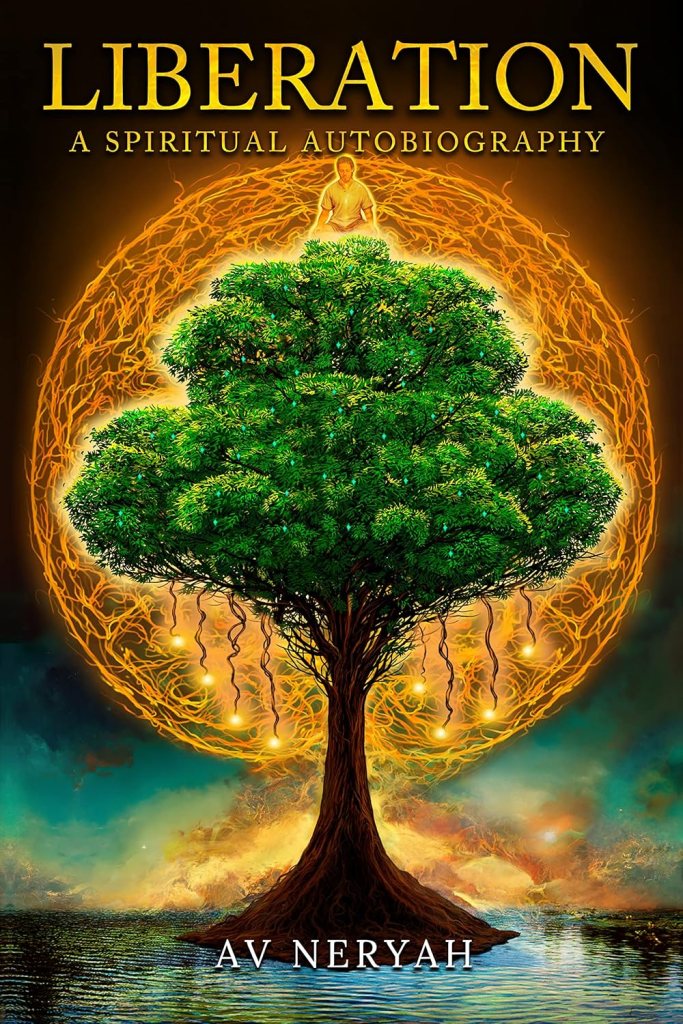
Liberation: A Spiritual Autobiography by Av Neryah is a transformative journey into nondual awakening, blending personal experiences with profound spiritual insights. This compelling memoir serves as both an intimate revelation and a guide for seekers on the path to enlightenment. If you purchase through this link, I earn a small commission at no extra cost to you: Amazon Link.

Chapter 26: The Grand Reveal (Or the Cosmic “Aha!” Moment)

Ramana Maharishi loved Chapter 26 because it’s the ultimate distillation of Advaita Vedanta—it doesn’t bother with rituals, methods, or long philosophical debates. It just drops the truth bomb right in your lap:

✅ You are Brahman.

✅ There is no world, no ego, no suffering—only pure Awareness.

✅ Stop pretending to be anything else.

It’s like when you wake up from a dream where you were being chased by a giant talking banana. The moment you wake up, you instantly know it was all just a dream. You don’t sit around debating whether the banana was real. Similarly, the Ribhu Gita tells you that this waking world is just another illusion—and once you realize that, all your so-called “problems” vanish like morning mist.

Breaking It Down: Ribhu’s Wisdom for the Modern Mind

1. “I am Brahman” – The Ultimate Identity Crisis

Imagine you’re an actor playing a role in a movie. You get so caught up in the character that you forget you’re actually just an actor. Ribhu shakes you awake and says: “Hey, you’re not the role, you’re the pure Awareness behind it all!”

2. “Nothing Ever Happened” – The Cosmic Undo Button

If Brahman is all there is, then whatever we think of as “problems” never really happened in the first place. It’s like getting emotionally involved in a soap opera, only to remember—wait, this is just TV!

3. “Don’t Meditate. Just BE.”

The Ribhu Gita doesn’t ask you to sit in a cave for years chanting mantras (though if you want to, go ahead). Instead, it says, realize you are already That. You don’t become Brahman—you already are. No effort required. It’s like realizing you were wearing your glasses on your head the whole time.

Why This Chapter Matters (And Why You Should Care)

Ramana Maharishi didn’t just love Chapter 26—he recommended chanting it repeatedly until the truth seeps into your bones. Why? Because the human mind is stubborn. It keeps wanting to “do” something to get enlightened. Ribhu says, “Nope, you’re already there. Just realize it!”

So, next time you catch yourself overthinking life, relationships, money, or why WiFi signals are always terrible when you need them most—pause, breathe, and remind yourself:

“I am Brahman. Nothing has ever happened. It’s all good.”

And just like that, the grand cosmic joke is revealed.

Final Thought: If Ribhu Gita were a person, it would be that brutally honest friend who refuses to indulge your drama. Instead of comforting you, they just say, “Dude, wake up. None of this is real.”

And you know what? That’s exactly the kind of tough love we all need.

What do you think? Ready to wake up from the dream? Drop a comment below, unless of course, you’ve already dissolved into pure Awareness. 😆