Dabba O Dabba

This is a small music quiz for you.

1) What is harmony?
2) What is a beat?
3) How is this connected with the dabbawallahs of Mumbai?

I finished my Senior Cambridge exams, which happened in December. This is unlike standard board exams, which are in April or so. So, I had a good 5 to 6 months before I could enroll in a college course. The axiom then was that an idle mind is a devil’s workshop. So before the shaitan could start applying for a three-phase connection to create a pattarai (Tamil word for workshop), I was carted away to ‘Amchi Mumbai,’ where my brother was posted.

So with trepidation, I set out to Bombay, as it was called at that time, bag and baggage. The plan was that I was to try out several career-oriented courses, and if I liked any, I would sign up. Since the earliest I could sign up…… I’ll leave that to your intelligence, dear reader. The experiment didn’t work so well, especially ‘the aaplla manoos’ part of the scenario, and so I was back, bag, baggage, and experience in Madras by about April.

During the four months in Bombay, I got a job as an apprentice audit clerk with a chartered accountant firm in Nariman Point. I was living with the bro in Borivli. In those days, the mid-seventies, Borivli was at the edge of civilization. Those morning train rides from Borivli to Churchgate and back were eye-opening. Everything went about in sheer harmony (clue number 1). If you rode the same compartment, you were with the same folks, and you were kind of guaranteed the same seat. Don’t ask me how. Things just happen in Bombay.

The dabbawallas

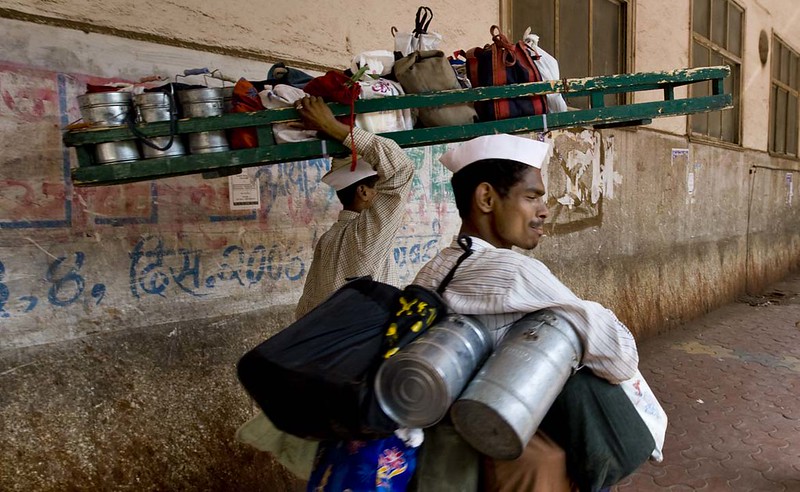
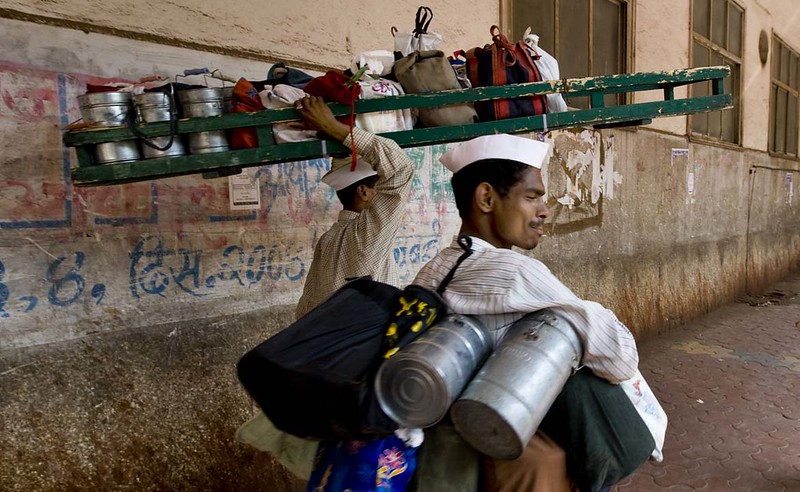
Then, I noticed these guys in off-white kurta-pajamas, with a neta cap to boot, scurrying around with long crates with similar-looking containers. They boarded the luggage compartment, and there was a minimum fuss in their operation until you crossed their path. Then all of hell would break loose.

The dabbawallahs of Mumbai

With some Sherlock Holming, I discovered that these were Mumbai’s dabbawallahs. Now that the stage is set let’s burrow in.

The dabbawallas coordinate home-cooked meal delivery to thousands of Indian office workers and have provided them a modest $3-7 monthly charge.

Some insights which you might not have known:

A lil’ bit of history

Dabbawalas first came into existence in 1890, when a Parsi banker in Mumbai’s Ballard Pier needed lunch delivered to his office. The banker asked a migrant named Havji Madhu Bacche to bring the food to his office in Mumbai. Meals were initially delivered by the many migrant workers living in Mumbai, but this changed as home cooks began preparing food for working people. Because of this, the number of dabbawalas steadily increased over 130 years.

The founding principles of the dabbawallas

The system has a moral code intertwined with the bhakti movement, called the Varkari Sampradaya, which treated all peoples as equals. This clashed with traditional Hinduism, which had varnas, where Brahmins were the masters of all the religious rites and were considered the go-betweens in the worshipper-God relationship. In the Varkai sampradaya, no one was superior or inferior; food was supreme as it was considered a common thread connecting humanity. No food was impure. So, serving food was considered an ultimate prayer.

Food is food, period. Since food is supreme, and nothing is impure, beef curry or mutton biryani is treated the same way a sattvic vegetarian meal is treated. This meant there were no religious distinctions; a Muslim’s tiffin was picked up and delivered the same way a Christian’s or an Iyer’s vegetarian meal was handled.

The lineage believes that they are the descendants of the great warrior Chatttrapati Shivaji, and the dabbawalla’s ancestors were foot soldiers of the great Maratha. Since there was no need for soldiers, they chose a profession aligned with their beliefs. “Our families believe that providing food is punya, a worthy action that brings religious virtue: work is worship. Serving food is considered a worthy action,” says Raghunath Medge, the President of the Mumbai Tiffenmen’s Association.

The dabbawallahs operate as a cooperative. This means there is no boss or subordinate. All are equal partners, including the supervisors who are called mukadams, who are elected. So there is no ‘yes sir, no sir’ culture. All are equal.

The operation

Every dabba is delivered to the client’s office on a handcart right before lunchtime. The dabbawala who initially picks up the lunch is not likely to be the one to deliver it. After being sorted, the lunches are loaded onto a train and distributed to different parts of Mumbai. Six days a week, dabbawalas ferry upwards of 130,000 lunch boxes from customers’ homes to their offices with remarkable accuracy: they navigate a congested city on trains, bikes, and autos, with no help from technology and not a mobile phone either. So Mr. Venkateswaran Iyer gets his rice, sambar, curds, and pickles while Mr. Verghese Puttemeparayil gets his parottas and beef fry while Mr. Mustafa Moideen gets his……..you get the general drift by now, right?

The way the codes work

Since the pick-up person and the delivery dabbawallah are different, how does the right dabba reach the right person? Here is where the hieroglyphs on the dabba begin to make sense.

There are four codes that are color coded on every dabba. There are other codes to narrow the delivery point further. So, in general, each letter in the color shows,
(1) the collection points,
(2) the starting station,
(3) the number for the destination station and
(4) markings for the destination – building and floor.

The codes of the dabbawalla

Let’s understand a similar code S 11 30 J 2.

So, to you and me, this is gibberish, just like music notation is to a layman. But to a dabbawalla, it is a complete address, like latitude-longitude is to a pilot or sailor. By the way, the pilot/sailor uses a GPS while the dabbawallah still relies on the codes. So blah to you, ye four stripers.

S – means Mira Road station – the point of entry in the train
11 – is Churchgate Station – the point where the dabba gets out of the train network
30 – Colaba area
J – a specific office building in the Colaba area, in this case, the Raheja Building
2 – second floor of the building

So effective is the dabbas delivery system that the President of Mumbai’s Tiffin Men’s Society claims that the dabbawallas only commit an error once every six lakh delivery. This amounts to roughly one missing delivery every two months. This is the estimate by Ragunath Medge, president of Mumbai Tiffinmen’s Association, and is not based on any scientific study.

Internationally well known

The dabbawallahs’ delivery system has become so well-known and fascinating that it has captured people’s attention worldwide. The 5,000-person cooperative is widely regarded as one of the most effective logistics networks in the world, despite its reliance on an unskilled workforce, a two-tier management system, and no technology more advanced than Mumbai’s train network. They bring in some extra cash by hosting high-ranking officials from shipping companies like FedEx and Amazon. Richard Branson, of all people, has invested a day in uncovering their techniques.

Their connection with the Royals of England

The first time Prince Charles of Wales visited India in 2003, he wanted to meet the dabbawalas, but the dabbawalas insisted on two things. They can’t inconvenience Mumbai’s two hundred thousand maharajas (customers) to meet the prince, now King, so they will meet with Prince Charles in their spare time after serving tiffin instead. Second, Prince Charles must personally meet with them. Prince Charles agreed to both terms.

The two office-bearers of the Mumbai Dabbawalla Organization, Raghunath Medge and Sopan Mare were subsequently extended invitations to the April 2005 wedding of Prince Charles and Camilla Parker. They both went to this wedding. 

They presented Prince Charles and Camilla with a sari and kurta. 

On the occasion of Prince Harry and Meghan Markle’s wedding in 2018, the dabbawalas presented a hand-woven Paithani sari, a specialty of the Indian state of Maharashtra’s Paithan region. Meghan Markle received an orange and green sari, while Prince Harry received an orange kurta, lehenga, and Maharashtrian turban.

The dabbawalas mourned the death of Queen Elizabeth II.

The present-day competition to the dabbawallas

The modern-day Uber Eats, the Deliveroos, the Swiggys, and the Runnrs of the world are being given a run for their money by the dabbawallas. Sorry for the pun; Runnr, run for the money. I just had to do it. “There’s no competition. They won’t be able to keep up with the service we provide,” says Kiran Gavande, a Lower Parel dabbawalla. “There’s only one Mumbai dabbawala.”

Now, what is the moral of the story?

-You don’t need a skilled force to make your operation a success
-You need to believe that what you do is a service to humanity and God
-You do not need a multi-tier corporate setup. Just a lateral format works
-All employees are equal. If one person slips up, the entire network is down.

Quiz answers

Like any good music, the dabbawallahs operate in harmony
Like you can predict the next beat, the dabbawallahs deliver your tiffin box on time, every time.

Jai Sri Vitthala!

Mumbai Dabbawala or Tiffin Wallahs: 200,000 Tiffin Boxes Delivered Per Day” by babasteve is licensed under CC BY-NC 2.0.

Dabba Markings I” by Meanest Indian is licensed under CC BY-NC-ND 2.0.

Cited Sources

#mumbais food     #lunchbox delivery     #food vendors     #food delivery     #mumbais dabbawalas     #dabbawalas sort     #dabbawalas feel     #clients lunch     #dabbas delivery     #professional food     #mumbai tiffinmens     #lunch boxes     #mumbai dabbawallahs     #lakh deliveries     #lunch hours     

He came, he saw, he composed an unforgettable tune, and he left

For those of you who prefer to listen than read

The song Janaki Jaane, from the 1988 Malayalam movie, Dhwani, was composed and written by two gentlemen of Muslim faith, sung by a Christian, and is about Lord Rama. The lyrics are so endearing and beautifully written in Sanskrit, and it goes like this:

During our suffering, you are our only friend,
Only you can end our fear
To cross to the ocean of samsara, you are the only boat
O Lord Rama, the one who Sita knows so well

Unfortunately, so much is lost in translation.

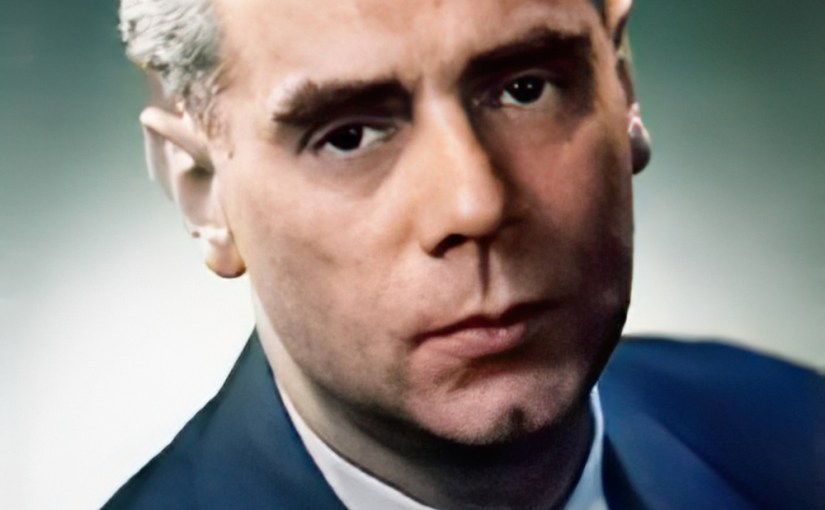
Now take a trip back to 1936. A Jewish refugee composer, a Parsee violinist, composed a tune in the raga Shivaranjini, played every day at dawn in India and probably in the house of overseas Indians and Indophiles.

1988: The song Jaanaki Jaani was composed by Naushad, written by Yusuf Ali Kecheri, and sung by Yesudas. These men have achieved so much greatness that there is no title like Shri. or Mr. that will do them justice, so I have just referred to them with their names.

1936: This tune was composed by Walter Kaufmann, a Jew, and played by violinist Mehli Mehta a Parsi, for a radio station first founded by Professor M V Gopalaswamy, who taught Psychology at Mysore University. Some of you must have guessed it by now. It is the signature tune of All India Radio.

Mehli Mehta, incidentally, is the father of composer-conductor Zubin Mehta.

Almost eight decades have passed since the composition of this piece is based on the raga Shivaranjini. However, the lilting violin notes played over a tambura still manage to evoke a sense of longing. The signature tune was followed immediately by Vande Mataram.

There is doubt if he created this melody solely as a signature tune for AIR or was it was part of a symphony he composed. Whatever that may be, the bottom line: the music is Kaufmann’s, and Mehli Mehta played the violin. No doubts about that.

For the very few who have not heard this signature tune

Kaufmann’s early days

From 1927 to 1933, Walter Kaufmann led opera productions in Berlin, Karlsbad, and Eger, Bohemia, during the summer months. The German University in Prague accepted Kaufmann’s dissertation on Gustav Mahler in 1934. Still, he declined to accept the doctorate after learning that his supervisor, Prof. Gustav Becking, was the leader of the local Nazi youth group. So carrying a letter declining the award of a doctoral degree, he went to the post office and then to a travel agent.

“I carried this letter to the post office, went to the biggest travel agent and bought myself a ticket to Bombay with the money I had received for the operetta (which he had composed),” Kaufmann recalled in his autobiography, which was based on memoirs recorded in 1934 but written up in the 1970s when he was a Professor of Musicology at Indiana University, Bloomington.

He arrives in Bombay

Boarding the Conte Verde in Venice, he arrived in Bombay, where he stayed with a friend until he could secure more permanent housing. His first wife, Gerty Herrmann, a French instructor and niece of Franz Kafka, joined him shortly.

It is reported that someone asked him why Bombay? He replied it was the easiest place to get a visa!

After arriving in Bombay, his first exposure to Indian music took him by surprise. He soon realized that Indian music would take some time to learn, so he decided to sell his return ticket to fund his stay. Regardless, he could not return to Europe while fascism was in power, so he remained in India for another 12 years until the end of World War II. India ended up saving both his and his wife’s lives. They had a daughter whom they named Katherina.

Kaufmann adapted to Indian culture in a way few of his fellow ex-pats could. A low salary and a position as director of European music at All India Radio (AIR) in Bombay awaited him in 1935. From 1937 to 1946, Walter Kaufmann lived in India and served as AIR’s music director.

When the All-India Radio station first went on air in 1939, he wrote an opera called “Anasuya” to celebrate the occasion. Although it had a European theme, the story was set in a fantastical Maratha kingdom.

Several people, including Mehli Mehta, under his leadership, founded the Bombay Chamber Music Society and established the Bombay Chamber Music Society, which performed every Thursday. Kaufmann taught piano in Bombay; he was Zubin Mehta’s teacher.

His stint in Bollywood

Kaufmann had a stint in Bollywood as well. Together with Mohan Bhavani, Kaufmann collaborated on films for Bhavnani Films and Information Films of India. To know more, please click here.

His works include operas, symphony orchestra pieces, ballet scores, chamber music compositions, and film scores. Among his works are ten string quartets, three piano trios, an Indian piano concerto, six Indian miniatures, and the Navaratnam.

His notable works include Musical Notations of the Orient: Notational Systems of Continental, East, South, and Central Asia and The Ragas of North India, and The Ragas of South India: A Catalogue of Scalar Material.

While the Western world has largely forgotten the Czech Jewish composer, his music is still widely prevalent in India. This concert is anchored by Kaufmann’s extraordinary life and the rediscovery of his concert works.

His archives

His works are archived in the Moldenhauer Archives in Spokane, Washington; the Houghton Library at Harvard University; and the Kaufmann Archive in the William & Gayle Cook Library for Music at Indiana University. According to an essay by Agatha Schindler, the Bombay Chamber Music Society performed several of his pieces from this period, including the Navaratnam, Ten String Quartets, Three Piano Trio, Indian Piano Concerto, Six Indian Miniatures, and Indian Concerto.

Friends in high places

Despite his many scholarly publications, and friendships with prominent thinkers like Albert Einstein, Franz Kafka, and Max Brod, Kaufmann is often overlooked when discussing the history of Indian Jewry or European Jews in India.

Albert Einstein’s letter to Walter Kaufmann – Source

Synagogue President in New Delhi and Bene Israel Indian Jew Ezra Kolet founded the Delhi Philharmonic. The New Delhi Philharmonic Orchestra played a previously unheard piece by Walter Kaufmann in 1995 at a symposium on Jewish exiles in India hosted by Dr. Georg Lechner of the Max Mueller Bhavan. From all accounts, Kaufmann spent a few months in Madras, India, taking in the local culture and music. The music by Kaufmann was exotic and layered.

Walter Kaufmann died in 1984, but his signature tune is still played every morning.

Sources:

https://www.thehindu.com/society/radio-reminiscences-the-golden-years/article34840785.ece
https://www.thehindubusinessline.com/catalyst/tuning-into-broadcast-history/article7765864.ece
https://www.asianjewishlife.org/pages/articles/AJL_Issue17_Winter2016/AJL_Issue17_The-Walter-Kaufmann-Story.html
https://thejewsofindia.com/remembering-the-jewish-refugee-who-composed-the-all-india-radio-signature-tune/
https://runtheyear2016.com/2019/08/19/who-is-the-composer-of-all-india-radio-tune/ 4
https://newsonair.gov.in/News?title=Walter-Kaufmann%2C-who-worked-as-Director-of-music-at-AIR%2C-Bombay-from-1937-to-1946%2C-composed-Akashwani%26%2339%3Bs-signature-tune&id=428199
https://holocaustmusic.ort.org/resistance-and-exile/walter-kaufmann/
https://www.thebetterindia.com/169757/all-india-radio-tune-composer-archive-history-kaufmann/
http://www.e-pao.net/epSubPageSelector.asp?src=The_Jewish_connection_to_AIR_Tune_By_Kamal_Baruah&ch=leisure&sub1=EI
https://en.wikipedia.org/wiki/Walter_Kaufmann_(composer)
https://maddy06.blogspot.com/2008/02/air-signature-tune.html
https://www.sweatlodgeradio.com/who-composed-the-all-india-radio-signature-tune/
https://qz.com/india/287319/remembering-the-jewish-refugee-who-composed-the-all-india-radio-caller-tune/
https://schoolofmusic.ucla.edu/event/from-india-to-indiana/

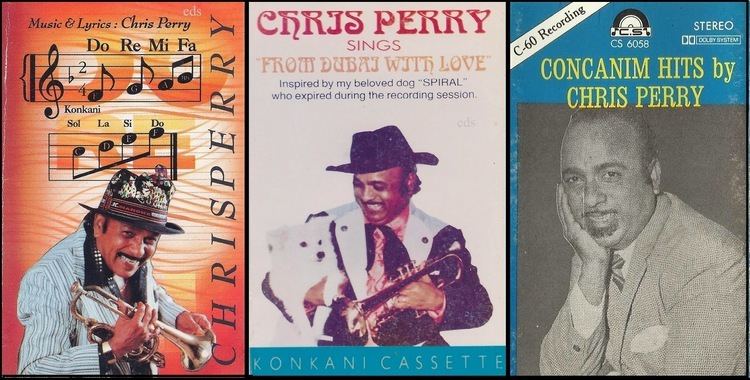
Chris Perry – arranger and the re-inventor of Konkani pop

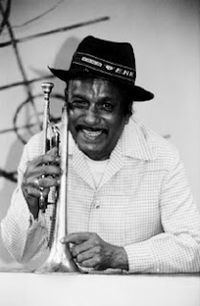
Chris Perry – image courtesy Alchetron

Chris Perry was born in Borda in 1928 as Kristovam Pereira, the second of eight children born to Agostinho and Espiciosa Pereira.

Goa, the smallest Indian state, located on the Arabian Sea in southwestern India and was a Portuguese territory from 1510 until 1961. While Konkani is the official language, most Goans were taught in Portuguese before 1961. Many Goans are Catholic, speak Portuguese, and hold Portuguese family names. Goa was India’s most Westernized region during Portuguese colonization and 19th-century inflows of British and other Westerners. It is a home of Western music, with Goa being the home to most Indian jazz musicians.

Perry was raised in a musical family and began performing on the tiatr (musical theatre) stage at a young age, playing the role of Bab Pinto. He began to produce his own Tiatr plays and is known for the plays Noxibantlo Nhovro, Padricho Lob, and Vid Mog Kornaranchem in the region.

He became an accomplished musician, especially in the trumpet and the saxophone. He was known for perfect timbre (absolute pitch) and his ability to change between the trumpet and the saxophone mid-song. He was also a prolific singer-songwriter, having written several hits during his era.

Perry infused jazziness in the traditionally Goan music while Anthony Gonsalves, another arranger and violinist, helped introduce Western sounds to Bollywood.

Chris started working in the Bombay movie industry as a violinist during the 1940s, becoming one of Bombay films’ most important arrangers of music. He performed in many Hindi films, notably Kabhi Kabhi and Trishul.

One of the more recognized acts from the 1970s scene was trumpeter Chris Perry and singer Lorna Cordeiro, the resident artists at the Venice club in Central Bombay. Chic Chocolat, the trumpeter, became a fixture in downtown Bombays Taj Mahal hotel, (click on link to listen) working with Chris Perry, the genius who had re-invented Konkani popular music. (click to listen) If you read my article on Chic Chocolate, that is the same Chris Perry I am referring to. Perry moved between Bombay and Kolkata (now Kolkata) in the late 50s and had his own band, The Chris Perry Band.

Chic Chocolate – Taj Mahal Foxtrot

Perry had to engage in an accepted practice of finding gigs, even after making a name for himself. Goan musicians met at Alfreds, a Kolkata restaurant, every morning. Perry, Tony Cyril, Dennis Vazo, Johnny Rodriges, Johnny Baptista, and Mike Machado had tables. Anyone planning a nighttime event would “book” musicians, for example, “one trumpet, and one piano”. . Each musician was paid Rs. 15, and Rs.18 if he wore white jackets and black trousers.

Bombay was a very cosmopolitan city by the late fifties, and people came from around the world. Everything was becoming Westernized, with Western influences flooding, especially fashion and music. The best restaurants served Western food and had dance floors featuring Jazz bands. La Bella, located in the Bombays Fort area, was at the top of the list of such restaurants.

Everybody was there, and every night was packed. Reporters kept away from the doors as alcohol was still tightly banned and obviously nobody wanted the goings-on to be reported in the Press. However, Chris Perry was known to get his feet into Bombay’s doors at La Bella, and since Goa was still under Portuguese rules, he had to get a special visa to perform there. Perry and his band were a regular act in the 1960s at the Venetian, the elaborate disco in Astoria hotel in Bombay. The Astoria was located on Churchgate Street, the city’s musical and entertainment district and Venice were known as the “jazz man’s jazz club,” drawing musicians from across India. In 1958, Dave Brubeck performed there, as did Duke Ellington in 1963.

Perry was considered to be brilliant, a perfectionist, and was obsessed about his musicality. His drummer, Diogo DeSouza, said, “Anyone who joined his band ended up honing their craft The group began touring, stopping in Delhi, Mussoorie, Shimla, and Ooty before settling in Bombay..”

He would carefully write out the arrangement for each player, expecting them to play exactly as he had written. Even if one note was misplayed on any instrument, he could detect it from afar. According to DeSousa, Perry once gave a black eye to one of the band members for not playing a note correctly. Since this happened on the performance day, he brought the musician an ice pack and gave the rest of the band dark glasses. This became a trend setter and since then, the band always wore dark glasses for night performances!

Perry saw 16-year-old singer Lorna Cordeiro performing “Underneath the Mango Tree” at the Bandra fair, Bombay, in 1960. Cordeiro, also from Goa, was brought to Bombay by musician Raymond Albuquerque after winning the Connie Francis Sound-Alike Contest while she was still at school. He offered her a place in his band, as she was outstanding and had received an excellent reaction from the crowd. She agreed, and Perry became her mentor.

Perry worked with her for six months before introducing her to audiences, teaching her to dress, move onstage, and use the mic. She made her debut at The Lido at Calcuttas elegant Firpos restaurant, singing an arrangement of Ella Fitzgerald’s “Cry Me a River.” Cordeiro was signed by His Master’s Voice company (HMV), which initially refused to let him record in Konkani. Perry fought on her behalf, and HMV relented. Cardeiros’s career took off following the album’s release. She became known as just Lorna and became a household name across India.

Perry’s songs were memorable, thumping, romantic, and blended Goan folk and jazz elements. These songs were immediate hits, getting lots of airplay thanks to their romances. Audiences were drawn to Lorna and the apparent chemistry between her and Perry.

Nachom-ia Kumpasar Let’s Dance to the Rhythm), a musical strung together with 20 of her songs composed by her music mentor, Chris Perry, in the Sixties and Seventies show cases their relationship both musically and socially.

Despite Perry being a Catholic man married with three children and the difference in their age, the two began an extremely public, non-marital affair. Offstage, Perry was jealous of Lorna and would hit any man that spoke to her. Their dalliance ended in 1973, with Perry returning to his wife and family.

The rumor was that he forced Cordeiro to sign a contract that she could not perform on stage with any other band. Perry was said to have used physical force to enforce that contract. However, Chris Perry’s son, Glenn Perry, challenged this. Perry claims in his lawsuit that Lorna and Monserrate worked together to bring up several allegations against his late father, including that Chris Perry had made a 20-year deal prohibiting Lorna from singing.

“Lorna was simply the singer that sang Chris Perry’s songs. She did not compose, write lyrics, or perform the music. She was an absolute newcomer to the musical world. Chris Perry molded her to become a great singer through teaching and mentoring her, just as a flower would blossom from a bud.

Glenn claimed her father had chronic Parkinson’s and was not able to speak out during the years leading up to his 2002 death. Glenn said: “I am 100% committed to telling the truth. To fight against that stigma, I am going to do what is necessary to reclaim the good name of my dad,” said Glenn Perry, adding that he has confidence in the legal system and that the truth will eventually prevail.

Despite being a megastar, Cordeiro was forced out of the music business. She never married and became a recluse and an alcoholic. She made a successful comeback in 1995.

A street in Margao was named after legendary singer Chris Perry at Goa’s Heritage Festival as a gesture of respect for his contributions to Konkani music and the film industry. Perry supported other musicians’ careers, with her songs being covered by Mohammed Rafi, Asha Bhonsle, Usha Uthup, Adolph Fernandes, Seby Fernandes, Hema Sardesai, Lulu Fortes, K. Alvares, Ophelia, Mohana, M. Boyer, and H. Britton.

Chris Perry died on 25 January 2002, following complications of Parkinson’s disease.

M.B. Sreenivasan – a music director par excellence

Movie: Paadhai Theriyudhu Paar – Music M B Sreenivasan – Lyrics Jayakanthan – Singers P B Srinivas & S Janaki. Flute – Maali

paadhai theriyudhu paar – i can see the path!

One of P B Srinivas’s and S. Janaki’s best songs, “Maali,” plays the flute (T R Mahalingam). The sound of the flute evokes the call of the cuckoo and the chirping of sparrows. Listening to the song, one feels and sways to the thendral or southern breeze. 

Even after so many years, this song is so hauntingly beautiful. Imagine getting the legend Mali to play the flute for a movie song! Even in that simple phrase, the flute sounds heavenly.

M B Sreenivasan, the legend, who is still not recognized for the depth and breath of his musicality.

Another lovely song in the same movie is “Chinna Chinna Mookuthi” sung by TMS.

“Oru vattom koodi en ormakal meyunna…” is a song that any Malayalee with musical taste will recognize. Many of us are aware that ONV’s poem inspired it. However, few people remember the composer of this piece, M.B. Srinivasan. This is because MBS was a private person who let his work speak for itself and did not interact with the media. 

Dr. K.J. Yesudas

Did you know MBS introduced Yesudas?

MBS made a significant contribution to film music by introducing Yesudas, who became a pillar of Malayalam film music. MBS gave Yesudas his first solo song, “Jaathibhedam Mathadvesham,” in “Kalpadukal” (1961), as well as his first duet with Shanta P Nair a famous artist then, in the same film. , In a function to honor Shanta P. Nair, Yesudas said that on hearing that she was to sing with a newcomer, she said, “Aa kutti paadikote, athine enda,” meaning, let the kid sing, it’s OK. 

MBS collaborated with all the great singers of the time. S Janaki won a national award for her song “Ettumanoorambalathil…” MBS was once again the man who gave P Jayachandran his memorable award-winning song “Ragam Sree Ragam…” He wrote the lyrics for Usha Uthup’s movie hit “Peethambara O Krishna.” 

Birth and childhood 

Manamadurai Balakrishnan Srinivasan was born in 1925 to a wealthy family in Chittoor, Andhra Pradesh. Even though neither of his parents was a professional musician, he was exposed to music at a young age. He attended P.S. High School and Madras Presidency College for his secondary and higher education, respectively. During his college years, he was drawn to Marxist principles and became a full-time member of the Communist Party. He was appointed Secretary General of the All-India Student Federation. He also belonged to the Madras Students Organization (MSO). While in college, he was involved in and led numerous anti-colonial agitations. This led him to establish the Madras Youth Choir, which I will discuss later. At the time, Bharatiyar’s songs instilled patriotic fervor, and the freedom struggle was nearing its conclusion.

Meanwhile, MBS, the nephew of CPI leader M.R. Venkatraman, moved to Delhi to work as a private secretary to CPI leader A.K. Gopalan. He was drawn to the Indian Peoples Theatre Association (IPTA). This association assisted him in becoming acquainted with regional strains of plays and music in various parts of the country. 

Later, he met, fell in love with, and later married Zahida Kitchlew, a Kashmiri Muslim and the daughter of freedom fighter Dr. Saifuddin Kitchlew. Pt. Jawaharlal Nehru married them.  The couple had a son whom the named Kabir.

Film Music 

MBS studied Carnatic, Hindustani, and Western music in the meantime. In 1959, he decided to make a career out of music. 

He worked in the Tamil film industry with director Nimai Ghosh. Both were key figures in the leftist Kumari Films. He only appeared in about 8-9 films in the Tamil film industry. His political beliefs hampered his career in the Tamil industry, so he turned to Malayalam films. 

MBS’s most well-known compositions are in the Malayalam film industry. Adoor Gopalakrishnan, MT Vasudevan Nair, Hariharan, K.G. George, Mohan, Lenin Rajendran, and others came to MBS to set music for their films. The ONV-MBS combination produced some of Malayalam film music’s best songs. “Oru vattam…”, “Nirangal than…”, “Manthram pole…”, “Bharatha muniyoru…”, “Ente kadinjool…”, and so on. MBS and ONV’s communist sympathies, combined with their mutual respect, resulted in rare chemistry that gave birth to unforgettable songs. 

The ability to be versatile and retain identity

The challenge for any music director is having an identity while being versatile. MBS songs are easily identifiable. He was also versatile enough to provide songs in a variety of styles. Semi-classical (“Ragam Sree Raagam..”), Melody (“Thenankeetru Oonjaliley…”, “Saradindu..”), Western/Pop (“Peethambara..”), or Folk (“Neelakkuda choodi..”, “Machane..”). Although he was not Malayalee, he composed the tune only after the lyrics were written. He deeply respected poets and their works, and his music never distorted or overpowered the vocals. His songs were always challenging, so they didn’t become as popular as songs by other music directors. 

Expert in re-recording – background scoring

MBS saw film music as more than just songs. He was an expert at re-recording. He knew exactly where to use and which musical instrument to highlight or underline a scene. He demonstrated how a background score could add meaning to a film through the careful use of tools. He even composed scores for films in which other composers wrote the songs. He demonstrated that silence could be used effectively as music by sparing with BGM. Some of his films had no vocals at all. 

Activism – Madras cine musicians union

He founded the Madras Cine Musicians’ Union and several South Indian Cine Technicians’ Unions. He ensured that musicians were paid on time (spot payment), and their wages were determined based on their skill and experience. He also assisted in regularizing their working hours. While he worked to improve workers’ security and status, he also reminded them of their role in completing the work. He believed in responsible union activity. 

Indian Performing Rights Society

MBS spearheaded the fight to ensure song composers and poets’ performance rights through the Indian Performing Rights Society (IPRS). The result of a European concept is that whenever a song is played on radio and television or in hotel lobbies and public places, the composer and poet receive a royalty payment. This has ensured a reasonably good source of income for people who had many hits in their prime but were no longer active. He served as Chairman of IPRS until his death. 

MBS as an actor

MBS played the lead role of an eccentric professor in John Abraham’s “Agraharathil kazhuthai.” This film became one of the most well-known and perhaps controversial films in Indian cinema history. MBS, being a multi-talented individual, jumped right into the role and excelled. 

Censor board

He worked for the Central Censor Board for a short time. He also served as an adjudicator for numerous national and international music competitions. He was a member of the Sangeet Natak Academy and other cultural organizations. 

Death 

On March 9, 1988, M.B. Srinivasan died of a heart attack in Kedamath, a small village in the Lakshadweep islands. His son Kabir and wife Zaheeda survived him. Kabir, his son, a schizophrenic, passed away on April 4, 2009, and Zaheeda died on October 23, 2002. 

Elis R. Dungan, the man who introduced MGR to Tamil films

Birth
Elis R. Dungan, or Dungan Ayya, as he was popularly known, was born on May 11, 1909, in Barton, Ohio, U.S.

In the early 1930s, foreigners were addressed as ‘master’ while Dungan was called Dungan Ayya, a more endearing term than ‘master.’ His first forays into photography came about when he bought a box camera to take pictures for his school yearbook. That was his first brush with photography.

Early days
Later, after having saved up enough money working in a gas station, Dungan traveled to Spain and bicycled through most of Spain. He later ended up in Paris, France, where he got a job in the American Library. Duncan’s interest in photography grew during his two years at the Library, and he began doing exhibitions. The library director asked Duncan to take his photography seriously and said he would sponsor him for a university course. That’s how Duncan returned to America. He enrolled at the University of Southern California in cinematography.

Serendipitous meeting
There he met with M. L. Tandon, serendipitously, the son of a wealthy film producer who invited him to visit India. Tandon wanted Dungan to direct Indian movies and raise them to the level of the existing Hollywood productions for viewers in India and the world. It was to be a six-month trial run. Manik Lal Tandon directed the 1935 Tamil film Bhakta Nandanar (transl. Devotee Nandanar) with K. B. Sundarambal, a Carnatic singer and stage artist, and made his film debut. 

This was also Ellis R. Dungan’s first film. There is no known print of the film, making it a lost film.

In a later interview, Duncan remarked that the six-month stint ended as a fifteen-year journey with the Indian movie industry.

Indian cinema in the 1930s
In the 1930s, the Indian film industry was at a nascent stage. Drama troupes were made to stage their plays in a studio. Nothing had to be done. The actors knew their dialogues, and everyone knew their part. A static camera was placed, and the stage was adequately lit up. This meant boring long shots, and most films had a theatrical feel with the actors exaggerating their emotions and delivering their dialogs at the top of their voices.

Changes to Indian Cinema
Dungan changed all that. He said that he had a tough time sobering down the actors of those days and getting them to deliver the dialogs in a normal tone. Most actors in those days were chosen more for their singing talent than their acting prowess.

Dungan struggled to get the actors to emote naturally during the close-up shots.

Dungan was also credited with using mid-range and close-up shots of the scene instead of a long static shot. He introduced a lot of Hollywood technics in his Tamil films, despite technical limitations at that time.

Around the same time, Himanshu Roy’s Bombay Talkies had hired a German crew led by Franz Osteen. Franz worked from 1935 until 1939 and directed the film Achuth Kanya, which starred Devika Rani and Ashok Kumar and was a super hit.

Ellis R. Dungan popularized contemporary makeup, the moving camera, and cabaret dance numbers for Tamil Cinema and moved Tamil cinema away from stage plays’ influence. Dungan, who trained in Hollywood, introduced some crucial techniques to the industry at its infancy in each department, which would have a unique place in its history.

Dungan also introduced the track and trolley to Indian cinema. In fact for a long time, it was called the Dungan track-and-trolley!

Popular films of Ellis Dungan
Dungan mainly worked on religious and historical films during the earliest days of Tamil filmmaking; the movie is talked about because it has daring close-up scenes. It was with Iru Sagodarargal (1936) that Dungan emerged as the leading filmmaker of the newly developing Tamil film industry. The film was shot in Bombay in the Saroj Filmtone studio. It was pivotal to establish a more polished film language for Tamil films, mainly merely photographed dramas and little else. Iru Sagodarargal (1936) is one of Dungan’s best-known films and one of his favorite. In a language and culture that he knew nothing about and was unfamiliar with Tamil. He hired translators, known as rush directors, who were fluent in English and Tamil.

Although born as an Irish American, Dungan made highly appreciated devotional and historical films like;

  1. Sathileelavathi (1936),
  2. Iru Sahotharargal (1936),
  3. Ambikapathi (1937),
  4. Sakunthalai (1940),
  5. Meera (1945),
  6. Ponmudi (1950) and
  7. Manthirikumari (1950)

The film Ambikapthi, starring the then superstar, M.K. Thiagaraja Bhagavathar, had the famous kissing scene with M.R. Santhalakshmi. It is said many returned to see the kissing scene repeatedly! Many at that time felt that M.K.T. did not know how to act. However, the same film was remade in 1957 with Shivaji Ganesan, one of India’s finest, in the lead. Many felt the earlier Ambikapathi was much better. Dungan’s Ambikapathy was filmed based on a Romeo and Juliet style, including the balcony scene, which resembled a Hollywood production.

Meera, starring M. S. Subbalakshmi Meera is a 1945 Indian Tamil-language musical drama film directed by Ellis R. Dungan and written by Kalki Krishnamurthy. 

The film, based on the life of the 16th century mystic and poet Mirabai, stars M. S. Subbulakshmi as the title character, a zealous devotee of Krishna who considers him to be her husband. 

Despite marrying Rana (Chittoor Nagaiah), she lives her own life, which her husband and family find unacceptable. 

Sadasivam wanted to make a film that would make his singer wife Subbulakshmi’s music accessible to the general public, so he began looking for a good story; Subbulakshmi chose Meera’s story. 

To maintain credibility and historical accuracy, the film was primarily shot on location in North India, including Jaipur, Vrindavan, Udaipur, Chittor, and Dwarka, at Newtone Studio in Madras. 

Meera was released on November 3, 1945, Diwali day, and quickly became a critical and commercial success. 

This prompted the production of a Hindi-dubbed version, with a few scenes reshot, which was released two years later on November 21, and was also a success. 

Despite the fact that the Hindi version made Subbulakshmi a national celebrity, it was her final film as an actress, after which she decided to concentrate solely on her musical career.

Introduction of M.G. Ramachandran
Ellis Roderick Dungan made his directorial debut with Sathi Lilavathi, the first film of the future Tamil Nadu chief minister, M.G. Ramachandran. Dungan had no Indian language skills, an issue that never affected his career as a filmmaker in Indian languages, mainly Tamil.

Dungan directed some renowned Tamil movie actors in his director role, including M. G. Ramachandran in Sathi Lilavathi, T. S. Balaiya, Kali N. Ratnam, and N. S. Krishnan. He was acknowledged for introducing various new techniques in Indian cinema.

Role in the Second World War
During the Second World War, the American Cinematographer made A Short-Return Soldier (1945), a Tamil movie starring T. S. Balaiah, to support the war effort.

From 1941-1945, the United States entered the Second World War. Dungan served as an official photographer for the Madras Government and made wartime newsreels, propaganda films, and a handful of documentaries for The Indian News Parade.

He also filmed the final journey of Mahatma Gandhi.

Return to the USA
Ellis R Dungan returned to the States. Before his final Tamil film, Manthiri Kumari was completed. His wife, Elaine Dungan, who was not an Indophile, didn’t share his passion for making movies and wanted to return to America. So, she gave him an ultimatum, which I am guessing went something like this: either me or the film. So, like any good husband, he dropped his project and returned to the States. T R Sundaram, the studio owner, completed the film. Thus, his last film in Tamil was Manthiri Kumari in 1950. Karunanidhi was the scriptwriter for this film, and much alliteration and social ideology were heavily promoted in the film’s dialogues.

Interestingly, Karunanidhi wanted M.G.R. to be the lead. Still, Dungan felt M.G.R. was not photogenic enough for the role because M.G.R had a cleft in his chin. Ultimately a compromise was reached, and in Mandiri Kumari, M.G.R is seen sporting a small goatee to hide the notch in his chin!

Projects in America
In America, he formed Ellis Dungan Productions, which made documentaries, industrial films, and similar films for almost two decades, starting in 1963.

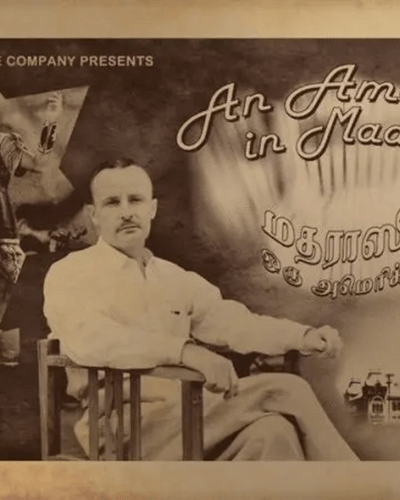
An American in Madras, a documentary film by U. S. based filmmaker Karan Bali, examines Ellis R. Dungan’s contributions to the art of cinematography and his later years as a director of documentary films. The hour-long documentary on Dungan was made in 2013 using information from West Virginia state archives and interviews with people who knew Dungan.

Ellis R. Dungan, the man credited for launching M.G. Ramachandran into Tamil filmmaking with his 1936 movie Sathi Lilavati, passed away in Wheeling, West Virginia, in 1958. He was paid Rs 100 to make his movie Sathi Lilavati.

“Of all the Tamil stage-movie films that I directed in India, my Meera is considered my best film by my peers and the critics in the field,” said Dungan.

I am inclined to agree.

Is the modern-day stand-up inspired by 10th-century Chakiyar Koothu?

Was chakyar koothu the earliest form of stand-up comedy?

The first stage productions of Chakyar Koothu appeared in the tenth and eleventh centuries. It is believed that Kutiyattam, the earliest surviving form of Sanskrit theater, is the ancestor of Chakyar Koothu.

Historically, the koothambalam,  a performance area in a temple built to specifications in the Natyashastra (a detailed manual about dance and allied subjects), was the only venue for Kutiyattam and koothu performances. Painkulam Raman Chakyar (active 1905–1980), a rebel with a cause, was responsible for the first public performance of koothu outside of the koothambalam, which caused widespread outrage and earned him social isolation. He also played a crucial role in adding it to the Kalamandalam ( a premier dance and music school of Kerala) curriculum.

Chakyar koothu accords great importance to the vidushaka (jester/ narrator, very much like the modern stand-up comedian), and his monologues combine prose and poetry. The vidushaka’s commentary is full of biting sarcasm and witty asides. Although the choreography is light, he makes his point clearly through his facial expressions. He makes the act more contemporary and inclusive by getting responses from the audience, making analogies, and commenting on current socio-political events. Minus the profanity and the cussing, doesn’t this describe a stand-up comedy show?

Here is an invitation to witness a chakiyar koothu by a modern-day artist.

The artist begins with a Sanskrit verse and invites people to watch him perform in Malayalam as spoken by the Namboothiris and Chakyars!

Typically, the vidushaka or the performer would first offer his prayers to the presiding deity. He then chants a shloka or verse in Sanskrit, which is an outline of the theme he is going to perform. The verse is then translated into the local language for everyone to understand. Although a central theme is specific to the performance, nothing stops him from dragging various contemporary subjects like politics into it. He is accompanied by the mizhi, a large copper vessel with it’s mouth covered by a taut skin on which the drummer plays and a pair of large cymbals.

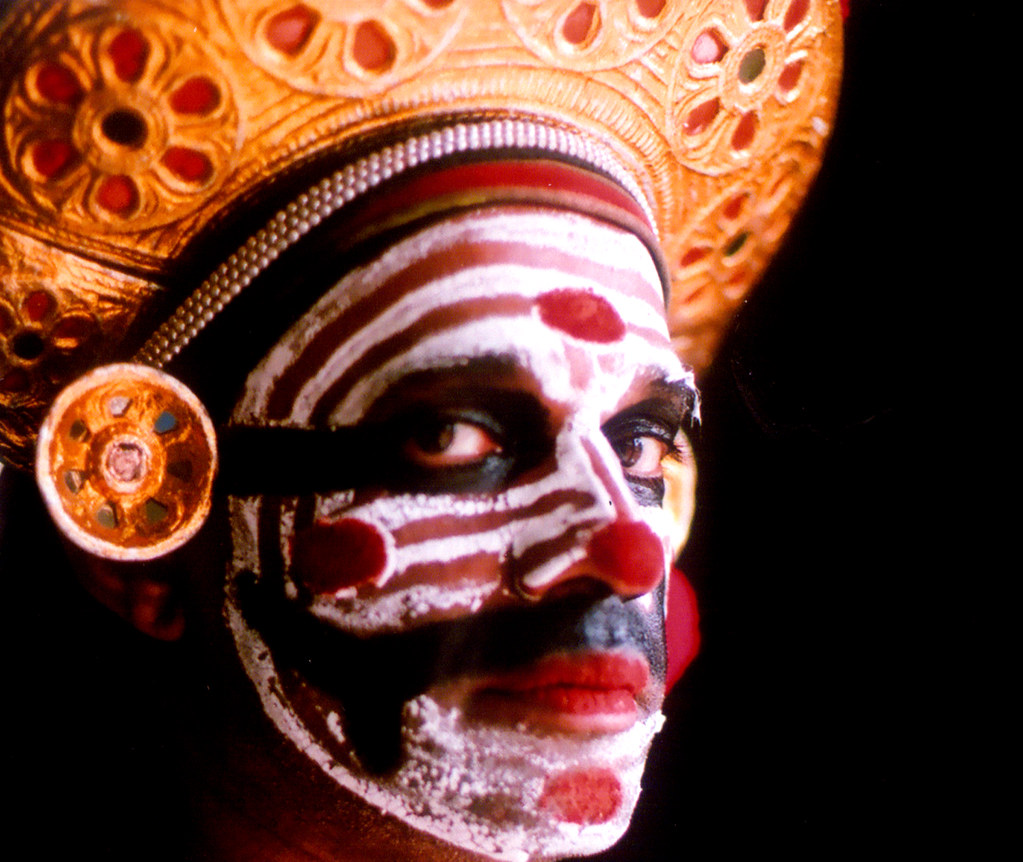
It is a ritual specific to the Chakyar people (a priestly caste). The performer wears a colorful headdress, has a bushy black mustache, which is deliberately exaggerated, and is covered in sandalwood paste with bright red spots. His very appearance is quite comical.

It is only the male members of the Chakyar who perform the koothu.  Not to be outdone, there is also a female version called Nangyar Koothu, which is by the Nambiar community of Kerala.

So, it would be safe to say that modern-day stand-up shows originated in Kerala in the tenth century. 

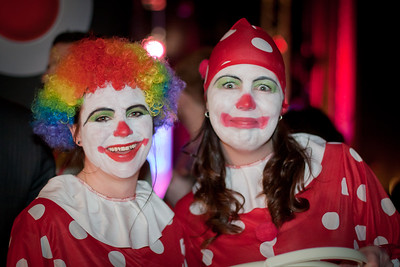
The costume of the modern clown is very similar in color combination to the performer of the koothu.

What say you? Write to me if you don’t agree!


Photo credits

koothu” by Paul Varuni is licensed under CC BY 2.0.

mizhav” by Arayil is licensed under CC BY 2.0.

File:Vidushaka-Mani Madhava Chakyar.jpg” by Sreekanth Vis licensed under CC BY-SA 3.0.

Bring on the clowns” by markleepower is licensed under CC BY-NC-ND 2.0.

Suyash Dwivedi, CC BY-SA 4.0 https://creativecommons.org/licenses/by-sa/4.0, via Wikimedia Commons

Sources

https://prepp.in/news/e-492-chakyar-koothu-indian-folk-dance-art-and-culture-notes

https://www.thehindu.com/entertainment/dance/the-necessary-nuances-of-chakyar-koothu/article26078823.ece

A man on a bicycle help record some all-time popular film songs?

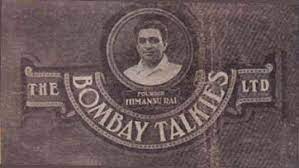
Himanshu Rai’s The Bombay Talkies Ltd logo – Wikipedia
If you prefer the audio version!

If I asked you what the most critical instrument necessary for recording a song was, you would probably say violins. Some would say the tabla, while others might say it is the baton of the conductor and so on. I say it was the bicycle. Want to know why? Read on!

Indian films almost always have songs; some have five or more. Here is how the song is made, from the words of an insider!

A song is born

A prominent arranger Dattaram Wadkar, who is known for his association with Shanker-Jaikishan for over four decades, summed it up like this:

The song is composed on day one. This means the basic tune is composed. It is then handed over to the arranger, who adds all the song’s embellishments and interludes. The musicians are then called in and given their parts, and two or three rehearsals are done. The song is then recorded.

Until recently, recording meant a live performance by the entire ensemble, including the singer. If a mistake happens, then the whole recording must be done again.

If you want to know who Dattaram was, listen to tabla in the songs of Shri 420; Mud mud ke na dekh and Ramayyaa vastaavayyaa and Chori Chori: Aaja sanam madhur chandni mein hum.

Apart from the tabla, Dattaram also played the duff; Dil ka haal sune dilwala and Mera naam raju gharana annam in Shri 420 and Jis Desh Mein Ganga Bahti Hai.

The duff can be heard clearly. Dattaram Wadkar played this

He later became a percussion arranger for Shanker-Jaikishan. His colleague and fellow Goan, Sebastian D’Souza, would arrange the rest of the music on Western instruments, like guitar, saxophone, accordion, etc.

Now, all this is easier said than done. Very few music directors had a permanent orchestra. Often, there would be core musicians and the rest freelancers who would one day be playing for S-J, and on another day, Kalyanji-Anandji and so on. Sometimes, the permanent musician would suggest one of his friends for the job, who would then show up for the rehearsal and the recording.

In some cases, acquaintances alone could not fill all the vacant slots. The word had to be spread far and wide to get the required musicians.

Lata, Asha, Manna Dey & Rafi singing a song. Only two mics and no separate mic for the chorus

The Messengers – the man on a bicycle

This gave rise to a need in the system. Those who could muster up the required musicians for a recording session at short notice. They were called messengers. Later, the messengers came to be known as music coordinators bringing about a modicum of respectability, maybe?

In those early days, telephones were not available to everyone. So the messengers would bicycle to the required musician and tell them that they had to report at this studio and, this time, with this instrument! This was because some of the musicians played multiple instruments. If the musician was unavailable, the messenger would cycle down to the next on the list. To the freelancer, this meant keeping the messenger happy by being very respectful.

Most of the messengers traveled the streets of Bombay close to midnight. So. if you heard a knock at your door in the middle of the night, it was probably the messenger bringing you the good news that you had work tomorrow!

In the orchestra, if you were in the first row, you had to be at the top of your game. Messengers had no say here since the music director would know the front row musicians by their names and specifically ask for them. But if you were in the fourth or fifth row, you had to keep the messenger happy, and some would even offer them a commission, a bribe of sorts!

Messengers were an essential part of the development of the cottage industry that was Old Bollywood; without them, no recordings would have been possible. In time, however, they came to play crucial economic roles in the lives of many musicians, as they were often the deciding factor between employment and unemployment.

Cine Music Association

In theory, the music director must inform the CMA (Cine Music Association) of their requirement. The CMA would then allot the number of musicians required based on equal and fair distribution. This would never happen in real life, so the messengers were all-powerful.

The A-R-P trio

Musicians Alfonso Albuquerque, who played cello, Ram Singh saxophone, and Peter Sequeira on violin and guitar, were known collectively by their initials as “A-R-P.” They were a trio, and often others would refer to them as A-R-P. They were among the first and most influential freelance musicians who also were music coordinators.

A-R-P not only provided their musical talents to composing early film scores but also served as orchestral brokers.

They helped recruit and coordinate other musicians’ efforts to fill out the small orchestras of the time. Of course, for a financial reward.

Ram Singh was succeeded by Manohari Singh much later. There was no alto sax used for a long time until Mahohari Singh took his place.

Some of Manohari Singh’s sax can be heard in this song and in the interludes of Mehabooba Mehabooba in the film Sholay.

The advent of the voice booth

Then another thing happened. The microphone of the singer had to be isolated. Either the technicians were striving for better recordings, or the listening public became more discerning. The long and short of it is that this gave rise to the silence booth, as it was called those days.

During the very early days, the singer would be in the same room as the orchestra and so would be able to sing correctly, maintaining pitch and beat.

This changed with the vocal booth. Many singers felt isolated and also went off scale and tempo. On the one hand, there was a clear vocal recording, but what use if it was off pitch and rhythm.

The song violinist

This gave rise to a song violinist. The song violinist would sit along with the rhythm section of the orchestra and play the song exactly as how the singer was supposed to sing. The song violinist would play into a separate microphone and a mixer which would mix the rhythm section and feed the mix to the singer. This helped to keep the singer in the right tempo and scale. Some of the finest violinists who were song violinists were Harishchandra Narvekar, Gajanan Karnad, and Prabhakar Jog. The absolute pity is that they were never heard in the final recording.

The scenario today

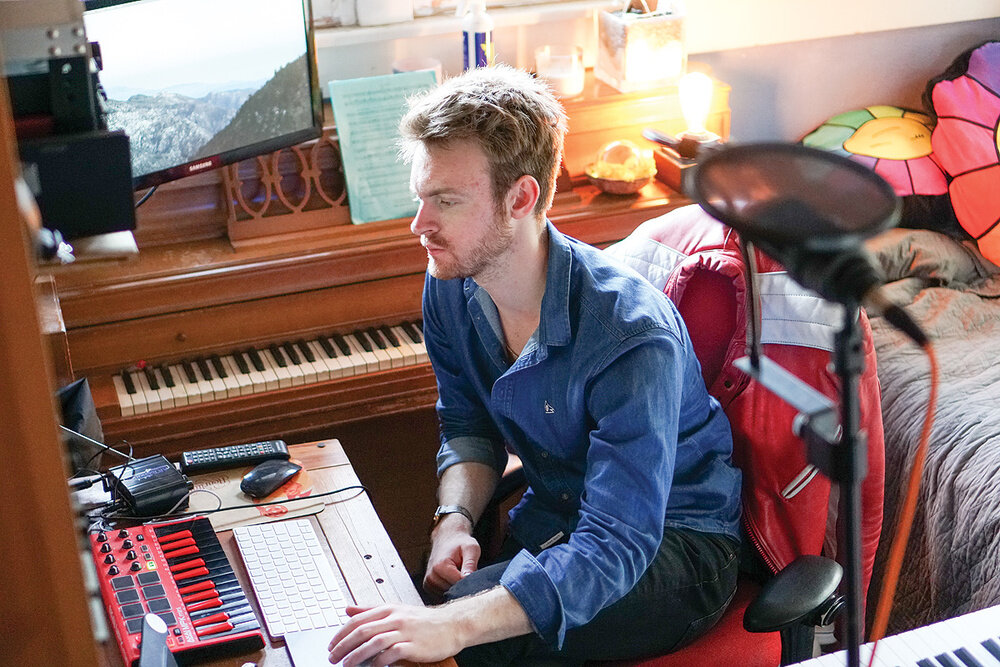
Fast forward to today. Anyone with a reasonably good computer, DAW software, and a good mic, can produce music that can rake in the millions. Bille Eilish, the singer-songwriter who won 4 Grammys in 2020, has this setup.

Image: https://www.forevercurrent.com/blog/2020/2/4/inside-billie-eilish-grammy-winning-home-studio

Finneas O’Connell, Billie’s brother’s modest production setup consisted of Apple Logic Pro X, a Universal Audio Apollo 8 interface, and a pair of Yamaha HS5 nearfields with an H8S subwoofer, all of which were housed in a standard bedroom with a bed against one wall, where Eilish sat to record her vocals.

The total cost of the setup is less than $3,000! Rewards, 4 Grammys!

Sources:

https://mehfilmeinmeri.wordpress.com/2018/03/23/songs-picturised-in-a-recording-studio/

Behind the Curtain – Making Music in Mumbai’s Film Studio – Gregory D. Booth

The one who kept many maestros of Madras in the right key – S. Venkateswara Rao.

black grand piano gray scale photo
Photo by George Becker on Pexels.com
If you prefer the audio version

Digital vs. Acoustic pianos

Most pianos found in homes today are of the digital kind. The reason is that they occupy lesser space and are cheaper than most acoustic pianos. Some have more voices than just the piano tone.

Although some of the more expensive digital pianos are close to acoustic pianos in tone, they are never quite the same.

The essential thing most people are unaware of, there is no need to tune them periodically.

Striking the right keys

Piano tuning is critical. It is not enough to strike the right keys. You could be the best pianist in town, but it will not sound perfect unless the piano is tuned true to scale.

Tuning the piano

All experts agree that a brand new piano needs at least two annual tunings to compensate for humidity changes brought on by the changing seasons. Three or four tunings should be performed within the first year to help the strings stretch. It keeps the piano in tune and keeps the pitch from deteriorating.

Voicing

The timbre of a piano can be tweaked by voicing, which entails changing the hammers’ hardness or softness. Altering a piano’s “voice” is a task best left to a trained piano technician, who can modify the instrument’s tonal character.

Enter the piano tuner of Madras

S. Venkateswara Rao, who has worked as a piano tuner for over half a century, says about birthdays: “I only celebrate music.” He is quick on his feet and loves to brag about himself and the glitzy film industry surrounding him. He can remember specifics like dates and events, but he often forgets the names of the people who come up to greet him. “I never expected this much trouble at my age,” he says with a wry smile.

Video courtesy: Benedict G. https://www.youtube.com/user/benedictgn

Nobody knows how old Venkateswara Rao is. He moves like he is in his twenties. A flood obliterated his birth certificate, so he nor anyone else knows.

Rajahmundry is the place of his birth. When he was five years old, his father passed away; when he was twelve, his mother succumbed to tuberculosis. His upbringing by an uncle who worked as a street theater harmonist kept him connected to the arts community. His apprenticeship with Ratna Varma in Machilipatnam began when he was 14. During that time, he became an expert in constructing and repairing various stringed instruments, including veenas, violins, and harmoniums.

When he was 16, he moved to Madras, India, where trams were still a common sight. Working in various city music stores gave him hands-on experience building and tuning larger, professional instruments.

After four years, Musee Musical offered him a job as a technical assistant, and he accepted, in exchange for Rs. 60 per month, that he could work on pianos. He’s been a freelance tuner there for a while now, and a two-hour shift earns him around Rs. 1,000.

Musee Musical

One of the best piano stores in Madras is Musee Musical. Musee Musical, established in 1842, is a 180-year-old institution. Kishore and Sachin Das are the ones who manage the store. I used to visit the store quite often, not to buy anything since I could ill afford even to buy the cheapest instrument as I was still in school. I remember there used to be a Chinese restaurant nearby, and the delicious smells of Chinese food made me feel hungry.

Pianos by Steinway, Boston, and Yamaha are available for immediate purchase at our store. says Kishore Das, one of the directors of the store, who is also a classical guitarist. “We supply military bands and have serviced some rare instruments, including an 1823-vintage piano at the Air Force Club, New Delhi, a Steinbeck played by MS Subbulakshmi, and a piano played by Tagore.”

The room’s focal point is an elegant grand piano costing roughly Rs 22.28 lakh (approximately $30,000).

Senior to the maestro, Ilayaraja

Even before Ilaiyaraaja had the chance to study with the renowned musician, he had begun training under Master Dhanraj to learn global tuning. “I am senior than Ilaiyaraaja,” he says broadly.

Rao is unique, as he has only heard of three or four other tuners in the city. “You’ve seen movies where Rajnikanth and Sri Devi play the piano, right?” He says, “I’ve tuned those,” with pride and casualness.

He also claims that he has been the on-call piano tuner for every piece written by Ilaiyaraaja.

As soon as Rao started working at Max Mueller Bhavan in 1967, he tuned a piano for the great Handel Manuel. Since then, he’s fine-tuned the radio broadcasts of many famous people, such as musicians Roman Rudnytsky, Billy Taylor, and Chico Freeman, music directors A.R. Rahman, Yuvan Shankar Raja, and Harris Jeyaraj, and singers Unni Krishnan, Srinivas, and Karthik.

He still finds time to tune pianos for various clients across the city, including The Music Academy, Taj hotels, The Leela Palace, Chennai, the show Vijay Super Singers, weddings, receptions, and pretty much any stage with a piano that needs his attention. Every month, he tunes about 15 to 20 pianos.

He has complete authority over the process for the hour and a half it takes him to tune a piano. As he has done since the beginning, he tunes using the same method as Bach. He says, “The method will remain the same until the end of time.” All the other things are constantly evolving.

Mr. Rao is tuning the piano. Thanks to the late actor, Mr. Vivek, whose comedy I have thoroughly enjoyed

It was difficult for him and his five children when his wife of 50 years became ill. He spent money to take care of her diabetes, which she had for a long time. Then, without warning, a heart attack took her life. When asked how he has dealt with her death, he simply responds, “I’m all right. Nothing else exists in my world except the music.”

His seven-year-old grandson misses out on his grandfather’s attention because his life is consumed by his passion for music and work. Having hobbies prevents one from achieving “fine-tuning,” he says bluntly.

When Rao is at work, he doesn’t stop to rest because his satisfaction comes from his work and nothing else. However, he finishes up long before the lights go up on the stage.

While on stage, a guitarist uses only six strings; offstage, he becomes intimately familiar with the piano’s two hundred and twenty. When asked how long he has been tuning for this city, Rao replied, “One town has one man.”

I hope Mr. Venketeswara Rao is well and active. I would appreciate it if anyone could update me on this.

Is the violin a European instrument or an Asian (India)?

Most of us from India might have noticed how we try to credit every good thing, be it in science or the arts, for having its roots in India. I haven’t heard anyone say that English has roots in Sanskrit, at least until now. Having a good dose of patriotism is nice, but sometimes it goes to ridiculous lengths.

Now, let us tackle the issue on hand. Is the violin a European instrument, or did it originate in Asia, especially India? Read on, and it shall be revealed!

The violin is tailor-made for Indian classical music. It is not too loud and very expressive, obviously in the hands of talented musicians. The ornamentations in Carnatic music can easily be mimicked by the violin; the gamakas (oscillations), the grace notes, or kan-swars can be reproduced precisely like its rendered by the human voice. For some reason, the violin is not as popular in Hindustani as in Carnatic music. The harmonium still reigns supreme in Hindustani, an instrument that cannot reproduce meends or gamakas. Some virtuosos try to get around this by playing the notes bridging the meend or a gamak, but at the end of the day, it’s like trying to draw an elephant using straight lines. You can try to compensate for it with shorter straight lines, but it’s still straight and not curved lines!

I come in peace to all ye harmonium players, for I am not a violinist but a non-violen-ist. Get it? In Madras, we would call this a kadi joke!

North Indian classical music has adopted the violin as an accompaniment and a solo instrument. However, its use is still far less common than in its Southern counterpart. The sarangi, with its strikingly vocalistic tone, is still the most popular bowed string instrument in the region.

Violins were first incorporated into Carnatic music at the turn of the 18th and 19th centuries. The violin’s rise to prominence in Carnatic music saw it used as an accompaniment and a solo instrument. Many outstanding violinists dating back to the 19th century have contributed to the refinement of these methods.

At least four musicians are credited for incorporating the violin in Carnatic concerts. One of them is Balaswamy Dikshitar, who belonged to the lineage of Muthuswami Dikshitar, one of the trinities of Carnatic music; the other two are Syama Shastri and Thyagaraja swami. They made the violin famous. After that, it was carried on and improvised by different eminent personalities like Varahappa Iyer, Sri Vadivelu, and Sri Krishna Swamy Bhagavatar.

There is another strain of thought that Balaswamy Dikshitar studied violin with a European violinist in Madras and was inspired by Manali Mudalaichar. Since then, he’s spread the practice of playing the violin in the Carnatic style. His brother and mentor, Sri Muthuswamy Dikshithar, is credited with writing “Nottu Swarams” in the Sankarabharanam Raga for violin practice. Sankarabharanam ragam is all natural notes, like a major scale in Western music.

The ektara, dilruba, and sarangi are all common in Indian music and are bow-played string instruments well-suited for vocal accompaniment. However, the European-style violin found a natural home in the classical music of South India.

The instrument is identical to the ones used by classical Western musicians. Carnatic or South Indian classical music requires a different tuning and playing style, so the violin is adapted accordingly. Although the violin is typically used as an accompaniment to vocal music, it is also played as a solo instrument in Eastern music, albeit with a different grip and technique than in Western classical music.

Violinists from the South Indian subcontinent sit cross-legged on the floor, right foot forward, with the scroll resting on the ankle of the outstretched foot. The violin’s back rests against the player’s left collar bone or shoulder. One of the defining characteristics of South Indian music is the rapid tempo at which musicians play alankarams (ornamentations). This playing position is ideal for Indian music because it allows the hand to move freely all over the fingerboard while keeping the instrument in a steady position to accommodate such rapid tempos.

South Indian Violin as accompaniment
File:Ravikiran 33A.jpg” by Joe Mabel is licensed under CC BY-SA 3.0.

Vadivelu (1810-1845) was the youngest member of the famous Tanjore Quartet.

His contribution to South Indian classical dance is as significant as his innovations in music. He is widely regarded as the musician who made the violin an integral part of Carnatic music, to the point where even former purists accepted it as a fully-fledged Indian classical music instrument. Vadivelu, a composer, vocalist, violinist, and exponent of Bharatanatyam dance, is remembered for his early death at 35. He had studied the violin with a European missionary in Tanjore.

So does the violin have its roots in India, or did the East India Company import it?

According to INTO THE EARLY HISTORY OF THE VIOLIN FAMILY BY CARL ENGEL, published in 1883, the violin originates in (drum roll please) India! And here’s the proof!

From the Internet Archives – The early history of the violin family – Carl Engel – 1883

Engelbert Humperdinck: How a shy Madras boy became a pop singer and a heart-throb.

Early Days

Arnold George Dorsey was born in Madras, British India (now Chennai, India), in 1936. He was one of ten children to British Army NCO Mervyn Dorsey, who was of Welsh descent, and his wife, Olive. She was of German descent. Like Sir Cliff Richard, some sources say he has an Anglo-Indian heritage. He was christened Arnold George Dorsey but became known professionally as Engelbert Humperdinck.

He dropped out of school at 15 to pursue his dreams alone and described himself as a dreamer. He and his family emigrated to Leicester, England, in 1946. He took up the saxophone out of a desire for music. For nearly a decade, he performed under the stage name “Gerry Dorsey,” a nickname he earned thanks to his ability to do impressions of Jerry Lewis. As a saxophonist in nightclubs by the early 1950s, he was already in the music scene. However, it is thought that he didn’t begin singing until he was well into his late teens.

Tuberculosis strikes

When the British Army requisitioned Humperdinck to serve in the Royal Corps of Signals in the ’50s, it ended his music career. His post took him to Germany. He was discharged from the Army in 1958, after which he recorded his song with the label Decca Records, his debut single, “I’ll Never Fall in Love Again,”

Unfortunately, this bombed with the listeners. He resorted to singing in bars catering to eke a livelihood. In 1961, he was diagnosed with tuberculosis, worsening his already difficult situation. It was nine months before he felt normal again. After getting better, he returned to singing in nightclubs. His life was challenging, and he had yet to achieve success.

Engelbert Humperdinck: the reason behind the name

After relocating from South Wales to the United States in the early 1960s, Sir Tom Jones’ career took off. Gordon Mills, who managed artists including Engelbert Humperdinck, helped him out. In 1963, promoter Gordon Mills signed the singer Thomas Woodward, who changed his name to Tom Jones so that he could cash in on the success of the Oscar-winning film of the same name. With Gordon’s help, Sir Tom signed a Decca recording contract. He quickly became a multimillionaire and international sensation after releasing the James Bond theme song for the film Thunderball.

Gordon then signed another promising young performer, Arnold “Gerry” Dorsey, whose stage name was changed to that of the legendary singer Engelbert Humperdinck. Tom Jones biographer Colin Macfarlane explained the reasoning behind the name change in an interview with Express.co.uk.

Arnold Massey asked Gordon, “Gordon, can you make me like Tom?”

Gordon said, “You’ve been around too much, so I can’t. I’m powerless to make you like Tom.”

But Gordon discovered one night that he had an album by the classical composer Engelbert Humperdinck sitting next to his record player. He instinctively decided to rename Arnold “Gerry” Dorsey Engelbert Humperdinck.

Although Englebert and Sir Tom Jones had the same manager, you would have thought this would bring them closer, but it didn’t. Vying for the top position on the charts might have caused a rivalry.

The singing ‘Paki’

Tom Jones referred to Engelbert Humperdinck as the Singing Paki. Paki was a universal epithet the British would use to tag anyone from the Indian sub-continent. You could be an Indian or a Sri Lankan, but you would still be called a ‘Paki’. 

His management always treated Engelbert as being something of a low priority. The song Release Me, which brought him success and launched his career, was earlier turned down by Tom Jones. Engelbert bitterly resented the step-brotherly treatment. He cannot have been pleased by Jones’s name either. Here he was, with the sonority of an opera singer. He could easily traverse a three-and-a-half octave range, a gift he got from his mother, an operatic singer, and still being given second-class treatment.

His rise to the top of the charts

In the 1960s, three of his singles were among the best-selling in the UK. When he recorded the ballads “Release Me” and “The Last Waltz” in 1967, both songs were top of the UK Singles Chart and sold over a million copies. Then came a string of hits, including 1967’s “There Goes My Everything,” 1968’s “Am I That Easy to Forget,” and 1969’s “A Man Without Love” (1968). In doing so, he amassed a sizable fan base, with many followers taking the moniker “Humperdinckers.”

After marking over 50 years as a successful singer, Humperdinck continues to record and tour, having sold more than 140 million records worldwide. In the 1970s, Humperdinck had significant North American chart successes with “After the Lovin'” (1976) and “This Moment in Time” (1979). With these, he gained a reputation as a prolific concert performer.

Englebert received renewed attention during the 1990s with his recordings of “Lesbian Seagull” for the soundtrack of Beavis and Butt-head Do America (1996) and a dance album (1998).

The 2000s brought in a lot of recording gigs for Englebert. The Grammy-nominated gospel album Always Hear The Harmony: The Gospel Sessions (2003) and a double album of duets, Engelbert Calling (2014). Humperdinck represented the UK at the Eurovision Song Contest in Baku in 2012 with the song “Love Will Set You Free.”

Humperdinck’s concerts were a more profitable enterprise than his recordings, so his manager went slow on recordings and encouraged him to do more concerts and fewer recordings. As a result, he did not figure in the rankings of the music charts. This affected his ratings quite considerably. In 1976, he signed a new deal with Epic Records, which returned him to the American Top Ten with “After the Lovin‘.” This album made it to the Top 20 and became his biggest-selling LP since 1970.
Humperdinck also topped the charts with 1979’s “This Moment in Time” in 1983, with “Till You and Your Lover Are Lovers Again.”

Engelbert attempted a recording comeback with the 1987 album Remember I Love You, which featured a duet with Gloria Gaynor and earned him a Golden Globe Entertainer of the Year award. The album Winding Road featured songs by Eric Clapton, John Lennon, Christine McVie, and others. This fetched Engelbert Humperdinck his second Grammy nomination.

Some stats:

  • Sold more than 140 million records, including 64 gold albums and 23 platinum,
  • Received four Grammy nominations, a Golden Globe, and stars on the Hollywood Walk of Fame and Las Vegas Walk of Fame.
  • Recorded everything from the most romantic ballads to movie theme songs, disco, rock, and gospel.
  • Performed for the Queen and many heads of state.

After appearing on MTV several times, Engelbert struck a chord with the younger generation.

The sideboard trademark was copied by Elvis!

Even Elvis owed a debt to Engelbert. His sideboards, first introduced by Engelbert, were copied by Elvis.

Engelbert and Elvis were good friends and sang each other’s songs. Engelbert sang Love Me Tender. Elvis sang Release Me, and There Goes My Everything.

The Las Vegas concert circuit saw Engelbert earn the friendship and respect of Frank Sinatra and Dean Martin. The now famous Jimi Hendrix began his career as the first half of Engelbert’s show.

Engelbert Humperdinck was made an MBE in April 2022 during an investiture service at Windsor Castle. The British pop star, 85, was among a host of high-achievers to receive royal honors by Princess Royal on Tuesday. Others collecting awards included rocker Rick Wakeman, actor Sir Jonathan Pryce and former rugby player Rob Burrow.

————————————————————————————————————————————

Pic credit: “After the Lovin’” by elvissa is licensed under CC BY 2.0

Engelbert Humperdinck (singer) – Wikipedia. https://en.wikipedia.org/wiki/Engelbert_Humperdinck_(singer)

Engelbert Humperdinck – The Last Waltz, Pop Vocal cover by iggylee …. https://www.coverium.com/music-video/engelbert-humperdinck-cantante-the-last-waltz-vocal-cover-by-iggylee/TM7O7_MnM8c

Engelbert Humperdinck: How a shy Madras boy became pop heart-throb – dailyO. https://www.dailyo.in/arts/engelbert-humperdinck-british-pop-singer-golden-globe-elvis-presley-frank-sinatra-32995

Engelbert Humperdinck Biography, Songs, & Albums | AllMusic. https://www.allmusic.com/artist/engelbert-humperdinck-mn0000098081/biography

ENGELBERT HUMPERDINCK LYRICS – SongLyrics.com. https://www.songlyrics.com/engelbert-humperdinck-lyrics/