There are some forces in life that quietly shape us long before we fully understand them.
For me, that force was always Devi — the Divine Mother.
Even as a young boy growing up in India, I felt an unexplainable pull toward Her. Not out of fear, nor because of strict religious conditioning, but from something much deeper and strangely familiar. Looking back now, I sometimes feel it may have been the quiet continuation of spiritual impressions carried across lifetimes — a culmination of punya that naturally drew my heart toward the Mother.
And perhaps, like many of us, my first glimpse of the Divine Mother came through my own mother — through her care, sacrifice, protection, and quiet strength. Before we understand philosophy or spirituality, we first understand love through a mother’s presence.
Life eventually carried me far away from home. Nearly three decades ago, I relocated to the United States. Like many immigrants, I became absorbed in the practical realities of building a life — work, responsibilities, survival, family, adapting to a new culture. Yet through all the movement and noise of life, one thing remained constant:
My connection to Her.
Prayer continued. Worship continued. Even when life became turbulent, Devi remained the silent center I returned to again and again.
Then, through what first appeared to be a chance encounter with a professor at Rutgers University, life opened another unexpected door. One thing led to another, and I was blessed to meet Sri Amritananda Natha Saraswati of Devipuram, who initiated me into the Shakti path through the sacred Panchadashakshari mantra.
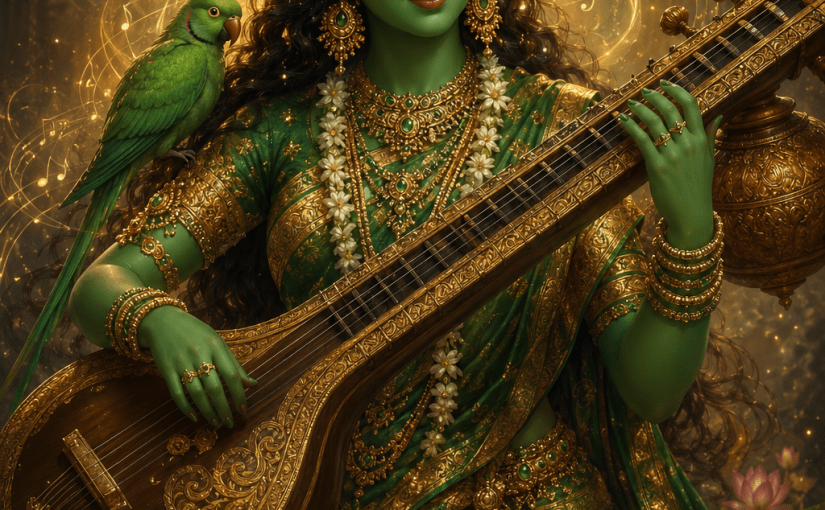
Years later, Guruji asked me to help clean up some audio recordings; Viraja Homam and Rashmi Mala Mantras, and add musical interludes to them. During that process, I heard chants and invocations to Matangi Devi. Something within me immediately responded. It did not feel like discovering someone new. It felt like remembering someone ancient and intimate.
I was irresistibly drawn to Her.
Life, of course, did not suddenly become free from difficulty. Like everyone else, I have experienced uncertainty, disappointments, emotional upheavals, and periods where the road ahead seemed unclear.
But through every rise and fall, my faith in the Divine Mother has remained unwavering.
And perhaps that is what motherhood truly represents.
Not perfection.
Not control.
But unconditional presence.
The ability to nurture life even while carrying one’s own burdens. The ability to comfort, protect, sacrifice, forgive, and continue loving despite exhaustion and pain. The world often celebrates power loudly, but the quiet strength of a mother sustains humanity itself.
Over time, I began to realize that the Mother I worshipped in temples and mantras was also present in the women around me — in their resilience, compassion, intuition, creativity, and immense capacity to give of themselves.
To all women, I say this with great reverence:
You are blessed to embody Her Shakti.
Whether you are raising children, caring for family, supporting others emotionally, creating beauty, healing hearts, or simply carrying love into a difficult world — you are expressing the Divine Feminine in ways both seen and unseen.
And even if you are not a biological mother, the nurturing principle still lives within you. The ability to create, protect, inspire, and nourish life is itself sacred.
What greater gift can there be?
On this Mother’s Day, I bow to the Divine Mother in all Her forms — and with gratitude remember my own mother, through whom I first experienced Her love.
Shree Matre Namaha.
Happy Mother’s Day to all.

